specifically choosing your direction of bounce flash
The reason why I want (if possible) only indirect light from my on-camera flash, is that any direct flash looks too harsh.
Here’s a typical example:
As you can see, using the Stofen helps to disperse some light and is a huge step up from direct flash. But you can also see in the entire frame that the light from top to bottom is uneven. In the close-up you can see how there is a hard shadow on the bride’s face, as well as some specular reflection on her skin from the flash directly from the Stofen. And in some way, any time there is flash directly from the flash modifier on your subject, you get this kind of light. It is inevitable.
On the right-hand side images, I simply took the Stofen off, and pointed the flash over my shoulder into the rest of the hallway. As you can clearly see, having only indirect light from the flashgun, completely changes the look of the image.

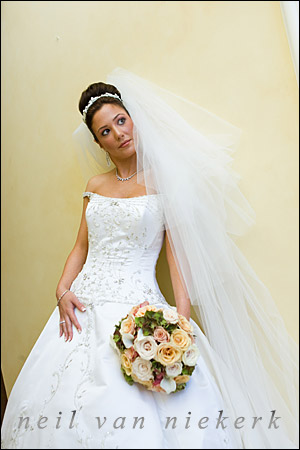
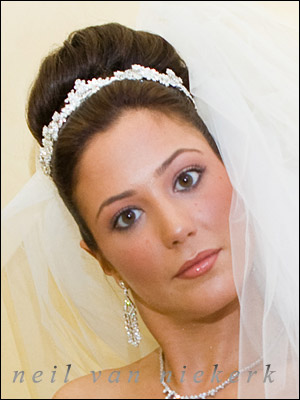
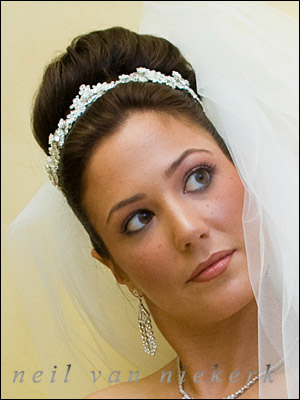
.
Remember : any time your subject can see your flash-tube you have direct flash.
This implies that if you are “bouncing” flash with the flash set to 45′ upwards, you’re not doing anything to improve your flash photography.
There are occasional times to do that with specific intent, but mostly it just gives bad results.
The key idea here is that bouncing your flash does not mean simply putting a flash modifier on your flashgun and pointing it at the ceiling.
As to why I prefer not to bounce from the ceiling – in a studio set-up you would most likely never set up a soft-box directly over someone’s head as the only light-source. Similarly, why would you want to bounce flash from above someone, if there are walls and other surfaces around to bounce from? Pointing the flashgun upwards is a poor choice compared to other possibilities when shooting indoors.
It is with this approach that I want to specifically choose where I want my light to come from.
There are times I do want to throw light forward from my flashgun.
But this is a specific choice, whether a short-cut or a specifically intended thing, or just a limitation of the scenario I am working in.
I like the comparison. The indirect flash does look better.
But, doesn’t indirect flash increase required flash power and therefore flash recharge time? How do you deal with long recharge time in an event?
This is a very good post which pretty much summarizes some of your previous articles on the secrets of indirect flash. I think I’ve really learned something from your blog. Thanks for sharing your skills!
I think I’ve learnt more from a week or two reading your blog than the last ten years of trying myself!
Thanks for these articles and keep them up please!!!
Rod
UK
I don’t quite understand “pointed the flash over my shoulder into the rest of the hallway”. A picture on the setting would definitely help. Is there still a surface to bounce the light? Sorry for the naive question.
Neil, just to be clear here, you bounced the flash over your shoulder, into the hallway …BUT… off the ceiling, to provide inderct flash.
Is this correct?
I’m wondering what you mean by throwing the flash over your shoulder? Is it similar to the picture in the previous blog entry?
Neil, So when you turn the flash around are you using it at full power or is that decided on location for each shot?
I really learned alot from your flash photography techniques but I always keep wondering when you say bounced over your shoulder, how will it look from a 3rd person perspective?
Photography is a hobby I’m picking up on my own so I really want to learn how to use my gear properly. :)
Thanks.
Dear Neil,
Awesome blog, indeed! I’m totally newbie in flash photography. On practicing yr concept, I bounce my flash off of the walls but I noticed inconsistency among subsequent numbers of shot. That being said, white balance keeps changing all over the shots.
Yes, I put WB setting on auto, this is the culprit. But, under same lighting conditions and most potentially the same angle of flash bouncing, theoritically speaking, I could expect to see same result. Or, am I missing something here?
Setting I use for above scenario: camera on Manual, f2.8 ISO 100, speed about 1/100, iTTL, Nikon D80, indoor, halogen lamp (spotlight).
Thanks,
Jusuf, Indonesia
Superb info on this blog Neil. You have taught me more than you can imagine and I thank you for this.
Question……Do you ever find that when bouncing flash behind you that your own body blocks some of the light that should be falling back on the subject (a bride for example)?
Regards,
Tom K.
My goodness. I thought I was reasonbly good with ETTL, but after reading your site right through, I’ve taken a huge step forward. Even things that I sort of knew worked, but not why, I now have a much better handle on, and it is so much easier to work stuff out if you know WHY you are doing it.
Thanks for the insight.
Trevor
this is a very informative blog. but why you are not mentioning TTL-BL,Matrix or evaluative? i think this is also a valued feature of a camera and speed light/flash to ease the job.
tnx.