spacer
spacer

Tangents

review: Canon EF 100mm f/2.8L Macro IS lens

October 30, 2009

The specialty of a macro lens is in allowing you much much closer to your subject than a normal optic would .. with the ease of continuous focusing from infinity to the closest distance.  No need to screw in additional rings or lenses or reverse your lens.  A macro lens works as a close-up lens, and as a more usual optic.  And that’s the versatility of it.

hands-on review: Canon EF 100mm f/2.8L Macro IS lens

The main feature of the new macro lens is that it offers stabilization.  Now this might not seem such a big deal to photographers who work with a tripod and photograph more static subjects – but the moment you want to shoot on the move, and play around fluently with your composition and angles – then using the lens hand-held becomes a huge advantage.

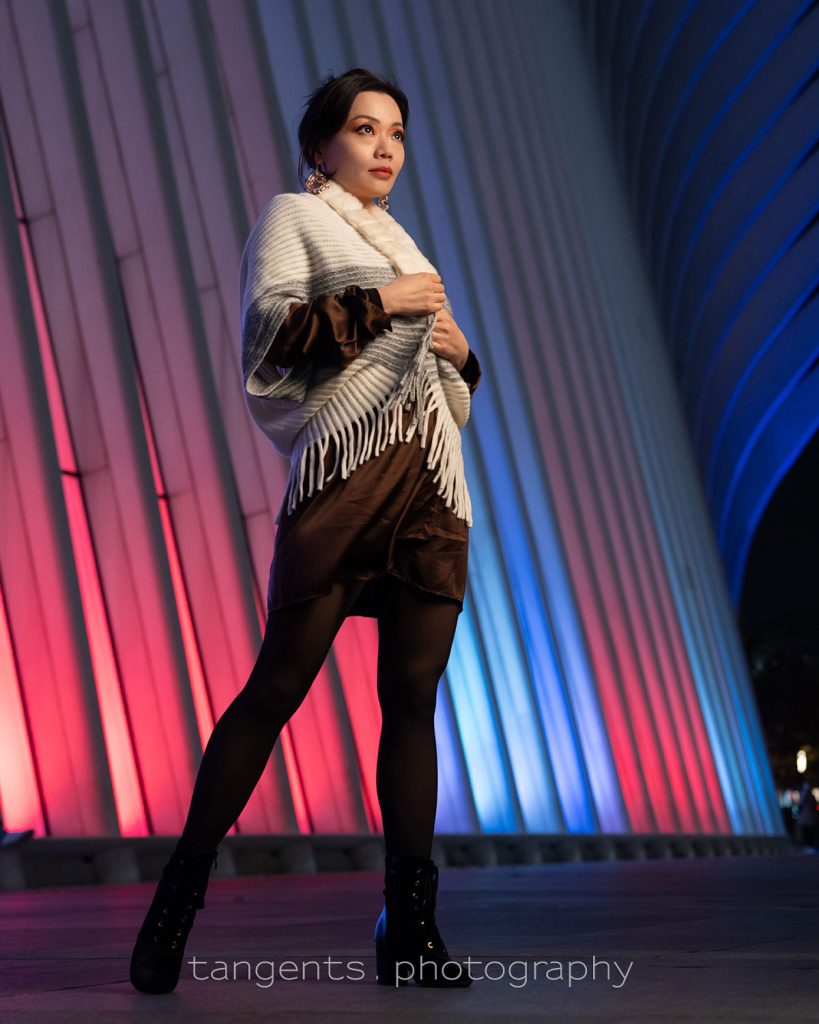
Instead of photographing the usual macro subjects – flowers and insects – I decided to test the Canon 100 mm f/2.8 IS macro lens (B&H), during a portrait session with a model, Annisa.  

In the photo above, my settings were 1/200th @ f3.2 @ 400 ISO.  In testing the lens with and without the IS enabled, there is a clear difference in the crispness of the (handheld) images.  There’s no doubt that the IS works, and is a major improvement on the previous generation of this lens ..

(more…)

       Comments (18)


favourite image from the weekend ..

October 27, 2009


[ click on the photo for a larger image ]

using off-camera flash on location

It was a busy weekend again, with a wedding and a portrait session on Sunday.  From the photo session on Sunday, here’s my favourite image of the day.  I just love the way the background appears in this photograph.  The bokeh of this lens is just wonderful.

camera settings:  1/250th @ f4 @ 400 ISO
The camera used was the Nikon D3, and the lens was the 70-200mm f2.8 VR
A telephoto zoom like this, or the Canon 70-200mm f2.8 IS, is essential for this kind of portrait work.

That image is typical of the seperation you can create between your subject and the background, by zooming tigther.  Here I was zoomed to 170mm .. for no real reason than I liked the perspective at this point.  I had a comfortable working distance in that he could listen and see any instructions I gave him on how to pose … yet the perspective is nice and tight.

Lighting is exactly as described on this previous post on off-camera lighting, where I used the Q-flash’s wireless TTL system.  The Q-flash was held to my left, and at about 45 degrees to the boy, and diffused with a softbox.

My choice of settings was for the background exposure, and I was at maximum sync speed for a very specific reason.  In using TTL flash, I was able to control my background exposure from my camera, by changing my aperture and ISO as needed .. while remaining at a high enough shutter speed.

And that’s it.

If you found this and other articles valuable, then using these affiliate links to order equipment & any other goodies, would be a welcome way of helping towards the cost of hosting this site.
Thank you!

       Comments (33)


taking photos under the mid-day sun ..

October 25, 2009

taking photos in hard sunlight

A recent post on the benefits of using off-camera lighting, the question came up about how I work when I’m on my own and don’t have an assistant holding up a softbox.   Using off-camera lighting does make your options easier in how you position your subject, since it is much easier to have great portrait lighting on your subject.   By adding light to your subject with the flash & softbox combination, you have the freedom to be less concerned about perfect light on your subject.

When I work on my 0wn, I approach things differently.  I now have to not only consider how I place my subjects in relation to the background, but also consistently look at the light on my subject.

With an on-location portrait shoot a while back, the session was for 1:30 – 3pm while the sun was overhead.  And from experience we all know that with the sun overhead that it isn’t the most ideal conditions to take photos under, especially portraits ..

(more…)

       Comments (12)


Zones of Light ..

October 23, 2009

A recent thread on the Flick group on flash photography techniques dealt with exposure metering .. and the questions revolved around  understanding your camera’s built in meter.  One of the group members, Arnold Gallardo (Zeroneg1), replied with a lucid explanation on exposure metering, relating it to the Zone System in a clear understandable way, using images from my blogs.  I’d like to present this article by Arnold Gallardo as the latest guest spot on this blog.

I might not have such a specific linear approach to metering any more during the actual shoot, since with practice it becomes near instinctive .. but this analyzing of a few images might make an interesting outside perspective to the thought-process in exposure metering. 

.


.

Zones of Light – an approach to exposure metering using the Zone System

by Arnold Gallardo  (Zeroneg1)

We all have made a picture where we didn’t get the representation we wanted it was either too dark or too light or not quite there in terms of how we wanted the camera to capture the scene or how it imparts an emotional element to the image.  Then we realize how professionals do it ‘so easily’ when thinking about well exposed and composed images. Well, a Pro would have developed an innate sense of tonal placement and tonal awareness that has been developed through experience as well as ‘seeing’ and not just looking and solving things on the fly.

Okay let us talk about tonal placement and what does that term really mean? 
Let’s look at a series of images from a recent workshop:

(more…)

       Comments (30)


Photoplus Expo, NYC this week ..

October 19, 2009

One of the biggest events in the photography trade in the USA, is taking place this week, Oct 22-24,  in Manhattan – the Photoplus Expo.  But then, I am sure every photographer local to New York already knows about this.  No big revelation there. 

But the big thing for me is that I will be doing a short presentation at the Unique Photo booth, each day, Thu – Sat.   The topic will be a variation of the talk I gave at Unique Photo earlier in September - Just Give Me The F-stop.  I will also be selling copies of my book on flash photography techniques. 

Thu  (Oct 22)  .. 11am – 12 noon
Fri  (Oct 23)  .. 11am – 12 noon
Sat  (Oct 24) ..  12 noon – 1pm

Come stop by, hang out, and say hello!

       Comments (13)


here’s why I love off-camera lighting ..

October 18, 2009

There are a few reasons why I love off-camera lighting, and I want to show some images from a recent photo session with one of my couples, Jill & Mike, as an example.

The main reason for me, is that you can have perfect lighting on your subject’s face with much more freedom than if you just relied on the available light. I am usually quite particular about the backgrounds to my photos, where it is in my control. The backgrounds need to be complementary, or add something to the image. I have a preference for an out-of-focus background. The defocused backgrounds create separation that helps my subjects pop out.

When I only use available light with a photo session, I am reliant on finding both a good background, AND great light on my subjects’ features. However, when using supplementary lighting, (such as flash with a softbox), the pressure is off. I pretty much just have to find a nice background, add my subject, and then use off-camera lighting to light them properly. Dead easy.

Here’s a straight-forward portrait of the couple against a background which I knew would work – the sun-soaked leaves in the back would create a golden glow behind them.

(more…)

       Comments (37)


workshop view: Atlanta, GA

October 14, 2009

The near-penultimate workshop for this year was held in Atlanta yesterday, covering the range of topics relating to flash photography and lighting.  As always, it was good to meet and work with a group of people – and then throughout the day, watch and experience everyone’s progress in getting more familiar with the subject.  Thank you to everyone who attended!

For anyone who is interested in still attending one of the workshops this year, there are still three upcoming workshops – Palm Beach (FL), and Austin and Dallas (TX).   From next year there will only be a series of 2-day workshops held in the NYC / NJ area.

And as usual with the workshop feedback posts, I always like to add a little bit of useful information for everyone else …

(more…)

       Comments (16)


a slight change in direction ..

October 13, 2009

Last week I had the opportunity to meet up with a fellow South African photographer, Jaco Fourie, who was visiting New York for a few days.  I knew Jaco’s work from some of the forums that he posts on, and his work with flash was invariably quite impressive .. so I looked on this as a great opportunity to see another photographer work and learn from him.

I arranged for two models, and we met up in Manhattan for these photo sessions.  Jaco specifically wanted scenic views of Manhattan, and incorporate the model as part of the urban landscape.   It would be less meaningful to reduce the images so that they looked like they could’ve been taken anywhere.  So he shot wide and allowed the landscape room in his images.  And to make the model really stand out, he used a very simple arrangement of two speedlights on light stands – direct manual flash, triggered by pocketwizards. I was very impressed with his results, which you can see here on his blog.

When working outdoors, my approach has largely been that of using a softbox or some modifier so that my flash is more diffuse - which made it quite refreshing to try something slightly different than my usual method …

(more…)

       Comments (23)


how much flash exposure compensation?

October 12, 2009

With the recent posts on lighting the formal wedding photos, a question came about what the flash exposure compensation (FEC) was that I had used. (The image above is from the sequence.) Instead of replying in that thread where the reply might get lost, I thought I’d post it as a separate short article.

My settings for that photograph: 1/100th @ f3.2 @ 800 ISO
and flash was bounced TTL flash.

How much FEC did I dial in?  I could answer that my FEC was +0.7 EV, but that numerical value might not contain enough real information …

(more…)

       Comments (20)


lighting the wedding formals (part 2)

October 7, 2009

The previous article on the topic showed a more static set-up in how I light the formal portraits of the bride and groom and families on their wedding day.  But I try and get as many on-location portraits of the bride beforehand to bring in some variety to the portraits.  It is also a very good idea to get as much done as early on as you can on the day .. just in case the time-line gets compressed and things don’t quite follow the original plan.  Then you’ll be much happier for having some solid portraits in your pocket.  So it definitely is a good idea to shoot some formal portraits when you can just after the bride has finished her preparation.

In this example, I had the bride in the hotel’s foyer, but I specifically had the bride stand in a place where the overhead tungsten spotlights didn’t fall directly on her, but there was obviously enough spill light to give a strong colour cast.  So she was relatively in ‘shade’ compared to the brighter background.  This was done on purpose, so I could use flash to light her properly.  In this case, on-camera flash in TTL mode.  And to make sure I don’t get an ugly colour cast in adding “blue” flash to the warmer tones of the tungsten+daylight mix .. I gelled my flash with 1/2 CTS gel and had my white balance set to 3700K.  More about that on this previous post on using flash in a tungsten environment.

 I bounced my flash to camera left, and used the Black Foamie Thing to shield any direct flash that would’ve fallen on the bride.  I specifically want indirect flash.  The moment that your subject can see any part of your flash tube, there is direct flash … and that would spoil the effect that I am after here … soft indirect light that is still directional.

(more…)

       Comments (18)


Older Posts »


All Rights Reserved © 2006-09 | Client Login