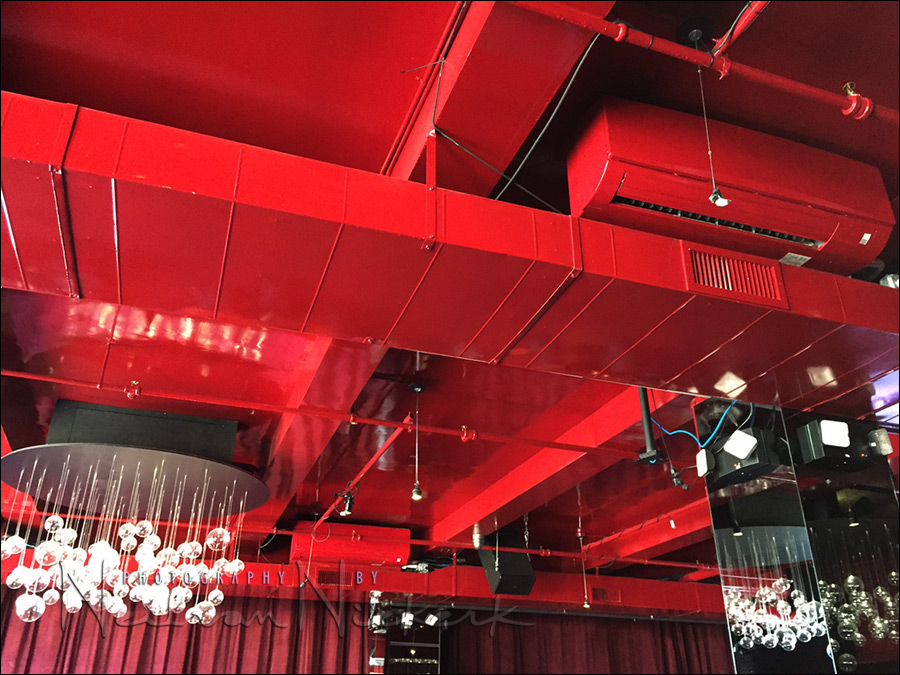
What do you do when you can’t bounce your flash?
A question that I’m often asked in emails or on this site or in person is, “What if there is nothing to bounce your flash off?” Sometimes the question seems to be directed as a challenge, but mostly I think photographers are hoping for a great solution that may have evaded them. Maybe, just maybe there might be a technique that could help when faced with super-high ceilings and wooden walls. Or, as in this photo above, when you encounter a venue with red ceilings and walls. This would be a tough color cast to fix in post-processing!
When asked what we can do when there is nothing to bounce our flash off, my usual reply is that that little speedlight only has so many electrons that can be turned into photons. Even thought we can get surprisingly good results with bounce flash in some touch scenarios (some of which are mentioned in the Related Articles links), there is only so much we can do with bounce flash. We have to improvise then.
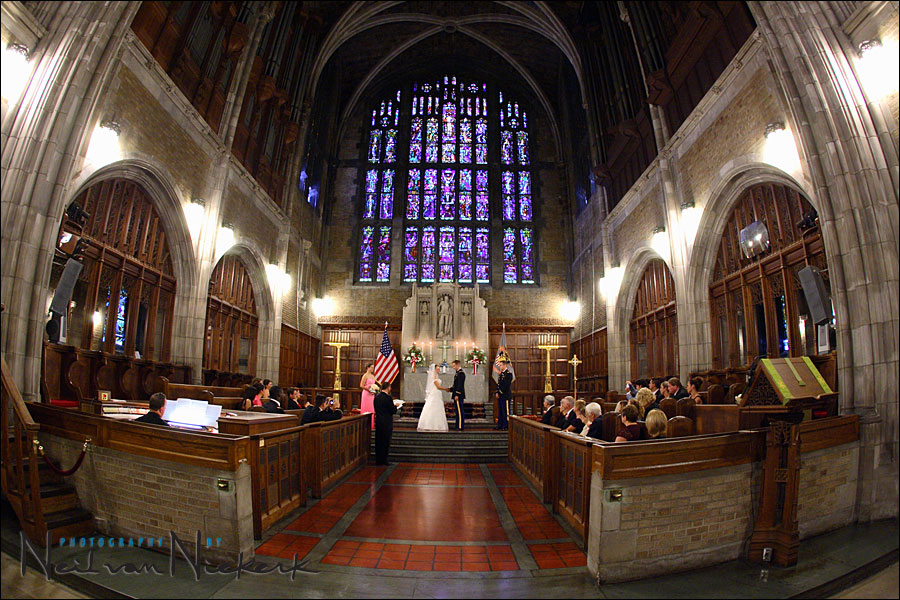
For example, with this church at West Point Military Academy, no flash is allowed, and you have to rely on the ambient light. Then a high-ISO capable camera and wide apertures are necessary to grab any of the available light.
Much of this website deals with ways of bouncing flash. Sometimes we can find innovative ways to bounce flash. (Check the Related Articles at the bottom.) But despite pushing the limits of our cameras and lenses and on-camera flashguns … there are those times when we’re just out of reach of what is physically possible with our equipment.
Then we have to improvise or perhaps accept that we simply are in a situation where there are no easy options. So while I did once reply to this question about bouncing flash in these impossible places, “you’re screwed” .. I’d still like to offer some suggestions and help.
- We may have to use additional lights.
- We may have to use umbrellas and softboxes … although these aren’t always practical at events,
- We might very well have to resort to plastic diffuser cups on our speedlights, or even direct flash.
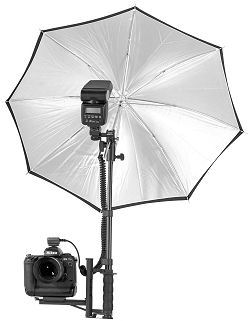
Now, I wouldn’t quite go so far as to say you’d look like a clown waltzing around with one of these at an event, but it can’t be described as unobtrusive.
It will give you pretty awesome light in any venue where you have a black ceiling and black walls … but I don’t quite think it will be practical at most events.
But, there is this option. Just so you know.
When the ambient light levels are so low that you can not get away with a reasonable shutter speed, then you have to use flash. Ideally, off-camera flash of some kind. But that isn’t always practical. When there is nowhere practical to bounce flash off, and off-camera lighting isn’t feasible … then you have to pick your favourite light diffuser for your flash, or even resort to hard direct flash. I try and stay away from this last desperate option though.
I recently had to photograph a wedding at a museum where the reception room had black walls and a black ceiling. There was simply no room to put up additional lights. I had to resort to my usual technique when in a pinch like this .. I put a wireless TTL transmitter on my camera (such as the Canon ST-E2 or Nikon SU-800), and hold my speedlight up in my left hand with a diffuser over the speedlight. This way I am still trying to get directional off-camera light from my flash, even if it is a hard light from a small light source.
In the instance of the red ceiling shown above – I mostly worked closer to the big windows to use the available light at a reasonable ISO range of 800 – 1600 ISO. Deeper into the room, I used 3200 ISO, and relied on the stabilization of my lens. For the group shots, I used off-camera lighting.
Summary
Finally, there are no easy answers. No quick options that will still give you wonderful light in such challenging indoor settings. You have to adapt and improvise .. and sometimes you accept the limitations of where you are and what your equipment is capable of, and use direct flash.
Related articles
- Bounce flash off a dark ceiling
- Bounce flash outdoors with a reflector
- Using on-camera bounce flash outdoors at night (wedding: Jen & Chris)
- Using on-camera bounce flash outside (model: Precious)
- Bouncing flash off an outdoor shop-front
- Bouncing flash off a brick wall
Thanks Neil! The idea about using a transmitter and handholding your flashgun is a great tip! I would love to see a photo you have taken using this technique.
A plastic thingy on the flash isn’t going to help when direct flash is required though is it? After all, all it’s doing is sending light off in directions it can’t bounce from, and it’s not increasing the size of the light source.
@Russ, I’ve found that almost anything as an attached diffuser/reflector is an improvement on the harshness of direct flash from a bare tube.
But, I’d agree with you – I always think it looks daft to see someone in a club environment (a lot of black) with a Stofen diffuser and the flash set at 45º bounce. Yes, I’d use the Stofen (with the head straight forward), but I’d not delude myself that there is going to be anything to bounce from (but ya gotta look pro – only a complete noob wouldn’t bounce their flash).
Barrie
how about bouncing light off the floor for once?!?
tried once when taking a photo on a ship out on the deck on a late evening.
I flipped my camera with my speedlite pointing downwards and grabbed a few shots.
The floor turned white but it was able to bounce light into my subjects face and they turned out reasonable once I flipped the photo back to the right orientation and cropped the floor.
Though holding the camera and pressing my shutter button was a bit awkward.
That would work. However, my only objection against bouncing flash off the floor, is that it would give Horror Movie type lighting, with the light coming from underneath.
Hi, Neil! I’m a new follower to your blog and teachings. :-)
I’ve tried your black foam thingie advice and it works perfectly! This photo was taken with it, having bounced my flash on a church column some 10 feet in front of this musician. (55mm; 1/30; f/2; ISO 1600)(http://www.flickr.com/photos/alaricyanos/4659982807/)
Regarding this post, wouldn’t a cup-shaped or curved white bounce card help in this situation?
Neil, I love the humour. I think you’re right, many of us look to those we look up to those that we respect (that would be to you!) hoping to hear words of wisdom that we have not yet found. “You’re screwed,” is a succinct answer and indeed it is helpful to know that there is no magical bullet that will help. One of my favourite weddings recently was after dark, by candle-light, no flash allowed during the vows.
Thanks for this post Neil… I have been racking my brain over this lately as I have a wedding this weekend where the reception is in one of those low-lit, high-ceiling venues… makes me feel a little better!
I should’ve added that there IS good news to all of this.
You’re going shopping for f/1.4 and f/1.2 optics!
Just curious on your thoughts about pumping up the ISO and shoot it using available light only like Ascough does?
Jeff Ascough’s business model, (as far as I understand it), is quite unique. He delivers a pre-designed album to the client, with a handpicked selection of B&W images of his choice.
With B&W, your concerns for correct color balance is less of an issue of course. As well as balancing flash for tungsten. It really becomes much simpler in terms of post-production workflow .. but also in terms of how you shoot and use lighting during the actual event.
In only delivering a smaller selection of images you also reduce the pressure in having to cover the minute specifics of the wedding. For example, every bridesmaid in the processional. So where the vast majority of wedding photographers have to deliver a workmanlike coverage of the wedding like that, covering every facet .. a more artistic approach (as ‘sold’ to the couple), brings in a lot more freedom. (I hope I am explaining this well enough in a non-contentious way.)
That said, I would be hugely surprised if Jeff Ascough doesn’t use flash at all. I deal with reception venues were f1.4 @ 3200 ISO doesn’t give you much of a shutter speed. You simply have to use flash to a certain extent.
No matter how great a craftsman you are with the camera, when the light just isn’t there, it just isn’t there. And at those times the advice to “just look for the light” or “just find the light” become hollow instructions. You have to add flash or other light of some kind.
As an aside, also check out the work of Ben Chrisman .. he is also predominantly an available light shooter, and he is quite exceptional.
Thanks Barrie. Maybe a home-made bouncer (a white foamie thing?) may be the answer then? Like this- http://super.nova.org/DPR/DIY01/ or this- https://www.flickr.com/photos/chrisgcom/271222003/
Hmm, so in these open areas, even a f2.8 isn’t going to cut it? Looking at Nikon’s site, they only have f1.4 prime lenses. This implies lots of “sneaker zoom” for the photographer (i.e. moving around a lot more).
If using a prime lens is what you need to do the job, you better have your selection of prime lenses on hand.
thanks Neil
Bens work is inspiring like yours – whats nice with this business is theres no right or wrong just distinct styles and business models as you say.
I am very much a speedlite person however I am trying to step out of my comfort zone slowly to try more available light – really just to see if it compliments my style.
cheers
Neal
This is just another example of how versatile a “good” wedding photographer has to be. You got to adapt and adapt quickly!
Brian Carey
I have resulted to bouncing flash off the white shirt of a guest, sniper style.
Not wedding related, but I have bounced off menus in restaurants, bounced of a piece of paper when photographing a car interior while on site. First thing I look for is a bounceable surface no matter how crazy it might seem. Anything to get the shot.
Thanks again for kicking of a great discussion.
Regarding Ben Chrisman – I follow his work like yours. Looking at most of his pictures,those look like a very creative use of flash with snoots and gels. I think he is a heavy user of off camera lighting and modifiers.
-MP
I got in troubble last time at a wedding, when the bride and groom came out of the church they kept on standing in the doorway (of course before I had asked them to take a step outside but in the comotion…..they forgot)
Bright and sunny on the outside against the sun, but dark on the inside, nothing to bounce my flash at, so I took the shot with direct flash (I know….:)) and diffuser….. result ugly shadows.. :(
Reproduced the shot (for testing) at my own doorstep, but still can’t find a way to do this better next time.
Any help or suggestions would be very nice !
Thanks, learned a lot from you’re tips but still have te learn a lot more !!!
I
Hi there Ilse … that’s a situation where I would purposely make it a silhouette shot, and have then face each other; and adjust their pose from there if needed.
You’re simply never going to get enough juice out of a speedlight when you bounce it, and try to match bright sunlight outside.
Thanks for your response ! Make it a silhouette shot is a good idea….
But this is a shot what almost comes back in every wedding here so to make them al al silhouette…. mhh I think they are gonne notice haha.
My English is not so great, maby I didn’t explain very well :) I will open a topic in your flickr group with a picture to make it more clear sorry.
OK, I am wondering why no one has brought up an option that seems obvious to me – so maybe it’s a dumb idea and I’m the only one who doesn’t know it ;-) What about the Lumiquest bounce? Although I have noticed that the light is still quite harsh with these as the bounce spot is so close to the flash gun…
Thanks for this very timely post Neil. I’ve just recently had a wedding where this problem came up at a number of the venues. No clever additional solutions to offer: mostly I just bounced the flash off anything I could find and pushed the light forward when all else failed. Although I got a good number of usable pictures I’m left with the feeling that I wasn’t as in control as I could have been: I’m sure that you would have made more and better light and consequently pictures. Lots of food for thought in this thread and comments. I like the idea of holding the flash off to one side, Maybe not so straightforward for me as I’d struggle to hold the camera and 70-200 steady in one hand but I could probably persuade a friendly wedding guest to be a walking light stand for a bit.
Thanks as ever for all your help and inpiration. I’m very impressed by Jeff Ascough and Ben Chrismans’ sites.
i just wanna share something from my experience with regards to the last picture neil posted, in a situation like this where there is a small available light, aside from using a very high but usable ISO, you can combine that with ON AXIS on board camera flash (of course the big one like sb 900 or 580 ex) just keep in mind the balance between ambient and flash and stay away from the walls so you cant see the shadows.even in a very slow shutter speed you can still freeze the subject. BOKEH can help to help conseal any camera shake look at the background. it will look decent if you balance the flash with the ambient especially if used with telephoto lens with the flash zoomed to the max because of the light fall off. thanks
Mark, I think you meant that a shallow depth of field will hide any camera shake in the background, since the background will be out of focus anyway.
But you are right in your description there of the technique.
Hi Neil, thanks so much for the wealth of information you provide to us!
On the topic above (no surface to bounce your flash), have you considered using a ringflash? Would a ringflash eliminate/reduce objectionable shadows in your images? Thank you in advance.
Ringflash would give you a shadow-less light on you subject, but you’d still have that marked light fall-off in the background like you’d have with direct on-camera flash.
On top of that … I might be alone in this, but I really dislike the look of on-camera ring-flash as the main source of light. So it isn’t something I would use in this situation.
I made myself a fun foam reflector that looks decent and gets the job done if used not too far from your subject. Here is an example I made last night:
https://www.flickr.com/photos/g_alessandri/5338401340/
Neil, did you ever consider using the new Roque Flash benders when there is nothing to bounce? Did you already test the Roque flash benders?
I’ve seen the Rogue Flash Benders and they do seem a sensible flash modifier in that they are flexible and you can both flag or bounce your flash with it.
However, for an area where you don’t have anything to bounce your flash off, I’m not sure the Rogue Flash Bender would do more than a simple white card like the Better Bounce Card when used with an on-camera flash.
neil, i agree with you one that one. But imaging your in a romm where you can’t bounce your flash but the ceiling is low and painted red. Than you can use the Flash Bender like the BBC but bend it a little forward at the top so that there is no flashlight hitting the red ceiling anymore (no color cast). Do you think this would be an example of a good use for the Flash Benders? And if not, how would you deal with such a room?
Alwin, in that case, yes.
Neil, when using the 70-200 telezoom in combination with direct on-camera flash it does not make sense to use a betterboucecard because of the great (tele) distance from the subject it’s still a very small lightsource. But do you think it could be usefull to use a betterbouncecard or omnibounce from greater distance to avoid the risk of red eye? (because the flash light is placed a little bit higher…?)
If there is nothing to bounce your flash off, then there’s nothing to bounce your flash off.
In using a plastic cup / Stofen / better bounce card in the scenario you describe, it is often not quite an on / off … nothing / something .. kind of situation. Even if there isn’t anything much to bounce off, there might still be enough that comes back from various parts of the building’s interior, to subtly affect the way the flash is bounced with the card. In other words, there is often a tiny amount of light that does return. Not enough to give proper exposure, but enough to help lift the contrast. But the light from the bounce card *is* the main source of light.
Then, I’d still prefer to use a bounce card or plastic diffuser cup then, since it raises the level of the flash-head by another inch or two. Enough to help avoid red-eye from the flash.
In using a bounce device here, there is an amount of light loss. Your flash does have to work harder … and perhaps for not much benefit. But quite often in these circumstance, there isn’t much time or opportunity to test.
As an alternative to the beanie-mounted umbrella shown in the original post, what about an assistant holding a collapsible white or silver reflector at roughly 45 degrees, with an on-camera speedlight aimed straight up into it, or slightly over-the-shoulder into it? The size of the reflector could vary from 12″ (the white side of a Lastolite LL LR1250 collapsible grey card)to a typical 40″ or so collapsible hoop reflector/diffuser, to a really big one such as Fotodiox (and others’) 48×60 or so — which could handle a couple of speedlights bouncing off of it. (Just practice first to get the knack of collapsing it afterward. Bigger = trickier.)
It’s a small world! The photo at the very top of the post is from my Oxford college, Magdalen. I hope you had fun shooting the beautiful buildings here. In that hall you picture, I’ve resorted to bouncing off/through hand-held napkins held by friends to try and get a more directional and soft light. Thanks for your very many informative and interesting posts!
You said, “I put a wireless TTL transmitter on my camera (such as the Canon ST-E2 or Nikon SU-800), and hold my speedlight up in my left hand with a diffuser over the speedlight. This way I am still trying to get directional light to my flash, even if it is a hard light from a small light source.”
Nobody has mentioned putting your speedlite on the end of a monopod and holding it up high (or having somebody do it for you). Any problems with that?
Aside from the aching shoulder muscles? Nothing.
So…. other than being screwed… and maybe I missed it in the above article… What do you use when taking pictures of the bridal party walking down the aisle? Do you really hold your speedlight off to the side while taking those photos? I would love to see an example.
Serena, no, I don’t stand there like a windmill in the church with a flashgun held aloft. If I am really stuck and can’t bounce flash, then I use an on-camera diffuser.
Here are other articles covering the topics that you’re interested in:
– photographing the wedding processional
– flash photography during the wedding ceremony
– further articles on wedding photography
I am the staff photographer at a Crossfit Gym – which is essentially a warehouse. High, dark wooden ceilings, no windows, black floor, horrid fluorescent light. My main go-to for this situation is a small 10″ silver reflector like this:
https://www.amazon.com/Fotodiox-Reflector-Premium-Collapsible-Diffuser/dp/B003Y2KC7W/ref=sr_1_2?ie=UTF8&qid=1348594773&sr=8-2&keywords=10%22+reflector
I aim my flash to the left, hold the reflector in my left hand and bounce it off that. It’s a guessing game as to where to hold it sometimes, but with practice I’m able to nail the angle probably 85% of the time.
Hello Neil, thanks very much for this forum!
I’m about to shoot my first wedding.
I’ve the 5D mark3, Sigma 50mm 1.4, and Tamron 24-70mm 2.8.
I want to shoot using the available light. And my only question is… how should I focus in a very low light situation?
If I’d use Canon 600ex-rt, then it has the AF assist beam to help me with that. Is there a way to disable the flash from firing, and use only it’s AF assist beam?
Thank you!
There’s a round-about way to do exactly that. (There may be other ways.)
Set your camera as a Master flash,
and make sure it is in radio mode (not optical),
and in Menu 2, disable the Master’s output by pressing the left-most button.
This will give you an AF assist beam, but no flash.
Let’s not forget the helmet umbrella bounce apparatus. :-)
Or you could get an assistant to wear a white shirt, stand beside you, and bounce the light off him!
The one problem with bouncing flash off someone’s shirt behind you – the direction of light isn’t ideal.