|
January 30, 2011

review: Custom Brackets Digital Pro-M rotating bracket kit
The makers of the Custom Brackets flash brackets, recently sent me a copy of their latest and best rotating flash bracket, the Pro-M rotating bracket (B&H), for review. They had noticed my page on flash brackets, and even though I don’t much use my flash bracket any more, they still thought I should check their latest model out. Of the various makes of flash brackets I had tried out when I first started doing wedding photography full-time, the Custom Brackets was the one I settled on out of all of them. As far as I was concerned theirs was the flagship of the flash brackets. So I was curious to see what the updated model could offer …
(more…)
Comments (16)
January 29, 2011
Master with the Guild Of Photographers
 |
|
What a wonderful note to arrive in my mailbox this morning, inviting me to accept the title of ‘Master’ with the Guild of Photographers in the UK. Steve Thirsk, Director of the Guild of Photographers, informed me that I will be only the third person offered the title .. and the first ‘across the pond’.
It is indeed a huge honour to be accorded such an accolade, and be keeping such esteemed company!
|
Comments (31)
 |
|
It’s quite thrilling to hear that I won the Bride’s Choice Awards 2011 from WeddingWire! This is the 2nd year in a row. This means I’m in the top 5 percent of Wedding Professionals nationwide. Well, actually, it means I am in the Top 5 percent of wedding photographers in New Jersey. But being a percentage, it still holds true for nation-wide.
Working as a wedding photographer has its own reward in how clients appreciate the photography. Even then, it’s a great pleasure to be recognized like this.
|
Swinging cameras around on the wedding day is pretty cool, but the hours and hours spent in the office in front of the computer … I’ll take this award as recognition of that as well. ; )
Comments (14)
January 28, 2011
Your Complete Guide To Building A Photography Studio At Home
 |
|
Udi Tirosh, who maintains the DIY Photography website, has released an ebook. It is a collection of DIY tutorials designed to help build a studio at home. The book features a wide collection of DIY projects: some simple projects like snoots and gridspots; but also some more complex projects like big softboxes and continuous lighting systems. And it is a great addition to the free stuff on DIYP’s lighting section.
|
In the 115 pages of this book, there are 23 Home Studio Projects. It walks you through the relevant projects for building all the modifiers needed for a studio. Shows how to build cheap, yet fully functional versions of expensive lighting modifiers. Detailed step by step tutorials, with images and diagrams to illustrate the build process of each project.
To order this ebook, click on the graphic above.
Here is a screengrab to give you an idea of what you can expect with this book:

Comments (1)
January 26, 2011
The release of the Nikon version of the PocketWizard MiniTT1 and FlexTT5 has been so slow that you’d think interest would wane .. but they are finally hitting the market, and interest is quite keen. Everyone is hopeful that the Nikon version won’t be plagued with RF interference problems like the Canon 580EX speedlights have been. Initial reports are very favorable though!
Stephanie Zettl, a wedding photographer in St Louis, who has written guest spots for us before, managed to get hold of an early release of the new PocketWizard units. Here is her initial test report. I might add, her review here is more subdued than how she gushed over the phone about how easy the pocketwizards were to use! I hope to get hold of a set soon, and will follow up with my own review, but in the meantime, here are Stephanie’s observations …

initial review – PocketWizard MiniTT1 & FlexTT5 (for Nikon)
Using off camera flash is an excellent way to add drama and dimension to your photos. As Neil has explained in other posts, it’s not that difficult to use once you know the basics. Some of the main points are placing the light properly and being able to successfully trigger it.
You can trigger the OCF with several different methods, including the flashes built in wireless system or external radio triggers. However, the biggest challenge I find many photographers have in working with their off camera flashes is getting the flashes to fire properly and at the correct power. Perhaps you too have had issues with misfires or having to spend a fair amount of time adjusting the power output. This is why I am personally excited about a new product from Pocket Wizards.

As a Nikon user, I am generally happy with the advanced wireless lighting mode for their flashes. As part of the Creative Lighting System (CLS), it allows you to use multiple flashes wirelessly and control their output from an on camera commander or master flash. I work with the sb-900 flashes and I find that the i-TTL system works very well in the wireless mode. The i-TTL is accurate and consistent. The only draw back is that the sensor on the off camera flash needs to be visible to the on camera commander or master flash unit. I’ll get the occasional misfire. (This is a limitation with all infrared systems.) It’s important to pay attention that the OCF sensor is pointing in the direction of the master. A step in one direction or another can impair visibility and how the flashes communicate with each other, which can lead to the OCF not firing.
For most of my work, the limitation of line of sight visibility is not a problem. However, as I’ve gotten more advanced in my lighting set ups, I’ve found that I have wanted to put flashes in location where the OCF sensor is not visible to the master. This lead me to purchasing a set of Pocket Wizards Plus II tranceivers. The Pocket Wizards are an industry standard when it comes to consistent, reliable radio triggers. Because the units work on radio waves instead of line of sight infrared technology, it means the flashes can be fired from behind walls (or other objects) and have a range of about 500 meters.
The downside to the older Pocket Wizard units is that they do not control flash output. They only trigger the flash. You have to work in manual mode and be very careful with the metering. Another draw back is their max flash sync speed is 1/250 of a second. And personally, I think the unit is a bit large and don’t like having to connect the trigger to my flash with a miniphone jack.
This is why Pocket Wizard’s new MiniTT1 and FlexTT5 for Nikon is such a welcome piece of equipment. It combines all the strengths of both systems into one …
(more…)
Comments (47)
January 25, 2011

using flash during the wedding ceremony in church
Whether or not to use flash during a wedding ceremony in a church, is a tricky decision to make. You have to weigh the solemnity of the occasion, with the contractual and artistic requirements to create awesomely awesome images.
When to use flash during the church ceremony?
- when there aren’t specific church rules against using flash, and
- the light levels are too low to give correct exposure for the shutter speed, aperture and ISO combination we need.
The decision to use flash, and how to use flash, strongly depends on technology. Before high-ISO capable cameras, it was customary for medium-format film shooters to set up additional lighting. There would be at least one other off-camera flash to “double light” the scene along with the flash on the camera’s bracket.
The modern trend of a more natural look has been made possible by high-ISO capable cameras, along with fast lenses.
For me, this is the way to go .. high ISO settings and wider apertures. Ideally, I’d rather just use the available light, and not use flash at all. However, the lighting in churches is sometimes less than ideal with top-heavy incandescent lights. Then I will use flash to augment the available light …
(more…)
Comments (53)
January 23, 2011

Film Noir style portrait using video light
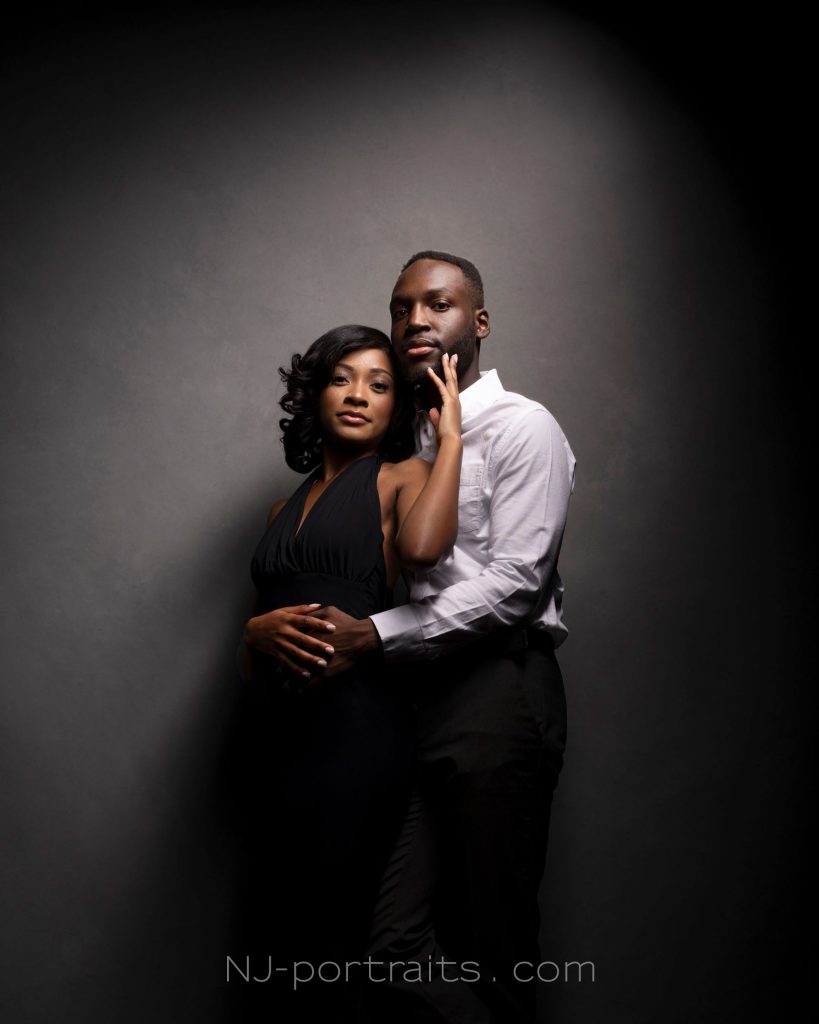
Last week I attended the Digital Wedding Forum convention in San Antonio, where I also did a presentation. Great fun meeting up with old friends and making new ones. Since this was the 7th DWF Convention, there are a few traditions that have been established by now. One of these regular unofficial events at the Convention is the Avatar Shoot. Stephanie Zettl, who has featured on a few guest posts here on Tangents, arranges this shoot at the convention. The idea is to shoot new portraits to be used as avatars.
The theme this year was Film Noir. Using just one (or sometimes two) video lights, she created moody portraits of every innocent bystander attendee hanging out at the hotel bar the one evening. The video light is perfect for lighting for a Film Noir look to the photos. With the dramatic drop-off in light to the edges, the area around your subject will usually fall into darkness rapidly. This creates a kind of a spotlight effect. Perfect lighting for this!
The photo at the top is my portrait. I just pulled up my collar and sank back against the wall. Working so close to the wall was useful in allowing a shadow to appear … and Stephanie very effectively used the negative space there to add more drama. Just to keep the momentum of the photography process a little off-balance here .. the moment she took the first shot, I stepped away and told her we are done. Just the one shot. And it worked. It had to.
A little more about the specific video light used here:
(more…)
Comments (12)
January 22, 2011

using a small softbox for lighting an intimate / boudoir photo session
With intimate photo sessions, I use a number ways of lighting my subject. This helps to bring some variety to the images. It helps mixing things up a bit by not using just one specific way to light the session.
While I sometimes use a softbox, the medium sized softboxes (or the 24″ x 24″ softboxes) are just a little too big to swing around in a small room. With a recent on-location photo session in New York, I used the Lastolite 8.6″ Ezybox (B&H) a few times. I took it along on that photo session because it is so compact.
So when I arranged with a model, Carly Erin, to do another photo session, I instantly thought of taking this smaller softbox along. With the previous intimate photo session with Carly, I used bounce flash and tungsten light (the Lowel ID-light). But this time I decided to predominantly use this new small softbox. And I really liked the results …
(before clicking on the ‘more’ link,
be aware that the rest of this post has images with some nudity.)
(more…)
Comments (35)
January 19, 2011

boudoir photography and the 50mm lens
With working space often times so tight for boudoir photo sessions, there is the temptation to use a 50mm lens for tighter headshots. (On a full-frame D-SLR.) Instead of stepping back a bit and using an 85mm lens or longer, a bit of visual laziness comes into play, and we rely on the 50mm lens too much. It really is too short a focal length for a tight portrait. I think many photographers are even too in love with their 50mm lenses, and use it without thought of how this would distort someone’s face when used too close to their subjects.
I totally understand the need for compromise. Quite often the angle we need to shoot from – whether because of the shape of the room, or the direction of the light – dictates a shorter-than-ideal focal length. This still doesn’t make the 50mm a default lens to work with, and still doesn’t mean the images we’re getting couldn’t have looked better with a longer focal length.
(more…)
Comments (26)
January 14, 2011

adding bounce flash to ambient light
Using images from a past workshop, I want to explain a simple concept with flash photography on location. In workshops and seminars I quite often describe the flash as ‘riding on top of’ the available light exposure. It’s just another way of describing the usual technique of under-exposing the ambient light somewhat, and then using flash to give correct exposure. We can thereby control the final look of the image by controlling the direction of light from our flash.
By using flash like this, we can use the flash to ‘clean up’ the light in the photograph.
This photograph of Crystal, our model at this workshop, was taken during the early evening. We were working outside, using some of the found surfaces to bounce flash off. The trick here is to find that combination of bounceable surface, a good background, and then to position your model so that the additional light from the flash adds to the final image. What I like about this specific image is how the sign (and the reflection of the sign) outside the hotel creates a halo around Crystal.
Here is the image without flash, and also a pull-back image to see what surface I bounced the flash off ..
(more…)
Comments (17)
Older Posts »
|
|