
A technique I often use to get crisp images in low ambient light when I shoot without flash, is to simply put my camera on continuous drive, and let it rip for a second or so. So while camera shake may ruin some (or even most) images, I am usually sure of getting at least one image that is really sharp.
I know this runs counter to so much of the philosophizing in photography – waiting for that oh-so-perfect-moment when it all comes together, and then with great precision and superb intuition of the moment you’re in, to take the photograph. Much of my personal photography is driven by the idea of The Decisive Moment – Henri Cartier-Bresson’s oft-quoted motif. Yet there are times, as with this photo session which were mainly static portraits in low light, where it is just easier to let rip with that motor-drive ..
There is always the option of a tripod, yet I find they slow me down. As an example, with this image, I changed my own position slightly between sequences, so that I could vary the pattern of out-of-focus highlights behind my model. A tripod would’ve been too static, and I wouldn’t have been able to get as much variety between images in as short a time.
Since I wasn’t shooting with flash, I was able to fire off rapid sequences without hurting something. (Aside from the sensibilities of some purists.) I refocus between sequences to take care of any possible focusing errors, or to avoid getting out of focus images because either of us moved slightly. Then later on in post-production, it is easy enough to pick out the sharpest images at 100% while viewing the RAW images.
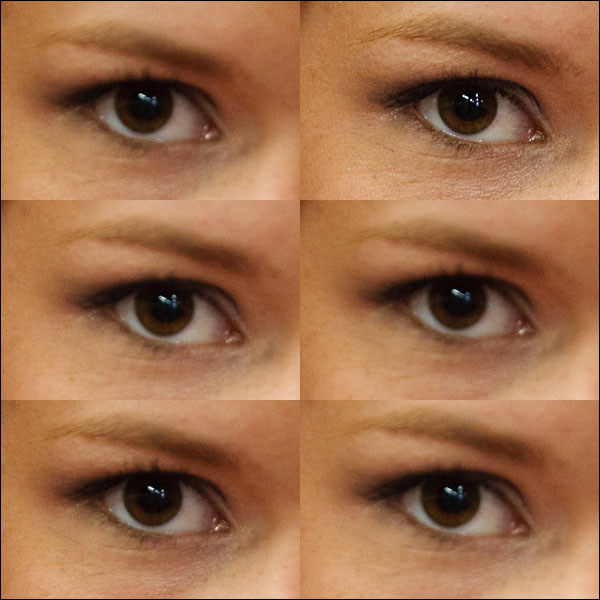
There you go. It is obvious which image I will keep – the sharp one.
With this portrait of Priscilla – which was also taken in the same photo session as seen in a few other previous postings – I was once again shooting with the Nikon 200mm f2 in low light. Now even though the lens is a VR lens, and the VR does work, the lens is so heavy and 1/100th is a slow shutter speed anyway, that there is always the risk of camera shake.
I also often use this technique during a key moment at weddings. When I am photographing the church ceremony in low light, I will often put the camera in continuous drive, and let the camera rip during The Kiss. It isn’t a solemn moment, since everyone is applauding. Well, everyone except for the guests with camera. But they too are adding to the noise. No one notices me machine-gunning the moment.
Now, there is the risk of missing a key moment when you rely entirely on the camera’s frames-per-second rate .. but for (fairly) static situations like this photo session, it is a simple enough technique to keep me fluidly working, and still ensure crisp images in low light.
Awesome Neil – I have often wondered about this as I often see other wedding photographers using the ‘run and gun’ technique whilst I am shooting much more conservatively. I guess there is a place for both techniques. Whilst I hate sifting through stacks of the same shot I dont hate it as much as the shot being ruined due to closed eyes or a funny facial expression.
As for the light – its lovely. When you say that this is a low ambient shot there is obviously some light coming in from camera left lighting up her face and hair.
How does your flash match the pace in continuous drive during a key moment at weddings in low light?
Hi Neil, this technique also works very well for macro shooting without tripod. I wonder if you use max fps or set to a slower fps. I use 3fps on my Nikon D300. Of three shots often the second is the sharpest. Using higher fps often didn’t produce better results.
Gruss Hinzmann | http://www.feineBILDERWERKSTATT.de
Heh. I do the same thing when the amount of ambient is questionable. Good to see that I’m not the only one.
Neil,
Love the idea that even the best think “ah what the heck” and go for it every now and again. Though I appreciate there is a little more to it then that.
I guess the real key ingredients here are a good optical quality lens that is fast enough and having the camera set up right to shoot at quick shutter speeds in potentially low ambient light. As evidenced by your choice of both lens and camera setup above.
Mark C.
Hi Neil,
as Ian said, this is a very useful technique for macro shooting handhold. But i wonder with wich fps you use it. I use 3fps on my D300, because I noticed that from a 3 frames burst mostly the first is blurred and the second crisp sharp.
If I use 6fps or more I find more blurry frames but not more sharp ones.
Guss Hinzmann – http://www.feineBILDERWERKSTATT.de
Neil,
Is the camera set to ‘follow focus’ when shooting in this way?
Jack
If I read you correctly, this technique is overcoming camera shake. But I guess if you are shooting at f2 the depth of field is pretty shallow and a burst will also help with nailing the focus assumin some degree of model and/or camera movement. I use this approach for macro shots when I am lacking a tripod.
Thats one thing about Nikon, my D80 hardly does 3fps, and even the D300 does only 3.5?
Meanwhile Pentax K20D does about >10fps depending on size…
And Canon always did about 6fps.
Canon doesn’t “always” do 6fps. It may be true for JPEG, but for RAW, the entry level cameras and even the 5D only do around 3fps. But 3fps should still give you enough to use this technique. Remember, your shutter speed also affect how much blur you may have from hand shaking. And the fps is totally separate from shutter speed, unless you shutter speed slow all the way to 1/3 or slower.
Shot with f2 is a valient and dangerous decision. I think: in the key moment if you don´t shot any picture in focus?
Hi Neil,
I’ve found this little trick to be of immense benefit in the past especially when the aperture is set to f2. As posted before this aperture having a very shallow dof is quite difficult to nail a really sharp and in focus image if you are on the go. I’ve found that sometimes when having locked my focus on someone’s eyes and then recomposing the shot and then firing away, in the moment of the recomposition of the shot, without me knowing it, I’ve just managed to move the camera enough to get the focus just slightly off as in your example above of the images. What a bummer when you check your images in Bridge and zoom in to 100% view and you see that the nicely composed shot is just a few degrees off pin sharp. Just so good to know that with a continuous machine gun burst of shutter speed going off, that in those few seconds, one or two of the images will have the sharp focus that we want.
Nice little technique there Neil… thanks….
Reading your post on gunning and running made me think about something and I thought I would share it with you and let you test it out !
This comes from sniper school but works well for long lens shooting.
Get yourself a length of rope / string / wire / chain and a 3/8 camera type bolt (I actually use a hot shoe release plate)
Tie one of the string to the bold and make a big-ish loop in the other end but what you need to do is measure it so it’s about ½ short of your eye when you pull it taught.
Then pull it till it’s at eye level and putting just a little extra upwards strain on it – this will create a rock steady monopod that will help you shoot at MUCH slower shutter speeds and it can fit in your pocket !!!!!! – I have mine in match box in my camera bag – it sounds dumb but give it a shot.
It works best if you make the loop pretty big so you can stand in the loop with both feet at shoulder width apart creating a triangle with the string coming out of the top to the bottom of your lens.
Anyway just thought I would share, seems right up your street.
Rapid firing is a great way to catch a baby/child too. As a mother of six, I know from experience how quickly an expression/mood changes, and how darn fast they move. I have series of shots that tell the story like one frame couldn’t. Birthday candles is one example. I also love to capture my toddler crying….the range of faces he makes in just an instant is astonishing.
I shoot indoors with a prime at f2 or as wide as 1.4, so I can fire them off fast.
Dear Neil,
you must have noticed my odd little questions here and there by now.
One of those sentence which kept my brain turning around bedtime.
‘there is the risk of missing a key moment when you rely entirely on the camera’s frames-per-second rate .. ‘
une petite explication pour moi s’il te plait?
thank you in advance.
Sophie .. I often rely on machine-gunning my camera to make sure I get sharp images when shooting handheld in low light. (Without flash of course.)
I also machine gun when I am photographing unpredictable action, as in this photograph I posted in the article on taking photographs in bright sunlight:
But then there are times when you need to observe and time your shot to get the peak of the action, such as this image I recently posted of someone jumping on a trampoline at a festival:
If I had simply machine-gunned it at this time, I might’ve only gotten some in-between moments, instead of that surreal moment. That’s what I meant that there is a risk of missing the key moment.
You need to apply whatever technique you are using, as it applies at the time. There is rarely one specific method or technique that will cover every potential scenario you might encounter.
Thank you Neil for your amazing speed in responding to me. Its 4.30 pm. here in Shanghai so I dont even know what time it is where you are.
Sorry for the question above. It totally makes sense what you are saying, I guess the sentence alone in that context ( of the initial post) made my brain wonder for no reason.
Hi Neil,
When you set your camera to continuous drive, do you mean the CL and CH settings on the dial on the top of the camera? If you do that, do you set the camera to continuous focus (the switch on the body of the camera just to the left of the lens mount)? Thanks.
Neil,
Bah, you’re making me think. :)
I would set my camera to either CL or CH to get continuous shooting (The few times I wanted to try continuous shooting, I usually use CL). If the model isn’t moving, then I’d just leaving it at single-servo focus.