choosing your shutter speed when using flash
A question that I was asked via email, that I thought would be of interest to everyone:
When using ambient light, I understand that you set your exposure using the camera’s manual mode, then use flash to fill in. My question, when your shutter speed goes below that usually used hand-held, do you count on the speed of the flash to produce a sharp image or go to tripod or monopod? Or, increase either ISO or f-stop until you reach and acceptable shutter speed?
This is entirely correct in that I usually increase my ISO or open my aperture, to get a high enough shutter speed for sharper images. I can count on the flash freezing the action when I am shooting in lower light levels, and my ambient light is around 3 stops or more under-exposed. This means the (TTL) flash will be the dominant light source, and the short duration of the flash will freeze the action
But when we get to situations in low light where we are using flash in nearly the same amount that the available light is, then we can’t rely on flash to freeze the action. I prefer not to use a tripod for my wedding photography, since it slows me down for the style that I work in.
I thought this might be a good opportunity to run through some examples again, and look at how we’d approach these scenarios. Then we can see what effect the flash might have on giving us sharper images .. or not. In other words, let’s see where flash would help freeze movement.
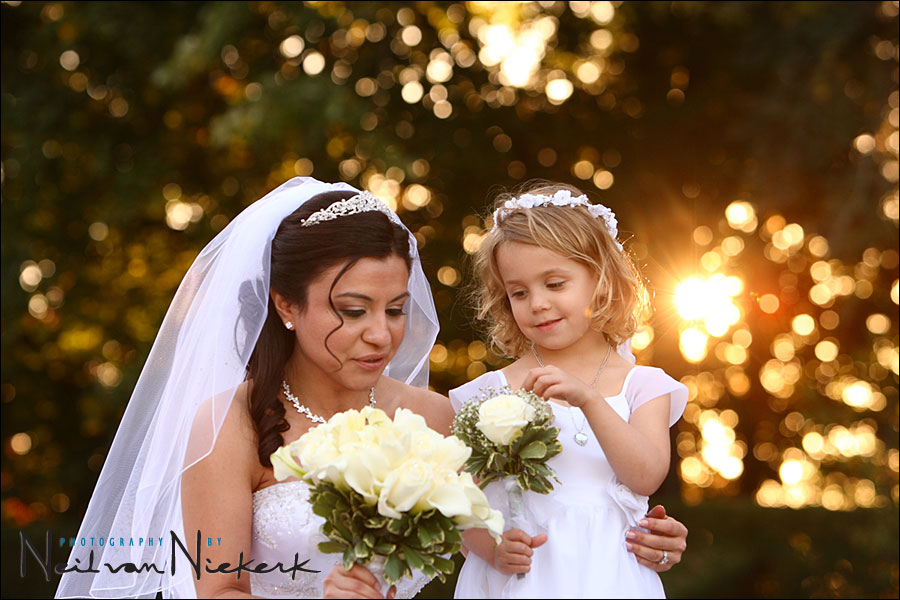
camera settings: 1/300th @ f4 @ 500 ISO
First, let’s start off with a scenario where flash is just a delicate touch of fill-flash to help lift the shadows. As you can see here, the available light is just gorgeous. I purposely turned the bride and flower girl away from the sun coming through the trees in the late afternoon. This way the light falling on them from the camera’s point of view, is very soft. So I just needed a touch of fill-flash (around -3 EV) to help lift any shadows.
It is obvious that in this instance, the flash would have no effect on freezing the subject since it is the merest hint of light. Therefore the actual shutter speed we choose; and how carefully we hold the camera and lens; and how still our subjects are .. all these will be the deciding factors on how sharp the image will be.
Similarly here, where the bride wanted a photograph of the bridal party during some air time … I needed a fast shutter speed to freeze the action.
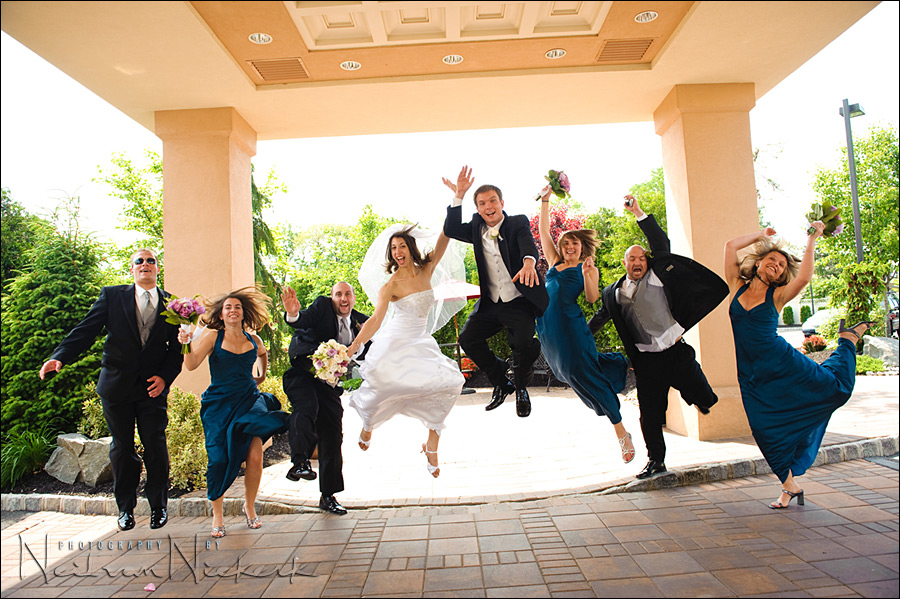
1/500th @ f4.5 @ 640 ISO .. lens set to 24mm
I choose the ISO such that I could get a fast shutter speed. I did go into high-speed sync mode .. which implies that I would lose range on my flash. But I could accept that, since I just wanted a touch of fill-flash again. So with this example too, the actual shutter speed that I choose will determine how sharp my image will be.
However, it becomes slightly more involved when we use flash when the light levels are low …
With weddings and portraits on location, I am most often also intent on having the available light be visible in the final image, to give us context and help retain some of the ambiance and mood of the place. To do so, is a matter of juggling shutter speed, aperture and ISO.
When the ambient light is brighter in the background, and there is very little light on the subjects, then we can easily drop our shutter speeds to get the background to register.
Here for example, a photograph of wedding guests at an after-party at a night club in the Bahamas. (Yes, my job truly doesn’t suck.)
First, a test shot to show the light levels that existed without flash ..
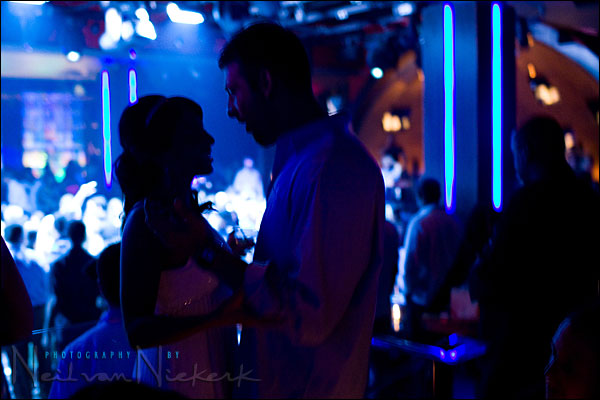
This was taken at 1/15th @ f2 @ 1600 ISO … very low light levels.
And this meant I could (or rather, had to) drop the shutter speed low, and open the aperture and raise the ISO, in order to get the ambient light to appear in the image.
In the area we were, the light falling on the guests were low … and this allowed me to go with such a slow shutter speed and still get sharp photos. The flash did all the work here in freezing movement, and I could easily get sharp candid images of the guests as they were dancing and having fun.

camera settings: 1/20th @ f1.8 @ 1600 ISO .. TTL flash +0.3 EV
The situation can be reversed though .. with our subjects in relatively brighter light, such as this example. Here there was a videographer adding light from the side, and therefore I needed a higher shutter speed or else there would be too much subject movement (for my taste), in the final image.
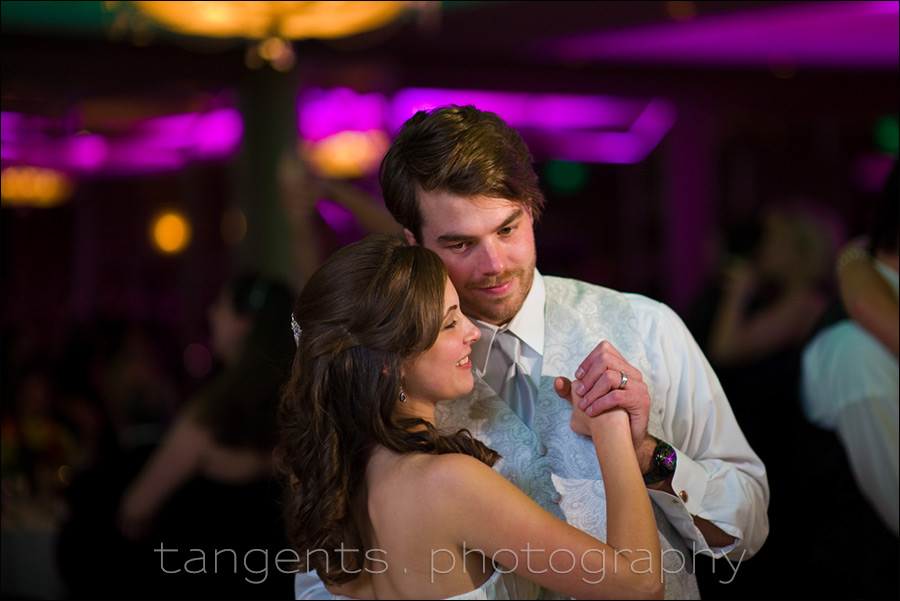
1/250th @ f1.4 @ 2000 ISO .. Nikon D700 and Nikon 85mm f1.4
I had a very high shutter speed here for a photograph indoors at a wedding, but this was specifically so that the video light didn’t cause subject smear as they danced. I could freeze the action with my choice of shutter speed.
I bounced my flash over my right shoulder, with the flash gelled with a 1/2 CTS gel to help counter the change in WB from the videographer’s light.
Then there is the possible scenario where we have low light levels, and our subject is lit by the available light .. and we have to use flash. I don’t have anything in my immediate archives that I can think of that would illustrate this .. but this is a situation we’d have to be very careful not to get camera shake or have the subject move too much during exposure.
As an aside to all this – sometimes a high shutter speed isn’t because we want to eliminate subject movement or camera shake .. but because we want a better balance between ambient light and flash.
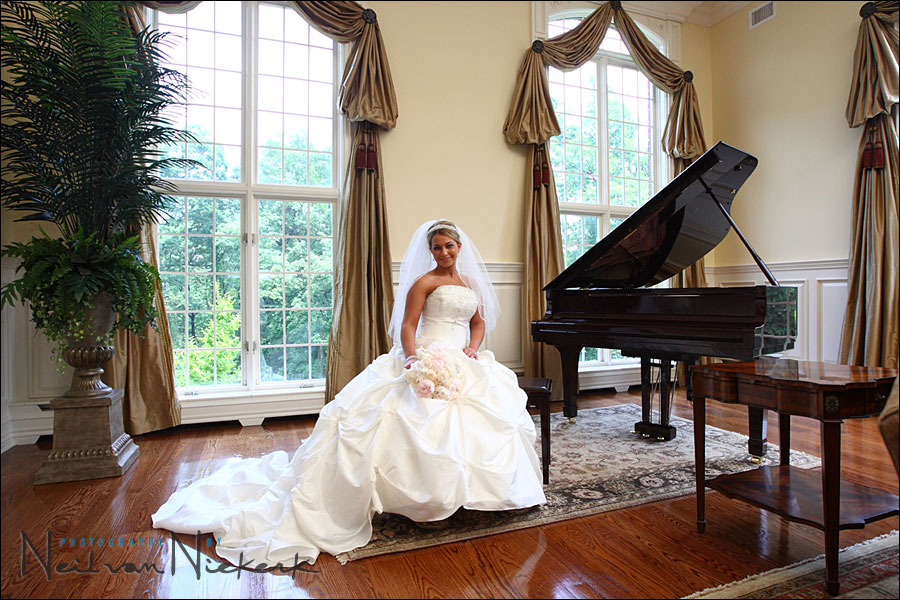
Camera settings: 1/300th @ f4.5 @ 800 ISO .. flash set to +1.3 EV
With this example of the portrait of the bride, she is very much static in the frame.
Here I wanted to retain some detail of the garden outside. When I want to balance a bright background (lit by ambient light), with my subject which is lit predominantly by flash … then the best place to be in terms of my shutter speed, is maximum flash sync.
Hi Neil, on the last example the shutter speed is 1/300. I thought the max flash sync for Nikon is 1/250…just curious
awesome post as usual.. I was just curious about the background in the picture in the club at the bahamas.. Did the ambient light appear blue like that due to some kind of spotlight, or was it because you purposely did not adjust for it in WB setting. It looks really cool. I guess what I am asking is if you gelled your flash but did not set the camera’s wb setting to match or was the light just blue looking?
Neil, same question as Bennet, but his time referring to the first image. Were you on high-speed sync mode? Thanks!
Hi Neil,
On a different subject but connected with photos above. In photos 3 and 4 I can see out of gamut colours (in the blues)
this is a problem I’m trying to deal with at the moment with some stage shots I took (RAW+jpg)
I’ve been experimenting when developing the RAW by reducing the colour to just above the point where the out of gamut colour blows but then the rest of the colours of the image look a little washed out, the jpg that was taken at the same time seems to maintain all the blues and keep the other colours without going out of gamut, I really want to use the RAW as it allows more headroom in other areas but am struggling with this issue.
PS: I’ve tried testing 3 different developing software packages (Silkypix, Lightroom and Raw Therapee) each have there good and bad points (the last one is experimental) but cannot seem to develop an image from RAW that maintains the colour range of the jpg without the blue colour somewhere in the shot going out of gamut, I’ve also tried fine tuning the colours to reduce just the blue but it still goes out of gamut.
What is your normal method for dealing with out of gamut colours while maintaining all the other colours?
Kind regards,
David
David .. this is going to sound like a cop-out, but I really am not concerned with out-of-gamut colours. The way I approach this, is that I am a portrait photographer. If I am happy with the skin tones, then I’m set. That’s usually as far as I am going to concern myself with an image. (Bright neon clothing will still be a problem though at times.)
So in that instance, where the over-bright lights in the night-club causes strange color shifts and patterns .. it just doesn’t bother me.
Hey,
just a little question: In the 4. picture, how did you use the flash? Set right upside or over your shoulder? If over shoulder, from where does the light reflect? Any wall nearby?
greets
thowi
Neil,
In reference to the bride in the large room w/ piano.
Although you are at max sync, could you have shot a little faster to expose for the windows a tad more? Bump up the FEC to perhaps +2 even though you are now into HSS?
Neil, did you use a softbox in the last image with the piano? Or just a simple speedlight?
Thanks Neil…
I kinda’ knew that, but wasn’t quite sure if the flash would have enough ooomph beyond max sync. Losing 1/2 power as soon as we pass max sync surprised me. I knew it is reduced, but didn’t realize 50% was gone?…Hmm. Seems to be all about a ton of flash power in large rooms to illuminate room AND subject; barring HDR.
Thanks again Neil
Neil – great site, I just came across it.
Can you clarify – when you say “fill flash (around -3EV)” or “TTL flash +0.3EV”, what have you done? Exposure compensation on the camera or the flash?
Thanks
Pete- remember, when you go into HSS or FPsync on nikon you lose around a stop–that is, your light is cut in half. 50%. (not sure if i’m breaking taboo by responding to someone’s question on your board). first time comment, but have browsed and really enjoyed your site. thanks so much.
Hi Neil,
another great post. I wanted to ask if you turn on the high speed sync on the Nikon cameras in the menu, does it not come into play until you go over 1/250 second, or does it keep reducing the power of the speedlights at 1/250 second and below as it is turned on anyway?
I hope this makes sense.
Paul
One odd thing I’ve noticed about my diminutive little D40 and vivitar flash, is that the D40 has a max flash sync of 1/500. Why would such a little consumer level jobbie have a faster max sync than a pro camera costing 10x as much?
From what I understand, for the D40 and certain other camera models, the sync is a combination of a mechanical shutter and an electronic shutter. See http://www.steves-digicams.com/knowledge-center/why-digital-cameras-have-mechanical-shutters.html. Most likely, the D40’s mechanical shutter isn’t good enough to stand by itself, so it is supplemented with electronics.
Oh so thats how they managed that. I always wondered. Somehow though, that makes me feel cheated, like they slipped an inferior system in without really telling anybody. On the other hand, it *is* just a D40.. :/
Neil,
Three questions:
1. Not clear about this:
“Then there is the possible scenario where we have low light levels, and our subject is lit by the available light .. and we have to use flash. I don’t have anything in my immediate archives that I can think of that would illustrate this .. but this is a situation we’d have to be very careful not to get camera shake or have the subject move too much during exposure.”
Image no 4 shouldn’t that be the example of the above statement ?.
2. Image no 3, can you just use fill-flash ?
3. Image no 5, no flash at all right ?.
TIA,
JohnG.
John … that example I mentioned, is for a scenario where I can’t rely on flash freezing the camera shake or freeze any motion. In that hypothetical example, there is already enough light on the subject, albeit in low light levels. But in this hypothetical scenario, I then can’t blast flash, but need to use subtle fill-flash. So therefore my shutter speed will still be slow, AND I can’t freeze action with my flash … and this would imply that I would have to be very careful with holding my camera very still.
I had to add that hypothetical example there in order to try and cover a wide range of possibilities.
Image #4 … without flash, they would be completely under-exposed. So the flash is the dominant source of light there. It is not an example of this hypothetical point.
re your point #2 .. (about image #3) … again, the flash needs to be a dominant source of light to give correct exposure. Mere fill-flash won’t quite work. I’d get an under-exposed image still.
re your point #3 .. (about image #5) … I did use flash there to open up the shadows a bit and lessen the contrasty video light.
Hi Neil! In the case you have to photograph people dancing in low light, you use first or rear curtain sync?
Thanks!
Matias, it depends on whether you’re:
– panning with your subject – then rear curtain sync has no effect;
– your subject is moving across your frame – then rear curtain will have the effect you want.
More info about rear curtain sync vs front curtain sync
– first curtain sync vs rear curtain sync
– when (not) to use rear-curtain flash sync
Great!. I didn’t think in the “panning” situation.
Thanks Neil!
I have a shot I took of a model on a very dark background, she is throwing a piece of cloth wrapped around her and I am practicising freezing movement with the flash. On most of the photos, she is perfectly in focus and so is Most of the fabric. I have, however, some of the edges of the fabric and her hand which is throwing the fabric, blurred. It this because the flash isn’t lighting up that part of my model. My zoom if I remember was zoomed at 35 mm and was about 8-10ft away from her. I cannot remember the strength of the flash, but I think I was using quarter power on a 580 ex II. Would appreciate some response.
It is most likely the available light bleeding through from behind your model.
Check this article for more: will flash freeze the action at slow shutter speeds?
1/250th @ f1.4 @ 2000 ISO .. Nikon D700 and Nikon 85mm f1.4 (BRIDE AND GROOM)
Just wondering how far you were form the subject as both Bride and groom are in Sharp Focus at 1.4f?
camera settings: 1/20th @ f1.8 @ 1600 ISO .. TTL flash +0.3 EV (TWO GIRLS)
At 1.8f how did you manage to get both in Focus? was 1/20 enough to freeze the motion?
FOLLOWING YOUR POSTS , REALLY VERY HELPFUL, SPECIALLY WITH EXIF AND PHOTOS TOGETHER
Here is the 100% crop. You will notice the bride is slightly more sharp than the groom, but at the distance where I stood – the edge of the dance floor – the drop-off in the DoF isn’t so dramatic that his face looks soft in the photograph.
At such wide apertures, you usually want just one person specifically in a plane of focus … with everything else dropping off noticeably. But when they are in the same plane of focus, or very close to the same plane of focus, you can make it work at such a shallow depth of field.
There was very little ambient light on them, and they were dancing slowly … which is why the flash was able to freeze any motion or cameras shake.
Here’s more on when flash might freeze action.