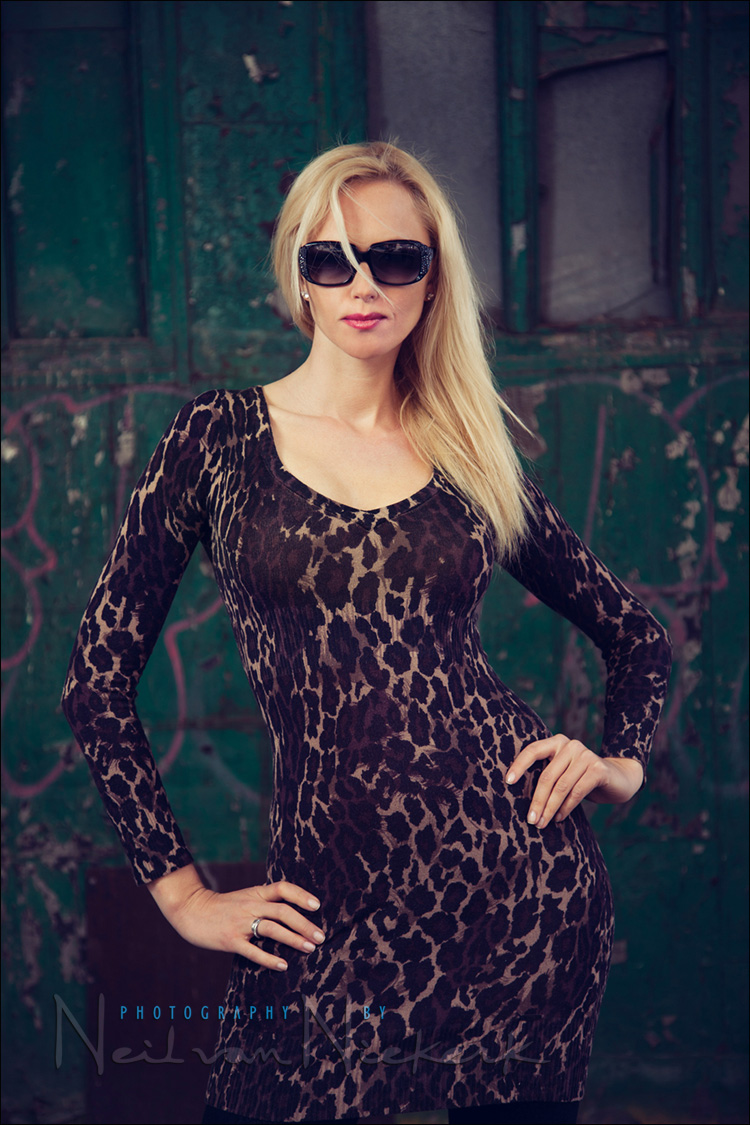
Reasons to use TTL flash – speed & simplicity
Okay, true strobists might recoil in horror, but I often prefer using TTL flash to sweeten an image when shooting on location. I get to the final image faster than if I had gone the more methodical route of manual flash.
For some situations, manual flash is the only way to go. For example, when your subject is static in relation to your lights and you have to get consistent lighting and consistent exposures, image after image, then manual flash makes the most sense. But for times where you want to shoot faster, and shoot on the run, I find that TTL flash is the easiest and most fun option for me.
With this photograph of Aleona, I chose an easy scenario where the available light isn’t harsh. While the light might be soft, it is also not all that exciting. It’s bland. But now we can easily finesse it with a bit of flash from a softbox …
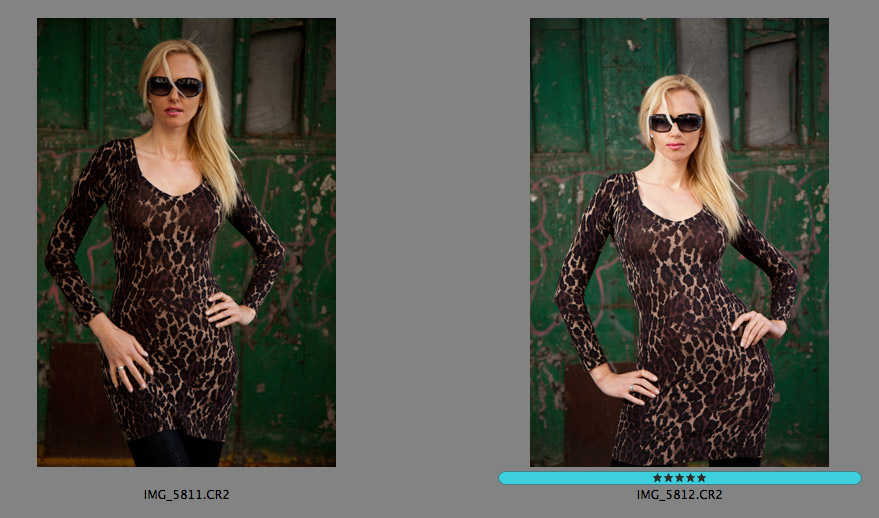
The technique is simple in this case – under-expose slightly for the ambient light. A stop or so. Maybe 2/3rd stop. Just a bit. And then let the TTL flash, diffused by a softbox, pick up the difference in exposure. This screen capture from Bridge will show the same image without flash, and then with flash added.
Of course it helps in using sensible camera settings:
Camera settings & photo gear used during this photo session
- 1/200 @ f/4 @ 200 ISO
- Canon 6D
- Canon EF 70-200mm f/2.8L IS II
- Canon 600EX-RT Speedlite controlled by Canon ST-E3 Transmitter
- Lastolite EZYBOX 24×24″ softbox
Related articles
- Off-camera flash vs. available light (model: Olena)
- Balancing flash & ambient exposure (model: Anelisa)
- Various scenarios: Balancing flash with ambient light (model: Catherine)
RadioPopper was more reliable than Pocket Wizard TTL? On Nikon too, or just with Canon flashes? Also, with Nikon flashes, I’m unclear as to whether RadioPoppers can work with flashes beyond SB800s. I read that Nikon changed the way the signals were sent, making RadioPoppers unusable(?) on SB900s and beyond. Maybe I misinterpreted things, but that was the impression I got.
Paul .. I haven’t had problems with the SB-900 or SB-910 when using the Radio-Poppers.
I changed to using RadioPoppers for the workshops, even though I use the PocketWizard TT5 units for my own work. With multiple shooters, the PocketWizards were problematic and there would be misfires and weird exposures.
So I changed to the RadioPoppers which work on an entirely different principle … where there is no conflict if more than one photographer uses a specific Slaved flash.
Neil, have you looked at the Phottix Odins yet? They’re only available for Canon at the moment, with a Nikon version expected soon.
I’ve been using a set of Odins with my Canon camera and Canon flashes, and have been loving the functionality and reliability of them.
I shoot with Nikon primarily. For the workshops, I need a flexible system of radio transmitters that can be configured for either Nikon or Canon …. RadioPoppers.
For the small Canon system I still use, I have moved to the Canon 600EX-RT flash.
So the Phottix hasn’t really featured on my radar.
Hi Neil,
How was the exposure metering setup on your 5D? We’re you using spot metering and Flash Exposure Lock to achieve consistent results. I’ve been using the Pixel ETTL radio set, but they don’t support FEL on Canon.
Thank you!
Al
Al .. my Canon 5D mark II was set to Evaluative Metering, as well my E-TTL settings.
Neil was your camera set in manual , what part of the subject did you balance your exposure?
Winston .. as mentioned there, I chose my settings. ie, the camera is in manual metering mode.
I don’t really specifically meter .. I just want to under-expose my subject to an extent. So as I mentioned there in the text, I under-expose to an extent. It’s not all that specific. And that’s the beauty of working this way.
The more I under-expose my ambient though, the more contrasty my photo will appear, since the ambient light acts as a fill-light in this scenario.
I can say Radiopopper works with Nikon 910 and Sb 900 without a hitch I use it with my D4 every weekend
I too find the PW TT5 “moody” at times… and those times I revert back to my Elinchrom Skyports which are bulletproof. I lose the TTL and have to work in manual however work becomes the keyword here as the TT5’s sometimes don’t…
Hi Neil
When u expose for the ambient, is the model in the frame or do u add her when you’ve reached the required ambient exposure?
Many thanks
It doesn’t matter in this case, since it is about the same light falling on the model as the background.
how about when shooting at night or indoors where there is next to no ambient light contributing to the exposure, would u still rely on ttl even though there is a bigger chance of flash exposure error since flash is the only lightsource
Naftoli … it depends partly also on how much of your subject fills the frame. For a tight portrait or half-length portrait, I’d still rely on TTL … but I will also be aware that I might very well have to dial down my FEC.
Hi Neil,
Have you been in a situation where you have to set your TTL flash to High Speed Flash Sync (HSS) in order to maintain a higher speed and a larger aperture? How does that affect the flash output, especially for an outdoor photoshoot?
Thanks so much for sharing your knowledge with us.
Hoang
Hoang … here’s a tutorial on high-speed flash sync.
Hoang, when u go so much as 1/3 stop shutterspeed over ur sync speed u lose more than half the power capability from ur flash, as opposed to closing down ur aperture 1 full stop u only lose 1 stop of flash power but u also cut out 1 full stop of ambient, if u use a bare flash head u can sometimes pull it off but any modifiers on it will usually cut down too much light to be effective, with HSS, hope this helps
As always – great material. Thanks Neil for sharing.
FEC – nI struggle with this. Is there a starting point for this? Do you start at 0 and how do you determine to dial up or dial down? I look at this shot and suspect you have it dialed down – as it does not look like it needs much flash.
Tutorial – Flash Exposure Compensation