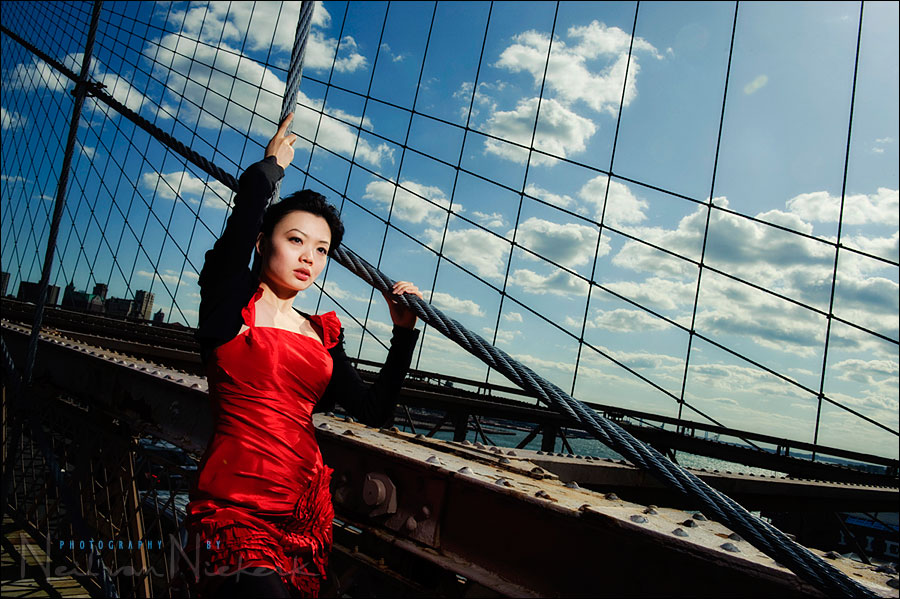
using direct, bare (un-modified) off-camera flash
I had the opportunity to meet up with a fellow South African photographer, Jaco Fourie, who was visiting New York for a few days. I knew Jaco’s work from some of the forums that he posts on, and his work with flash was invariably quite impressive .. so I looked on this as a great opportunity to see another photographer work and learn from him.
I arranged for two models, and we met up in Manhattan for these photo sessions. Jaco specifically wanted scenic views of Manhattan, and incorporate the model as part of the urban landscape. It would be less meaningful to reduce the images so that they looked like they could’ve been taken anywhere. So he shot wide and allowed the landscape room in his images. And to make the model really stand out, he used a very simple arrangement of two speedlights on light stands – direct manual flash, triggered by pocket wizards. I was very impressed with his results, which you can see here on his blog.
When working outdoors, my approach has largely been that of using a softbox or some modifier so that my flash is more diffuse. Working in very bright light though, I had to use direct flash off-camera, instead of the softbox. I used a Quantum flash for these images.
The image at the top was taken at 1/250th @ f18 @ 200 ISO … and with a speedlight or a Q-flash, that kind of aperture isn’t attainable when you stuff the flash inside a softbox. You’d need a much larger flash, or a studio strobe. So direct flash it had to be. But taking it off-camera, and positioned in a way to augment the sunlight, and even over-power the sunlight falling on our model, it looked quite dramatic.
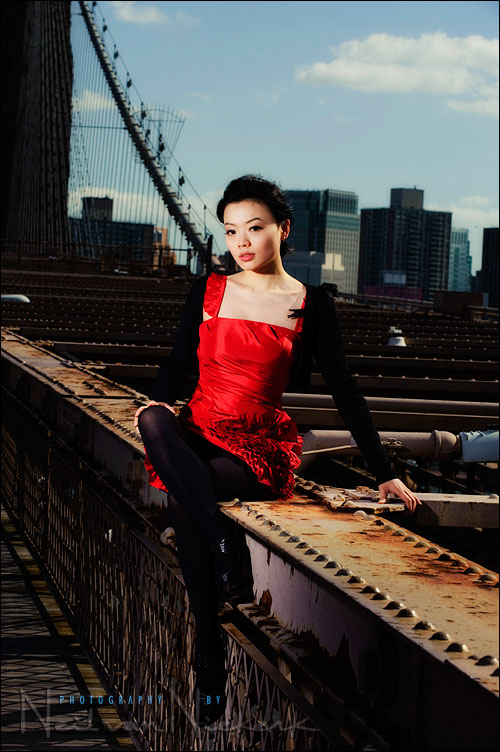
[ settings: 1/250th @ f18 @ 200 ISO, with manual off-camera flash ]
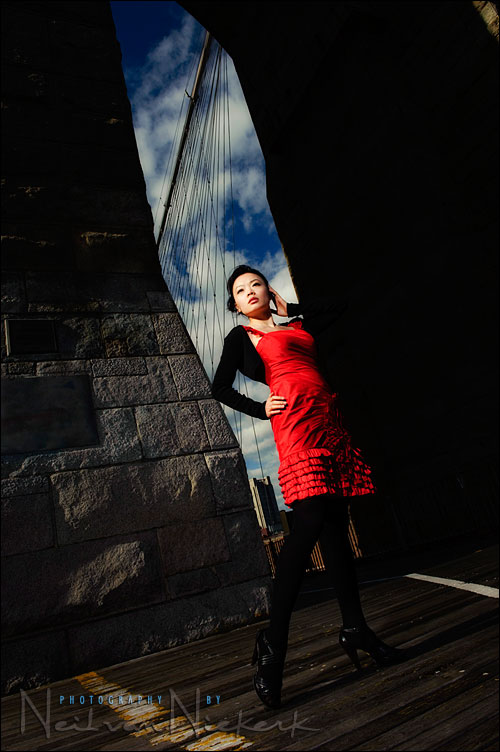
[ settings: 1/250th @ f16 @ 200 ISO, with manual off-camera flash ]
related articles
- getting the most out of your flash / speedlite / speedlight (model: Shawna)
- tutorial: how to use the guide number of your flash (model: Shawna)
- controlling bright daylight w/ direct off-camera flash (model: Molly K)
- practical tutorial: controls for manual flash exposure (model: Hannah)
- overpowering the sun with off-camera flash – what are my settings?
Hey Neil
Could you elaborate a little on how you ‘augmented’ the sunlight. Did you face the model into the sun, underexpose the ambient and overpower with flash.
Hi Neil, long time lurker here on your site. I really enjoyed seeing you step out of your comfort zone on this one, and I have to say the results are amazing!
Woah…just visited his site. Awesome pics. How did he get that amazing HDR effect?
I’m jealous. You get to photograph people in a controlled situation in New York. Nice stuff!
Every time I read about your equipment usage (QFlashes), I wonder what type of lights I should progress to. I currently use 2 580EX IIs & 1 580EX in my small home studio. Following one of your recent Tangents, I have switched from ETTL to manual flash so that I can better control the relative output of each flash in each of their positions to get the effect I want. My Canon is hardwired to flash ‘A’ as fill, ‘B’ is main and ‘C’ is fill/kicker/background. On the street I use 1 flash sometimes when I think people won’t mind.
My question is what should I invest in for events that I do as well as for more powerful studio (portrait) work? Quantums or studio strobes? Flash with modelling light or continuous? Hansels, Profoto, Photoflex, Elinchrom? what power 400ws, 800ws? Radio Triggers or what? Modifiers? A/C or D/C?
For those for whom photography is a serious avocation these are tough decisions since we don’t have practical experience regarding what is needed and what is available and justifiable. There are so many permutations and combinations and every author and Pro, like yourself uses something different. It’s a real quagmire.
How can this be resolved? Can you help?
Regards and thanks for all that you’ve contributed so far.
Fred
What is your web resolution for the images posted. I love how all your images have a ‘glaze’ to them. I never seem to get that effect when I upload pics to any site.
Neil, can you tell me how close the flashes were to the subject and I am assuming they were close to full power. I am surprised how much light you get at f16, unless the flashes were very close to the model.
Thanks,
Arnold
wow wow wow! i love these images, they certainly pop! would this sort of lighting be good on regular looking people or should it just be used on models? I shoot regular people and am wondering if this sort of light would be too revealing of skin flaws, etc.
PS: i got your book and it’s awesome! maybe your next book could be about photoshop workflow? just dreaming…
I usually have nothing but admiration for what I see here.
I suppose photography is so much more subjective than objective.
The lighting of these images is just too hard for for my taste and
a tad too much “Adobe Magic” going on. Sorry.
I much prefer the softer look you attain Neil.
Nice, dramatic photos.
I went over to Jaco’s website, and noticed a photo of you and Jaco (?) posing in front of a wall with Marilyn Monroe graffiti. Who took that photo?
Stephen .. the model of course!
It truly is a small world we live in. Whilst I’ve not met Jaco, I am very familiar with his blog as it’s one of several I keep up to date with because of his great images and how he creates them. Your tangents is obviously another blog I try to visit regularly!
It’s no big surprise to me to hear about Jaco using direct off-camera flash instead of through a modifier. As well as attending your workshop in Cork earlier this year, I’ve been fortunate to attend workshops by other visiting photographers that are also well known and respected for what they do; people like Bjorn Thomassen, Damien Lovegrove and Frank Doorhof. When it comes to using off-camera flash, each has their own way of working and each uses off camera flash very successfully. For example Damien does a lot of off-camera TTL speedlite work with direct flash (no modifiers), whereas Bjorn and Frank regularly use Elinchrom Rangers or the new Quadra with a variety of modifiers, metering meticulously by hand.
I think at the end of the day it comes down to working with what you are comfortable with (and this ultimately leads to each individual photographers’ recognisable lighting style). If the end result is a success, ultimately that’s all that matters. I think the best lesson to be learned from this is that everyone should take themselves out of their comfort zone every so often and try something new. You never know where it might lead! It’s also the reason I enjoy attending workshops whenever I can, in order to see and learn from the great variety of ways one can produce great images.
– Thorsten.
Hi Neil,
I didn’t realize the model took the photo of you and Jaco. Her composition of you two is pretty good/interesting!
–Stephen
Could you tell me something about the reflectors position? Did you zoom in to tele-position or did you even use the wide-angle diffusor?
Thanks
Mario
For this sequence of images of Lea, here is my lighting set-up.
I was holding the Q-flash in my left hand, extended away from me. Bare flash, aside from a diffuser disc over the flash-head. The ring that you see there is the speed-ring to which I would normally attach the softbox.
hi!
very brilliant shots!please what was the setting of power the flash.was it FULL power or 1/4.
philip
Neil,
I have started a biz recently and was doing some research for on location photography for my family lifestyle sessions. I got a hit on your site from my ‘overpowering the sun’ search and can’t tell you how thankful i am! LOVE your thoroughness/professionalism and artistry combo and your desire to share that w/fellow sojourners! Originally my desire for on location sessions was to be natural light but w/tips like yours and kelby’s i aspire to be able to be ‘on the run’ to C A P T U R E the moments my clients are hiring me for and still get that sparkle w/a boost of flash….love seeing the photo of you holding the flash in one hand and camera in another as for now i’m a one woman show soooo i gotta figure out how to balance all that and keep a steady camera hand! i love Radio Poppers btw–shout out for them! do you have any suggestions for flash w/on the move outdoor photography?
woops, i know what else i was going to ask—going bare flash for a harder lite source (well i think you mentioned a modifier on the head) how do you feel this image would have been different if that flash had been on camera and say TTL’d right at her or 45 degrees…guessing the small amount you get from angling it straight up would have been not nearly sufficient for your needs…thanks!
Hi Neil,
Is it possible for me to shoot at wide open (ie. 1.8) in this scenario?
Great example as usual. I’m curious why you didn’t use a ND filter to reduce the fstop for a shallower depth of field?
I didn’t bring one with me.