Should you use a filter on your lenses?
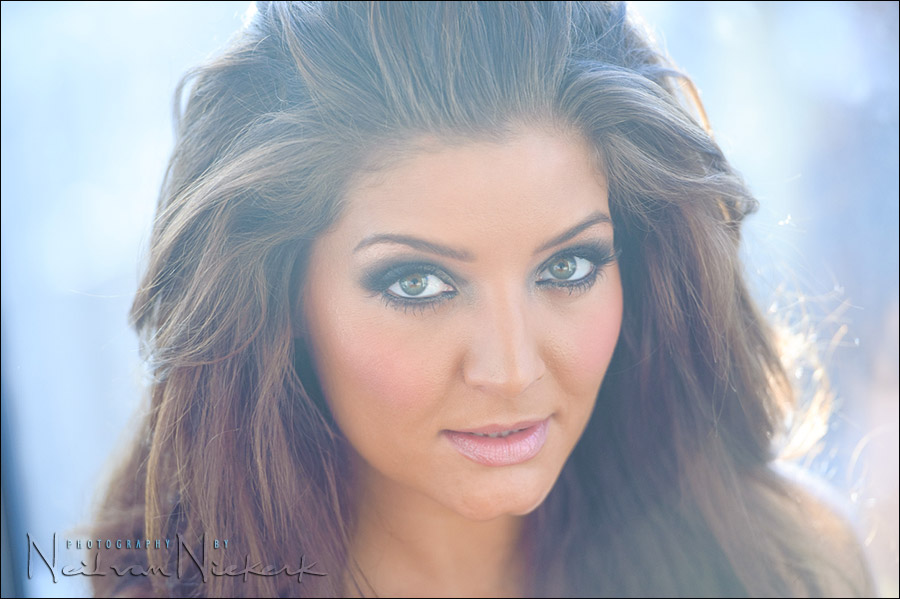
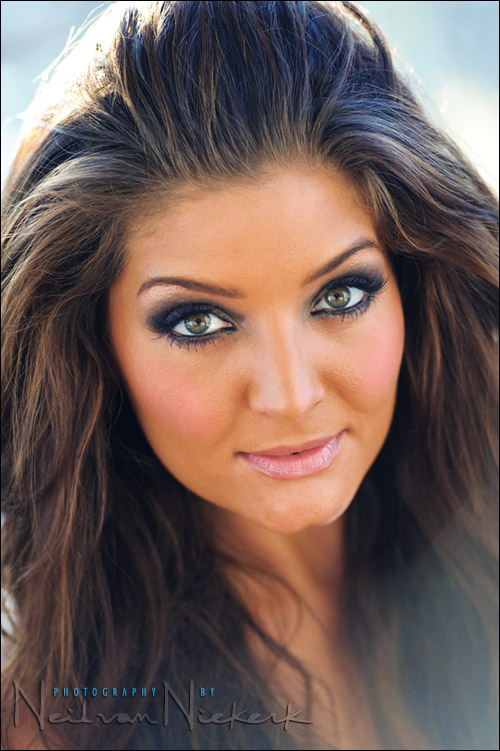
It’s a constant debate whether it is a good idea to use a UV / skylight filter on your lens for protection. There are viable arguments for either choice. During this recent shoot with Jeannie Dee, I immediately noticed that with these heavily backlit portraits, I was getting an unusual amount of flare … and removing the filter on front of the lens immediately helped. Noticeably so!
Shooting towards a bright light source or a bright background, is one time where NOT using a filter makes absolute sense.
You risk getting lens flare, no matter how good the filter is. This amount of flare doesn’t necessarily mean the image is unusable though.
Here is the original image again (shown above), and shown below, with the levels and contrast adjusted and the colors warmed up in Photoshop.
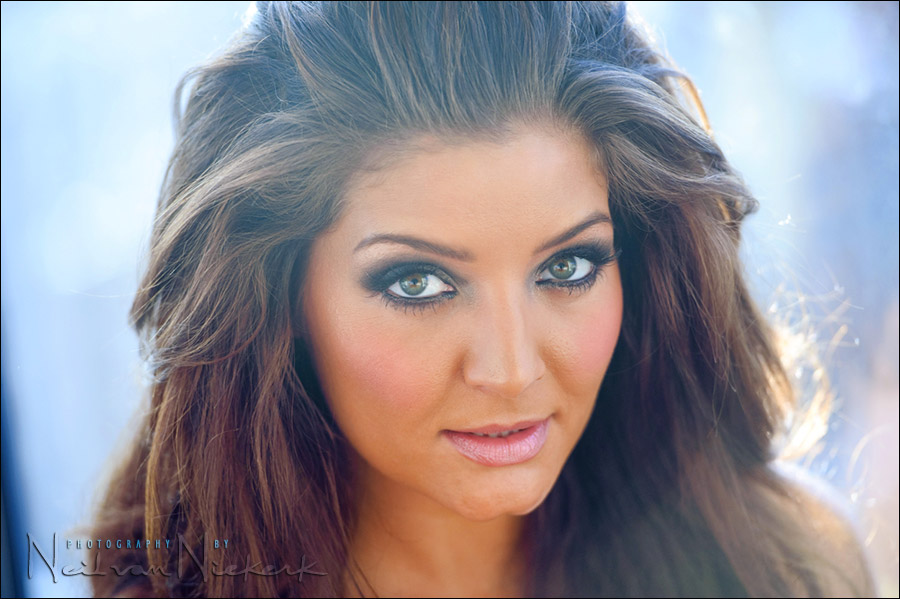
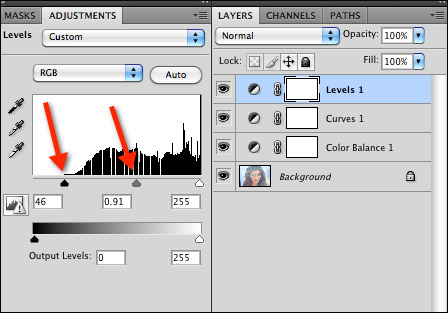
Here are the two points that I change on the Levels layer … the mid-tones and the black level. Then I add some contrast with curves on another layer. It is an improvement, but with this image there is still a gradation in tones noticeable from the top to the bottom.
As always, the ideal is to get the best image quality we can, IN camera already.
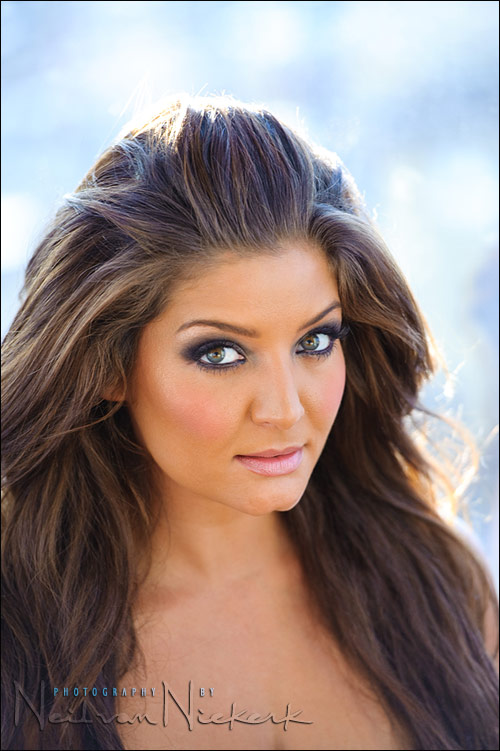
Using lens flare for special effect
Of course, lens flare can be used for effect. In this image here, I feel that the bit of lens flare in the bottom of the image helps to frame her face.
Examples where using a filter saved me from trouble and expense
In comparison, here are two examples of where I filter saved me a lot of trouble, and a lot of expense.
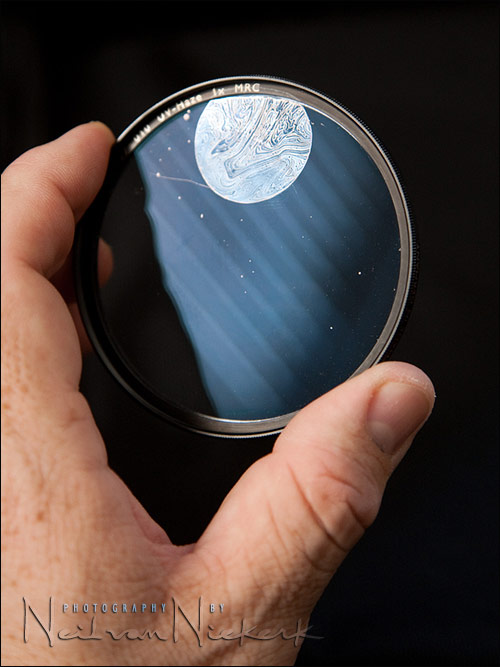
This is the *splat* that a floating bubble left on my filter at a wedding shoot. When they have bubbles after the ceremony when the couple leaves the church, then the bubbles become hard to avoid. And this spot is hard to clean without using water .. something I’d rather not put my lens through. (The white stripes are just the blinds in my office reflected in the filter.)
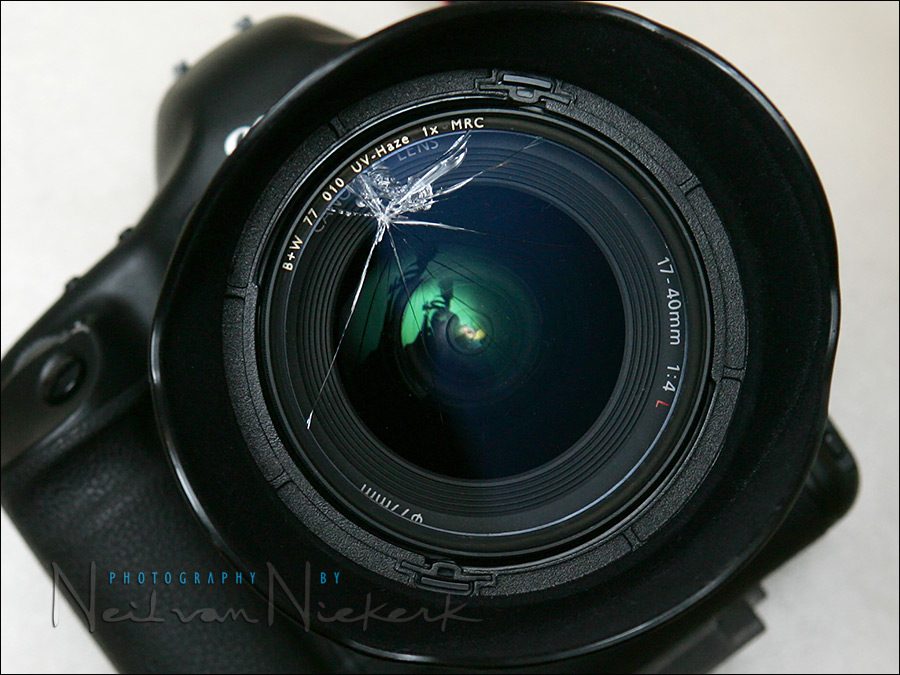
This image of a shattered filter which had protected my lens, is something I’ve already posted about before. I truly believe this filter saved my lens from considerable damage.
So, should you use a filter? It depends entirely on where you shoot and what you shoot. Do you need your lens protected? Are you risking flare? Balance these needs and requirements and there’s the answer. Sometimes you need a filter, but quite often, it makes most sense not to use one. Best not to argue about it, and just adapt your choice on the shooting situation you find yourself in.
Lens hoods are probably the best protection for your lenses, and it makes sense on every level to use a lens hood. They help protect against accidental dings and knocks.
Related articles
- Using filters to protect your lenses
- Lens hoods – the best protection for your lenses
- Using lens flare for that golden glow
- Using lens flare for effect
hi,
you’re wrong about the protection. Breaking a filter is very very easy … breaking a lens front element is very very very hard.
Once i mounted a protection filter, when the filter shattered into multiples pieces the glass parts just scratch the front element (glass on glass)
the best protection on earth is just the lenshood
pixelmixture, oh, I do agree with you on the lens hoods.
Re the issue of a lens element breaking … the front lens element need not be cracked to be severely damaged. In that image I show there, I still contend that whatever shattered the filter, would’ve damaged my front element as well.
As for something as simple as a soap bubble splatting on my front element … I can unscrew the filter to right then to remove any effect it might have, or for easier cleaning later on.
The gist of the article remains the same .. using a filter isn’t a permanent choice. You can change your mind as you continue to work .. which renders the polarized views on this topic as immaterial.
Many recent tests on Flickr showed that the front lens element of most lenses are fairly strong and any small scratches do not show up in the image if at all just a ‘contrast change’ or just looks a bit ‘fogged’. I have taken out most of my UV/Skylight filters on most of my lenses because of this and I like to avoid flare and contrast issues brought about by filters.
Here is one:
https://www.flickr.com/photos/28177041@N03/sets/72157616647751423/
While the author of that article has a valid point in that a single scratch will have imperceptible effect on an image … I just paid a truck-load of money for my 70-200mm f2.8 VR II lens. Out of my own pocket. Call me silly, but that just makes me want to take care of my equipment.
I’m a bit confused by the comments left on this page.
This is Neil’s *FREE* website where I for one have learnt masses about flash photography (and photography in general). Neil made it clear in his article that there are times to use a filter and times not to. He has given examples of where they have been of benefit and a hindrance AND the examples he has used are his own first hand experiences.
The two comments above completely disagree with Neil but give no evidence of their own to back up stating he is ‘wrong’! The first comment says a hood is the best protection… but Neil has stated this on numerous occasions AND in this article.
The comments function allows us all to debate the things discussed in the article not just tell someone they are wrong, when the article’s examples cleary back up everything Neil has said.
Sorry rant over…Thank you for all your efforts Neil!
Neil,
Well said, thanks for another great tangent article.
I think once people can get over the fact that nothing in life is easily solved with one magic solution, especially photography, they’ll begin to fully grasp some of the complex points you cover.
Jory, Omaha, NE
Jonathon, I have to disagree with you. I highly doubt Neil expects everyone that comes to his site to agree with him. And besides, in Neil’s opening sentence, he states that this is a highly debatable subject. My guess is that he expected that some people will chime in and disagree with him. Just because someone disagrees with Neil doesn’t mean they don’t appreciate the content of this web site or the fact that Neil takes his time to give back. I know I don’t agree with everything Neil writes but for sure, I appreciate his generosity and even thanked him personally.
As for lens filters, I absolutely think it’s personal preference. I’ve stopped using them because they’ve caused more issues than I want to deal with. And I have to agree, if you drop a lens and all that breaks is the filter, I think you could have saved the filter if it wasn’t on the lens :-)
Even Rick Sammon (the guy who teaches students what side of the camera points forward) advocates removing a filter before shooting into back-lighting. It has become second nature to me.
The debate will never end as long as cameras use lenses, so do what you feel is best and leave politics, religion and filters out of discussions.
My comment wasn’t about people having differing opinions it was about the first comment outright saying Neil was wrong! So what makes pixelmixture right? Having differing opinions is not the same as outright saying someone is wrong!
My 5 cents worth.
Don’t put a cheap piece of glass in front of your expensive piece of glass.
Do use the cheap piece of glass when transporting.
Do use a lens hood when shooting to protect the lens and block the sun
It’s an expensive piece of glass, watch how you handle it.
I worked for a newspaper and threw lenses and bodies around without care.
Never have I broke a lens or scratched it.
Now,
Do use a cheep piece of glass for cool Vaseline 70’s soft-core nudie photos. :)
Chuck
@ Jonathan,
When someone says “you are wrong” it is implied that they mean “In my opinion, you are wrong.” I think you’re being a little over-protective of neil. he can handle himself – even if someone thinks he’s wrong about some point of photography.
besides, often disagreements where people feel strongly can lead to valuable insight.
-n
This is a topic that always generated heated discussion in the past and will no doubt continue to do so in the future. Much like the JPG -v- RAW, Canon -v- Nikon, Mac -v- WinPC or indeed CocaCola -v-Pepsi discussion also do :) So who’s right and who’s wrong? In my opinion, everyone and no one, respectively. There is no “one size fits all” single correct answer here that will work for everyone. Or maybe I should take that back because the right answer is to do “whatever works for you” under a given set of circumstances.
Personally, I switched from being a “filter permanently on” person to a “filter permanently off” person when I started investing in expensive, top quality lenses. To me it just didn’t seem to make sense to spend an awful lot of money on great lenses in pursuit of better image quality only to prevent the lens from performing at it’s best by sticking another piece of glass in front of it which couldn’t possibly be engineered to the same quality levels as the glass used in the lens.
Do I still use filters for protection purposes? Sure I do. Aside from the example Neil has given, there are many other occasions when using a filter makes more sense than not, for example shooting by the sea (where the wind can very quickly deposit salt-laden mist on anything that is exposed).
– Thorsten.
A cheap piece of glass in front of an expensive lens. lol. $800 for a filter, tell me the cheap part of that? Very quickly you can have more $in filters than in one good lens.
You would struggle to find many landscape photographers that haven’t got filters on, and expensive ones at that.
It’s all different strokes….
I must admit to also smiling whenever I see a comment about “slapping a cheap filter in front of my lens”, when even a simple filter like the B+W UV filter (which is made of Schott glass), comes in at $120 a throw. We can’t call a filter cheap when it costs the same as a 50mm f1.8 lens.
Thorsten .. you’re right. I forgot about that scenario – photo sessions at the beach. Wiping grit and sea-spray off your filter hurts less than imagining the damage you’re doing to the front element of your lens. (The claims for durability notwithstanding.)
Anyway, I am surprised at the hefty reaction this article got, since I thought that in admitting to the benefits and disadvantages of using a (UV type) filter on a lens, that there’d be some balance. Apparently not! But the discussion is good. I like it.
I do agree Neil that having a $2800 zoom lens would also make me be very careful of it and even get the newer nano-coated filters. Heck even a 1K lens i would be careful about :) Also using a cheap filter would ruin a good glass. However for most of my everyday walk around lenses the filter has been taken off as well as in most of my primes.
Keep in mind that I used to have filters in all my lenses dating back when I used film and the UV/Skylight filters were more needed there However they didnt show much of its effects in film (slide and negative). With digital the difference is clear specially that the DLSR sensor is prone to internal reflections when you have a filter compared to a film SLR. I guess the digital sensor show more obvious stuff than film. I would be interested in finding out your experience here as well.
These are just his opinions here, it’s a free site. This is a highly debated issue, do what you think is right. This posts clearly illustrates the advatages and disadvatages in one particular scenario.
What’s most impressive to me, however, is the fact that Neil actually saw that this effect was caused by the filter. I don’t think I would have recognized it as filter-related and simply moved my position.
For me, I work on the beach a lot, and I work with kids a lot. All my lenses have an expensive multi-coated protective UV filter on them, plus a lens hood. I’ve broken filters but never the lens. Just this past Saturday I had a 5-year old child stumble directly into the front of my lens. It bashed the hood and his greasy fingers smeared my filter. Aside from my bruised eye I feel much better about the protection than without it.
As for the price — paying $100-$200 for a single glass element in a filter is expensive, not cheap. Think about how many elements are in your $1,000 lens, plus all the focusing, IS, mounts, casing, and everything else. It’s far more expensive, per glass element, than the lens.
Just my $0.02,
-Dave
What is a “cheap filter”? I bought a $80-$90 Hoya multi-coated UV filter for my 24-70 f2.8 specifically to protect the lens while minimizing contrast loss, etc. It’s reasonable to have a filter for protection for those who are in an chaotic environment or for clumsy people like me. :-)
Since there risks and benefits for filter/no-filter, there isn’t a definite way. For someone to say that another person is outright wrong seems illogical.
Hi all,
Just read all the post/contributions in this debate and would like to add one or two other things.
Firstly, a little preamble. From evidence I have seen provided online by a tester it is clear that filters CAN cause flare and reduce contrast. From evidence I have seen with my own filters and lenses I find that this CAN be a problem. Yes, it is also true that by and large the lens designers haven’t designed their lens formulas with filters in mind; but note that I say “by and large”, this is because I suspect Canon at least must have designed some of their lenses taking into account the likely affects of a protective filter placed on them given that in their own official recommendations they advise users to add a filter so as to ensure the lens is fully weather-sealed. Cheapo filters are unwise to use on expensive lenses, its pointless to do so, but because a filter costs $100 and your lens costs $2000 it doesn’t follow that the filter is cheap as given the filter’s size at $100 it can be considered quite expensive.
Now preamble over, here’s what I would like to add to the debate based on my own reading and observations.
Firstly, it doesn’t necessarily follow that the most expensive brands of UV filter are the best perfroming, see here: https://www.lenstip.com/113.2-article-UV_filters_test_A_few_words_about_UV_radiation.html
Secondly, I recently discovered that some filters simply don’t work with certain lenses and some lenses just don’t like filters at all. I recently purchased three Hoya HD UV filters because of their excellent light transmission properties and because they are probably the strongest filters on the market today. Anyway, I tested five lenses, and the Hoya filter worked well with only one of the lenses (introducing, and I stress “introducing” flare or making negligible amounts of flare glaringly obvious on those lenses with which the filter didn’t work). I also discovered that some of my lenses simply didn’t like any filter I put on them even the manufacturer’s own brand.
So it seems if one is minded to use UV/protection filters, given that they are in effect introducing a new lens element to the lens, one will have to test each lens and brand of filter on a case by case basis; like me you may find that even though your lenses are all the same brand you may have to use a variety of different brands of filters, and even range of filter within a filter brand, to get the right match for your individual lenses. You may, like me, have to just accept that the lens formulas of some of your lenses are such that they simply don’t like any filter being place in front of them.
I hope I haven’t bored folks here by telling them what they already know (?) and that some folks found the info helpful (?).
Warm regards,
plevyadophy
I’m chiming in with a slightly different angle if I may…
The issue I’m having with filters is autofocus. It always seems to take “the edge” off when I have one mounted. Especially in lower contrast situations I found my AF marginally worse (hunting a hair longer, locking a hair later and so on). Never did any serious testing though ( to be honest I would not know exactly how to do it scientifically).
Has anyone noticed that?
Cheers!
Bogdan
I’ve always used a filter. I put it on immediately when it comes out of the box. I also always use a lens hood. Always. Always.
After having said that, I’ve never damaged a lens whatsoever (knock on wood).
I use good multi-coated filters but the idea of the filter slowing the AF is interesting. My 5D’s AF definitely isn’t as good as I wish it was, especially on the outer points. I know the AF system in the 5D is lacking, especially by today’s standards, but it would be interesting to test the speed with and without filters.
The other day I did notice that under strong backlighting I had an issue focusing with an outer point even though the amount of light on the subject itself should have been sufficient for a good focus. (That was with a 24-70 F2.8L w/ Hoya SHMC)
Neil, thanks for this article. It certainly got me thinking about my use of multi-coated protector and UV filters.
Thus I wonder if more knowledgeable people will be able to answer my questions:
1) Why does adding a filter increase the possibility of flare in backlit conditions? (Something to do with adding another layer of glass which only increases the odds of stray reflections???)
2) Would changing the angle of the shot or slightly shifting the location of the subject (if possible) help?
Sincerely,
Kwang
Kwang .. it is exactly that – the extra layer of glass causing internal reflections.
You could change the angle of the shot, etc to minimize this. But with strongly backlit shots, it is often unavoidable, and just simpler to not work with a filter.
I think using a filter is a good idea in some situations, but I won’t argue that it can affect image quality…A while back I was taking pics of my boys with my new 35L f/1.4 lens…I had the lens hood on which in a lot of situations would be enough to protect my lens from getting scratched, banged up, etc. Well, they were playing in a pile of leaves and to my horror, tossed a large amount my way! There was dust, dirt, tiny pieces of leaf debris all on the inside of the lens hood and the front of my UV filter(thank god I had it on)…I can’t imagine all the tiny scratches it could have added to the front of my lens, not to mention possibly getting dust inside the lens itself…the 35L is not dust proof. I felt like the UV filter saved my lens that day much more than my lens hood.
Hi Neil, first I just wanted to say what a great site you have here, I am no stranger to on and off camera flash but there is always something new to learn and your site is definately one of the best. I am going to have a look at your book too.
As for filters for protection I used to always use them and would buy a filter specifically to protect any new lens I bought. But now I rarely use them for protection, I suppose having insurance on my gear alleviates the fear of damage but my reasons for not using them are as others have stated. If it’s not improving my output and has any chance of degrading it, I don’t want it on there. I had to laugh when people start exclaiming that their filters for protection are by no means cheap and can even approach the price of the lense itself. So how exactly does it save you any money when the filter gets damaged? and if both the filter and lens go I suppose it just costs double what it would have if the filter wasn’t there.
But it just comes down to what you are comfortable with I suppose, I put my gear through a lot more than others would be comfortable with but I prefer to get the shots than preserve my gear for antiquity.
I do always use a hood though.
Hi there lensflare … quite an appropriate name. Thank you for your comments! I have to address the one part though:
“I had to laugh when people start exclaiming that their filters for protection are by no means cheap and can even approach the price of the lense itself. So how exactly does it save you any money when the filter gets damaged? and if both the filter and lens go I suppose it just costs double what it would have if the filter wasn’t there.”
My observation about cheap vs expensive filters, and that an expensive filter approaches the same price as lenses like the 50mm f1.8 optics … it can’t be interpolated to mean that I put a $2000 filter on a 70-200mm f2.8 lens. You shifted the meaning and context of my words around there to make it sound ridiculous. Just stay on track with this!
Hey Neil,
Thanks for the reply, you’re correct of course and I should know better but I suppose I was just taking all the comments here and lots of other places I have seen heated debate about filters and generalising a bit, no offence intended for anyone using filters for protection. If people prefer using filters for protection then I don’t think that is a lesser aproach in anyway as long as they know how it can effect things and the reasons why they are using one, as you already pointed out. I suppose for me though taking the time to remove a filter when necessary or even worse not noticing the problems until after the shoot is a problem that can be avoided by leaving the filter off from the get go.
As I mentioned I used to use them all the time, there was a time when I wouldn’t think twice about it and always have a filter on for protection. It’s funny how we change our views over time and I think it’s important that people challenge even their most deeply held beliefs on what is the best way to go about all aspects of photography. One of the reason I love your site is I can actually see how some of your ideas on things have developed over time, you don’t just say here’s the best way to do it and I have always done things this way. You make it clear that there is no one solution to every situation and no matter how developed your skills and techniques you are always refining them.
Oh, I completely agree with you there. This blog definitely shows the arc of how I develop as a photographer and continue to grow. Which means there is more to come. : )
I find the lens hood as protection extremely funny. I dropped my N-90 once, and the hood went one way while the camera went another. Yes it did still damage my glass UV filter, but the lens was safe. Lens hoods fit very loosely on the lens, they will not protect the lens, they will however fly off. The two best pieces of equipment I have found to protect the lens are a good strap, and a good filter. Most cases it seems is when a strap breaks and the camera fell, or not using a strap, as was mine I was free handing it with the strap hanging off the camera. I have heard people say they had a filter scratch their lens, yet of all the lenses I have seen that used a filter, I have never seen a lens damaged by a filter. Not even a scratch. So I believe this is more urban legend than fact. I shoot landscape and wildlife, and I am often in unfriendly places for a camera. I have shot gators in their environment, and on top of water-towers to get a good scenic shot. The only things from a drop that I have damaged is one filter, and one adapter ring. I’ll take the filter over anything. And I use filters a lot, because I shoot more film than I do digital, and using filters gives you more than a editor can.