
[ click on the image to see a larger version ]
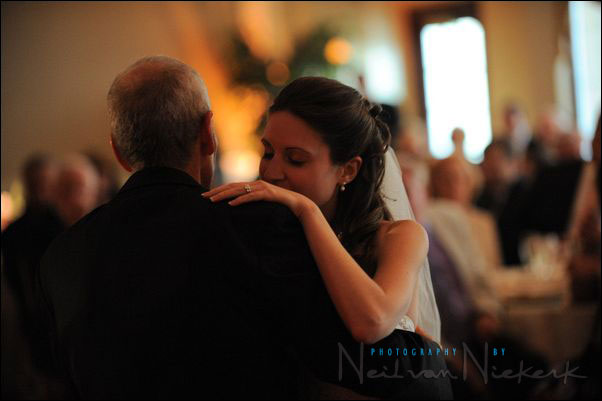
What do you do with an image that is under-exposed but there is a certain moment that you love?
Well, perhaps you get lucky that when you convert it to B&W and crank up the exposure and embrace the noise / digital grain … and all this adds to the mood and in this case even poignancy of the moment.
Here is the original unedited image of the bride dancing with her dad …
I was shooting a little too fast for my flash to keep up, and got the occasional under-exposed frame when the flash didn’t fire. As I often do, I try to keep the ambient light 2 stops or so under, and then use TTL flash to bring up the exposure on my subject.
Even though I did get lucky here, I did help it in my favor by how I position myself in relation to my subject and the background. I do try to place myself so that I can use some background light to give a sense of place, and help giving the image depth as well. Doing so helped here in creating a lighter background when I pulled up the exposure by 2 stops to give “correct exposure” on the image. With the background now blowing out, it gives an ethereal look to the image, which for me, enhances it.
For us gear-heads:
Nikon D3; 70-200mm f2.8 AF-S
1/60th @ f2.8 @ 2500 ISO
At such a high ISO, under-exposed by two stops .. the digital grain / noise will be there. But really, the noise? Does anyone even notice the noise here? Look at the photograph again … and feel it instead. The mood and the moment. It’s all there.
Neil,
Photo is magnificent! Just out of curiosity, were you using the Nikon SD-9 pack or maybe the Quantum Turbo SC with your flash? I know you’ve used both. Do you notice a difference between the two? Can you clip the Quantum to your belt?
Many thanks,
Diana
I agree, great image. Interestingly, if I’ve read your post right it sounds like you’ve gone from the background being ~2 stops under to being (at a guess) ~1 – 1.5 stops over. It would be interesting to see one of the shots where the flash did fire to compare the two effects.
Great shot – definite accidental keeper!
It seems that you use quite often the 70-200 f/2.8 AF-S. I had the opportunity to rent the lens for 3 days about two weeks ago. And I really felt in love with that lens (as far as one can love material ;-)). Funny enough to mention here, I had a stage shooting with very low light conditions and encountered about the same problem that some images were underexposed by a stop or two. And I came to the same solution to go black and white. It’s impressing how well b&w images can go away with fairly high ISO noise.
I think the only people that fret about noise are pixel peeping photographers – the rest of the world doesn’t notice or doesn’t care. I too would like to see the next frame where the flash did fire.
I find that the resort to B&W is also great when you’ve really OVER-exposed a photo, and can’t get much of it back even from a RAW format file. Using Aperture, you can recover highlights and save enough of the detail to make some really impressive photos.
For ppl like Mac Swift, I guess you haven’t considered making large prints to sizes like 24×36 and up. Dialing back the noise can make a BIG difference in perceived quality. The Noiseware plugin by Imagenomic has saved my butt any number of times for large prints, and small. Their Portraiture plugin can do amazing thing for model shoots, and if you actually want more grain, their RealGrain plugin can emulate just about every one of ppl’s fav. film types.
Neil, I know post-processing isn’t one of your favorite things. I, too, try to get it right straight from the camera, but I find the extra nudge you can get from these processes makes the world of difference when you want to save that perfect photo, or get artistic and take some to extremes.
Nice save, and the picture really works well in B&W. No, I didn’t notice the grain until you asked if I noticed the grain.
You can feel the moment and I think it works better in B&W. Who gives a crap about the noise. Your clients aren’t going to care and they are the ones with the check book. It’s a timeless shot and it would look beautiful printed and matted with a plain black frame. That’s just me.
Neil,
Nice B&W conversion!
Although, I have to agree with Andrew that I initially read “ambient light 2 stops under” as the background being 2 stops under (with the subject being even more underexposed). Is “ambient light exposure” always referring to the exposure of the subject?
Neil,
Do you dial down the -2stops on your camera or on flash? The exposure compensation button is not active when working in manual camera mode.
Neil…how do you get such good, directional light on the subject’s faces while bouncing? I am really trying to learn this technique, but when I bounce behind and to the side me it seems like more often than not the whole room lights up. Are you darkening the backgrounds down in post?
Hi Neil
Did you push the iso to 2500 to increase flash distance because of your chosen focal distance with the 70-200mm?
Hope that makes sense :-/
Leon
Sorry, I hope it’s not too silly a question to ask…
How do you determine ambient exposure is 2 stops under?
and am I right to assume that TTL flash will always try to correct the exposure?
Thank you,
Max
Neil,
Can I expect similar performance from a Nikon SD-9A as compared to the Quantum Turbo SC. I just read the comment above about the Turbo losing communication with the SB900..
I notiticed this as well on the last two weddings I did and I’m not sure I am OK with this. As a result I have given some consideration to the SD-9A, I’m just not sure how long the Nikon pack will last throughout the day..
Thanks,
Brian