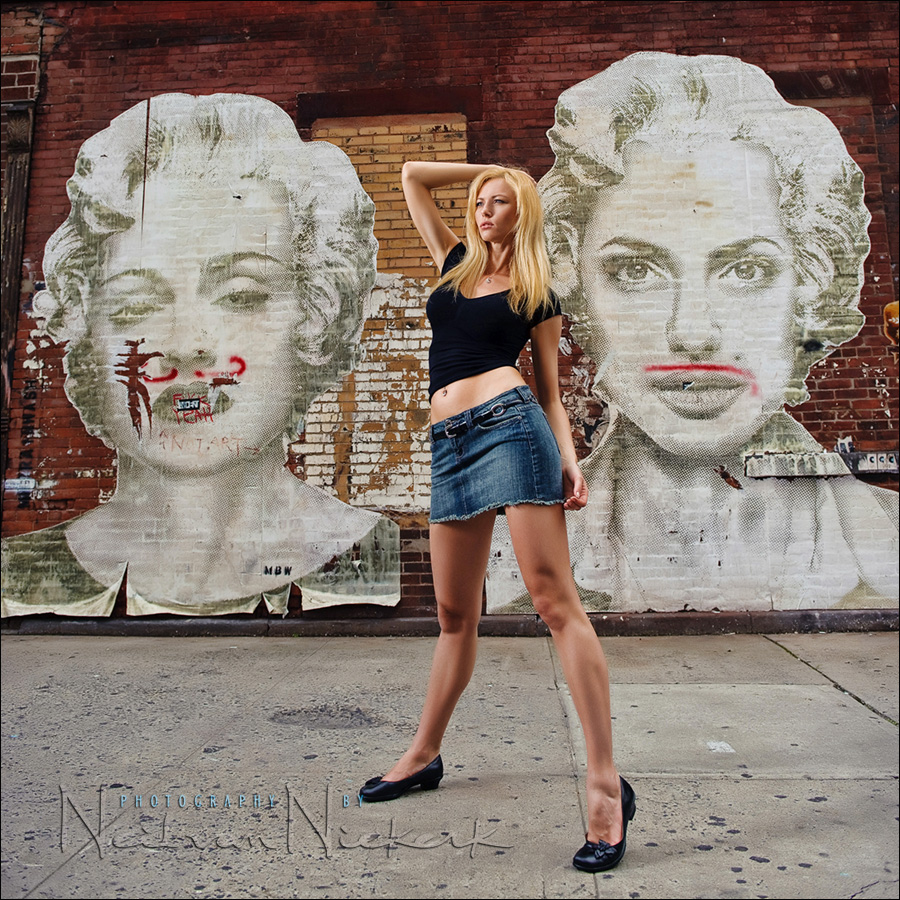
Syncing at higher than max flash sync speed
The model, Aleona, was lit with an off-camera Q-flash T5D-R, using Quantum’s wireless system, and a 24×32 softbox, mounted on a lightstand.
The settings were: 1/1000th @ f4 @ 200 ISO
It is noteworthy that this was shot at 1/1000th of a second with a Q-flash .. and they don’t support high-speed sync.
I never paid much attention to the physics and shape of the pulse of flash, or how the pulse of light is shaped, but after reading up on how the new PocketWizards work, I was curious .. and played around with the Q-flash. And to my surprise, I found I was able to shoot at much-higher-than-sync speed with the Q-flash when I am using it at full power. So I had to delve further into this.
Now, the usual short-hand description of the way the flash pulse is dissipated, is as a near-instantaneous burst of light. But the reality of it is that there is a specific rise time to the pulse, and also a specific way the light decays from the moment the flash is fired. This decay in the light pulse becomes slower for certain flashguns (mostly non-studio flashguns), as the flash is fired at higher power settings.
This becomes essential knowledge once you delve into the realm of action-stopping flash, but for most of us as wedding and portrait photographers, it is immaterial.
Here are a few test shots to show what happens at various shutter speeds with the T5D-R Q-flash either at full power or at 1/8th power, while going over the maximum flash sync speed of 1/250th for this camera. (Nikon D3)
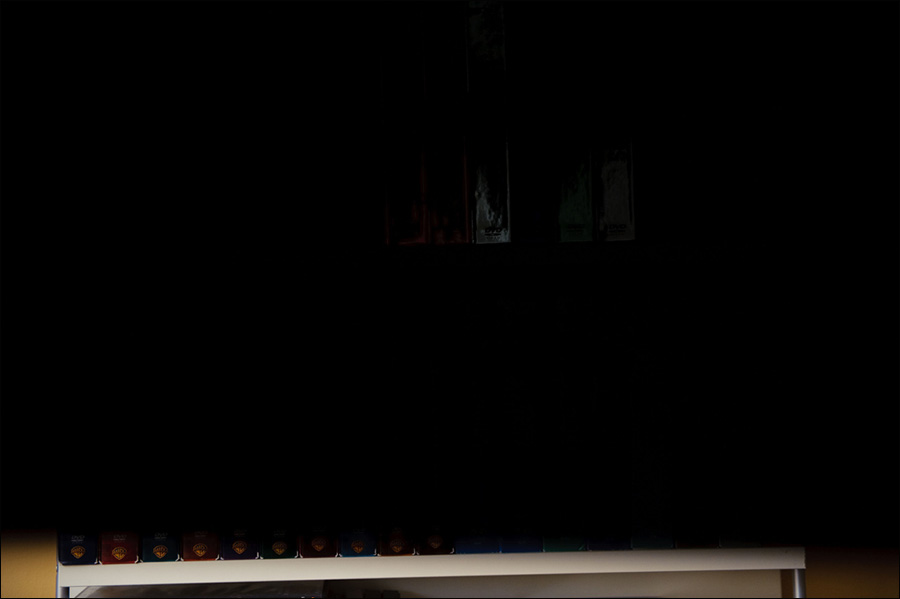
At 1/500th of a second at 1/8th power (@ f2.8), you get the expected nearly black frame as the one shutter curtain obscures the flash exposure:
But the moment I went to full power on the Q-flash while still at 1/500th, I got this:
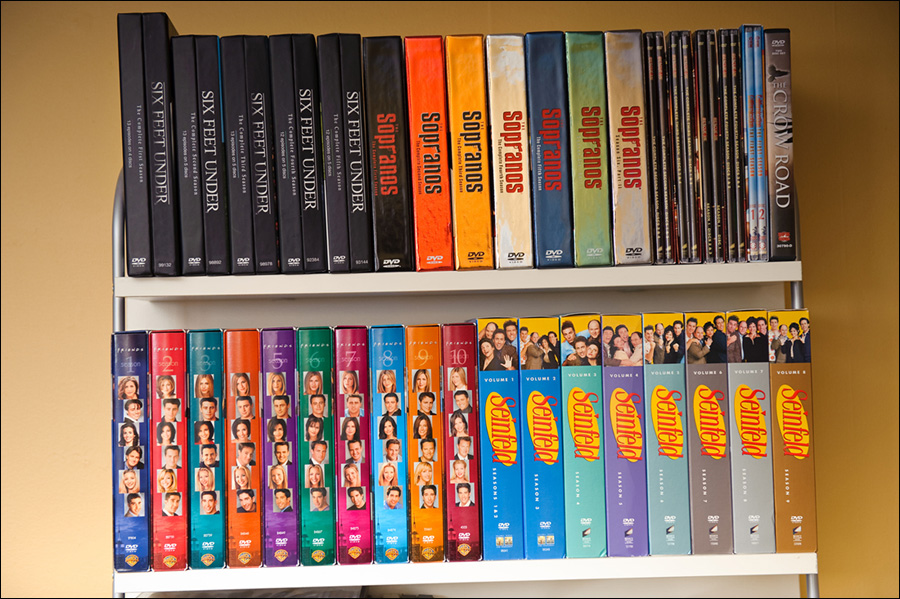
Flash exposure across the frame! But very uneven – the bottom part clearly has more light than the top half
Going up all the way to 1/1000th of a second:
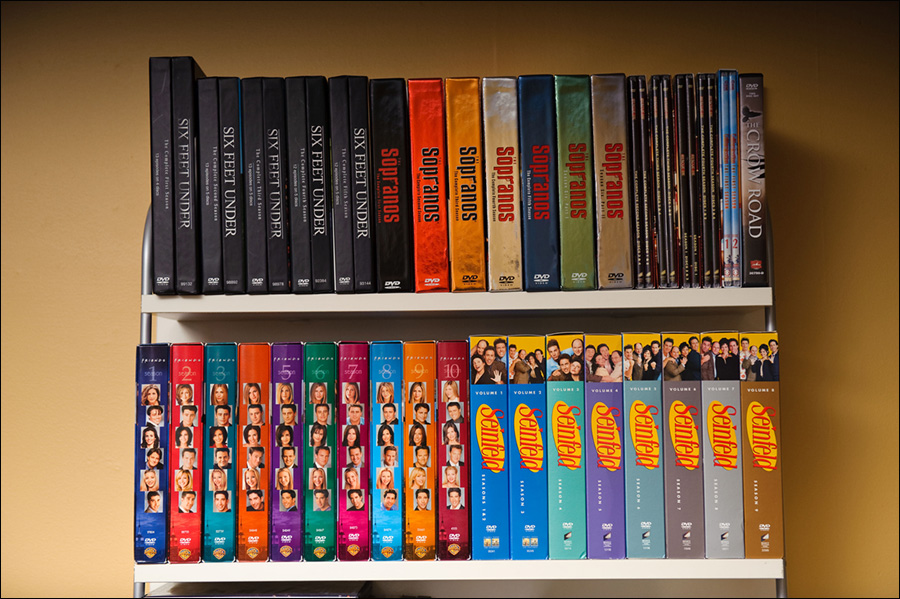
The flash exposure seems now a little more even across the frame, although there is a noticeable darkening of the image at the top.
In trying to figure out the physical reasons for this, I found these helpful webpages ..
http://www.scantips.com/speed2.html
http://www.flickr.com/groups/strobist/discuss/72157618877229864/
.. and here is what I surmise is happening:
(and I would love to hear corrections or fine-tunings of my understanding of this.)
Looking at the flash pulse duration,
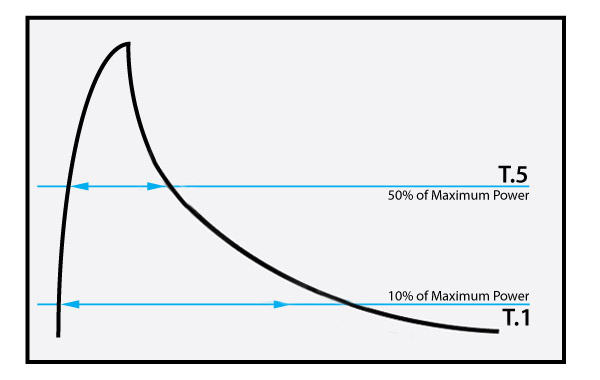
The flash duration is usually described in terms of how long it takes for 50% of the flash power to have been released .. this is the t.5 period. But that whole time there where the flash more slowly releases some of its juice, is measured as the period until only 10% of the power of the flashtube remains to be dissipated.
So here is how I’ve figured out what is happening with the Q-flash:
Checking with Quantum’s technical dept, they told me that the flash duration is as slow as 1/300th of a second at full power.
At 1/2 power it increases to 1/700th of a second, and at 1/4 power 1/1300th of a second. At 1/8th power, the flash duration is as short as 1/2400th of a second.
So while we remain below max sync speed, we get to see most of the flash exposure register on the frame. All is good, and life is how we understand it. The moment we go over max sync speed (at less than max power), then we see the shutter curtain. This still makes sense.
But once we hit full power, the flash duration is so long, that at a high shutter speed, we hit the back end of that pulse .. I surmise somewhere between the t.5 and t.1 time. This then means we get flash exposure across the frame … but since the flash power is declining as the shutter curtain moves across the frame, we get that uneven exposure.
And I suspect it is more noticeable at 1/500th, because then we’re probably hitting the flash pulse closer to the t.5 spot.
So there you have it … I was able to shoot at a much higher shutter speed with the non-HSS Q-flash .. simply because the flash duration is so slow at full power. Of course there is a huge loss in effective exposure .. but I was able to sort-of-sync at a shutter speed higher than max flash sync speed.
I don’t really see a practical application for this in terms of action freezing, because the difference between 1/250th and 1/300th is marginal. Where this might be used is if you need to use a shallow depth-of-field and can sacrifice the loss of power. In the photo above, I didn’t really need f4 and in a more serious shoot, I’d be in the region of 1/250th @ f8 and using less flash power for the same results. But I thought this was an interesting bit of exploration. It certainly helped my understanding of how flash works.
I would love to hear comments on this, and any corrections to my understanding of what is happening here.
Neil,
How are you triggering the Quantum specifically?
The trouble with this technique on most cameras is usually that the pc port doesn’t fire until the first curtain is fully open, which is too late, because the second curtain is already partly closed. The new pocket wizards get around this by sensing pre-flash communication, and allow you to adjust the timing. Another way is to set an on-camera flash to High Speed Sync, so that it will start firing before the first curtain opens, and use it to optically trigger the big flash.
These t.1 times vary widely by manufacturer, and many (most?) usually advertise their t.5 times (to be more impressive).
The typical speedlight fully charges the capacitor, and regulates power by cutting short the flash, so low power means very short flash pulse, useful for freezing hummingbirds etc.
The typical studio strobe does the opposite – for 1/4 power, it charges the capacitor to 1/4 . The lower voltage on the capacitor means that current takes longer to get flowing, so lower power means somewhat longer flash pulse – maybe not as pronouced an effect.
At least this is my limited understanding.
David Graham
David, I was hoping you’d reply. :)
From your comment in the max flash sync speed post, it looked like you had some knowledge of this.
I triggered the Q-flash with the Quantum FreeWire wireless system (FW9T, FW7Q, D22wR) … so that could very well have influenced the specific timing here, even if inadvertently.
Hi Neil , that all sounds pretty logical .
On a side note according to my calculations high fp mode on a SB800 drops the power to around 27% [ 2.7m as opposed to 1.4 m ] .
My D40 with its 1/500th synch speed and electronic shutter allows me to get the same distance throughout the range at 4m working distance with an SB24 . http://realsynch.blogspot.com/ .
At F4 1/3200th sec iso 200 it catches most of 1/4 power from my SB24 giving me the same working distance as an SB800 at normal synch speed – except for the fact that the 1/500th synch speed gives me 2.5 times the effective power as well -compared to 1/200th synch speed . This gives me close to 8X the power of an SB800 at 1/3200th sec [ 1.4m as opposed to 4m ] – in practice it is around 2.7 stops more power .
Of course that’s nothing to do with your tests and a focal plane shutter but high -fp mode is a continuous light that gives the same distance with equivalent aperture and shutter speed changes – maybe if they used a smaller flash bulb it would be a slower release for the same power output which would be useful for ‘trick modes’ as in your experiments . I suppose if there was a way to do it better they would have done it by now :) … perhaps if they made more electronically switched shutters it would be better for flash in sunlight .
Neil
i just test it out with canon 40d and t5d-r, i tried it with pc port direct connection or trigger by pocket wizard plus II. i got no luck to get pass 1/500 with full power of my quantum. maybe the freewire is the trick?
Ooopsss. Sorry, after reading a bit more and notice that I need to change my Vivitars. But looking at the prices it also seems i need to work more. I guess I will keep shooting and change to at least two SB900’s.
Thanks Neil
Cool this is all very interesting and new territory. Should lead to some great photography!
Regards
Brian Carey
Chuck Arlund posted an interesting article on his blog about using studio strobes at higher than max sync speed.
All, I just purchased a QFlash with the D adapter. My Nikon D3s was set to HSS. Playing around I attempted to overpower a very bright background using 1/1,500 shutter and f5.6. Much to my surprise it was able to balance the ambient and there was no black band at the bottom of the photo. That’s how I ended up here trying to to figure this out. As I suspected, it’s the result of the QFlash’s longer flash duration. Thanks!
The idosyncracy with this is that at faster shutterspeds you can actually get more benefit from your flash than you can using full x-sync. It may not be much more – maybe 2/3 stop @ 1/4000s – 1/8000s. The useful thing is that in bright situations, once you hit your max output and you have nowhere else to go, you might be able to squeeze a little bit extra power, or use a wider aperture, or benefit from a faster shutter speed, or even all those at the same time.
I posted some samples and a write up here: FP mode and HSS – exceeding flash sync with no loss in output. I think that the reason why the faster end shutter speeds benefit more over the 1/320s+ shutter speeds is that at this lower end the shutter duration is almost double that of the faster 1/8000s shutter speed end with the second shutter curtain being so far behind the first. Essentially, this means the 1/8000s shutter is using more of the peak output/greater brightness and tail than the 1/320s is and there is less of the decaying tail being used. Although 1/150s to 1/180s might be the ideal flash duration to match shutter duration in this respect, the 1/250s and 1/300s of the Quantums turn in pretty decent results, and afford this little bit extra at the top end as well.
Ian,
Great write-up on that link provided. I must explore the use of my Quantum with *HSS*.
I have the QFlash T5D-R, and the Quantum FW9T FreeXwire using the Quantum FW7Q FreeXwire Wireless Digital TTL Receiver on the T5D-R QFlash.
Now, although I have the FW9T mounted under the Nikon D3, but using the Sync Cord from my camera’s sync socket into the ‘Sync In’ on the FW9T instead of the D22wR QTTL adapter, can I still be able to utilise the HSS say at 1/2000th with QFlash set in Manual Mode at Full Power?
In the write up you stated: “This was with a D3x, 24-70 f2.8 @100ISO using a FreeXwire transmitter and D22-wr adapter on camera, nothing else. The same can be achieved without the D adapter but using a speedlight in it’s place instead.”
What do you mean by that exactly and how do you use a speedlite in conjunction with the QFlash. Using a sync cord from speedlite to FW9T?
I do have the D adapter but for a Canon, which I could use, but wanted to use this HSS theory on a Nikon D3s and QFlash.
Judging by the sample shots you showed I am verrry impressed with the 1/1000th f6.3 up to the 1/4000th f2.8 range.
The exposure table you provided is a great little cheat card, printed out and shall keep in bag. :)
I presume you were manual full power on the Quantum X5d-R you were using.
If I can get something similar with the 160Ws QF T5D-Rs then I would be happy.
Great explanation once again.
Trev.
Hi Trev,
The cheat sheet is Pocket Wizard specific and was based on my results, so yours might be a little different.
There’s very little discernable difference between the X5d-R and T5d-R results. Using a speedlight on your hotshoe will just trick the camera into advancing the sync point and you just plug a transmitter into the speedlight or into your camera’s PC sync. On Nikon, both are advanced for FP mode sync when higher shutterspeeds are used. With the Quantum D adapter the camera just ‘thinks’ it has a FP mode flash fitted and advances the sync point accordingly. Canon might be different.
Rather than taking up Neil’s message board, if you post your question on my blog I’ll show how I fit the FW9T and various flashes all at the same time. Managing all the equipment and cables and be adaptable at the same time can be a right chore.
I’m glad you found it useful.
Hi Ian,
Excellent, thanks. I have just finished reading a lot of your posts on your site less than 2 minutes ago. :)
Trev
I did a commercial job recently where I shot a lady cooking food over a table on a beach at sunset. I used fill through a shoot through brolly via a 580EX11 fired by my Skyport. My settings were ISO400, f4 at 1/320. I achieved well lit results and was about to sip my tea with the relief that follows a job well done when it occurred to me that this should have been a complete disaster-why on earth didn’t the second curtain ruin my images?
I was on Manual-probably 1/16 power and no HSS.
I posted this issue in the EOS Magazine Forum run over here in the UK and a reply has suggested that as the light was used as fill only, it is not affected by the second curtain, whereas it would have been had the subject ben lit principally by the flash, as per Neil’s results above in the studio set up which is ambient free.
I don’t know if this clears it up-i’m not convinced, but like any keen photographer/pro, when I don’t understand something about the technical side, I worry it will undermine my creative side because whilst it went well for me on my recent shoot, on the next one….
Neil, anyone, is there any chance we can get to the bottom of this issue-it’s like defying the laws of gravity to say a flash can properly illuminate a subject when fired with shutter speeds beyond the camera’s theoretical synch speed! And it’s driving me nuts now…
@Alex Hare: can you show the image in question, with the EXIF included? Perhaps via mail? (kontakt at fotopraxis dot net). I would suggest, that 1/320 is still almost ok … it depends on your camera and on your shutter and with the 5D Mk II afai remember, at 1/320, the effect is only a dark bar of approx 1/4 image width.
This, combined with the fact, that you shot outdoors and that you included ambient light in your image (what brightens up the dark bar) could deliver well-exposed images.
—
As you were shooting at 1/16 power, this cannot have anything to do with the supersync trick Neil described above. I tried this trick with speedlites and it works (sort-of), but only with powerful flashes at full power.
all the best, Tilo
Well explained Neil.
I was struggling to use my two Canon 600rt flashes on high speed sync in bright sun because they need to be within around 6ft on full power. Kept one of my 5tdr anyway and just upgraded the freexwire transmitter to co-pilot.
I have now got full exp at1/5000sec on 5d mkiii. Thank god.
Your explanation of the difference between camera flashes and studio flashes was clear too.
I remember using Vivitar 283 flashes back in late 70s as the first ones to use a thyristor circuit to ‘cut off’ the flash to a smaller power with the plug in auto sensor.
Thanks.
Dave
It is not working for me :-(
I have QflashT5D-R with FreeXWire FW7Q. Canon 5D MKlll and FreeXWire FW9T with FW 12 and it does not work higher than 200. Higher than that it is getting dark with a little curtain of light.
It only worked for me at full power, if I remember correctly.
Hmmm I tried again. The flash is set to Man. 1/1, and still the same dark result .
Kim.