
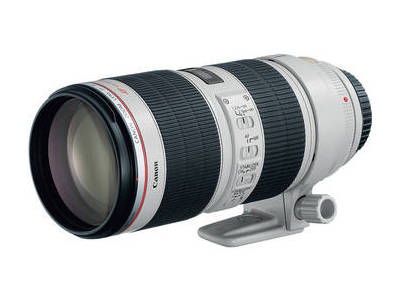
review: Canon 70-200mm f/2.8L IS II USM
The Canon 70-200mm f2.8L IS II (B&H / Amazon), is touted to have improved optical quality, faster auto-focusing, and much better stabilization than the much-loved previous version of this lens. Using the lens on different shoots and walkabouts and tests, I got a fair idea of how the lens performs. In short, the lens is all that .. faster, sharper and with better image stabilization. Noticeably so.
The bokeh of this lens is pleasant. Easily seen in this portrait of my little model, where she is busy collecting feathers. The image above was shot at f3.2 (And to go off-topic for a moment: shallow depth-of-field is not the same as bokeh.) Anyway, this lens has fairly pleasant bokeh. Other lenses might render the background even smoother, but the bokeh in this image above isn’t harsh and intrusive.
My main disappointment with the lens is that it looks so much like the previous version. The focusing grip is slightly different, and the lens is a touch longer by a few millimeters. They are quite hard to tell apart. The disappointment would come in that no one would really know you had just spent a small truck-load of money on a new lens. Unless they bothered to read the numerals on the front lens barrel. At least Nikon had the courtesy to make their new lens look substantially different. Easier to swagger with the new gear. ;)
But the Canon 70-200mm f2.8L IS II (B&H / Amazon), is definitely a good-looking chunk of glass!
The lens, even on a classic Canon 5D, follows focus fairly easily on a moving subject.
I had enough frames in focus to be happy with the results.
1/500 @ f2.8 @ 500 ISO .. with the lens zoomed to 200mm
As you can seee, the bokeh isn’t entirely smooth if you look at the way the branches were rendered.

My personal opinion is that lenses in the range of the Canon 70-200mm f2.8L IS II (affiliate) is ideal for portrait photo sessions. Flexible, and with a wide enough aperture to render the background without distracting detail. Of course, that depends on your composition too.

Available light in the cafe; 1/50 @ f2.8 @ 400 ISO .. with the lens zoomed to 125mm
As you can see, the image is crisp even at such a slow shutter speed.
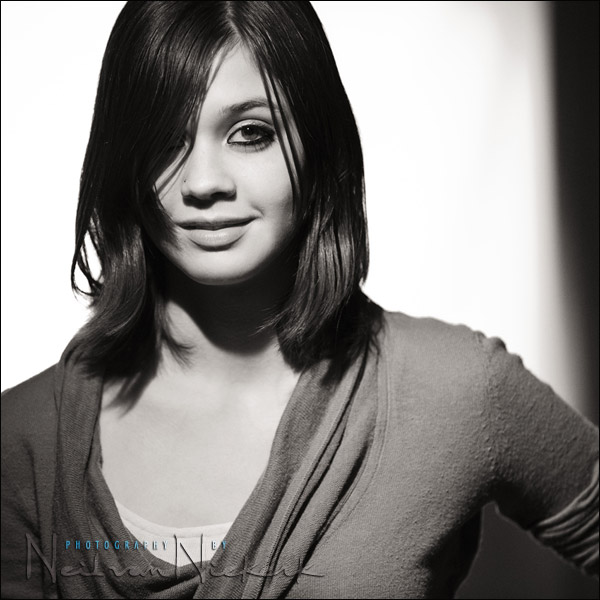
Video light; 1/200 @ f2.8 @ 800 ISO .. with the lens zoomed to 110 mm
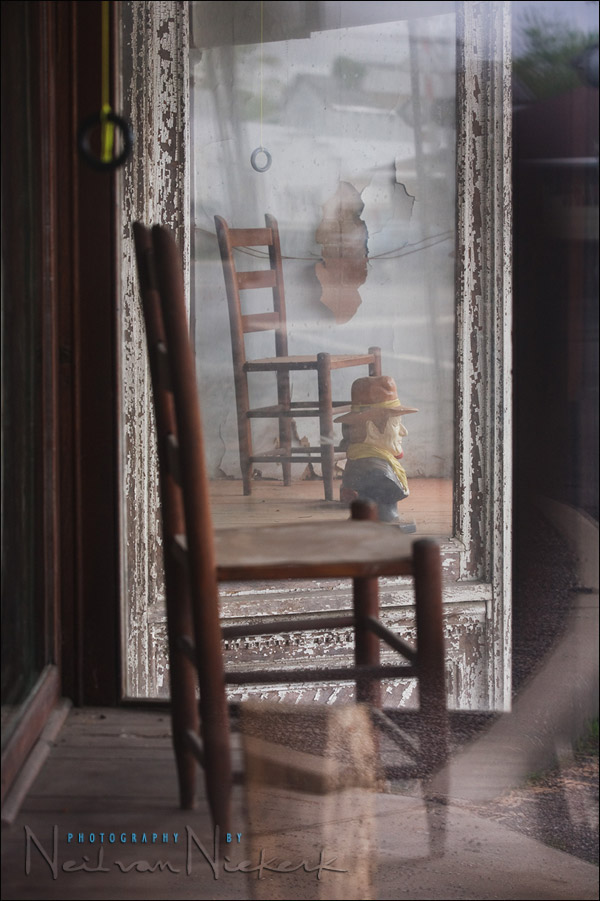
I roamed around Birdseye, IN, one afternoon, photographing interesting details in some of the unoccupied buildings. Again, the range of this type of zoom is perfect for picking out details, or zooming wider to encompass more of the scene. This found collage appealed to me – random decaying items within multiple frames, and a bust of John Wayne.
1/100 @ f5.6 @ 400 ISO .. with the lens zoomed to 90 mm
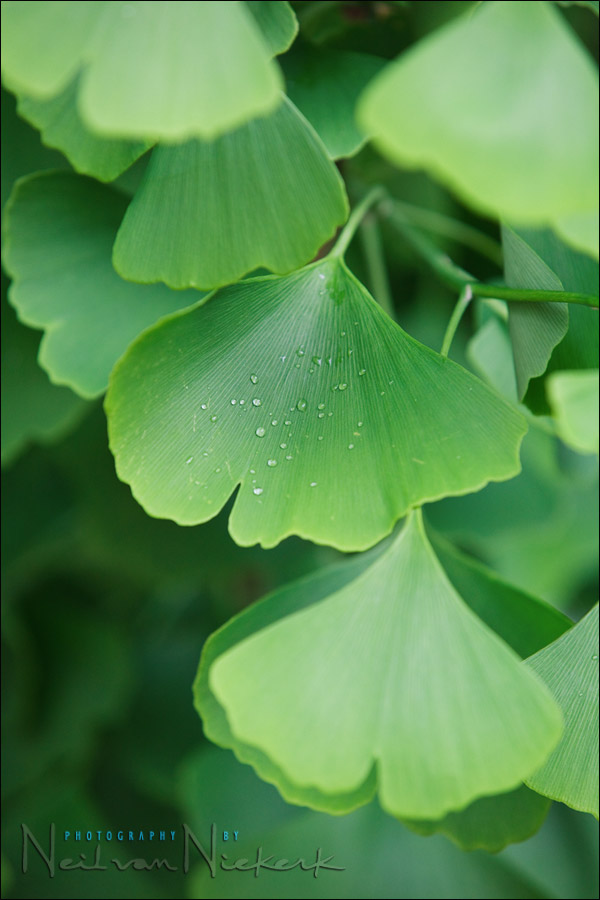
The minimum focusing distance of the mk II lens has been every so slightly improved.
It now focuses as close as 3.94′ (compared to the previous 4.6′)
Zoomed to 200mm, you can get surprisingly tight images.
1/160 @ f5.0 @ 400 ISO
This photo below shows but a small section of the astonishing decor and architecture of the West Baden Springs Hotel at French Lick, IN. This is part of the vast central dome in the hotel. And the colors gradually change! (Click on the photo for a larger version of the image.)
1/50th @ f4 @ 800 ISO … with the lens zoomed to 200mm.
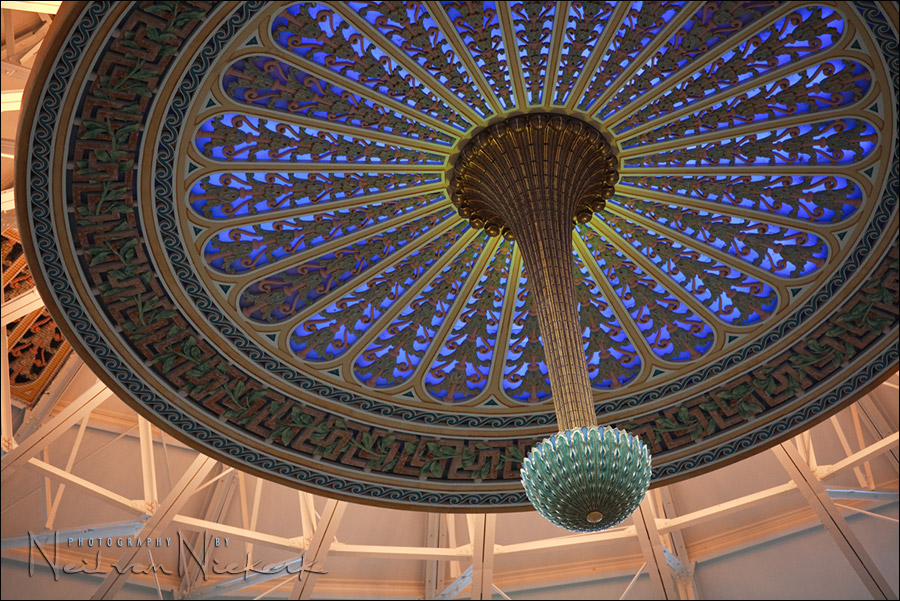
The one big feature of this newer version of the lens, is the improved Image Stabilization. Here I shot hand-held at 1/50 @ 200mm .. and the majority of my images were crisp. Quite impressive. The Image Stabilization is definitely more aggressive than the mk 1 version of this lens.
I then decided to push it even more. Here’s a test shot of part of the hotel facade inside, but shot handheld at 1/5 @ f2.8 @ 1000 ISO
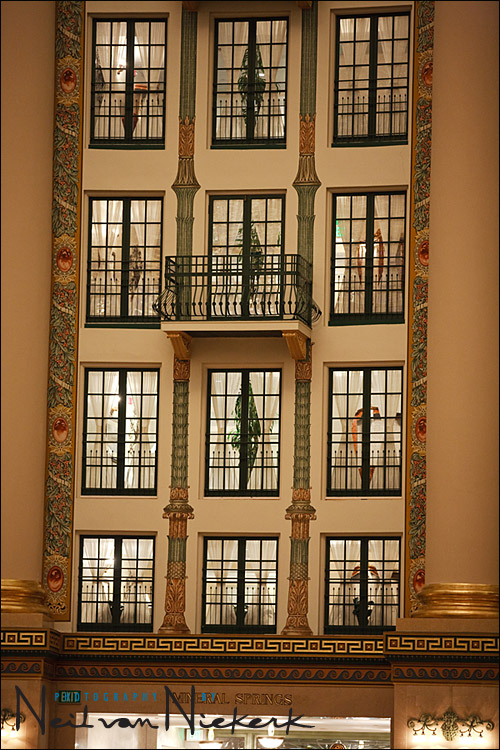
.. and here is a 100% crop of a central portion of the image:
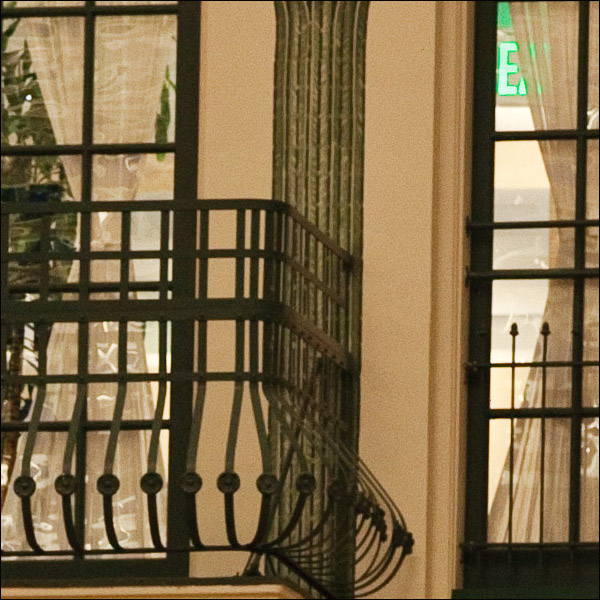
Truly impressive for 1/5 of a second hand-held! About half the images I shot were this sharp. Keep in mind that we’re dealing with the lens wide-open, so the optical quality isn’t at the peak either. On top of this, I shot at 1000 ISO which is starting to push it a little on the classic Canon 5D. Even then, this might be a good illustration of the sharpness you could expect in low light at very slow shutter speeds, hand-held with this lens. This improvement alone makes this lens a strong contender for an immediate upgrade.
Finally, let’s look at how the optical performance of this lens has been improved.
By the way, at f2.8 there is vignetting, as you can see from this cropped screengrab of 2 images next to each other as displayed in Adobe Bridge. (The two images were direct-from-camera JPGs.)
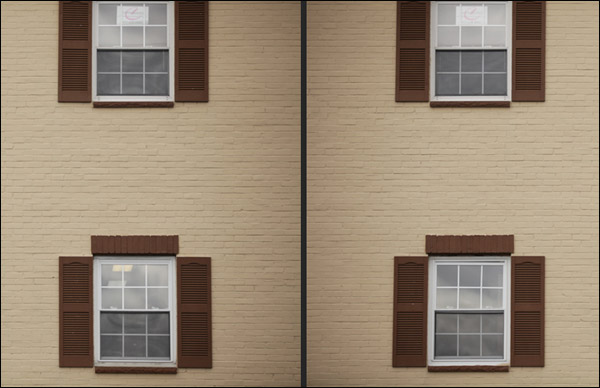
This is typical for zoom lenses used wide open, and wouldn’t concern me. In fact, I often add even more vignetting to portraits.
For the lens sharpness test, and to compare the mk 1 and mk 2 versions, I photographed the side of this building. I could then look at how the detail in the shutters and windows were shown.
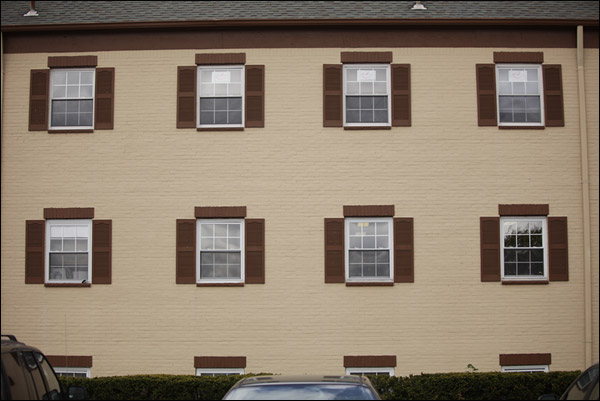
This is at 70mm, and you can see there is a fair amount of barrel distortion.
At various focal lengths, the mk2 version was sharper than the mk1. As it would hopefully be.
Here are two examples, all from in-camera JPGs with sharpening set to minimum.
A: from this framing ..
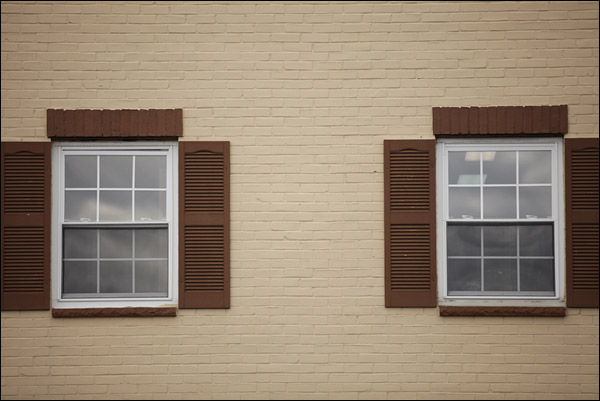
A: 100% crop of the left hand side: Canon 70-200mm f2.8 mk 1
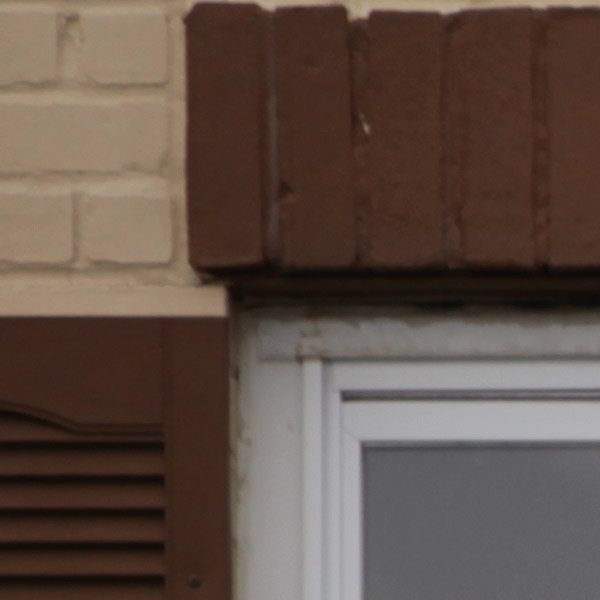
A: 100% crop of the left hand side: Canon 70-200mm f2.8 mk 2
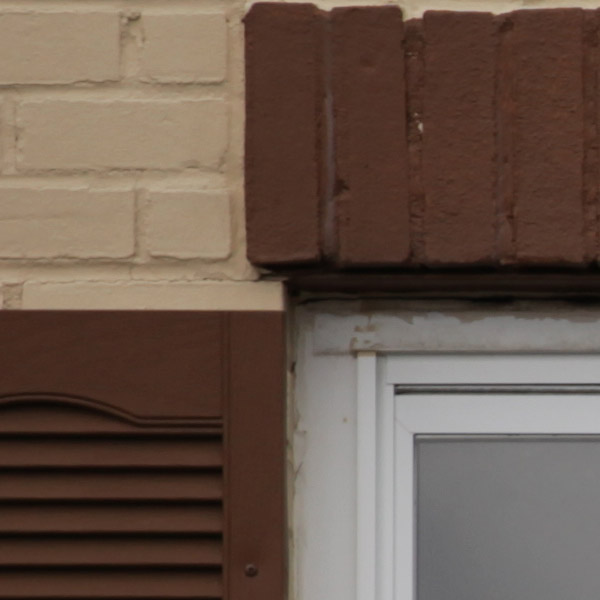
.
B: from this framing ..
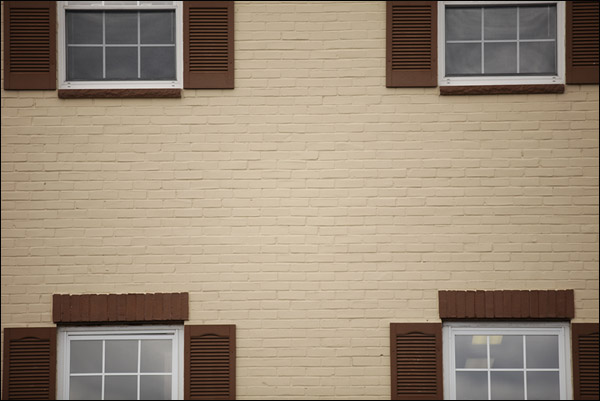
B: 100% crop towards the bottom left hand side: Canon 70-200mm f2.8 mk 1
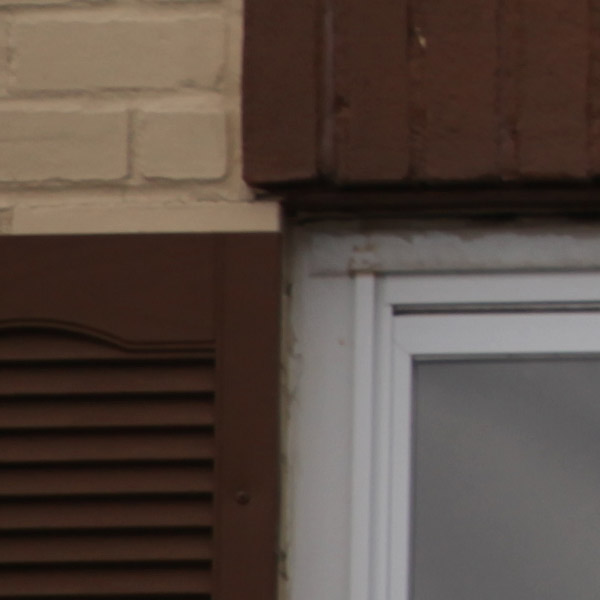
B: 100% crop of the left hand side: Canon 70-200mm f2.8 mk 2
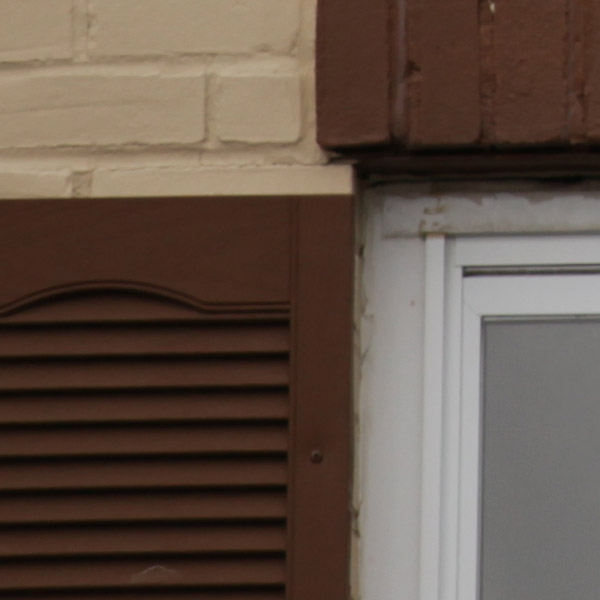
In both those comparisons, you can see that the newer lens has a sharper image with better contrast at f2.8
Overall assessment of the Canon 70-200mm f2.8L IS II
The lens clearly shows improvement over the previous version of the IS lens;
– improved sharpness when used at wide apertures,
– image stabilization is quite impressive now,
– autofocus is faster.
While these might seem like incremental improvements, for some photographers these changes will add up to make this lens an obvious upgrade. For other photographers, the mk1 version will remain their workhorse lens. For photographers that are working in low light, and would need the improved sharpness and contrast at wide apertures, and would need the more aggressive stabilization, the Canon 70-200mm f2.8L IS II will be a compelling lens.
If you would like to buy this lens, it is available via these affiliate links:
Canon 70-200mm f2.8L IS II (B&H / Amazon)
Reviews of other Canon gear
- Other Canon photo gear that I’ve reviewed.
Thank you for posting this Neil. Very insightful.
Hi Neil,
As you compare this new Canon lens with Nikon 70-200 VR2 for sharpness, bokeh, image stabilization and weight?
Thanks again,
Alfredo.
Hi Neil
Most of the time I agree with you when it comes to gear and photography, but this time I cannot… IMO these lens is really bad, and 100% not worth that huge amout of money. Maybe you call this nice bokeh, but IMO it looks horrible, like from mirror tele lens. AF is faster, but the image quality is way way lower than it should be in such expensive lens. My opinion – 2/10 for this lens, no more… I used it for a month or so, and I’m very, very happy I sold it…
Neil, what was the lightning on the first two shots (the girl on the meadow)? I guess there’s some flash, but given that she must’ve been moving all the time, I wonder how you’d kept up with her. Or is it just available light after all?
The first two photographs (of the little girl), are shot with only available light.
Thanks for the review Neil, I thinking about buying this lens!
Brian
Also the difference in flare is huge, I’m totally impressed with the new version and feel it’s one of the best upgrades for Canon in a long time.
As soon as I heard u mention being impressed with this lens I got the new one ( sold the older one for the same price I bought it for, talk about holding your value). I shoot for Susan g Komen – race for the cure every year and got to test it out there (pictures posted on the blog – all natural light, all handheld and for 5 hrs straight- didn’t even bring another lens). My verdict is, your dead on in everything you said above! I love the lens and don’t regret it for a minute. Can’t wait to use it for my kids wake boarding pictures as soon as it gets a little warmer.
Thanks for the detailed and insightful review. I have a couple of questions for you though. Since you also have an 85L which lens will be your primary portrait lens? What conditions would you use the 70-200II over the 85L and vice versa? Thanks for sharing your experiance!!
Neil – great review. Thanks for doing this.
Rich
Thanks Neil, your reviews are so helpful!!!
Well Neil, normally I always look forward to your articles. But now, a review like this is just plain mean. You leave me a tough decision of whether to upgrade or continue squandering my money on useless things like rent and food for the family…
Hi,
I’m just wondering if I would get a ‘similar’ Bokeh using a 50mm lens at f1.8? or this type of Bokeh is only possible with tele lenses!
I’m not familiar with the Canon 50mm f1.8 so can’t comment on its bokeh. The 50mm f1.4 has harsh bokeh.
Even this lens’ bokeh could be softer. So bokeh doesn’t really have much to do with the focal length, as far as I know .. but rather the optical design of the lens. (Amongst other things.)
For shallow depth of field where the background just melts away and the subject pops out, you need a wide aperture. And the longer your lens, the more obvious the separation between subject and background.
great write-up….still don’t know if it’s worth paying almost double what the MkI version retails for though. Decisions, decisions…..
Neil,
A hard question… (that too many people say to not ask).
With what equipment whoul you prefer: Cannon 5D + 70-200mm or Nikon D3x + 70-200mm
?
I know, its the old fight Cannon vs Nikon, but… the question is this.
Best Regards,
And continue with your incredible site. We from Brazil love your publications.
Nice image Neil but can’t agree with you on the Bokeh. Just OK at best. Not even close to what the Nikkor 70-200VR produces.
I discovered your website, fantastic …
much information and nice image.
I bought your book. it’s very interesting.
thank you for sharing your experience.
guillaume
France
Hi Neil and Co.
Thanks for i nice blog.
I pre orderd the 70-200 mkII and have used i quite a lot. Im very happy with it. I’s much better than the previour version especially the micro contast has improved a lot.
It is my impession thoug that the new version of the lens has a more hash bokeh.
I have used the 70-200 is mk I for several yers but ende up exchanging it for the 70-200 4L IS before the new lens was released so I have not had the chance to compare the two.
I had a Sigma 70-200 but found myself not using it much because it didn’t have IS but when the 70-200 f2.8 IS Mk2 came out I jumped on it and it works out real well. Glad to see its better than the old version.
Is there a big difference between the Sigma 70-200mm with Is and Canon with the same characteristics.? Sigma is much cheaper then Canon.
Hi there Beatriz – I don’t have any experience with the Sigma, so unfortunately can’t offer you useful advice here.