Photography: Finding the light
I’ve been so inspired by the various photographers at seminars and magazine articles, telling everyone to just look for the light and to find the light.
So many photographers just use available light, and make the rest of us who aren’t blessed with perfect light like they have in la-la-land, feel so inadequate. It is our failing as photographers if we can’t find the light and use it properly. I felt I had to rise up to this and push myself as a photographer, and just look for the light. It is there to be found!
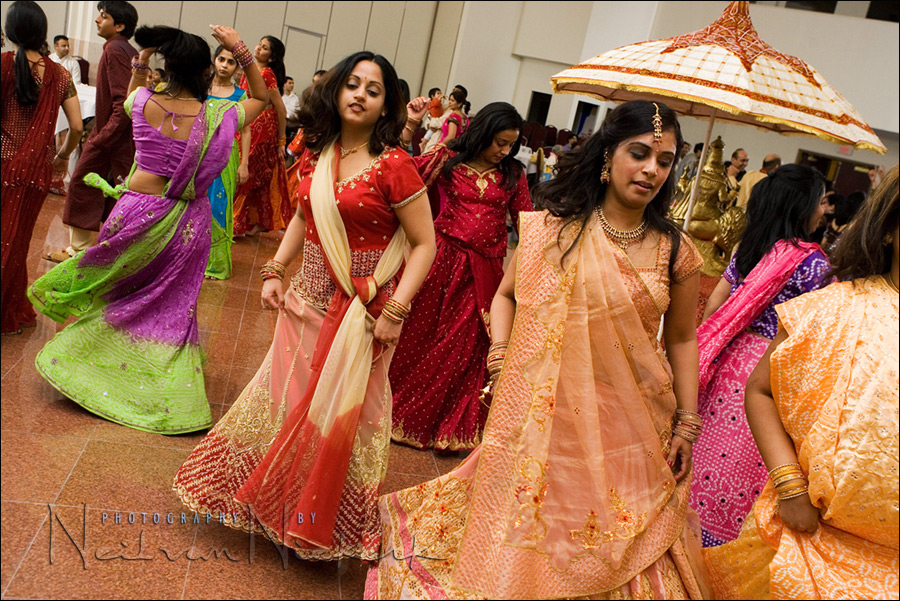
Inspired like that, I approached this very colorful Hindu wedding (April 2006), with a fresh mindset …
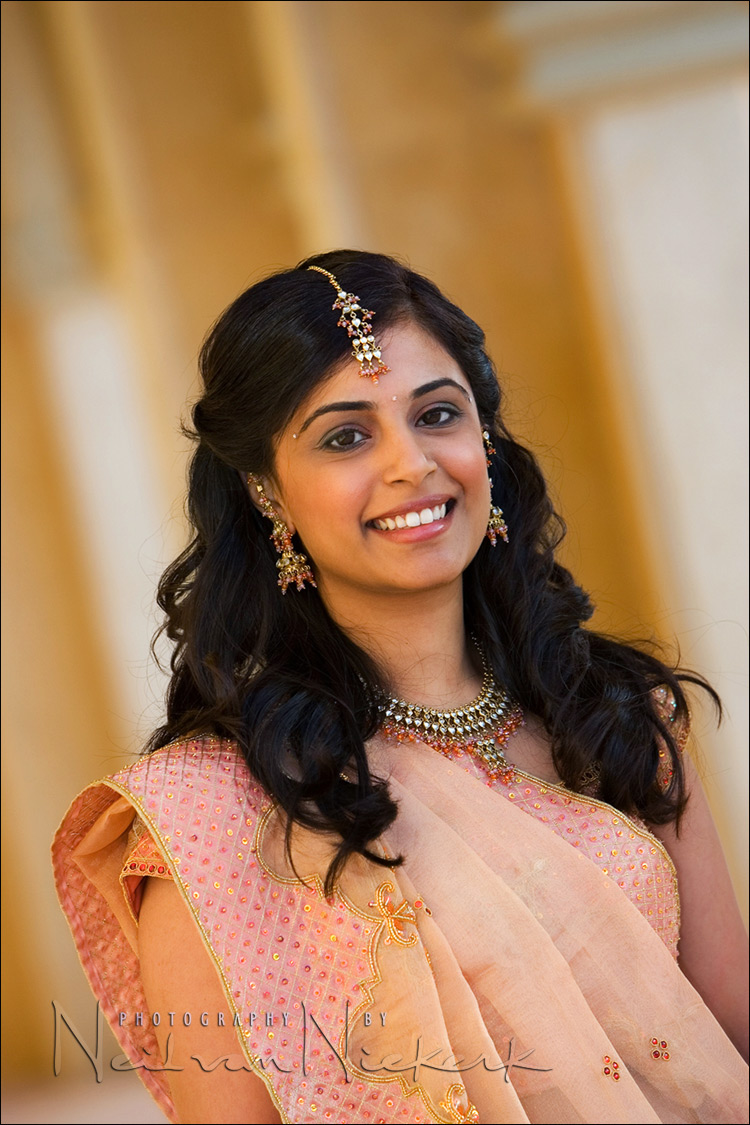
Photographing portraits of the couple and family members were done outside the temple. The temple the late afternoon light was incredibly harsh, so for the portraits, I moved the bride (and others) into the open shade between the pillars in the front. The strong vertical lines behind them helped to make the simple portraits more striking.
Well, I was happy at this point. I was able to get lovely portraits using the light and the setting … but walking inside of the room where the guests were going to dance, my heart sank.
The ceiling was high, with only fluorescent lights, which meant the light was top-heavy and dim.
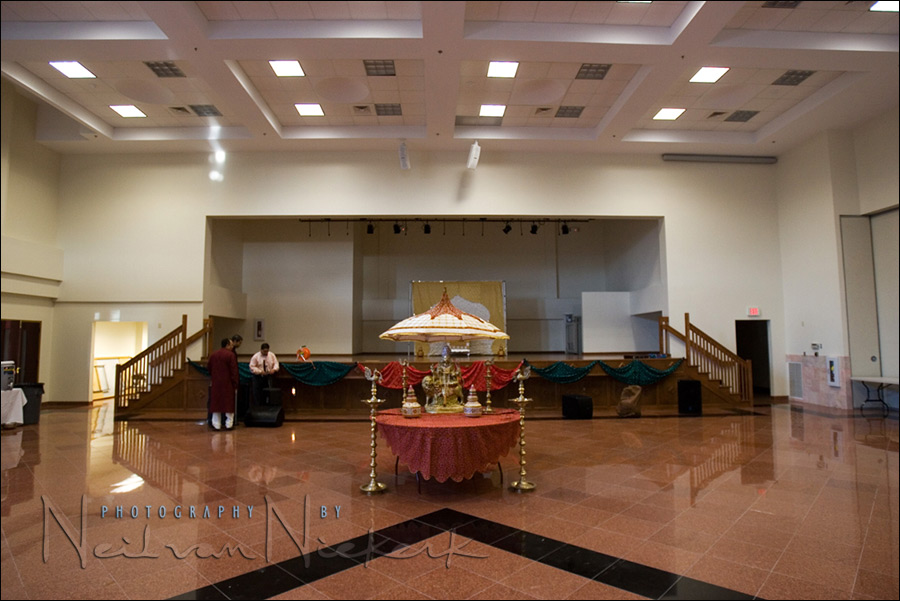
Light levels were low – 1/60th @ f2.8 @ 1600 iso.
Hmmm .. just not enough to stop action. And the client wouldn’t be too happy with hundreds of impressionistic color smears for photographs.
But .. I just had to look for the light.
Nevermind that this is a dimly-lit New Jersey room, and not a brightly lit la-la-land venue.
This would be MY failing for not looking for the light,
and finding the light,
and finally .. getting to USE the light.
I scoured the place … and .. sure enough .. there it was .. light!
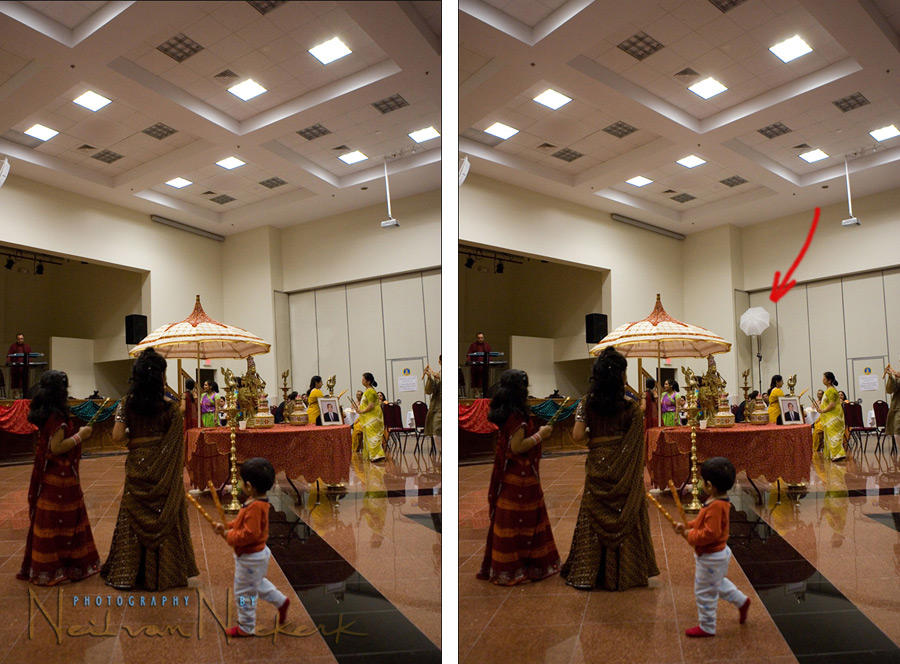
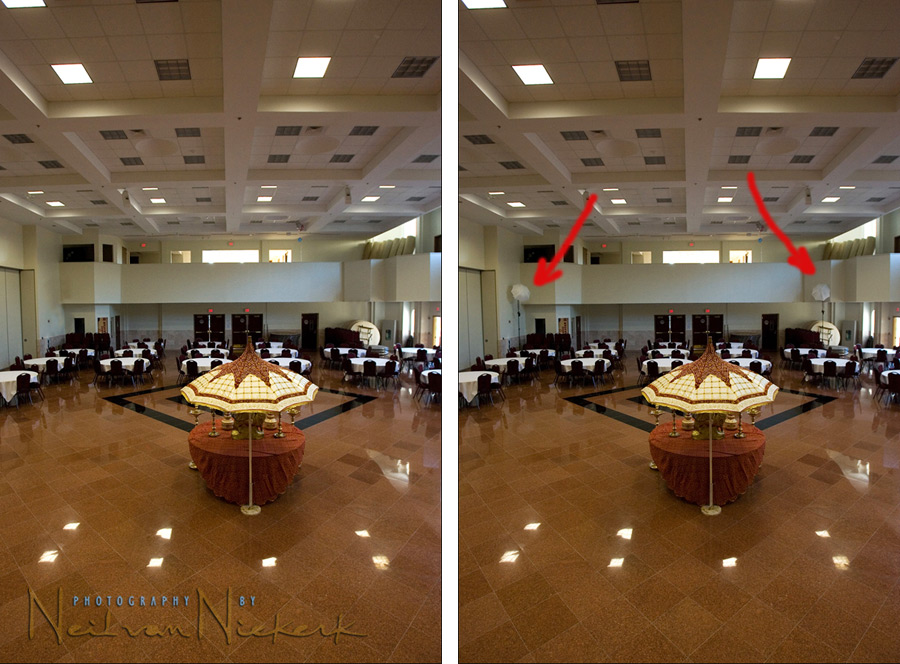
But .. was it available light?
I looked around .. and sure.\, no one else was using it.
It was available! I could use the light!
I saw it and found it, and now I could use it! 
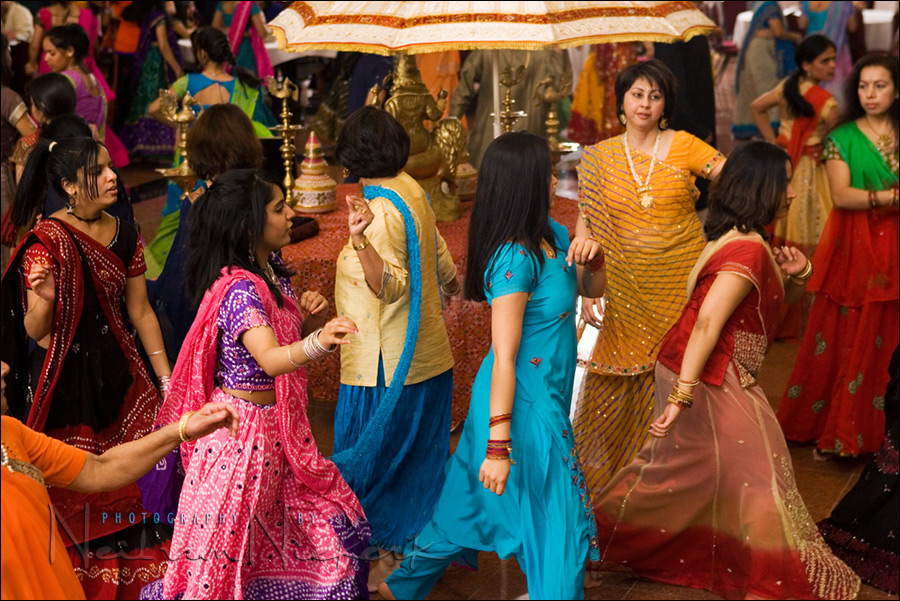
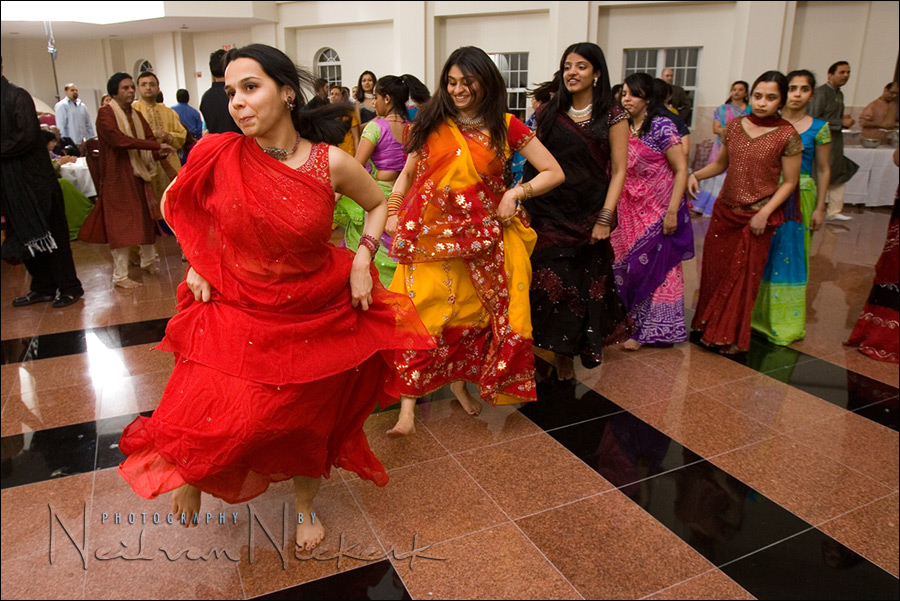
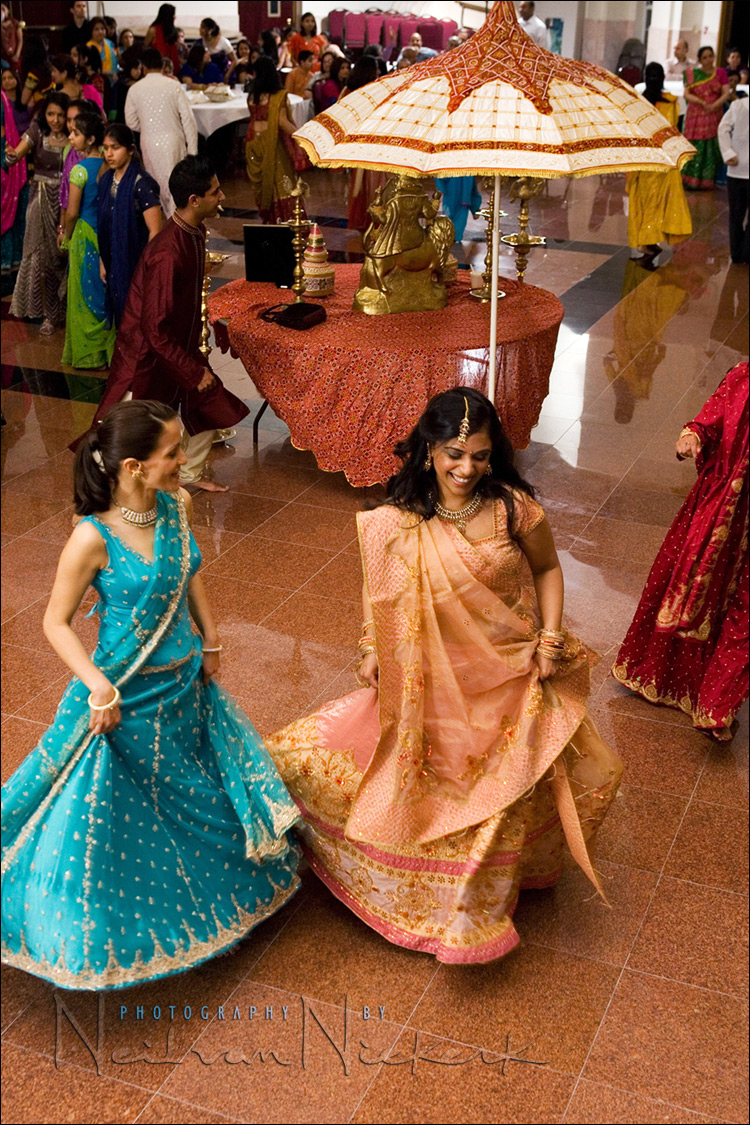
And boy! Am I impressed! Just look at the light! Look at the colors pop!
People were dancing around me, and I could stop the action if I chose to, and have faces recognizable. The bride would be able to recognize herself and her friends and family.
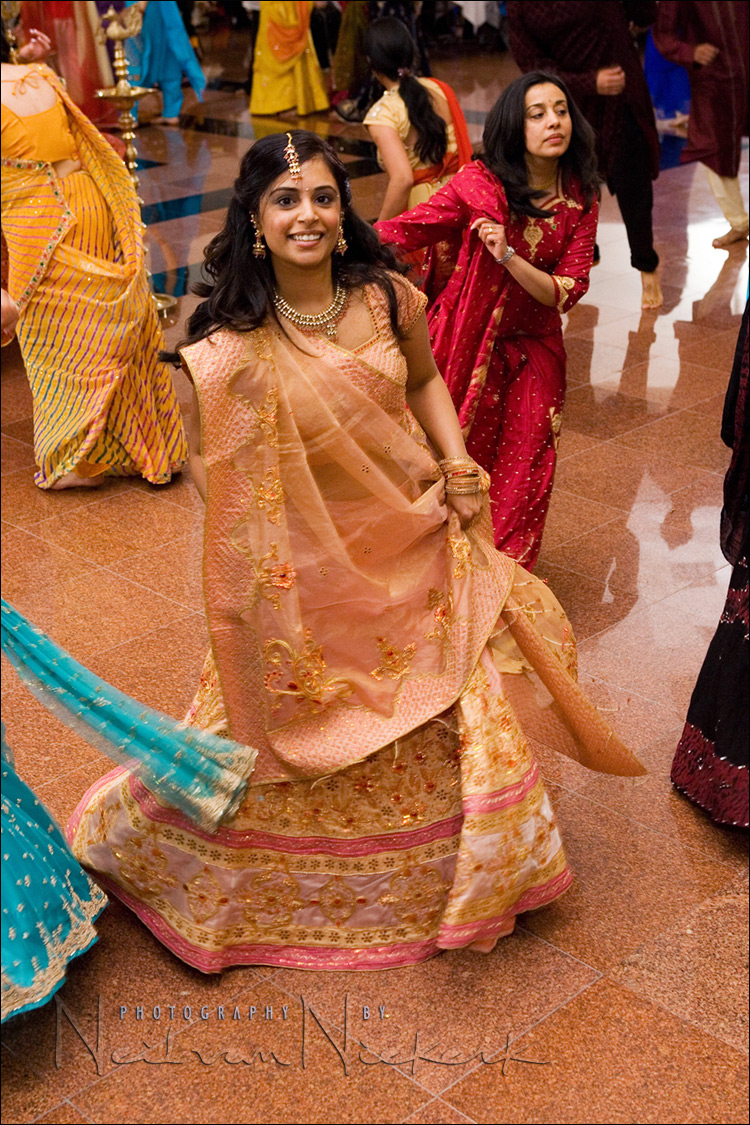
Finally
So, a genuine thank you to everyone here who inspired me so to rise above my own inadequacies as a photographer, and just frikkin LOOK for the light. 
Thank you, thank you, thank you.
Technical info:
The additional strobes that I put up in the corners of the room, were Quantum T2 strobes. They were powered by Quantum 2×2 batteries, and triggered by Quantum 4i radio slaves. The stands are Red-Wing stands. These strobes were run in manual mode, and at 2/3rd stops down from full output, to ensure consistency in exposures in faster sequences of shots.
I also used an on-camera flash which was turned around and slightly bent backwards, with a Stofen with the top cut open. This meant that most of the light from my on-camera strobe was thrown upwards and slightly back .. but because of the Stofen, enough light spilled forward, to ensure there were no raccoon eyes, and that the lighting was as even as I could make it under the circumstances.
Exposure info .. all shots at 1/125th, and 800 iso.
The aperture varied between f4 and f5.0
The on-camera flash was in TTL mode, and bounced behind me. The FEC varied from +0.3 to -1.0 EV, as needed.
Related articles
- More articles on using Off-Camera Flash
- Tutorials on Wedding Photography
The origin of this article
This was first posted in April ’06 on the Digital Wedding Forum, as a tongue-in-cheek reaction – or caustic response then, if you will – against the numerous articles and seminars where we photographers are urged to “just look for the light”.
What triggered me to write this article in the first place, was that there seems to be a trend where use of flash is disdained in favor of only using available light. As if it is always that simple.
This article was also published in the Sept 2006 issue of Rangefinder magazine.
So freakin’ funny. Love it! Thank you.
CA
Very well done. The strobes provide pleasant soft ambient light, even with this difficult, highly reflective floor.
Wow, you solved that problem just perfect. But I’m wondering how these strobes where strong enough to give you enough light, considering the large room? Or are the pictures you show mainly lit by the on-camera flash?
Serge … it varied, depending on which direction I was shooting in.
My comment about the flash exposure compensation will give you an idea:
The on-camera flash exposure was varied from +0.3 to -1.0 EV.
Sometimes the on-camera flash added the majority of light to the subject, and the off-camera lights lit up the background … and at other times, the on-camera flash was acting more like a fill-light.
As I said, it varied. It wasn’t a static situation, so I had to work the controls a bit. :)
Neil,
Thank you for a good laugh first thing in the morning!!!!!!
Your work is inspirational..
Brian
Great work ! Outstanding. Very inspirational. Very innovative.
I’m wondering what the attendees thought of the strobes going off while they were dancing, every time you took a shot. Did they find it disrupting ? The whole room got lit up, right ? Did they complain ?
Thanks for sharing this.
The general lighting in the room wasn’t as dim as reception rooms generally get. The lights were never dimmed from the settings I gave there.
Also, the Q-flashes were quite high up … 12′ or so.
And the light was dispersed upwards and out.
So really, the light from these flashguns were much less bothersome than the direct flashes from the point-and-shoot cameras that guests were holding. And since the light wasn’t concentrated, and were brief bursts of light, they weren’t a bother at all, imho.
Neil,
This is great – I liked the terminator look, so have managed to fit my camera with all sorts of weird and wonderful brackets: it is great if you want to take pictures of people looking confused or scared.
Fancy doing a course in London?
Neil – maybe a dumb question – but why did you not need 2 strobes on the other side of the dance floor? Isn’t the light more intense near the source and trails off way across the floor?
Thanks,
Rob
Rob, sure … if I were to take a photo covering the entire space of the area. Instead, I concentrated on photographing in such directions that the spread of light were fairly even.
The thing is .. *I* can still choose which direction I shoot in for the most part.
Dear Neil,
Can you please explain how did you setup the remote strobes to trigger thru the wireless, while your on camera flash was in the TTL mode. Its my understanding that when on camera flash is in TTL mode it emits pre flashes, this pre flashes results in the pre-mature triggering of the remote flash whether its optically triggered or thru radio wirelss. Please elaborate on how to use this combination of on camera ttl with remote flashes (I know Nikon CLS flashes can do that bit you did not use it).
Thanks for your input..
Singh
Dear Singh, you missed this:
“The additional strobes that I put up in the corners of the room, were Quantum T2 strobes. They were powered by Quantum 2×2 batteries, and triggered by Quantum 4i radio slaves”.
They triggered by Quantum 41 radio slaves, so pre flashes won’t affect them.
IMHO
Neil,
What would have been the best approach/technique if you had shot this wedding and were limited to one on camera flash? I am shooting an event in a similar room(big room /high ceilings) and limited to one flash and no battery pack. My thinking is to diffuse my flash and shoot direct (allowing me to conserve power/recycling time) off camera via an sc-28 cord; the cord giving me some control of direction of light.
Is my thinking flawed?
Robert
Robert …
Because of the size of the room and the height of the ceiling, I wouldn’t have been able to get a similar look to the photos than I have achieved here with the aid of using additional Q-flashes.
In the scenario you mention, being limited to just one flash, I would also make sure that I use a high ISO, and as wide an aperture as makes sense.
My own preference is to stay away from using direct flash. It rarely looks pleasant. If you need a faster recycle time, then use a Nikon SD-9 battery pack, or perhaps one of the Quantum battery packs.
Shooting with direct flash just seems like such a poor compromise.
In regards to the Indian wedding setup for the reception, would Canon wireless ST-E2 and a couple of 550’s or 580’s work for the volume of light required by that large reception hall? I’m trying to avoid investing in PW’s as well as the IR system.
Mike … you could, but it wouldn’t be as reliable as a radio slave set-up. The problem with TTL wireless is that you need line-of-sight.
Hello NEIL,
Thanks for sharing with us your work and your knowledge.
I would like to know, at what moment do you take the decision to use flashes outside camera (Quantum’s on the corners)?.
If I have walls too, too far, to bounce the light on them, is it a good idea to use this technique?
When a ceiling is too heigth to take that decision… ? and..
What is the top height of ceiling to use only the “black foam”.
Thank you very much.
IÑAKI, there are a few factors that make me decide to use additional light. A few of them are:
1. if I can’t bounce flash
2. if the ceiling is too high, and I can’t bounce behind me. Bouncing up would usually give me top-heavy light. And using the Black Foamie Thing ™ is only effective with wider apertures and high ISOs. If I have to bounce at such an angle that the light is coming in too steeply on my subject’s face, then there will be dark eye sockets. Not flattering.
3. when I see that my backgrounds are too dark, and I need to bring in additional light to lift the background.
Neil,
You are a genius.
Thank you very much for sharing your work.
I am sure your techniques will help me a lot.
Ameer
just wanted to say thank you for your generous sharing with us!..;-)
I am learning a lot from your site!
Hi Neil,
I want to make sure that I understand: Were you shooting the 2 flashes into-shoot through umbrellas?
Yehuda
Yehuda … yes, as shown in the photos.
Thank you.
Yehuda
Tim … My own preference is for soft light. I therefore don’t particularly like the look that bare-bulb flash gives … although, with the bare-bulb flash bouncing off the walls, and being far enough from the main action on the floor, the difference might not have been that dramatically different.
But for a starting point in using lighting, I always try to create the largest light source that I can … and bare-bulb flash isn’t that.
Neil
i re-read this article and have questionS, why would you use a shoot through umbrella instead of Bare Bulb mode? the lights should be soft enough if you take out the quantum reflector?
Neil,
Were the umbrellas pointed at the middle of the ceiling? ( the points where you have drawn the red arrows?
Thanks
Issa, the umbrellas weren’t specifically pointed at the middle of the ceiling .. I just pointed them upwards.
Neil,
I’ve been reading your blog and really impressed with your flash techniques. This one is inspirational too.
Looking forward to buy your upcoming book.
Sorry for this silly question, but how do you control wireless Quantum flash with an iTTL flash on hot shoe?
Do you use the on camera flash as the master to control the Quantum flash or do you use a Quantum wireless controller to control both on camera flash and the Quantum flash?
I’m currently using Pentax K20D and AF540FGZ flash (wireless capable).
Can I use your setting with my gear too?
Thanks,
Herman .. thanks.
The Quantum flashes here weren’t TTL controlled. They were set to manual output. So the radio slaves just tripped them .. and the Q-flashes would emit that amount of light as I had dialed it in when setting them up.
So the only flash that is TTL controlled is the on-camera speedlight.
The Q-flashes just help lift the general amount of light that registers for the scene.
Neil,
Thanks for the useful information.
Is this your default setup for most, if not all wedding receptions in a dimly-lit room? The wedding photographer that I second shoot with automatically puts up two Quantum light (with the round, white, plastic cover, no umbrella) in each corner of the room doesn’t matter the size of the room or the height of the ceiling, do you see anything wrong with that or he should access the situation more carefully before deciding whether to use this setup or not. Is this generally a foul-proof/standard way of shooting receptions?
As a second shooter, I choose to use my own flash and not the Quantum lights so I don’t steal his light during important shots. I know I should avoid pointing my flash directly at the subject or bounce off the ceiling, so what should I do or how should I point my flash if I want to create soft, directional light in the middle of a big room where I can’t bounce off the wall? Can you give me some insight as to how your second shooter handles this situation? Thank you.
Patrick
Patrick .. really, it varies.
Where I can, I try to work without additional lighting.
The most recent D-SLRs give exceptional high-ISO performance, where 1600 ISO is clean, and 3200 ISO is very usable.
Couple that with fast optics, and flash gelled for Tungsten .. then it is possible to get excellent results, using much less flash than was previously necessary to get some light in a dim reception venue.
When the ceiling is low, and there is a fair amount of available light, I invariably go without additional lighting.
When the reception room is large and boxy, and has high ceilings, then additional lights really does help.
But even then, I still check whether I can get very good results still using only an on-camera speedlight.
The reasons why I try to go without additional lighting where I can .. it takes effort to set up! (I’m not that eager to exert myself when it isn’t necessary.) Additional lights mean light stands that get in the way or can get knocked over.
When I have a 2nd shooter, and I want to use additional lights like that (my choice being Q-flashes), then I give them radio slaves to trigger my lights.
My 2nd shooters are also required to shoot like I do in terms of how they use flash. NO flash modifiers except the black foamie thing. High ISOs, and fast optics. And the flash HAS to be gelled for Tungsten if that is the predominant lighting inside.
As to your specific question as to how you should point your flash .. think in terms of, “where would I place my softbox if I were in the studio now.” That will take you a long way to thinking about the direction of light.
How much white balance “pollution” did you notice from the flourescent mixed with flash? Do you ever use the “green” filters?
Jeff .. there was very little fluorescent light that registered.
If you compare the settings I mention in this article, that I would’ve had to use without flash:
1/60th @ f2.8 @ 1600 ISO.
Compared to the settings I actually used:
1/125th @ f4 to f5.0 @ 800 ISO
Then you’ll see I was at least 3 stops away from the ambient exposure, and as such, the fluorescent light had very very little impact.
Neil
In an Indian Wedding they sometime use a Mandap. A smaller structer inside the room in which they do the actual ceremony. In that circumstance how would you do the lighting. I have used a Quantum and bounced it off the top of the Mandap. What is your opinion.
Thanks
Raj
Raj .. the Mandap does block bounce light. But fortunately, we are allowed to move closer during the ceremony. Also, people tend to be seated during much of the formal part of the ceremony.
So I would try and get closer and just use on-camera bounce flash.
You’re supposed to use a Leica when you ‘seek the light’! The sync is so frickin’ slow that you *have* to seek the light.
Neil, when looking at the first picture from the room it seems to me that with ISO 1600 and F2.8 it must be possible to point your speedlight at this white ceiling…???
Alvin, you’d still have a problem in that the angle of the light coming in on your subject would be too steep. This top-heavy light would mean dark eye sockets. That’s just not flattering.
A room this big needed additional lighting.
Hi Neil,
One question, you say you’ve used an on-camera TTL strobe. You also say you triggered the two Quantum strobes with a trigger. Then where do you place that trigger? I guess the hotshoe of your camera is occupied with the on-camera TTL strobe? Or did I miss something…
Thanks, Jan
Hi Neil, you commented above on low ceilings with enough available light. What would your approach be if the ceilings had been low (~13 feet) and there was not enough available light?
Scott .. it would still be the same approach – try and see how much available light I can have register in the photographs, and use bounce flash for clean open light.
Hi Neil
Your work is truly amazing, but bouncing your flashes through umbrellas seems like an incredible waste of light, and in my untrained and totally unqualified mind, it goes against your bouncing philosophy. If you’d shot bare bulb and aimed both flashes at one point, you could have created a hot spot on the ceiling and therefore made the main light source more directional, surely? And helped to save the planet with a lower carbon footprint :P
Or am I bonkers? Ok, I’m probably bonkers, and I’ll go back under my rock!
Rob, I don’t think that would be a practical way to set up the lights. The room is too big, and the lights are relatively low from the ceiling .. and I would have to snoot the Q-flashes. Lots more work than setting them up to shoot though the umbrellas (and bounce back from the walls) like that.
I’m not trying to be efficient with my use of flash here. I want pretty light. If I wanted efficient, I’d use direct flash.
Thanks for replying Neil. I guess I just don’t understand how you can direct light just to the ceiling, when you’re shooting through a brolly, which will throw light everywhere like a giant light bulb. I’d have expected the effect to resemble the Gary Fong tupperware which you’re not so keen on. Ie broadly lighting up the scene instead of the softbox effect of diffused directional light. What would be really interesting, to a learner like myself, would be to see how the light actually got dispersed, ie to see a wide shot of the empty room with the flashes firing in shot. But I guess I can try it for myself, next time I find myself in a ridiculously big room like that :)
Rob .. the way I diffused the flash there, did create a large omni-directional light source. It didn’t bounce just of the ceiling.
Ultimately, the result is in the photographs.
Hi Neil,
Greetings from Poland. :)
There is one thing which I don’t understand. Your on-camera flash was directed upwards and backwards. In such a large room reflected light has a very low level, especially in comparison with lamps Quantum.
What is the role of the on-camera flash, taking into account that Quantum flashes was triggered by radio? Can we don’t use the on-camera flash at all?
Neil, I am just a very slow person. Can you please, please write down step by step how you connected the flash, Pocket wizard and trigger of quantum together as shown in the picture above….which device connects to which? Thanks a lot
Neil, one more thing – how did you get pocket wizard to stay on that 580EX? Is there an adapter or what and what’s that under the flash head? I know these are dumb questions but will very much appreciate your reply ‘cos I’m a rookie in this business.
Joe,
2 ways to mount the PW on a flash.
1] Velcro [bit messy, but do-able]
2] Pocket Wizard Caddy @ http://flashzebra.com/products/0070/index.shtml or simply Google ‘pocket wizard caddy’ for other results.
That ‘thing’ under the flash head is Neil’s little ‘secret’ to great flash results.
He calls it the ‘black foamie thing’ and you can search his site for it or even google it and you will get to his site anyway.
It controls light spill, gives direction to light, point it to where you want the flash to come from without any flash spilling directly onto the subject from the flash head itself. Lots of articles on this site re black foamie thing.
Trev
Joe … this is easy to connect. Flash in the hot-shoe, and the PocketWizard connected to the camera’s PC terminal. In this case, the PocketWizard is attached with velcro to the flash.
Re the thing under the flash, it is the ‘black foamie thing‘ that I use to control my on-camera flash in how I bounce flash.
ie .. what Trev said.
Neil,
I ran into this post looking on your site about fluorescent and flash combined with the ambient fluorescent contributing to the majority of the light source. We are shooting a senior suited out in her basketball uniform in the school gym on Saturday. Will use an off camera SB900 in a softbox with enough ambient light to give some detail to the surroundings. Would you use a green gel on the flash? Automatic white balance or place it on fluorescent on the camera? Thanks in advance for your answer and your contribution to portrait photography.
Steve
Steven – it depends on how bad the fluorescent lighting is. Tough call.
If the light there isn’t too industrial green, but closer to daylight, then a 1/2 CTS gel would get you most of the way there, and not be too extreme to correct for skin color.
Great article, albeit tongue in cheek!
The window of time for natural light photographers in winter is only 8 hours in good weather. I have no idea how they shoot a longer wedding!! ?