review: Nikon SB-900 speedlight
With the SB-900 Speedlight (B&H), Nikon’s flagship flashgun, it is clear that they did their homework. The SB-800 was a great flashgun, but there were certain things about it that were very frustrating, but the Nikon SB-900 gets all of this right.
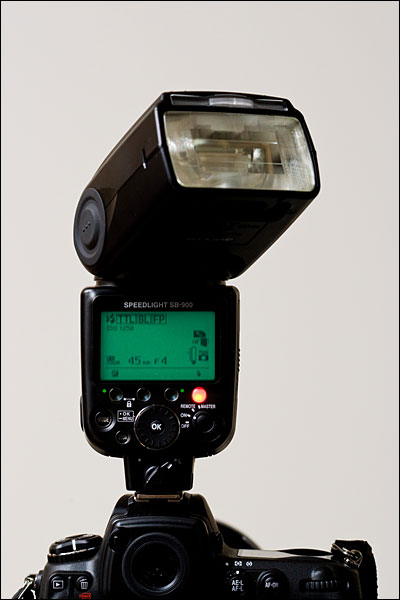
- A huge improvement is that the SB-900 rotates 180′ to either side!
Right there in this image is the main reason to get the SB-900 … it now rotates 180′ to the right, instead of stopping short at the 90′ mark like the SB-800. This is a huge benefit in bouncing flash with specific effect in mind.
That the SB-800 stopped short at the 90′ mark when you rotated the flash-head to the right, was a huge downside for me in comparing the SB-800 to the Canon 580EX.
But there are more reasons to love the SB-900 …
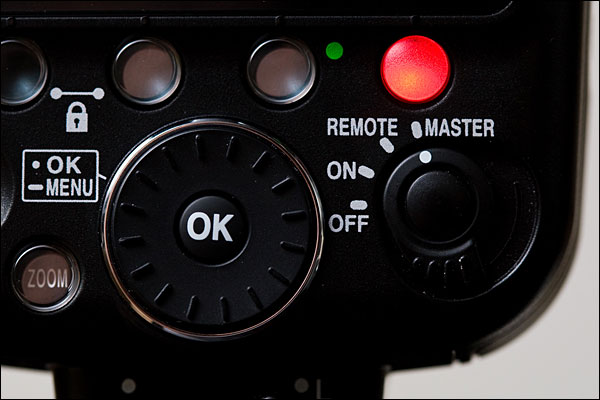
- Accessing the CLS functions are now just a flip of a switch away.
For anyone familiar with the slooooow method of getting to the Nikon’s CLS system of the SB-800 by pressing buttons for several seconds to call up various menus to get into the Master / Remote settings, will love the ease with which the Wireless TTL control menu can now be accessed.
- The entire menu system is now easier to access and to navigate.
- The LCD display itself is larger and the menu system is self-apparent. The menu really is obvious now, and easily accessed. You can even set “My Menu” on this flashgun.
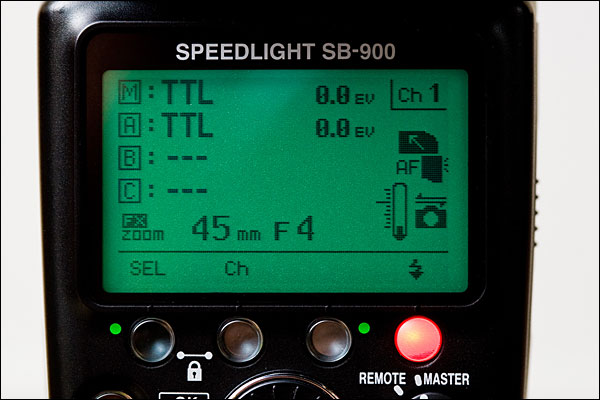

For me, these differences are profound enough to make the SB-900 an automatic upgrade over the SB-800.
The build quality of the SB-900 also appears to be a step up from the SB-800. Not only is the SB-900 much larger than the SB-800, it also feels more solid. While some may argue that the SB-900 is too bulky, the extra size of the SB-900 may have been a side-effect of several improvements by the SB-900, such as:
– building the flash-head to rotate like it does,
– and the fact that the SB-900 offers a little more power than the SB-800,
– the larger LCD display.
There are other smaller touches as well:
– The filter set now comes with a clip-on holder.
– There is now a thermal cut-off for the flash to stop it from over-heating. Fortunately this can be disabled. (Quite often I need to get the shots, without much concern for my flashgun.) I do have a quibble with the way it is implemented though.
– You can set the illumination pattern. ie, how much light fall-off there are to the edges of the image taken with the SB-900. But this is a trivial point for anyone who favours bounce flash over direct flash.
There is very little to quibble about with the Nikon SB-900 (B&H), and I would definitely recommend it as the best flashgun out there.
As an aside, we can look at the Canon 580EX II as to how a designer can completely miss the mark in updating a piece of equipment:
– The 580EX II made the controls to access Master / Slave far more clumsy over the original 580EX.
– Even in offering an Auto Mode now on the 580EX II, Canon fudged it by not having the Auto mode immediately accessible. Instead you need to go in to the menu to change it … and then disable TTL. Seriously!?
– The menu of the 580EX II (and the original) is so obscure you need to carry the manual with you, or some kind of note.
Nice and simple review there.
and how many are you buying?
I’m quite happy with my sb26 and sb800 at the moment, but I am considering making mine into an sb850, perhaps when I have a bad day!!
As an entrenched Canon user, I totally agree with your assessment of the 580EX II. Press-and-hold for a few seconds just doesn’t work, and so I can never switch into the remote flash control modes when under pressure.
The only aspect of the flash that makes it bearable to use is the ability to change many of the flash settings via the camera, in my case on a 40D. Changing the custom functions in this way is a given, as you actually get all the explanation text. It’s also quicker to switch wireless control off and on via the flash control menu (~4 levels deep in the menus!) than it is to do the press-and-hold shuffle.
I’m not sure if this feature is well known or not, so hopefully this will be helpful to others who battle with their 580EX IIs.
One more point that is overlooked by a lot of people, on the SB800 I constantly CONSTANTLY have to check to see it is locked in place as there is no “click” when you move the latch to lock position. The SB900 now has a very secure feeling and it “clicks” into the locked position and will not easily move out of it. Very confidence building. The SB800 would slowly “walk” out of the locked position and I would often find the latch lever in the middle going over to the unlock position in a sneaky way. By habit I trained myself to always have to push it to the right to make sure it is secure. Doing this a few hundred times during a wedding is pretty annoying. Annoyance all gone – happy now :)
Peter
I traded in an SB-600 for this on my D300. It is bigger and heavier than my SB-800 (I had two flashes). I’m not familiar with all the controls yet, but the 180-degree swivel either side has already helped greatly.
I also have a flash that doesn’t rotate 180 degrees both ways (Olympus FL-50). My work-around is to shoot holding the camera upside down to reverse the backward rotation. However, in such postion I can only put a slight upward tilt on the flash head (unless I tilt the whole camera downwards).
….Neil…while I was excited about this new 900, (I have 4 SB800’s and several Metz flashes) I am hearing about a couple of items that should be of concern to those who will use this on jobs. On mine..I had the “mode switching” situation. I have a D700, MBD10 grip. At times I will take the battery out of the grip and just use the camera battery, to lighten the load. With the SB900 in any of the “standby modes” with grip sans battery…as you turn the camera off for a short time while the flash remains on, and is in TTL…when you cut the camera back on the flash flips to “A” mode. If you put the battery in the grip it will not “switch” like this (NONE of my other 800’s nor Metz flashes do this) I have contacted Nikon, and they have forwarded this info to Nikon Japan. On another note (which has not happened to me yet) is the “thermal cut out” function. A friend of mine had his 900 cut out twice while attempting to shoot some pre-wedding incidental shots…he broke out the SB800 backup and continued with the wedding. He intends to return the 900 to the dealer. I am now reluctant to use the 900 “on a job” as I have started to read about others having the same situation (and I will stress here…this is NOT from shooting continuously or in rapid succession). The reason I want to relay this info here is I want to hear from others whether this is a problem for them. My friend even “disabled” the cut out function, and it still locked up. I have used several of your curves in my D200 and respect what you offer in the way of “working pro information” about your gear, and how it is used in the field. If you would be so kind as to let me hear from you if you start hearing more of this I would appreciate it!
…my regards, Doug Pitts (Doug Pitts’ Photography)
Agree entirely on the 580EXII user interface.
Needing to hold a button for a few seconds to access a menu is a crazy design.
Another quirk is that when the PC Sync port is used, master/slave mode is disabled.
Thus, to trigger the master remotely (using a Pocket Wizard/Skyport), a hot-shoe with a PC Sync port needs to be used on the master rather than using the built-in PC Sync port directly.
i performed this mod on my canon 430ex II and i stopped at 135 degrees
but i’m happy that it works =D