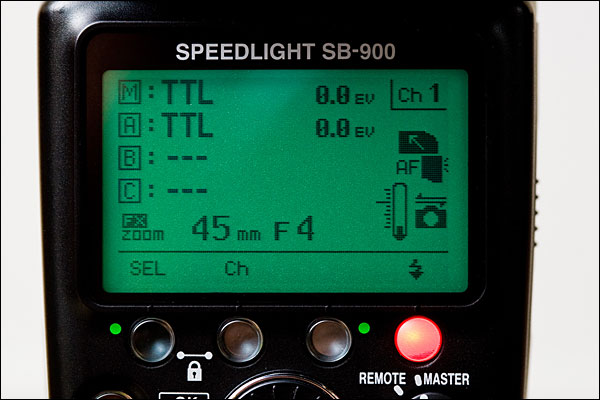
Nikon B-900 Overheat Protection / thermal cut-out
One of the features of the new Nikon SB-900 speedlight is the thermal cut-out. This feature allows the speedlight to stop firing (ie, stop working), when there is danger of it over-heating from shooting too fast. The temperature gauge can clearly be seen on the right-hand side of the SB-900 LCD display.
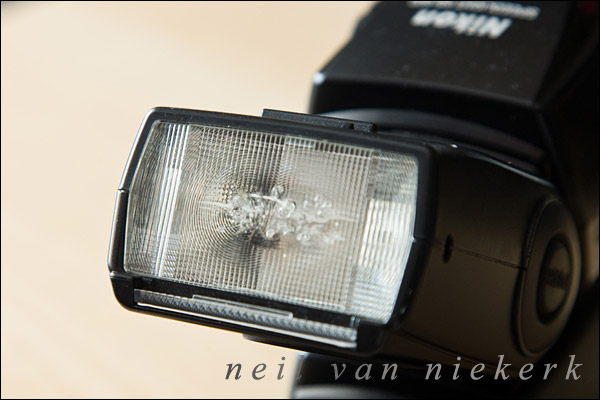
I’ve shown in an earlier posting here what a speedlight can look like when it over-heats and starts cooking. Here is what my one SB-800 looks like:
I have to stress that this is through no fault of the equipment or the equipment manufacturer’s design. *I* am using the speedlight outside of the recommendations. Purposely, as explained in the other posting.
With the SB-900 the Nikon engineers cleverly built in a thermal cut-out to stop someone from doing this by accident. It will let the speedlight cut out when a certain temperature is reached inside the unit. This is a good thing. It protects your speedlight from possible damage. Fortunately, the engineers also allows you to bypass this in case you do need to shoot faster than the speedlight is designed for. This is easily set via the menu on the speedlight. (One of the many pluses in favor of the SB-900 is the self-apparent menu.)
Some people don’t seem to be aware of this feature, which is strange considering they just spent $400+ on a top-of-the-range speedlight and didn’t bother to flip through the manual or figure out all the controls.
Others seem to think that this feature is a negative. They seem to think that this feature implies the SB-900 is prone to over-heating. Now, without doing destructive testing on my SB-900, I would say that I would be hugely surprised if the SB-900 is more prone to over-heating than any other speedlight, whether it be the SB-800 or any of the Canon speedlights. Having this feature does NOT make the SB-900 prone to this problem. It allows you to side-step the over-heating problem. In other words, it’s not a negative … it’s a positive, because the speedlight now warns you, and if need be, cuts out.
Therefore my take on the thermal cut-out feature of the SB-900 is that it is one of the advantages that the SB-900 has over other speedlights, and even more of an advantage that you can over-ride it. The best of both worlds.
SB-900 thermal protection is over-engineered
With a bit more experience now of how the SB-900 thermal protection cuts in, I do believe Nikon over-engineered this feature, because when the SB-900 goes into thermal protection, it also disables the camera’s PC terminal!
I photographed an event this past weekend, and when the on-camera SB-900 cut out, the PC terminal of the D3 was also disabled .. and this meant that none of my off-camera flashes worked. The off-camera flashguns would’ve saved me here, but in this instance the SB-900 over-rode the D3. There really is no reason for this to be designed this way, and is an unfortunate implementation of what really is a good option to have on the speedlight.
Similarly, if the batteries of the SB-900 become depleted, the camera’s PC terminal is once again disabled. And that’s just silly.
I love the Quantums, and mostly use the older T2 / T2D models as manual off-camera flashguns. I originally tried the T2D as a flashgun on a (rotating) bracket with my camera, but the problem was that the Quantum was good for power and fast recycling, but didn’t have a linear output for much more than 3 stops.
In other words, as soon as I went over f4 at 400 ISO it would blow out, regardless of me pulling down my flash exposure compensation by a few stops.
And if I went smaller than f11, it would under-expose.
So for subtle fill-flash at wide apertures and high ISOs, the Quantums just didn’t make it, and a dedicated speedlight offered much better control and better results.
I haven’t tried the newer Quantum T5D-R in a similar set-up, but the bulk of the camera (and my dislike of a bracket), would make me hesitant to even try.
So for delicate control over flash, a dedicated top-of-the-range speedlight is hard to beat.
You have often eschewed the virtues of your Quantum -how does this compare ?
Seeing that you are happy with the SB900 and have put it through extensive real world testing …. what capabilities does it offer that the SB800 fell short on? (Besides the head rotation ability)
Neil, I think Nikon have just released/are releasing a new firmware revision that resets the thermal cutout higher. The engineers might have been a little too protective.
https://nikonrumors.com/2008/11/05/nikon-sb-900-firmware-update-coming-soon.aspx/
Firmware updates for speedlights? What’s next?
Thom Hogan has a very thorough review of the SB-900 and compares it to the SB-800. You can check out his review at . I think that Neil and Thom both agree that this is a great flash. I just ordered one. Although I haven’t received it, to me the only drawback appears to be the size.
The SB-900 firmware has already been released on Nov. 19. The official list does not talk about adjusting the thermal cutoff point.
I have the SB-900 and it is definitely bigger and heavier than the SB-800.
I too have the SB900. I have actually had the flash cut out on me during the cake cutting…..
I now over-ride it but I leave the audible tone on. I figure I can squeeze out a few more bursts when I absolutely need them and then swap out the flash during the “not so important” times.
brian
I have an SB900 and I can say that it might appear bigger then the SB800 but surprisingly it is actually lighter then the Sb800.
Regarding the thermal cutoff point you will notice a huge improvement if Alkaline batteries are used instead of NiMh.
Oh my goodness! This is a good thing indeed. My husband and I just about melted our SB-800 at a wedding this summer. I took the batteries (alkaline) out of mine and they were oozing and hot as biscuits. Not good. Of course the comp was about +2 to 3, so I should’ve been looking out for this. Thank goodness they cooled off and still worked! What a great feature for the 900!
Hi– I am wondering if you disable the temperature shut off feature does Nikon void your warranty?
In response to Adam’s questions, though I am not an expert in lighting, I thought it might be helpful to post what I have learned about the Qflashes vs the SB-900. I recently purchased a T2D, an X3d-r (an upgraded X2) and I own all of the SB’s from 600 to 900. I have read through every review and forum discussion I can find online to learn the pro’s and con’s of the Qflashes vs Speedlights. Ultimately, there is more rumor and anecdote than clear fact. So, since I actually own both systems, I did some testing to try to figure out how the Qflashes really compare to an SB-900 which (aside from the heat cut out, which hasn’t been a problem for me) is a joy to use.
I was interested in:
a) the actual coverage of each (vs advertised), and
b) the actual power of each (vs advertised).
To do this, I compared the lighting pattern and intensity on an off-white wall about 10′ from the camera, with the flashes set on manual 1/64 and 1/8 power (i.e. both were compared at 1/64 and again at 1/8 power).
Quantum states that the standard reflector covers 70 degrees (in its wide position, something the 4 & 5 series no longer do). On a Nikon DX format camera (D300), that translates to a 23mm focal length. However, my test photo’s showed that to get a uniform lighting pattern, without any diffusion, the actual focal length was about 55mm, which is about a 25 degree coverage. Adding the opaque diffusion disks expanded the coverage to about a 45mm focal length (about 30 degrees). And, with the wide-angle (dome) diffuser (and no disks), the coverage was about 35mm (38 deg), though the drop off/vignetting was not too bad (maybe 1/2 stop) to about 24mm (54 deg).
By comparison, with the SB-900 set to its “even” coverage pattern, the lighting levels were extremely uniform across the frame, down to about 24mm (54 deg coverage) and very good, with very minor drop off (maybe 1/4 stop in the far corners) at 18mm.
Also, interestingly, the light output of the SB-900 regardless of light pattern, vs the T2 with the Wide Angle diffuser, and no disks, was about 1/2 stop higher. With out any diffusion, and with the light pattern of each matched as similarly as possible (SB zoomed to 28mm or 35mm with an 18mm actual focal length and using the CW pattern vs. reflector in Std position for the T2) the T2 was about 1/2 to 1/4 stop more powerful (depending on the zoom setting of the SB), with a round lighting pattern; the SB had a football (American) shape and the T2 a round pattern. All of the SB-900’s lighting patterns were more uniform in the center, and had larger centers, before there was any light drop off. With the CW & Std patterns, the drop off outside of the center, was fairly rapid, though was actually no worse than the T2; the drop off was just more abrupt.
I did not do the complete battery of tests with the X-series Qflash, but with the same settings, it was about 1 1/3 to 1.5 stops more powerful than the T (with X powered by the 400watt-second Qpaq configuration). I also did not run through all the tests with the Qflash’s reflector in it’s standard position (which is the 4 & 5 series only position), however a quick comparison between wide and std showed that the light drop off is much more abrupt with the reflector in standard position, similar to the SB-900’s Std & CW light pattern, though still less uniform across the center than the SB.
What I could not tell from these tests is whether the Qflash, when feathered could produce a wider, more even lighting pattern than an SB-900. That is the typical recommendation for key light position with a parabolic reflector. Based on some quick, flash-held-at-arms-length-and-feathered shots, I think the QFlashes “might” have an advantage there (i.e. be able to produce a wider, evenly lit area when feathered properly).
However, It seems clear to me that for on-camera fill, at least, the SB-900 is superior to the Qflashes: it is comparably powerful compared to the T (more powerful than the T with its WA diffuser), more uniform than the T or X, and is capable of lower levels then either. The X is more powerful, even with the WA diffuser, so the X seems a useful compliment to an SB when a lot of light is needed. Also, if overheating is a problem, the Quantums win on that count. Also, the Qflashes are a noticeably warmer light, so putting a 1/8 or 1/4 CTO or CTS on the speedlight and doing a custom WB probably makes sense if they are mixed (I haven’t tried this, but I plan to :).
Bob
I don not understand this..could i be he only one on the planet with an SB 900 that does not overheat? I shot 5 weddings in the last month 2000 shots per job….shot 1400(with flash) with the sb900 and quantum turbo pack..never shut down….
my quantum’s die out before the flash does
I am not tech savvy with all the ins and outs of the digital nightmare! But what i do know is i shoot at ISO 320-400
have the flash on auto set to F4(sb900 as main light) bounced with a white card. And a Quantum Q flash as my second light also set to f4 (bare bulb with silver tube) …I adjust f stops if needed..And besides with the D700 you can really shoot the whole wedding(other than a dank reception hall) available light since noise is not an issue anymore
could it be that this flash is not meant to shoot all day at full power at a rapid pace?
I wish i had more of a technical grasp on this stuff…all i know is that works for me :)
LOL open mouth insert foot! mine overheated on my last job…was getting heavy use. Back to my quantums !
great comments from everyone!
sb900
the thermal shutdown engages in specific situations….i did not do a scientific experiment, only experience
using low ASA, like 100ASA in TTL makes the SB900 flash ‘POP’ with more energy…the flash gets hot quick
using high ASA high 800/1000asa in TTL mode the flash doesnt work as hard…and subsequently you can get away with more flashes
also
if you face the flash head toward the subject (in TTL) the flash doesnt work as hard as it would if you bounce the flash around/like off the ceiling or back wall
the distance the light has to travel to create the exposure has an effect on the flash head.
lastly: the plastic fresnel lens on the sb900 gives a burning smell when the flash is used frequently. The manufacturer may have ‘forgotten’ to give a ‘breathing portal’ for the heat transmission of the flash heads.
Can someone ask Nikon if we need to drill holes into the Fresnel Lens of our SB900
s? Or should we ask Toyota to fix the problem?
Hi Neil,
Shooting with flash in sunny day, I must go to 1/250 ISO 200, but due to the warming problem of SB-900 to low ISO can I go to 1/1000 FP ISO 800 without any further consequences?. In other words, the high sync FP may introduce some damage to image quality?
Thanks again,
Alfredo
Alfredo, actually your speedlights will work harder in HSS mode. This article on maximum flash sync speed will help explain why.
It’s somewhat weird but I’ve never managed to overcook any of the 4 SB80 I own even though I mostly and mercilessly abused them for years. The SB900 is much better in terms of color, exposure and pretty much everything else but this termal thing. I had this guy (SB900) quit on me MUCH sooner I expected it would… Maybe Nikon engineers went on the “conservative side”? (make that VERY conservative)
Just my two cents.
Cheers!
Bogdan
Hi Neil,
I was the photographer for a wedding 4/22/10 for a friend of my daughter’s and this is my second wedding shoot as far as me being in charge, but this one I did the pre-wedding photos etc…During this wedding, I used your flash techniques, a battery pack and the SB-900 flash. When the bride was coming down the aisle the SB-900 shut down. It started working again later on, but when the couple got to the kiss, it shut down again. Of course I was very upset. This wedding was definitely a learning experience. I will not give up on doing weddings, but I forgot about using my on camera flash to save the day and when it was time to light the candles I did increase the ISO which was a plus. I will always have two cameras on my shoulders during the ceremony from now on. I did have my SB-800 but I had it set to remote and in a time crunch it is a pain to go to TTL, which is the main reason for purchasing the SB-900. I am returning my SB-900 until NIKON corrects this problem. Luckily I did explain to the bride that I was not a professional and that I would take the pictures for her since she was trying to save money and I needed the experience. I was able to lighten the pictures in Photoshop somewhat… What would be your advice on this situation?
I just picked up an SB-900 last week and did a sunrise (sun rising behind my model) shoot by the lake. I’m glad I got something with more power than my SB-600 because as the sun came up I was able to make the sky look extra amazing by under exposing a stop (a la Neil’s teachings) and used the flash in an umbrella to bring my model up to perfect exposure. It did cut out on me twice after, what I would consider, some normal shooting. Seems I need to update the firmware, because I had to throw the SB-600 on and shoot hard on her since she was kneeling in the lake at 5:45 AM and I didn’t feel like waiting for the flash to decide that it was time to play again.
I am on my 2nd SB900. Both have cut out with only casual use. The second one cut off on a sunny day when I hadn’t been using it for a while. I haven’t used it on a professional shoot yet and will rely on my SB800s for that. I wish I had bought more SB800 while they were still available new. It doesn’t seem like Nikon is going to do anything about it. They seem to be in denial that there is an issue. It does seem that some units have more problems than others. The performance, ex the thermo cut out is great. I don’t like the idea of turning it off but i also don’t like the lack of reliability even when taking all of the precautions – no bursts, alkaine batteries, software upgrade, etc. I can’t believe that Nikon has this unresovled issue on their flagship speedlite.
Unfortunately I’m slowly starting to hate this flash. Even with the thermal nanny switched off the flash slows down considerably when the warning is displayed on the LCD.
We’re talking white 15 foot ceilings, f4 at ISO 1600. After about 50 ceiling bounce shots in about 5-6 minutes (bridal party and couple grand entrance in the hall) my SB900 was already hot.
Pithy. When it works the results are great…
Cheers!
Hi Niel,
I saw that you disabled your thermal cut-out protection on your SB-900. I would like to know if you had any overheating problems in a weading since you disabled that feature.
Thank you.
I’ve blown three SB-900 speedlights this year already. No more than I would burn out regularly, whether it is the Nikon SB-800 or Canon 580 speedlights … a side-effect of working these speedights hard. It’s the cost of doing business.
I’m starting doing some weddings and using your technics that I learned from your book that I bought in portuguese! I was a little afraid that the SB-900 was in a way more fragile than the SB-800. But according to you it’s not.
Is there any risk of damaging the camera if the speedlight fries?
I hope you come to Brazil someday for a seminar.
Thanks for your time answering all the questions.
I finally came to peace with this flash. Broke down and bought a couple of them… I keep’em close and switch them as they heat up. It worked up well these last two wedding we shot…
Nikon engineering folk are marketing geniuses as well… I ended up paying more than double to have a bit more capability I used to have with my old SB800…
The power is awesome though…
Cheers!
Bogdan
An epitaph to my trials with these flashes… and maybe a (small) solution. I find that every time when I replace the warm batteries with fresh cold ones, the temp sensor goes down to about half in about half a minute. This heat sensor might be somewhere close to the battery compartment because by touch (so VERY un-scientifically) the fresnel (plastic lens) on the flash doesn’t go down one iota from this procedure, so the temperature inside the flash chamber stays the same (or very close).
In all honesty the SB900 is an awesome flash. WAY better than the 580EXII, more consistent, faster recycling… you name it.
As always, just my two Canadian cents…
Cheers,
Bogdan
I was using rechargable batteries in my SB-900 and it would over heat very quickly. Switched to standard commercial non-rechargable Batts and have had no problem with overheating. Seems the problem is the lower voltage of 1.2V that most rechargables supply as apposed to 1.5v for non-rechargables. Check you batteries and make sure they are rated at 1.5v.
Art,
You might be interested in reading this thread in the forums about the batteries.
https://neilvn.com/forum/discussion/comment/1279