A question that came in regarding material covered in the book on flash photography techniques ..
Sven Pohle asked:
I am reading through your book (second time already) and have a question about metering plus adding the flash. I do meter for a white tone in my image and add +1.7 or 2 (I’m on Nikon) to my exposure. Now without flash my image is exposed correctly. But if I add the flash then the white starts to blow out as it does add flash light to it. So this is there i am confused. Would you rather go and meter for the background to get that right and then just add the flash to bring the subject up ?
I’d like to answer this here, since I am sure this is a widespread question or point of confusion …
First, to anyone who is confused by the question – part of the metering techniques explained in the book, revolves around using your camera’s built-in meter. We use it to calculate ambient exposure by metering off the brightest relevant tone of your subject if they are wearing white. And in order to do so, we have to adjust our metering so that it places white correctly on the histogram. In other words, we have to correct for our camera’s tendency to expose for everything as a medium toned grey, by pushing up our exposure by around +1.7 stops.
Back to the question about adding flash to available light ..
Let’s break this up into two broad scenarios:
1. Your subject is shaded and your background is brighter.
In this instance, you would expose for your background. You might expose correctly, or you might allow your background to blow out a bit, or even under-expose for a punchier image. Your choice. You would then expose correctly for your subject, using flash, whether TTL or manual flash.
So in that case, you wouldn’t meter off the subject per se. You might meter off your subject to see how much darker he / she is than your background, but you wouldn’t meter specifically for the ambient light falling on the subject to get your camera settings. Therefore you wouldn’t meter off any white tone the subject might have, such as a white shirt or dress, to determine your base exposure. Instead, you’d look at your background.
Here’s an example from a portrait session with a couple yesterday:
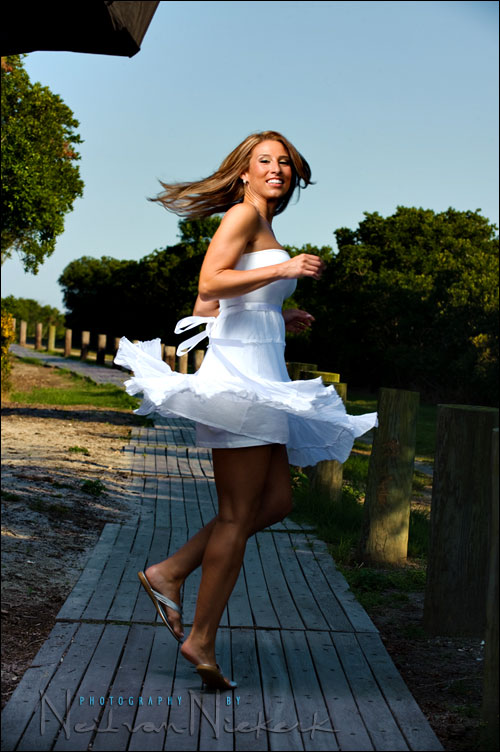
She wanted a few photographs with the pathway leading to the beach, but the light was very uneven with the sun pouring through the trees. I therefore positioned her in the shade, and used flash (Q-flash in a softbox) to light her to the same level as the background. So in this case, my background determined my settings.
1/250th @ f11 @ 200 ISO
manual exposure mode on my camera, with manual flash in this case.
(I purposely left the softbox shape in the image here instead of editing it out, to give an idea of the positioning of the softbox.)
How did I figure out my exposure settings here? By using the Sunny 16 rule as a mental starting point, but keeping in mind the sun was getting lower, and then doing a quick test shot and looking at the back of my LCD. I then used the histogram method to get my manual flash exposure settings – which are controlled at this point by the distance between my flash and my subject, and the power setting on the flash. In the end, I had to pull down the exposure in RAW by 1/3rd stop. A minor tweak.
The next scenario is where it gets interesting:
2. Your subject is well lit, but you want to use flash to bring up some shadow detail.
This is where you’d meter correctly for your subject, with little regard for your background. (Unless you have additional lights for the background. But we’re just looking at a simpler scenario where we have one flash and want to light our subject.)
Now, if our subject is already well-lit and properly exposed for, then adding the same amount of light from our flash – ie, “proper” exposure from our flash as if there was little available light – will mean we are adding double the amount of light necessary for proper exposure.
Therefore using getting correct ambient exposure for the subject is the base exposure, and then we’d just add fill-flash .. usually a stop or more under the ambient light. So, using the histogram method or selective metering with the camera’s meter to get correct ambient exposure for the subject works, but we can’t just add equal amounts of flash .. instead, we have to decide how much fill-flash to add.
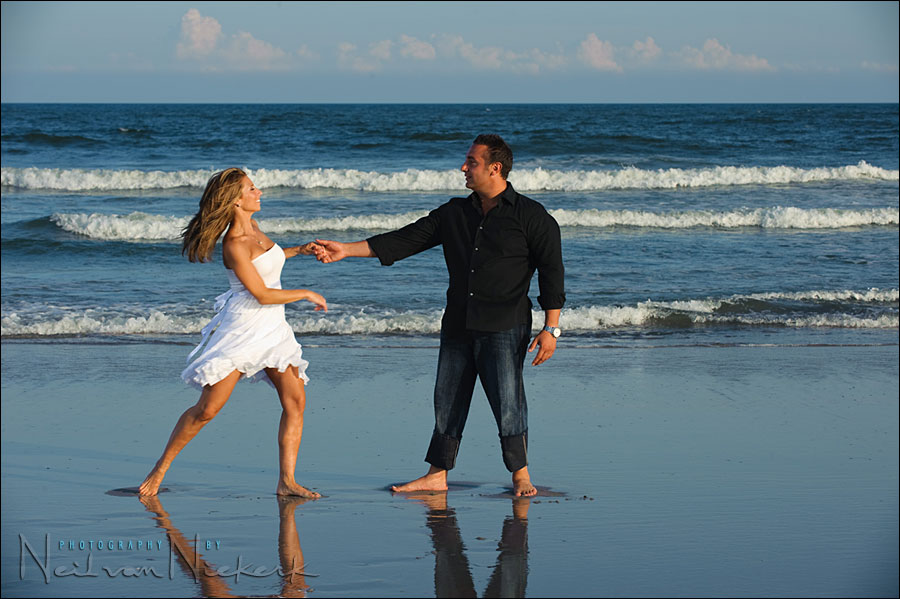
Here is the couple on the beach in direct sunlight. I got to correct exposure for my ambient light here with a combination of checking my histogram on her white dress, and confirming it with the blinking highlights display NOT blinking for her dress.
Then all that was needed to bring up exposure on the shadow sides a bit, was to add fill-flash. In this case, the flash was once again via the Q-flash and softbox held off to the left of the camera. There is no over-exposure though, since the flash exposure is lower than the ambient exposure.
And as an aside … here is an image where the ambient exposure was purely based on the mood I wanted.
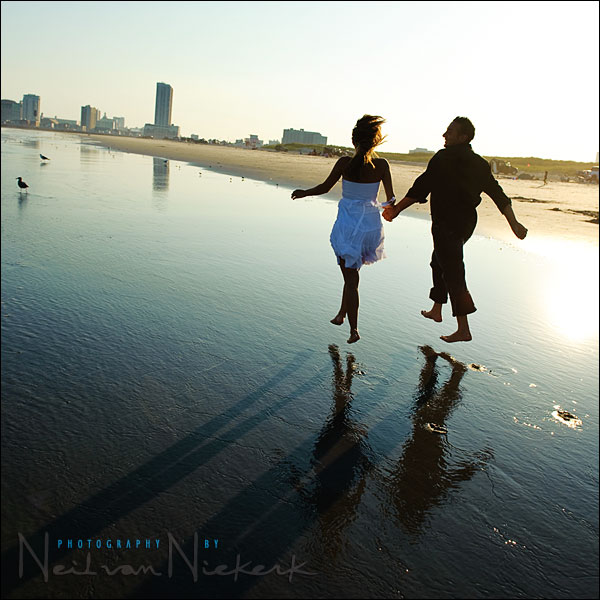
I didn’t expose for my subject per se. However, I did make sure that in my composition they were positioned such that they do stand out from the background. My exposure was based on the overall scene, and not a specific tone. I didn’t want the bright sun in the viewfinder to affect my exposure, so I once again kept to manual exposure mode, and used my LCD preview to get an idea of whether my settings were good.
1/1000th @ 6/3 @ 200 ISO .. and a bit of juggling of values, and you’ll see that I was once again close to Sunny 16 settings. It’s usually a good starting point when working in bright light.
Hey Neil, thanks for the informative post. I’ve recently been getting a bit confused about how to use fill-flash without blowing out the properly exposed (by ambient light) highlights on the subject, and this post has cleared that up. Thanks again.
Cheers,
Chris.
Neil,
In the first two scenarios, could you have used TTL instead of manual flash? If so, would you have used straight TTL or TTL-BL?
Thanks,
Les
Hi Neil, just like Les has asked if using the Nikon speedlights in TTL-BL would you use it in this mode for fill and put in -2 or -3 flash exposure comp?
Paul
Neil,
I’m glad Sven asked you this question, because I was starting to get confused. I remember asking you once about the portrait picture of a groom in a church in your blog (unfortunately, I can’t find it). You mentioned that you metered the background rather than the groom, because you specifically wanted the stain glass window details. When I asked you about metering the groom’s white shirt, you mentioned that while that would be valid, the background would have blown out. This post provides a clearer explanation of what was going on.
Based on your book, you mentioned that TTL is generally better if flash was the dominant source of light is while TTL-BL is generally better if flash was fill. If “your subject is shaded and your background is brighter,” I presume I would be using the TTL flash setting. If “your subject is well lit, but you want to use flash to bring up some shadow detail” I presume I would be using the TTL-BL setting and have to play around with the FEC until the LCD and blinking highlights is where I want the image to be.
Hi Neil, yur book just arrived today from Amazon. Being down uder in Perth, Western Australia, we don’t always get the opportunity to attend the many workshops we read about on the blogs based in Nth America and the UK. But your site – and now your book – is a terrific resource. Can’t wait to getting more creative and competent with our use of Flash. Thank you, David
Neil,
Many thanks for a clear explanation. I judge my highlights by the histogram and adore the control it provides.
If I mess up, I can only blame myself !
Jim
Hi Neil, thanks for the tutorial. Your blog never cease to intrigue me. I’ve been reading your blog for some time but now its time to put on my first comment.
I’ve been thinking to buy your book, but the shipping cost to Australia here is quite dire. Do you have an e-book version we can get? If not then i’ll order the print one.
Regards,
Vic
Hi Neil,
Long time reader, first time poster here. Just wondering if for your future posts and sample shots you wouldn’t mind sharing exactly what lens you have used for the particular shots. Sometimes you do include the info into the blog posts which is great. The technical information that you provide already is extremely helpful, but sometimes leaves me wondering what lens and focal length was used for each particular picture. You already over-extend and bend backwards for us so I understand if you decline.
Your site and photography are truly an inspiration!
From Iowa,
Dinko
Hi Neil-
I know it’s been several months since you posted this but I just found this post and have a question about shooting outside with ‘dull’ light and avoiding subject blur when adding flash.
On a cloudy day when there is the same light falling on the subject and the background, and I want to add light in the eyes…Do I need to under expose the ambient 2 stops to make sure the flash is the key light and there is no blur?
Please tell me if what I am doing is right? I put the camera in manual mode and set iso to 400, fstop to maybe 5.6, depending on group size, and then ss to sync 1/250. I would then look at the in camera meter (through the viewfinder) and make sure the meter (with matrix metering) is at least 2 stops on the negative side. If the meter is in the middle, then I would increase the aperture from 5.6 to 8 or decrease the iso to 200 so flash is key. Is this how you do it?
If the subject is in even light outside and I only want to use flash to add light to the eyes, that’s not fill-flash right? The flash has to be the key light or it will cause blur – right?
Please tell me how I can know FOR SURE, with my settings, that there will be no motion blur because this is the only thing I can’t tell when looking at my histogram?
Thank you so much for your help!
Toni
D700 & SB800
Toni .. the method you describe there would work. But it need not be 2 stops (or more) difference between the flash exposure and ambient exposure.
Have a look at this photo shootout, where I metered for the ambient light, and then under-exposed the ambient light by a stop. It could’ve been 2/3 stop .. or more. Don’t get stuck on it needing to be a specific difference.
Just so you know … f5.6 to f8 is one stop. The same for changing from 400 ISO to 200 ISO.
Your comment there about flash having to be the key light or else you will get blur … isn’t quite accurate. Your choice of shutter speed .. and whether your subject is static .. and how well YOU can hand-hold the camera .. these are all factors.
How can you be 100% sure not to get blur? Shoot at a fast shutter speed on a tripod. But this might not be entirely practical.
To get sharp images, you’d have to look at a number of factors, all incrementally adding to your success rate. Most importantly, is using a high enough shutter speed. But even in that, the change from 1/60 to 1/125 is incremental to an extent. The same for 1/125 to 1/250.
Neil
I’ve almost finished studying your most informative book – came across this post again – it still bothers me that there’s no mention of the compensation for the white dress not to appear as middle grey, in neither of the two scenarios sketched above (neither subject shaded, nor subject well lit) – please help me understand the middle grey issue.
Many thanks
Neil
In the second scenario – “2. Your subject is well lit, but you want to use flash to bring up some shadow detail.”
.
and in particular – “Therefore using getting correct ambient exposure for the subject is the base exposure, and then we’d just add fill-flash .. usually a stop or more under the ambient light.”
.
When you mean .. “usually a stop or more”, is this the FEC you refer to ???.
Cheers
Angelo
Angelo .. when you use TTL flash, it has to be the FEC you adjust.
I see now that I didn’t specifically mention that the 2nd scenario was with TTL flash.
If it had been manual flash, it would’ve meant that my flash exposure is a stop (or more) under that indicated for available light.
eg, if available light is f/8 (for a particular ISO / shutter speed combination), then I would make sure my manual flash gives me f5.6 for that aperture / ISO combination.
Neil,
With the photo of the girl on the pathway to the beach, was there a specific
reason for f/11 @ 200 ISO, or could you have used f/8 @ 100 ISO?
Was it because of a certain depth of field?
Thanks,
~Zach