First curtain vs Rear (2nd) curtain flash sync
A topic that has been briefly discussed on the Tangents blog before, is that of first curtain flash sync vs second curtain flash sync. First curtain sync is also often called front curtain sync; and rear curtain sync is often called second curtain sync. (This is also covered in my book on flash photography).
Since it is an important topic in flash photography, let’s look at what this entails and the difference between the two ways we can sync our flash .. and why would the one way would be preferable over the other.
To help us with the explanation, we have a great subject who was quite willing to pose for some comparative photographs.
How the camera’s shutter works
To understand the difference between rear and first curtain sync, we need to look again at how a camera’s shutter works – two curtains that open, allowing light to fall on the sensor or film. The time interval between when the first curtain opens and the second curtain closes, determines the actual shutter speed .. ie, how long the shutter is open.
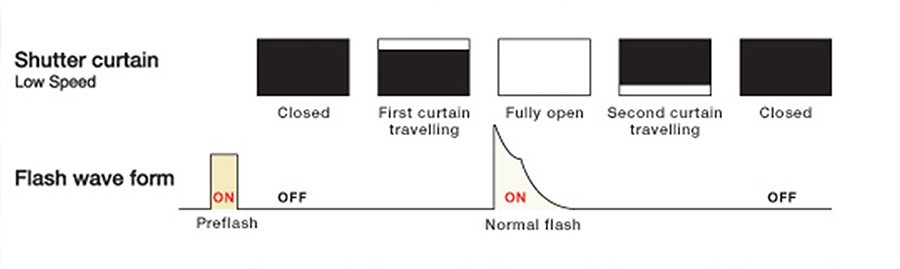
When the shutter is fully open, the flash will fire. For this discussion, we don’t need to consider high-speed flash sync (HSS). In fact, HSS doesn’t come into play at all when we look at first and rear curtain flash sync. First curtain sync and rear curtain sync comes into play at slower shutter speeds. HSS works at .. high shutter speeds.
Okay, so the flash will fire when the shutter is fully open. With slow shutter speeds – much slower than max sync speed – there is a certain time interval (the shutter speed setting), between the first curtain having completed travel, and the rear curtain actually starting to move. With this interval, we can now choose when we fire the flash.
With slow shutter speeds, we can fire our flash at two points:
– directly when the first curtain has completed travel
(but the rear curtain hasn’t started to move yet), or
– juuuust before the rear curtain starts to move.
Since we’re working at slow shutter speeds, we’re allowing subject (or camera) movement to affect how the subject appears by ambient light. (No flash). If we keep our camera static, and our subject moves, there will be some subject movement registering as blur. A blur of movement. If we pan our camera with our subject, it registers much less. For example, if someone runs, and we photograph them at a slower shutter speed and pan the camera with their movement, their body and head will appear relatively sharp .. but their limbs will still be blurred because of the movement and slow shutter speed.
Back to deciding when our camera should fire the flash:
– at the start of the ambient exposure
(ie, when the first curtain has just completed travel and the shutter is open), or
– at the end of the ambient exposure
(ie, when the rear curtain is about to move and close the shutter.)
These two ways / times / places to fire the shutter, will have a considerable effect on how the flash and ambient exposures appear in relation to each other. Note that the choice of first or rear curtain sync has NO effect on flash exposure, or how the flash and ambient exposures balance. What is affected, is their timing. We’ll come back to this point again. Let’s look at some diagrams first.
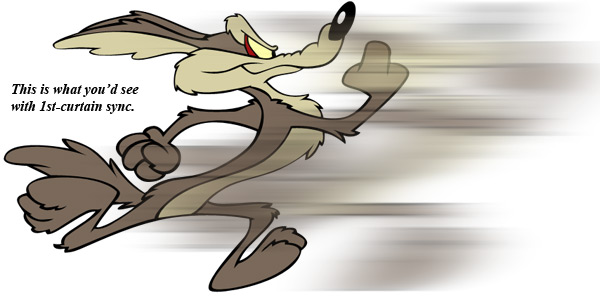
With 1st-curtain sync, the flash fires at the start of ambient exposure … the subject moves in relation to the camera (ie, we’re not panning the camera), and at the end of the ambient exposure, the shutter just closes. The subject’s movement will appear as a blur moving outwards from the flash-frozen subject.
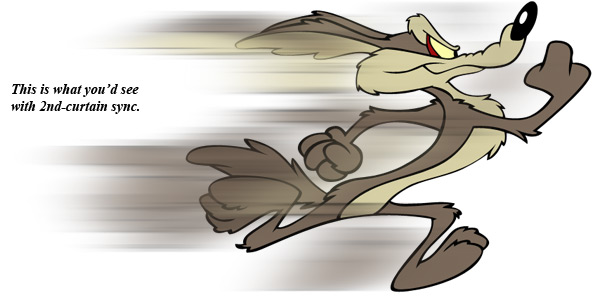
With 2nd-curtain sync, the flash fires at the end of ambient exposure. The flash fires just as ambient exposure is completed. Now the subject’s movement will appear as a blur behind the flash-frozen subject.
On-Camera Flash Photography – revised edition
This book is explains a cohesive and thorough approach to getting the best from your on-camera speedlight.
Particular care was taken to present it all with a logical flow that will help any photographer attain a better understanding of flash photography.
You can either purchase a copy via Amazon USA and Amazon UK, or can be ordered through Barnes & Nobles and other bookstores. The book is also available on the Apple iBook Store, as well as Amazon Kindle. Also check out the Amazon Kindle store.
Learn more about how the cover image was shot.
The advantage in using rear curtain sync
As is obvious in this explanatory image, you can see that rear curtain / 2-nd curtain flash looks more natural when your subject is moving in relation to the camera.
That blur behind our subject is how I think we intuitively want to see movement appear. Perhaps it is intuitive, or perhaps we’re just conditioned by a life-time of watching movies and cartoons and reading comics. We want to see the subject movement as a smear behind the subject, and not as a ghosting moving out of the subject.
The advantage in using first curtain flash sync
Now it would appear that rear curtain sync is the most obvious best way to use flash at slower shutter speeds. We have that blur of movement leading into the subject, frozen by flash. If we photograph action, or something like people dancing, then rear curtain sync would be the way to go.
There are two problems to using rear curtain flash sync:
1. The one problem with rear curtain flash sync is a minor problem of precisely timing our flash to the action. Since the viewfinder is blacked out for a fraction of time with a SLR as the mirror flips up, we might be a little off in timing the peak action that needs to be frozen by flash.
2. The second problem rears its head when we use TTL flash to photograph people. With TTL flash metering, the camera and flash emits a pre-flash to meter for the flash. This pre-flash is emitted before the curtain opens and the main burst of flash (the actual exposure), takes place.
This pre-flash isn’t really noticeable with most D-SLRs when you use first curtain sync. However, when you use rear curtain sync, there is a distinct delay between the two bursts of light. When you use rear curtain sync, people tend to blink in reaction to the first blip of light – the pre-flash. So when the actual exposure takes place, you often get people half-blinking or with their eyes closed. This definitely happens more often than if we use first curtain sync, where there isn’t a visible distinction between the pre-flash and actual main burst of light.
When to use First curtain / Rear curtain flash sync
I’ve seen advice given that you get better flash exposure if you use rear-curtain sync. This just isn’t true. The distinction between first curtain sync and rear curtain sync, is in the relative timing between the ambient exposure and the flash burst. The actual flash exposure and ambient exposure should not vary.
Also note that if you are photographing a static subject, that using rear curtain flash sync gives you absolutely no advantage over first curtain flash sync.
My advice would be to use rear-curtain flash sync if you have a specific artistic effect in mind. For most general photography, especially when you’re photographing people, I would suggest just staying with the default mode of first-curtain flash sync. You really do reduce the chance of people blinking in reaction to the pre-flash.
Related articles
- When (not) to use rear curtain flash sync
- Slow-sync flash / dragging the shutter
- More articles on Flash Photography Techniques
This is very helpful – thanks. I read about rear curtain sync and couldn’t figure out why you just wouldn’t use that all the time. Or why camera makers wouldn’t make that the default. Now I know.
Hi Neil, great article. One observation I have made is that when in aperture mode, the shutter speed selected by the camera (D300), is much slower when in rear sync. I need to raise my ISO and/or dial in minus EC to get the shuter speed up to 1/30. What is it about about rear sysc that tells the camera to drag the shutter in aperture mode?
Thanks
Jay, I so rarely use my cameras out of manual mode, that I have no real idea what it does in an Auto mode. So I had to check to confirm. I don’t have a D300 on hand, just D3 bodies.
With the D3 in Auto exposure mode, I can cycle my flash options through:
– normal flash (first curtain sync);
– red-eye reduction options;
– slow sync;
– rear curtain sync (which automatically enables slow sync as well)
This does make sense, in that with rear curtain sync, you see the effect more with a slower shutter speed that allows the ambient smear behind the subject. I think the camera manufacturers correctly assumed that someone who is using rear-curtain sync (in an auto mode), would want a slower shutter speed to show the effect.
Thanks a lot for the article! It was a huge help.
I shoot a canon camera and flash and it fires a preflash in manual mode also not just ttl.
Craig .. just double check again, shooting test frames at around 1 second exposure time. I checked now with my Canon 5D and a 580EXii, and there is no pre-flash with the flash set to manual.
Hello Neil, Thanks very much for this info. I have been shooting rear-curtain for a while now, and I just never really understood what my flash+camera were doing! (Wedding reception light trails in the background while dancing, etc etc).
I shoot with a 7D + 580 EXII and 40D + 430 EX. I set my flashes to manual and 2nd curtain sync. 1st or 2nd curtain…for my uses at least, don’t matter much if I shoot faster than 1/60 s. My light streaks/motion trails start showing up at 1/30s and slower shutter speeds.
I’ll post samples, but hopefully this info helps others out.
Thanks again, Neil! Please keep the tips and tricks coming!
Ian VL
Neil,
Does 1st or 2nd curtain only matter when there are slow shutter speeds?
Thanks for the article.
Yes, as you approach maximum flash sync speed, the difference in timing becomes less and less.
Hey hello Neil,
Interesting article, but I think you forgot to mention something. This thing is focus.
When I photograph evening party, when people are on the dance floor and there are projector and light effect in the background, I used an exposure time of about one second with TTL flash on camera. This allows me to have interesant effects (effect of taking a projector with camera movement when shooting) while freezing my subject.
To achieve this, I set my speedlight on the first curtain sync, and that to prevent my subject to going off fields at the end of exposure because he would have moved in rear or front to me (besause he is moving, dancing). First, focus and take photo, immediately flash fire (the subject is frozen) and after, shutter stay open to capture ambiant light (during this, rotate or move your camera to make background light effect). Because the ambiant light is very low on the dance floor, the subject (dancers) are frozen and correctly exposed and no subject blur appears.
In general my camera setting is: 1sec f/4 ISO 100 and on camera flash in TTL bounced in a close surface (wall, ceiling…), that give me very interessting effects. It works well if you shoot into the light (DJ’s projectors).
Hello Neil,
Recently stumbled across this site and I am amazed. You have a true gift of being able to explain complex topics with a terse, yet very understandable tone.
I was wondering if you new whether most point and shoot camera flashes are set to front curtain or rear curtain?
Cheers,
Mike
Mike … P&S cameras don’t usually have a focal plane shutter, so the idea of rear / front curtain sync doesn’t apply like that.
I know it’s been a couple of months since this question was asked, but I have a Canon G7 which does offer the option of 1st curtain (default) or 2nd curtain sync. Whilst it only has an electronic shutter, it fires a pre-flash and main flash exactly the same as an SLR.
Greetings and thanks for the great diagrams. Some videos I have been watching seem to hint that ghosting around a slightly moving subject (squirmy models etc.) will be less if second curtain sync is used. This baffles me. My only theory is that the duration of the flash (although minute), would be clipped short by the closing second curtain. I figured you might know if there is any truth to this.
Technically, I see no reason why there would be less ambient blur with rear-curtain sync, than with first-curtain sync.
The difference is in timing of the flash, not in the duration, as far as I understand it.
If someone could do a more structured test with this, and show the difference, it would help. Other than that, I’d say it is just wishful guessing to think that rear-curtain flash sync gives you less ghosting. (I would be happy to be convincingly proved wrong though.)
Neal and Robin,
I’m a commercial photographer who uses both 1st and 2nd curtain sync in my work. There is NO difference in the amount of blur using eitther one, so long as other seetings are the same (aperture, shutter speed, ISO). What happens in 1st curtain is that the blur is recorded, THEN the flash freezes the sharp image. In 2nd curtain sync, the flash goes off at the END of the long exposure, so blur is recorded FIRST, then the sharp image. In the case of a twirling object, like a sinning dancer, the sharp image and blur are recorded over each other, so depending on the degree of side to side movement, the blur may appear to be more or less. Usually, with wedding dances, 2nd curtain gives a better result as the sharp image is recorded OVER the blur. Best to leave plenty of room in your viewfinder or your dancers may well move off camera when using 2nd curatin, as a previous poster points out.
If you use a tripod you can drag the shutter to make your background darker or lighter at will, still freezing your subject.
Dear Neil, I have a question. If i well understood you have to put your camera on 2 nd curtain sync. Measure the studio light with a light meter at 1 sec exposure so your diafragma will be very small f22 ? I use a fujiXt1 and elinchrom flashes. I want to photo a model who is moving her hair that you see the hair moving but the model still sharp. Can you help me?
The aperture need not be that small, but rather be appropriate to how much light you have there.
The shutter speed needs to be that slow – somewhere around there. Perhaps faster.
Thanks you for this comprehensive explanation on first and second curtain sync.
Thank you for a good article and reasonable discussion. Though I am a commercial photographer for 15 years still found some statements and observations here useful for me in 2019.
Wonderful information Niel. I was wondering. Does using a bounce modifier such as a demb or bounce card affect the sync speed. I have several photos from a wedding that appear like there is a slight blur and shadowing around the subject in the images (some dancing and some standing fairly still). The flash SB-910 was set at front curtain TTLBL, D700 at Aperture Priority f4, 1/60, ISO 800. I used a demb flip it bounce flash diffuser. This seems inconsistent, sometime the photos look great other times they have this problem. Thank for any input
Your choice of flash modifier has no effect whatsoever on whether there is ghosting or not.
which curtain is best snapping a group pics
Check out this article – When not to use rear curtain sync. It will specifically answer your question.
Is rear curtain sync available in all flash modes, manual or ttl auto?
I have a fuji x-pro2 and tried with both the fuji ef-x20 and cactus v6 flashes.
I was wondering why I could not set my camera’s flash mode to rear curtain sync while out doing a long exposure where I wanted to use flash to freeze image at end of long exposure.. for instance a car moving and people walking at a street intersection.. wanted the blur to trail the subjects to show forward motion and not lead where it would look reverse and weird.
The camera could still be set to fire flash, just only normal first curtain flash.
I was simply on single shot full manual mode on my camera. Seemed pretty straightforward task, but i could not set camera to use rear curtain flash sync.
It wasn’t until I had time last night to fiddle with my camera and flash settings that I figured out that the option to set for rear sync flash was available only when the flash unit was set to TTL auto. When in manual flash mode on my flash unit, the camera would not allow me to set rear sync.
I found that strange because it would seem like rear sync should be an option when using manual flash.. I would think the camera would just have to send the delayed signal to fire the flash just before the end of the exposure. Simple enough, right?
Am I missing some science behind why I cannot use rear sync with manual flash?
Any insight would be great. Thanks.
Hi there Wing
This is most likely going to be individual behavior depending on the system. I don’t think it is necessarily a function of it being TTL or manual – it would depend on the design.
With my Canon 6D and the 600EX flash on the camera, I can do rear-curtain sync in both manual and TTL flash modes. But when I use the ST-E3 to trigger the slaved 600EX, then there is no rear-curtain sync mode.
With my Nikon bodies, there is rear-curtain sync, regardless of whether the slaved flash is TTL or manual.
So in your case with the Fuji X-Pro2, it might just be how the Fuji behaves … or it might be affected by the Cactus trigger (which I’m not familiar with.)
Hopefully others who have more knowledge about the X-Pro2, will also chime in.
I guess too many camera and flash combinations to say what will definitively work.
Ok, well, it would make sense you should be able to do rear curtain sync with manual flash and not just limited to TTL flash.. but, for some reason, on the Fuji systems it’s not possible.. only TTL.. somebody else has also confirmed that on other Fuji bodies it’s the same deal.
surprising, yet not surprising.. the one downside of Fuji has been their flash system.. I believe they are working on improving it, but it’s going to be a while and doubt it will be as capable as Canon or Nikon.. I know at least Canon has special flash capabilities that are proprietary to Canon cameras and flashes which most other camera companies cannot simulate.
At least there are work arounds and part of trying to be a good photographer is adapting and learning/knowing how to get the shot regardless of the gear.
Thanks for your insights.
My Nex6 normally syncs up to 1/160. However, when I choose front curtain I can sync up to 1/320. Does this work the same with all cameras?
Hi there Robert, I am not familiar with the Nex6, but in an attempt to give you a helpful reply, I read through the specs … but I have no idea why your camera would behave like this.