
Studio lighting: Ringflash as a single light-source
I have a confession to make about ring-flash, especially when it is used as a single light-source. I’ve never been a fan. I’ve never liked the stark over-lit look that it produces. Even in images that are supposed to be edgy and trendy.
I’ve seen some incredible examples where the ringflash is part of a multi-light setup, with the ring-flash doing a just little bit of the work. But I haven’t yet seen an image where the ring-flash was the only light source (or dominant light source), where the photo has set my world ablaze.
I’ve taken flack on some of the photography forums for that view – it’s as if I am attacking someone’s religion by offering a non-conforming viewpoint. But I really don’t like ringflash. But, you know, as the saying goes – don’t knock it if you haven’t tried it. So when I met up with Morgan Joyce, I thought her heavily tattooed appearance would make her a good subject for this style of lighting – something modern and … well, edgy and trendy. (Check her Model Mayhem page.)
For these images, I used the Profoto Acute 2 Ring-Flash (affiliate),
attached to the the Profoto Acute B2 600 Ws powerpack (affiliate).
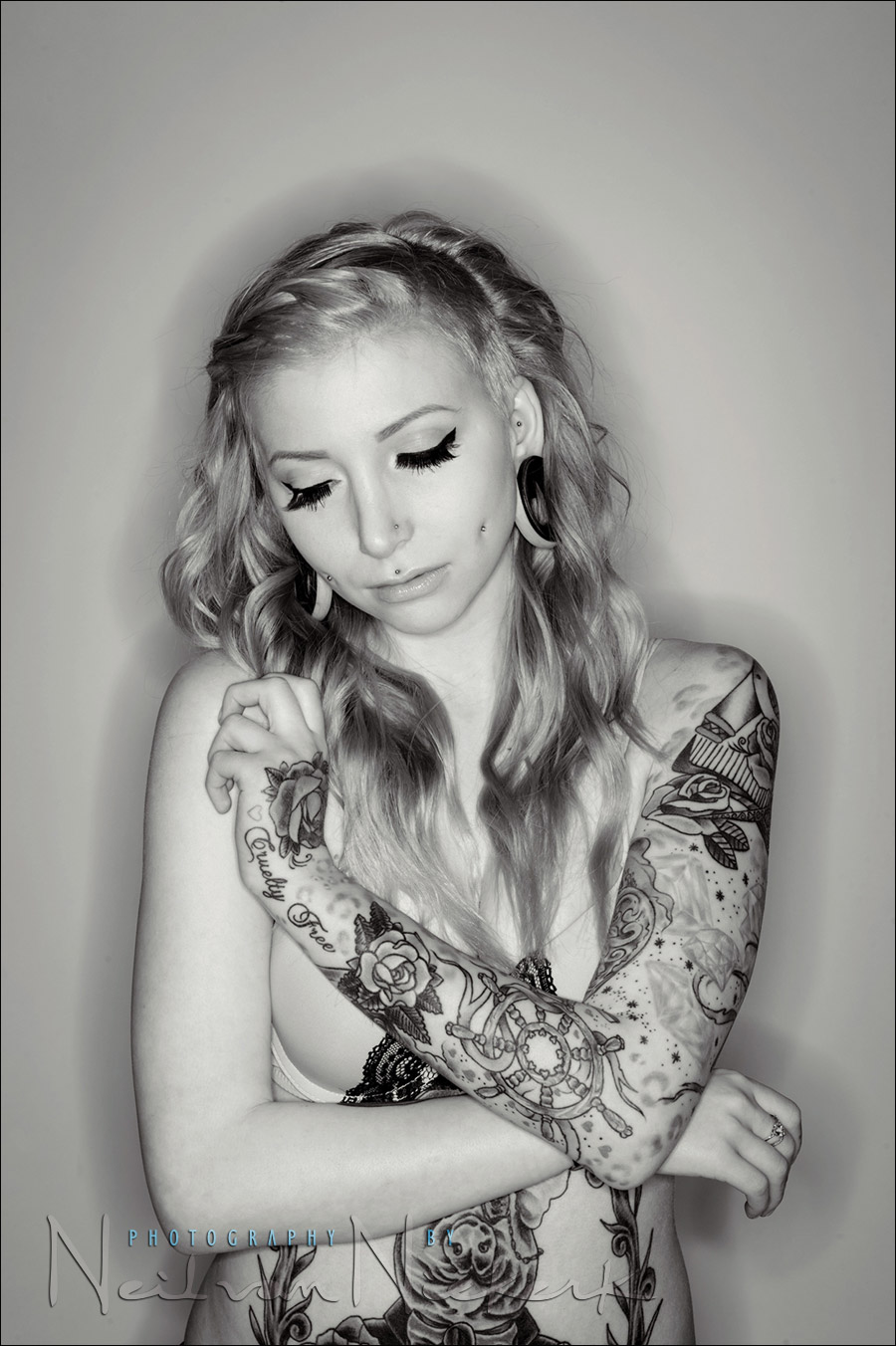
A few observations about using ring-flash in the studio:
- That shadow around her, is typical of ring flash, and because it is so distinctive, it is often used as part of the image. In other words, it is distinctly shown, as opposed to being hidden by adding additional light on the background.
- The light is very hard on the model’s eyes. You’re blitzing your subject directly in the face with a lot of light coming from the lens’ axis. So all my test shots were done with her eyes closed. I ended up shooting about a dozen images, and then went on to something else. I can only imagine how tiring it must be to have this flash go off directly in your eyes.
- Unlike other studio lighting, which are fixed on light-stands and such, the ring-flash is attached to your camera. So if *you* move, your exposure changes. Remember, manual flash exposure is dependent on distance. So for a few of the shots where I moved closer, I had to rely on the extra data of the RAW file to pull down the exposure a touch.
- To not trip over the power cable from the Profoto Acute B2 600 Ws powerpack (affiliate) to the Profoto Acute 2 Ring-Flash (affiliate), I had the Power Pack slung over my shoulder. The cable was also coiled loosely over my shoulder. I felt a little like Indiana Jones.
- edited to add:
The one limitation in how I used this ring-flash is perhaps in that I didn’t use it with a modifier like the Profoto Wide Soft Reflector for Ring Light (affiliate). This would’ve turned the ring-flash in a kind of beauty dish that fits around the lens. And it would appear that the nuisance value to your subject might be reduced with this.
So there it is. I still don’t like the look. The subtleties in light that generally appeal to me, are gone since the ringflash is purposely such a stark flat light. My tendency is still towards softer light, as shown in a previous article where I used Westcott Spiderlites to photograph Morgan.
But before I am forced to hand in my Cool Photographer card, I am still open to persuasion. If anyone has examples that I should see where the use of ring-flash enhanced the subject in a way that no other lighting setup could’ve … let me know. I’d love to see.
Photo gear (or equivalents) used during this photo session
- Nikon D4
- Nikon 24-70mm f2.8G AF-S / Canon 24-70mm f/2.8L II
- Profoto Acute 2 Ring-Flash
- Profoto Acute B2 600 Ws power pack
or alternately, the Profoto B1 500 Ws portable flash
I’ve played with the ring flash a little bit, and it seems like it usually produces an overlit look. But I like the look I got in these couple of shots:
https://www.facebook.com/photo.php?fbid=493009168285&set=a.239700573285.136073.818243285&type=3&theater
https://www.facebook.com/photo.php?fbid=493009368285&set=a.239700573285.136073.818243285&type=3&theater
-Mark
The ring flash is no different than other unmodified light sources in many ways; use it with the Profoto 15″ Wide Soft reflector not bare bulb out of the box.
I was just thinking that putting a hog in a top hat on your midsection was a gutsy choice. Then, I remembered the Hello Kitty steering wheel cover. She’s a risk taker!
I agree Neil. Those shots look pretty flat to me. The little halo effect is kinda cool, but I’d like some shadows better.
-Merrit
Rich. Ring flashes are different than other light sources in that they pour light onto your subject directly from your camera position in every angle possible.
In my observations, ring flash is similar to on-camera direct flash, but eliminates the direction of the hard shadow. Instead, it softens it up just TINY bit.
The only time I’ve contemplated using ring flash for a project is when I want very interesting/distinct catch lights in the eyes or glasses. But, I most always use a beauty dish overhead, which gets away from the ring flash principal.
Hi Neil. I have a limited budget, so I have to get a lot of use out of my profoto ringflash. I use it both in the studio as well as outdoors. But you are very correct in saying that it produces a flat light when used on camera. As a result of that, the few times that I do use it on camera, I only use it to do those high-key photos where the skin tones are overexposed. Some of the younger crowd seem to really like those images.
I do use it a lot off camera mounted either on a light stand or with an assistant using it on a stick. I always use some kind of white diffusion cloth to cover it when used in this way. I have a large reflector mounted on it much like a beauty dish. I can easily clip the cloth right to the front of the dish using small paper clamps purchased at a stationary store. This setup gives me enough power to use it as a key light for groups of people during mid-day. I can also mount it to a tripod if I want to use it a little lower to the ground perhaps for a fill light. And because it’s not huge like a softbox, I don’t worry about gusts of wind.
Key light, fill light, on camera, off camera, indoors, outdoors on location, bright conditions, overcast conditions. It serves many purposes for me.
Doug
Trent, while you are contemplating using ring flash I am teaching advanced studio lighting and fashion photography (including the use of ring flash) at the International Center for Photography in NYC. Just saying.
The ringflash option that intrigues me is this: https://www.roundflash.com [no affiliation] Lightweight, portable, TTL compatible, and a little softer. I haven’t been able to justify it to myself yet though. I’m curious if anyone else here has used one and has thoughts on it.
Gotcha Rich. Guess that makes my point invalid then?
Trent- Sorry for jumping on you but the part of your statement about ring flashes pouring light onto your subject in every angle possible is not correct. When you add a ring flash reflector or sunhaze you are enlarging and diffusing the light source and the light coming from an increased number of angles fills in more of the shadows on the background.
I’m glad you said it Neil
I’ve never really “got it” either, but each to their own I guess. To me it just looks weird
While you still want to give your models breaks when shooting with ringflash you can significantly decrease the blinding effect by increasing your ISO.
I have found that when wearing a power pack the Kata 3N1 sling is much more comfortable than using straps on the pack. I’m using the 3N1-30 to both transport and shoot with my 17lb Ranger RX pack; you might find one of their smaller slings better suited to your 8lb Acute B2600 and ring flash.
hi,
Neil,
I have received the book “Direction of light”. I live in Malaysia. thank you very much for such good book.
I’ve never been a fan of the ring flash as a primary light source. It’s incredibly popular in fashion work. I know that you can diffuse the light or work with various grids to soften the light a bit, but if you’re going through that much trouble why bother with it? Wrapping the cord around you is also a tad annoying.
I would much rather work with umbrellas/soft boxes and a beauty dish.
Got to agree with you Neil. I’m not a fan of ring flash look either.
I’m a fan of your work, Neil, but I think you missed a few things in this article.
Certain kinds of photos work well with ringflash and certain things don’t. Ringflash will look much better on shots with punchy saturated colors. Whatever that desaturated vintage tone preset you applied to the first shot is, it’s definitely not the right direction for ringflash.
Second, a model should be used to studio strobes and should not have to close her eyes during a shoot.
Ringflash is often misused by photographers who think it’s just a cool photo effect, just like instagram filters are often used to make boring photos look arty. You should only really use a ringflash when your subject matter really calls for it and it fits with the style. In the photos you posted, it’s just a girl kinda standing there not really trying, no fashion or props. So just like adding an instatgram filter won’t help, a ringlight won’t help either.
Anyhow, that’s just my opinion. Thanks for all the info on your blog.
It’s a matter of personal taste, but to me the ring flash really works for the color image. You’ve presented her in such flat and graphic way that the overall look echoes her beautiful graphic tattoos. Conceptually sound!
I’m in your camp on ringflash. It’s just not a quality of light that interests me. However, I don’t agree with those who say “don’t knock it till you’ve tried it.’ Why would I want to light a subject with a style that I don’t even like? It’s all subjective, so there’s no right or wrong here.
Antonio/Aimee- You are both absolutely right about the ringflash being great for color. For those who are new to lighting and reading this thread I’ll point out that this is because the subject is being front lit. Front lighting a subject brings out color just as side lighting a subject brings out texture.