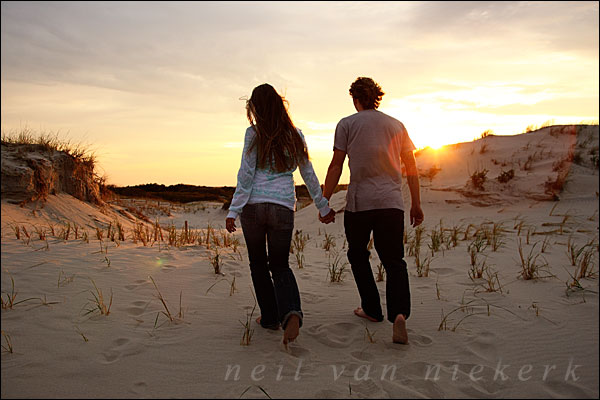
During the portrait sessions with my couples, I try to maintain a fluid style of photographing them. Instead of rigidly posing I try to direct only a little, adjusting my position and my composition. I really want as natural looking and flattering portraits as I can, while getting a variety of images. For these reasons I move around a lot while shooting … and I often try to get some lens flare on purpose. I love the way the image warms up and the flare creates pools of light within the image.
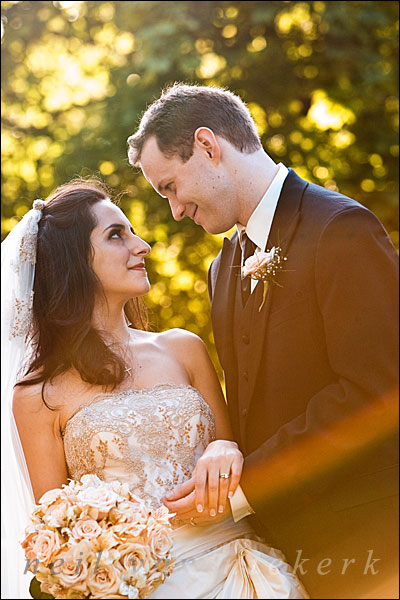
This is an unpredictable effect, but when it works, I feel that the flare adds something to the mood of the image – perhaps an image that is more romantic because it is drenched in light.
I shoot in manual exposure mode since I don’t want my composition to affect my exposure and because I want as fast and efficient a workflow as possible. But then I sometimes get a few frames that blow out completely because of the amount of flare …
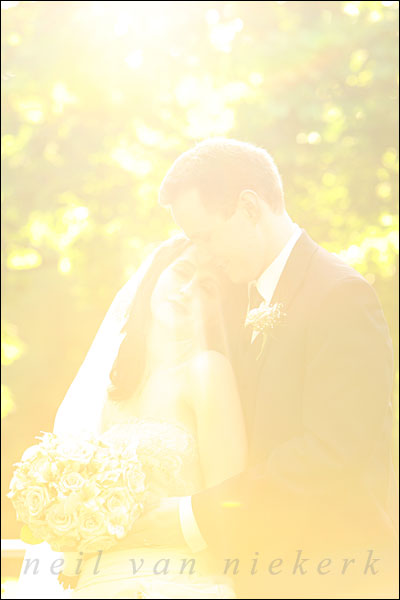
If I had shot this in JPG, there wouldn’t be much there to work with. But since I only shoot in the RAW format, I’m more often than not, able to pull back something from that kind of image and get something that works and really looks good.
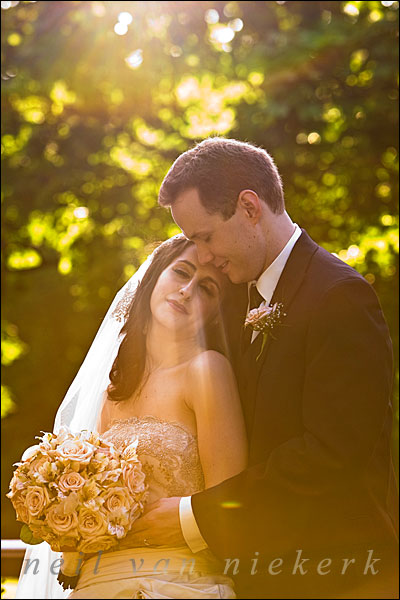
As much I believe that an approach to ‘get it right in camera’ is without a doubt the best way approach, much of photography done outside of the studio is under less than perfectly controlled situations. And there is simply no photographer good enough to be able to set the exact exposure, correct white balance, and proper contrast and saturation while busy shooting in a situation where the light and conditions change while shooting. So this already presupposes that to get something more from the out-of-camera image, that post-processing of some kind will be needed, it just makes more sense to shoot in the RAW format.
In addition to exposure adjustments, and white balance and contrast and saturation, other parameters such as sharpening, local contrast, black point and brightness can be adjusted at will with a RAW file.
Another way to look at it is that with the RAW format, your worst case scenario is that you’d have an image which looks like your JPG that you would’ve had.
.

.
This brings me to a related topic – the implied insult that I’ve seen a number of times on the forums that if you knew what you were doing, you wouldn’t need to shoot in RAW format. Simply get it right in camera .. all the time. That may work for controlled environments, but I photograph in an uncontrolled environment.
Here’s an example. Even though I had my exposure and WB nailed during the actual photographing of the wedding ceremony, when the couple kissed at the end, quite a few of the guests took photos at the same time. Someone else’s flash blew out my photo by more than a stop.
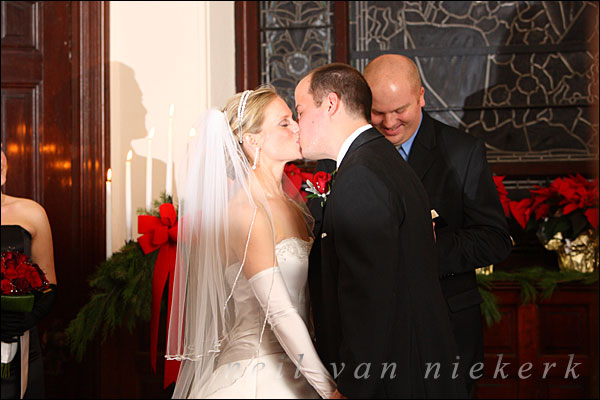
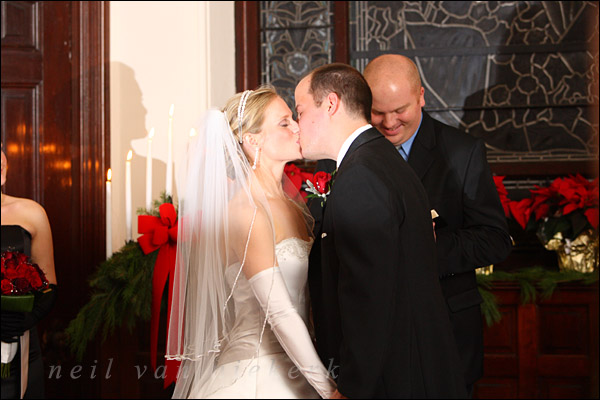
In this case it might be fixable in a JPG image without being really noticeable, but who cares? It is so much easier doing this as part of a normal raw workflow – merely dragging the Exposure slider down until the image looked good.
I also wanted to use this image here as only one example of being able to give my clients an optimal image without breaking a sweat because something was out of my control at the time.
.
.
In a large way, my choice of workflow heavily affects my shooting style. It’s as simple and broad a statement that shooting in RAW frees me up to concentrate on the actual moment of taking any photograph.
Shooting in raw also limits the number of photos you can take on one flash card, so that if your flash card goes bad, you’ve only lost that small number of photos. The downside is that you need to carry around lots of flash cards, and you need a lot of memory on your computer.
Speaking of carrying lots of flash cards…Neil, I saw you with a nifty looking flash card carrying case at Ken and Amy’s wedding. It looked like a CD carrying case, but with perfect sleeves for flash cards. Where did you get it?
Thanks again for the terrific insights!
In a private tutorial session months ago, Neil mentioned to my wife and I that not only does shooting in RAW help the photographer in recovering from badly exposed shots, but it also helps if you want to do some artistic effects. If you want to make the photo “black and white,” it was easy to do it in a RAW editor quickly.
Concerning RAW size, although RAW takes up more space than JPG, there are large-sized memory cards out there. I have an 8GB Compact Flash card, which on my Nikon D200, will store about 480 images. Thus, there is a possibility for losing a lot of photos if the card goes bad.
Hi Neil,
Just wanted to thank you for all the info on here. I have had you bookmarked for 5-8 months and always learn something from your post. Again thanks
Jim
Hi Neil.. see you again.. I’ve been thinking a lot about exploring your flash technique using proper speedlite. Finally I bought an SB-600 and change it into SB-800 a few days later. Sure, it’s really a big difference using 3rd party speedlite versus Nikon’s..
Talking about RAW, yes, I completely agree with you. Last month I got a project to shoot 50-yrs wedding celebration in Padang Style (one of so many cultures in Indonesia). And I found that the lighting was so terrible. You got a very shaded area inside the room, a dim incandescent light on the stage, while the background of the stage is very reflective (dominated by gold and mirror-like accessories).
I’ve tried to use JPEG for several test shot and found it’s hard to get the correct WB due to the background and lighting situation.. Later, I decided to shoot in RAW and corrected it easily in CaptureNX..
So, in summation, I’m a RAW believer too :)
I bet those people that say you should shoot in jpeg all the time if you know what you are doing are also the same “elites” that only shoot using “available” light and are anti flash etc.
From my research jpeg shooters use the same amount of memory as raw shooters they just have to take many more frames to compensate for the ones they lose in situations just like your example above.
Seems to me that you know what you are doing just fine!!!!
Well, I’ve been out and about and as you suggested I’m to use manual settings…
I’m getting happier with the TTL flash now…
But on metering, I generally use a grey/white card in my studio…
So why can’t I use the card outside for exposure and WB?
Regards
Clive, in the UK
Amen! And I was dealing with some guys who just simply couldn’t get over saying that “if you’re good enough, you’d get it right in camera”.
Not if you’re shooting a concert with 100+ moving automated lights and a handful of POS flashes going off in the 30 feet near the stage… Among the other factors at a concert xD
It’s a workflow thing. All that matters is the end result – and RAW is a means to that end.
My curiosity has peaked. Have you ever shot a concert, Neil?
Hi Neil,
To be honest, I absolutely love that 3rd image [one “blown out” before you ‘fixed’ it] as I reckon it would make an absolutely fantastic ‘romantic fade-out’ shot in an Wedding Album, hell, I even deliberately create those types of shots from a ‘good’ one just to get that effect for albums. :)
Veeeeery nice.
Trev