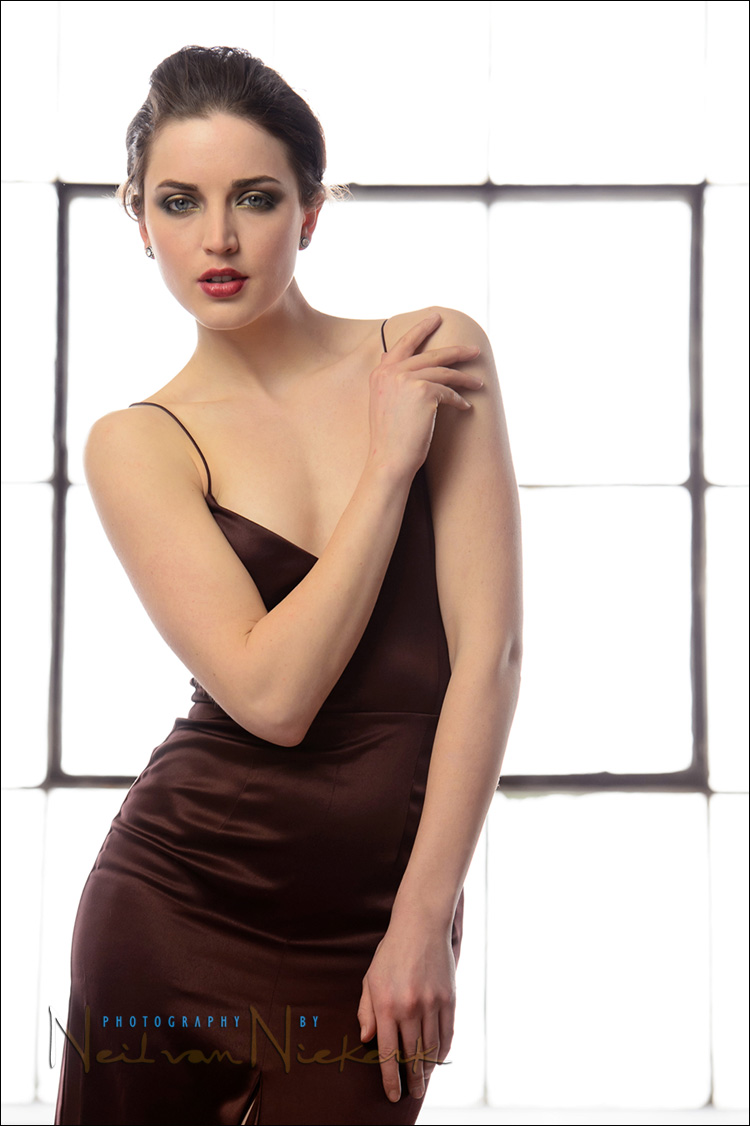
Continuous lighting – Westcott Spiderlite TD6
The beauty of continuous lighting, such as the Westcott Spiderlite TD6 (B&H / Amazon) , is that you can see exactly how the light falls on your subject. It is easier now to nudge your lighting to the best position, as well as your subject in how they should move or pose.
The Westcott Spiderlites can take a softbox, which gives you beautiful soft light. The downside of these lights, are that they usually aren’t very powerful. Unless you are working with a tripod, you’ll have to rely on higher ISO settings and wide apertures.
They now sport larger and brighter daylight-balanced (5500K) fluorescent bulbs. These bulbs have a high CRI of 93, which is an indication of how good the light is compared to actual daylight. The Spiderlites can take Incandescent bulbs as well, but I preferred using them with Daylight balanced bulbs.
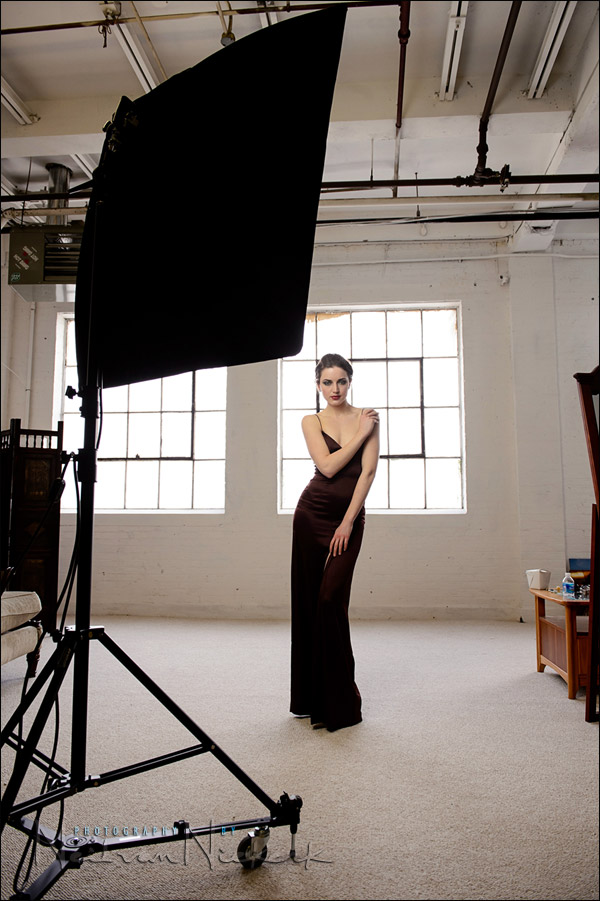
The pull-back shot to show how the Spiderlite was placed:
Below, the ambient-only photo:
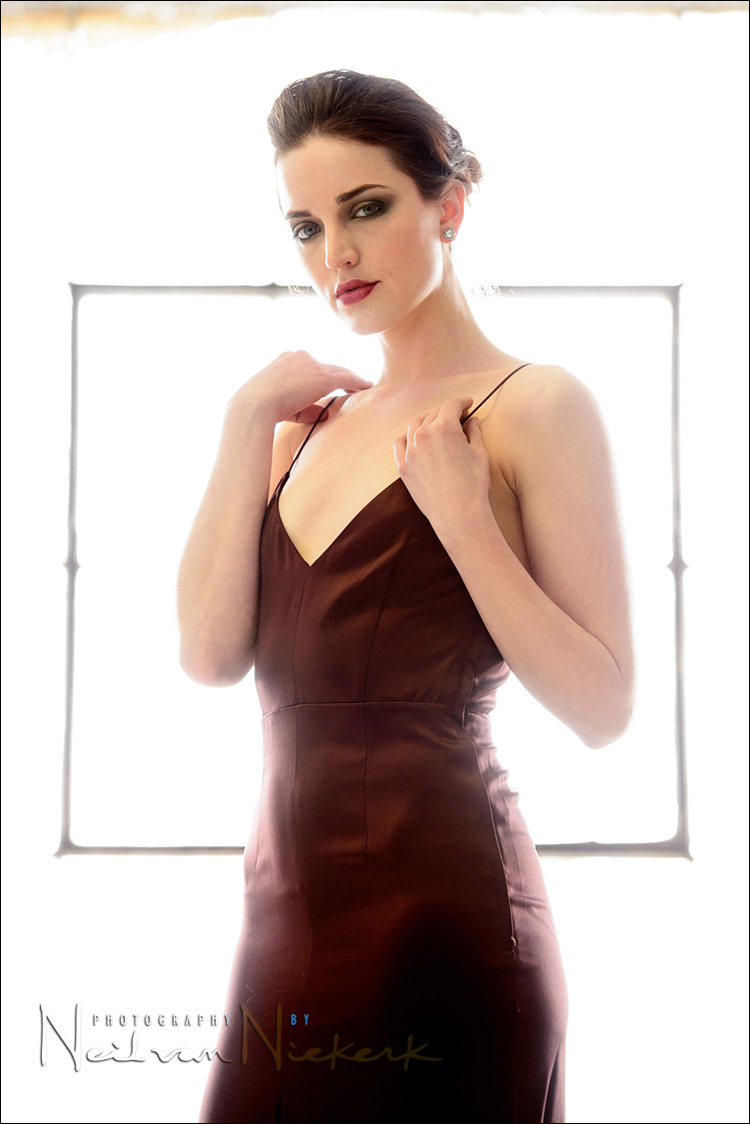
The image above is the available-light only photo – it does have a high-key look that work well, but there was no control over the contrast, and some of the highlights are sacrificed. Camera settings: 1/125 @ f4.5 @ 800 ISO.
By adding the Westcott Spiderlite TD6 (affiliate) with the large 3’x4′ softbox, I was able to bring the exposure settings to: 1/250 @ f/4.5 @ 800 ISO (as with the top image). The light on Anelisa is now balanced better with the background … while still allowing the background to blow out. Of course, the same could’ve been achieved with a touch of flash and a large softbox.
To create a promotional video clip for my studio, I had Anelisa stop by the studio so we could do a variety of looks. We used available light, continuous light, and studio lighting. It is also the first time we saw each other since the release of my new book – Direction of Light – so I was able to give her her copies. (In case anyone missed it, Anelisa is on the cover.)
As we reminisced a while about the number of times we had workshops and photo sessions, I realized that today was exactly three years, to the day, since the first time we worked together. The photos from that personal photography workshop resulted in one of the key articles on Tangents – effective on-location portraits. So yes, it’s been a long working relationship with Anelisa, my favorite model.
I love this photo for the elegance of the pose, and simplicity of design. I somehow feel that the more I grow as a photographer, the more stripped-down my images become. Less clutter. Less complicated. (And she looks hot there!) In addition to that, I also *really* like the lighting here. It is soft and flattering.
About the Westcott Spiderlites
With multiple light setups, you might end up setting one of the lights to be dimmer than the others … but I’m going to take a guess that if you are using just Spiderlite, you will pretty much just switch it to full power and keep it there.

The available-light photo is one of the best I’ve seen on your site! The high key look is wonderful and in stark contrast to the ring-flash images that I found rather uninspiring. You enjoy a great relationship with your model and it shows… the images don’t look contrived at all. Beautiful, Neil.
Really like the use of the casement to create a frame within a frame. Looking forward to seeing you at AD!
Dave
Just got my third book.
Anelisa on the cover is a hit in my book.
Today, Anelisa with make-up, hair do and a gown – OMG ! !
Fred Hoegeman
Macomb Mi.
Gorgeous! I totally love the way the window washes out except for the center frame work, very simple yet elegant. Reminds me of your work at the mall entrance. It gives such a dreamy look your attention can’t help but be centered on the subject.
Enjoy your new studio, I’m sure you’re having a ball!!
Anelisa looks amazing she has always looked beautiful in each of her portraits, but begin he first time I’ve seen her in full on makeup she’s totally breathtaking.
Wow…gorgeous high key lighting with spectacular model.Congratulations,Neil!
funny how you answered the exact question I was thinking about the image :) I am glad as always to see the behind the scenes info and pull back shot
The first thing that came to mind when I saw the teaser image was wow… Tighter portraits usually don’t make me say “wow”, but the way everything is balanced is just perfect. You nailed it.
Hi Neil I received my copy of the book this week. Thank you so much it has been a great read and something that I will keeping close to hand to refer to..
Thank you
Matthew Finnigan
Fabulous!
(and I love hearing WHY a photographer chooses a particular shot as “favorite”… thanks for answering that!)
You added an unexpected element in the window with the dark outline acting as a double-frame, further leading the eye inward to linger with your beautiful model.
Congrats to you both on the anniversary of such a long, successful working relationship, too.
This young lady is a really good model…Great images Neil!
For me, “Hot” is a very relative concept.
Anelisa is incredibly lovely and sexy, in a different and unusual way.
And this can be seen more easily on video.
Personally, I think she was more beautiful in the picture of the book cover.
But the light in this photo is spectacular!
Congratulations on your work!
And thank you for sharing your knowledge!
Hey Neil!
I only use the TD5 for my newborn photography, as flash (they say) is not good for newborns plus can be distracting. I use the 54×72 shallow box and too find the power just isnt enough. I’m always around 640iso, 1/80 and 4.5… I wish I could be at a lower iso, for my taste in sharpness. Plus, the design needs to be reworked because disassembling the softbox from the TD5 is always very difficult bc of the tension. Do u find that or is it just with the large box? I actually need a nonslip piece and my husband’s elbow grease to pull the ribs from the light fixture!
Amanda
Amanda .. I would agree. This softbox does need some muscle to get it assembled. It is sturdy though. But not fast to set up. (That’s why I went to the Lastolite softboxes for speedlights for when I use flash.)
Hi Neil,
as those fluorescent lamps don’t have a continuous spectrum of light like incandescent bulb (see https://en.wikipedia.org/wiki/Compact_fluorescent_lamp#Spectrum_of_light – did you ever notice problems with the colours in your photos?
Marcel
Marcel .. these fluorescent lights are a far cry from the green-hued industrial tubes that you might be thinking of. The light really is quite neutral.
In fact, I’ve replaced the ceiling-mounted incandescent lights in my office with these. Much easier on the eye than the yellow tungsten lighting.
Great posts!! Glad to hear you love your Spiderlites!