why I love off-camera flash
There are a few reasons why I love off-camera lighting, and I want to show some images from a recent photo session with one of my couples, Jill & Mike, as an example.
The main reason for me, is that you can have perfect lighting on your subject’s face with much more freedom than if you just relied on the available light. I am usually quite particular about the backgrounds to my photos, where it is in my control. The backgrounds need to be complementary, or add something to the image. I have a preference for an out-of-focus background. The defocused backgrounds create separation that helps my subjects pop out.
When I only use available light with a photo session, I am reliant on finding both a good background, AND great light on my subjects’ features. However, when using supplementary lighting, (such as flash with a softbox), the pressure is off. I pretty much just have to find a nice background, add my subject, and then use off-camera lighting to light them properly. Dead easy.
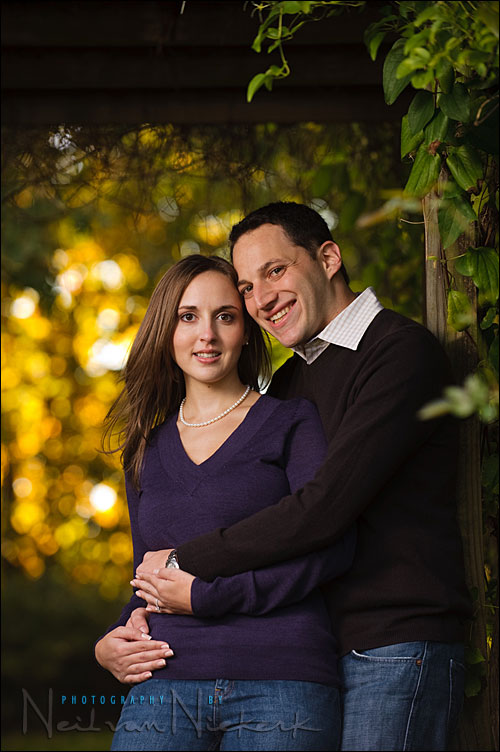
The image at the straight-forward portrait of the couple against a background which I knew would work – the sun-soaked leaves in the back would create a golden glow behind them.
However, where I wanted to position them in this wooden archway overgrown with plants, the light on them wouldn’t have been flattering. The light would’ve been top-heavy and given dark shadows under their eyes. Therefore I needed additional lighting. In my opinion, that intersection between “best light” and “simplicity” is around the point where you use an off-camera flash in a softbox.
camera settings: 1/250th @ f4 @ 400 ISO
My flash (Quantum T5D-R), was in TTL mode, and in a softbox. My settings were chosen for the background. I wanted it to appear exactly like that. I then positioned the couple, and added light from the softbox to camera left, with the softbox held up by my assistant, about 2 or 3 feet higher than the couple. You nearly always want the light to come from a higher point with simple portrait lighting.
The key here for me would be the simplicity of using the flash like this with a softbox.
Another image, where I moved so that I was viewing my couple through some leaves. This creates a more intimate look, and the leaves create a kind of border as well, highlighting her expression.

Now, you have to realize that with this kind of image, if I had used flash on my camera, the leaves in front of the camera would’ve been over-exposed. The only way to get light on my subjects without lighting my foreground, is with off-camera lighting.
.
Another image, where I was in love with the way the background appeared. I wanted to photograph the couple in front of it, but shaded by trees, they would’ve been completely under-exposed without flash. Or else, if I had decided not to use flash, but set my camera’s exposure settings for them … I would’ve lost the background entirely.
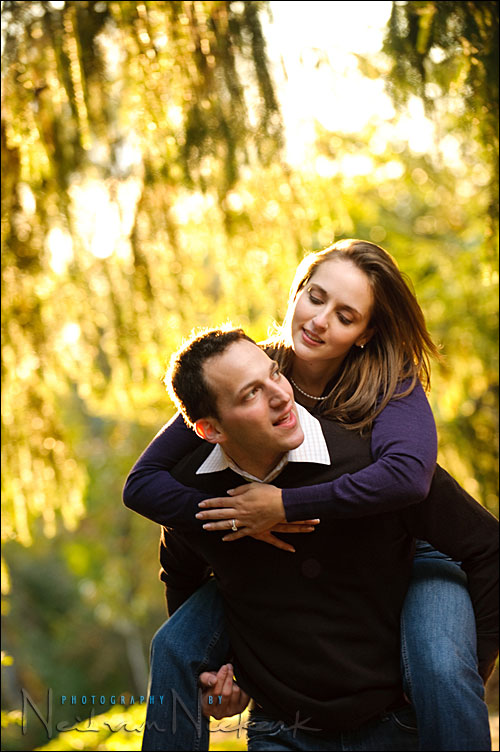
Therefore the only way to use *that* background, and get great light on them .. is with off-camera lighting. This time my assistant walked with them, holding the softbox up to camera right.
camera settings: 1/250th @ f4 @ 400 ISO
.
In short, the benefits of using off-camera flash:
– you can have perfect lighting nearly anywhere,
– on a grey day, you can make colors pop, and bring in some necessary contrast,
– you can control your background exposure, and therefore the way you position the background.
And as an extra, one of the images where I didn’t use (or need) additional lighting:

Great examples, You have me hooked to this method which has made a huge impact on my photography. The downside is now I have to pay an assistant, the upside my sales are up because my images are better!
I’m so with ya Neil. I did a portrait shoot for a friend at a local garden that she really wanted to shoot at, and it’s not exactly legit without approval. I wanted to be stealthy, so I didn’t want to bring my standard off camera setup. I took it as a challenge, to get great natural light shots. I found that it was just so limiting! I only found a couple places with good subtractive lighting overhead, and then I was just stuck with whatever background happened to be there. No where in the open looked good. Well, that’s the last time I try that experiment!
Neil- Excellent post with great examples. I’ve for the most part been a natural light shooter – which means I look for light AND backgrounds that work. But I’ve come to realize the value of making a good background work with some off camera light as in your example. Excellent!
Jonathan
Neil, Thanks for the article. In cases were you’re on location and need to get the assignment done there is no better choice than to use an assistant, there is diversity in using someone to hand hold the lighting. Annie Liebovits uses a lighting assistant constantly to get the suttleties that makes the perfect image. But I have when there was time, set up the light on a stand and was successful without an assistant.
Neil, lovely images as usual. Thanks for the detail. I have a question about “mixed lighting”. If this were an indoor shoot where the lights were florescent I would not be surprised to hear comments to use green gel on the flash to balance the flash with ambient and to set the white balance to florescent to avoid “mixed lighting”.
Now in this case the predominant ambient light is also green and yet you are using flash and don’t mention the white balance and I assume no gelling. Which makes this mixed lighting. It works – you expect the greenness of the leaves and the white light on the faces works too.
Could you comment on the difference, please and tell me what you did for white balance? I am assuming that because we expect to see green leaves it works and that you used a flash white balance setting (or custom wb).
Thank you.
Hi Neil,
Beautiful photos. And actually more aware of the importance of the background since following your blog.
I’m also keeping a shopping list of things to buy and my list keeps growing!
From you recent “wedding formals” post, I added two umbrella’s to cover indoor formals. Now I’ve added the softbox! So I have to ask;
1.) is there a particular reason why you use the umbrella’s indoors (for wedding formals) and the soft box outdoors?
2.) could I just buy, say, one medium to large softbox for both the indoor and outdoor shots?
Many thanks
Ernst
Great examples, Neil, and also some great questions from folks above. My question is about your use of the Quantum vs. an SB-800/800 os similar speedlight. Did you do this for the extra power needed to deal with the bright backgrounds? Also, does the Quantum TTL work just as well as the native flashes? Lastly, does the Quantum fit in the same softbox rig you’ve shown with the Nikon flash? Thanks.
Killer photos! I love the backgrounds you used here. Did you have the ambient underexposed by 2 stops? Also, what speed-ring do you use for your medium Photoflex Litedome Q39 (24×32) softbox? Would I be able to use a Manfrotto Nano lightstand with this softbox? Right now I use shoot through umbrellas and I am wondering if this will help me get better light.
Is there any reason why you chose TTL over manual flash in this situation? Great work.
Neil
Am I correct to say that when your lighting is correct, in TTL mode, if you zoom with a lens or move you position the lighting changes the subjects brightness. How do you shoot with a lets say 24-105 lens?
thanks
M
I’d be interested in knowing what lens and FL are used on the shots you post (not just this one but all posts). I love your style and thanks for providing such a great site to learn. Love your book too – still reading it.
-Mike
I also live off flash shooting. My only problem is that I have 2 cameras on me all the time with prime lenses….it is hard to manage the flash sometimes… :)
Awesome shots Neil. I’m experimenting with the same set-up. I have my Sb800 off camera to left or right triggered by my pocket wizard in manual in a softbox. Im not a big fan of the commander mode its a bit difficult to adjust quickly. Does TTL off camera work when your firing it with pocket wizard instead of commander mode? I usually meter with my sekonic and try to get the ambient/flash ratio around 50% flash. Also when u use a flash off camera to the side, you dont use another 1 on camera for some fill??
Thanks for all u do to help us!!
BILL
Forgot to ask you Neil, what white balance do you use for a sitiuation like this?
Thanks again!
BILL
Amazing set of examples like always….and you make it sound too easy. For photographers like me who work alone what would you suggest?
I have tried light stand and flash, but its too slow to work that way. Is there any other smart to get “good” results with on-camera flash for outdoor shots esp. when i get only 15 to 20 mins to shoot bridal portraits, bride and groom and also with the bridal party…whew…i dont know why they allocate such short time for such important photos. BTW i am based in Sydney Australia.
I have been using your back wall bounce technique with good effect and works like a dream.Thank you for that!
Your site is incredible! After some searching, I have found little information on umbrellas, but may have (or probably have) overlooked some. I found the pages on “wedding formals,” this info here, and the equipment you use. I am wondering if you have any pages on using umbrellas for smaller groups (indoor or outdoor), or information on bouncing vs shooting through umbrellas and which you prefer for certain situations, etc.? Thanks MUCH!!
Thanks for all of the wonderful tutorials and keep up the great work!
Hi Neil
I was wondering what specific softbox you use with your Q flashes because the 12″x12″ quantum softbox you mention in your gearpage looks a bit small for such even lighting. In case you used one of your Photoflex softboxes is it a similar set-up as with a Speedlite?
Greets!
Thank you so much for sharing your wisdom :)
Yay! Your information is always so helpful! Neil, I am perplexed by the lighting on your last image posted here, if you did not use any flash or fill. The scene looks backlit, and fairly bright so I think you couldn’t use a slow shutter speed to light their faces. But their faces are so nicely lit. Did you use a reflector? Thanks for your time. ~Nancy
Hi Neil
In the comment posted by Rob, he questioned the ambient being under exp by 2 stops and your reply was …
12. Rob .. thanks! I didn’t specifically under-expose my ambient by two stops. My main consideration was the exposure for the background… I based my exposure on how I wanted the background to appear in this instance.
.
My questions are –
.
Did you exp for the ambient perse by physically taking a reading from this
.
OR
.
Exp for the subj without flash first and then look at how the background appears. Then added flash to lift the subject. To me this would blow out the background if you exp for subject.
.
Cheers
Ange..
Hi Neil
Thanks for the speedy reply.
When will you visit our shores here in Australia.
Perhaps a side link to see what sort of numbers you would expect to see, if you were to get some sort of respone.
Im sure your visit would be well represented by your loyal followers down under.
Cheers
Ange
First i would like to say, im very impressed with your descriptions and pictures on this page, very informative and excellent you have replied to everyone on here… I really hope you reply to me! :)
I having been photographing properly for about 6months since i bought a d90 with a 18-55mm kit lens and a 50mm prime 1.8 which hasn’t left my camera since i bought it. I like portrait/people photography by far and i have been offered a 17-55mm 2.8 which i have been told is a good lens for family parties/weddings etc, at a very reduced price, any reccomendations?
Also regarding lighting, you mentioned the softbox and assistant on this page, but i doubt im going to be able to have an assistant to hold the box up for me on my shoots, i’ve recently got hold of a sb 600 cheap and would love to get either an umbrella or softbox for multi use to start to understand lighting and get more proffesional results. What would you reccomend?
Thankyou so much! starting out in photography especially all the settings is a mind field, im slowly taking it in, but in bite size chunks, i love it.
Nick !
I love your website!!!
so filled with info and so much to learn thanks you so much, My brother asked me the other day “are you going to read everything on his website” ?
Guest what my answer was? YES!!!
Hi, i’m wondering if you can help me with an off camera flash question. I’ve just been asked to photograph a party tomorrow night and they would like a shot of ALL attendees together, which means 45 older men (ages 60-80) together. I don’t have lights. I was thinking of getting up on staircase and shooting down on them. I can try bouncing flash off ceiling so it falls evenly on all below, or add another flash off camera as well. Can you give me some direction on how to do that? Thanks!
Hi, Neil. I’ve long appreciated your site (and even use the foamy thing) but this is my first post.
My question has to do with balancing ambient exposure and flash output when having the sun behind the subject to provide a rim light such as we see in the last two images above. Do I need to do anything to espeically allow for the rim light or does it happen naturally, by which I mean just go ahead and meter for the scene and throw an equivalent amount of flash onto the subject and know that the rim light will be just right?
Thanks!
Wow!!! This is about the best post i’ve ever read on off-camera flash…thanks a bunch.