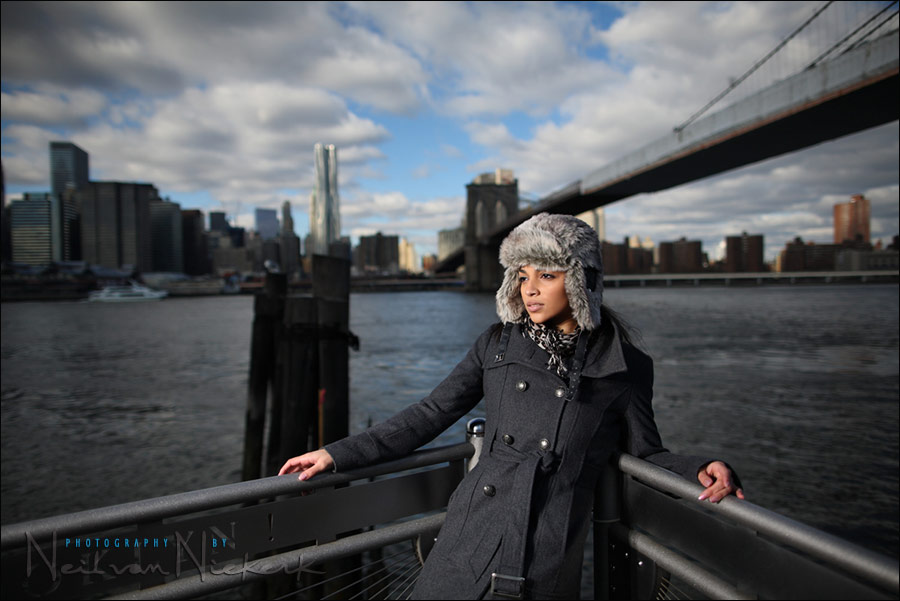
using multiple speedlights with high-speed flash sync
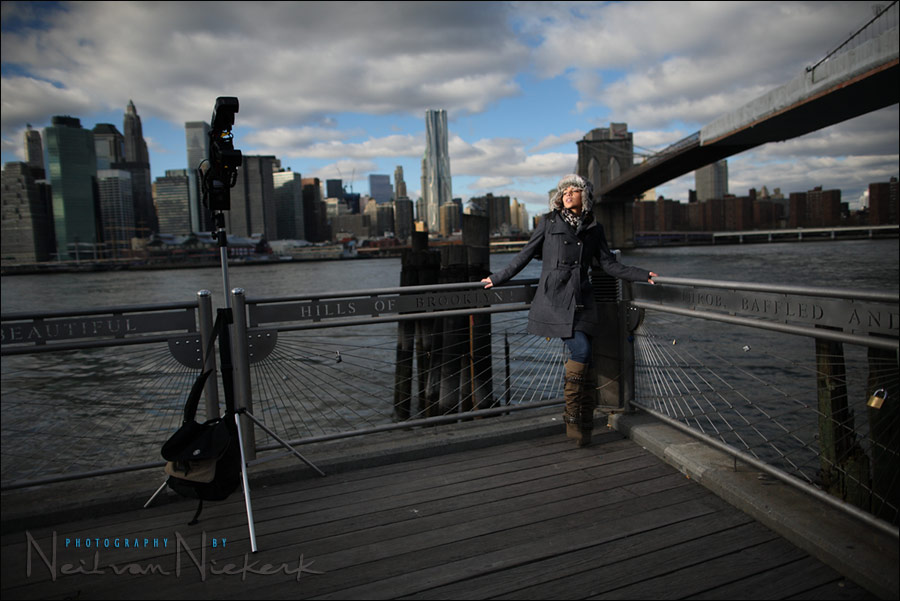
This photo of Angelique, our model, was taken at 1/8000 @ f2 @ 100 ISO. Yes, an eight-thousand-th of a second. The accompanying wide aperture (with an ultra-wide angle lens), gives a unique look to the image. The shallow depth-of-field and high shutter speed are mutually dependent effects in shooting in bright light. Working with a fast shutter speed, brought us into high-speed flash sync (HSS) territory.
Do keep in mind that this shoot was more of a technical exercise to work through the settings and see how the flash behaves when working in bright light, and needing either a faster shutter speed or wider aperture. (Or both.) In this case, we achieved shallower depth of field and a faster shutter speed. Obviously, in photographing a static model, the advantage of a faster shutter speed is lost. But when you do need the faster shutter speed, this is the solution.
With high-speed flash sync, there is a dramatic loss in effective power, as shown in this previous article. To overcome this, you need to work very close to your subject, or gang up a number of speedlights as a group.
Back to the sequence of images – I wanted to under-expose the city-scape and then use flash to highlight the model against the environment. So the lighting had to enhance the look of the wide-aperture wide-angle lens. The lens was the beautiful Canon 24mm f1.4 II (B&H). The camera that I used is the classic Canon 5D.
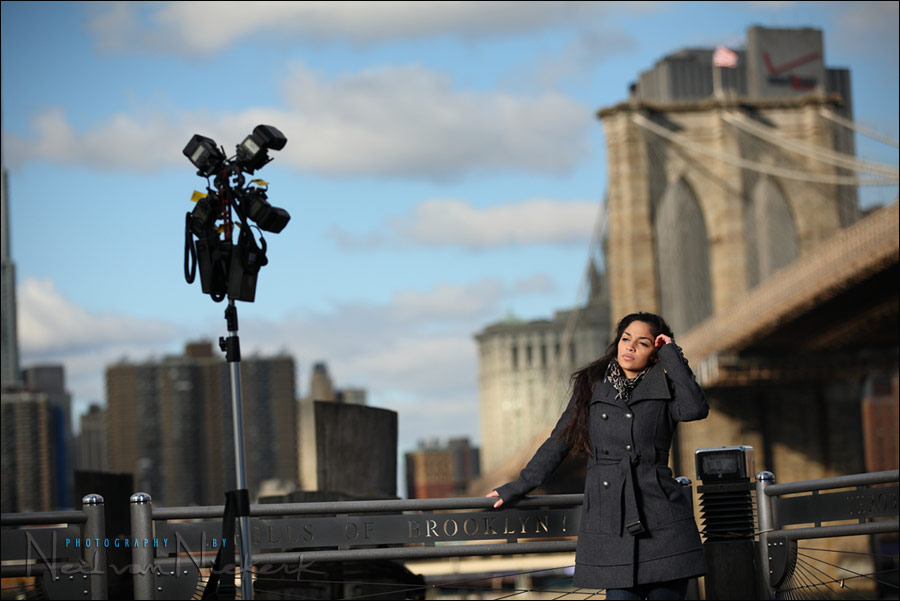
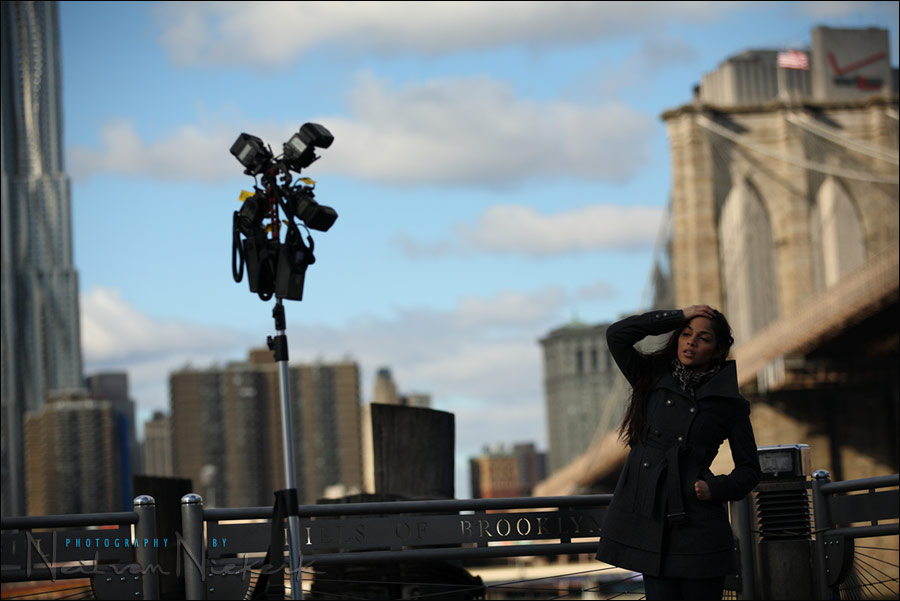
My friend Yishai, of HD PhotoVideo, had shown me his permanent set-up which he uses whenever he has the need of high-speed flash. His setup consists of four Canon 580 EX ii speedlights (B&H), held together via a Lightware Foursquare Block. To free himself up from line-of-sight restrictions, and give reliable control of these speedlights, Yishai had connected each speedlight to a RadioPopper PX unit. (They worked with perfect reliability during this shoot.) To have the speedlights recycle fast enough, they are powered by two Quantum 2×2 batteries (B&H). By ganging up four speedlights like this, we can start overcoming the loss of flash power when going into HSS.
To show me how these work on an actual shoot, we arranged to meet up with Angelique (on this icy cold day) on this pier in Brooklyn, for a photo session. Here is what this setup looks like …
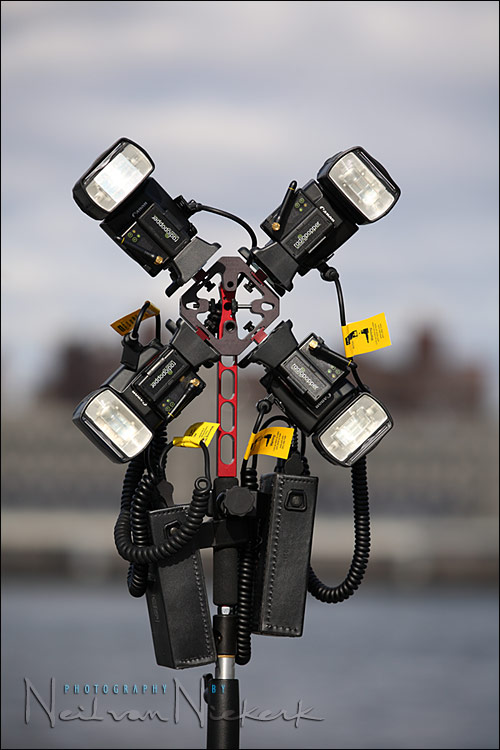
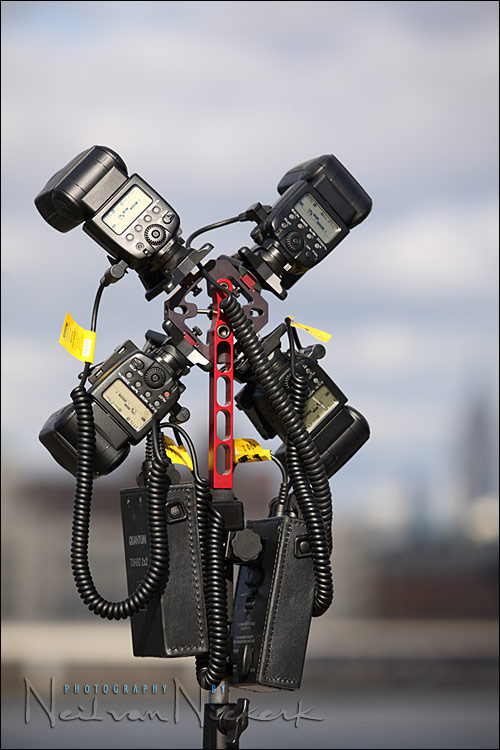
It would take a lot of time to assemble this from scratch every time, so Yishai keeps the four speedlights and four RadioPoppers connected with the FourSquare Block. Everything is then kept in a camera case. On a shoot then, the main unit is connected to a lightstand (via that red connecting handle), and the batteries attached. Elegant .. but if you add up the cost of this, it is spendy! But works very well.
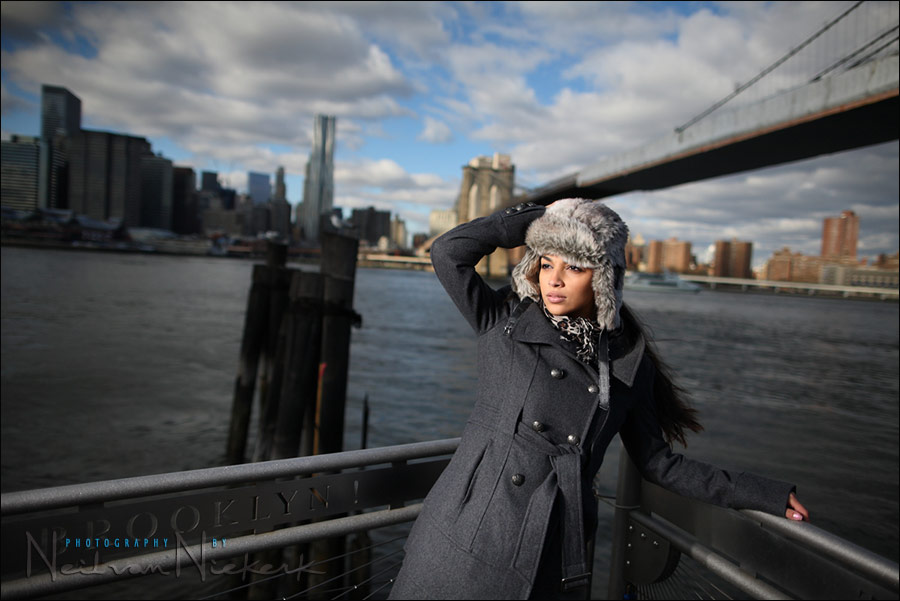
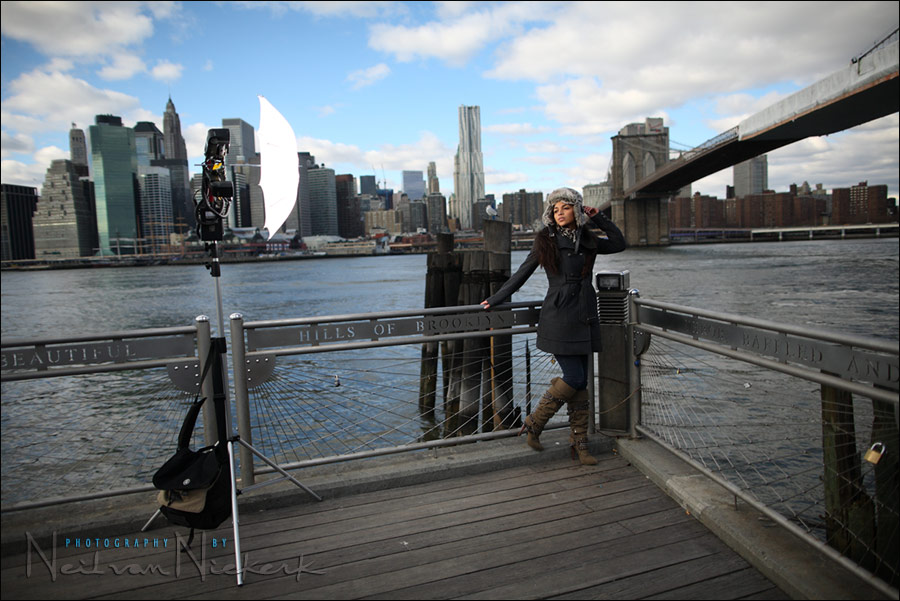
The pull-back shot to show the position of the lightstand:
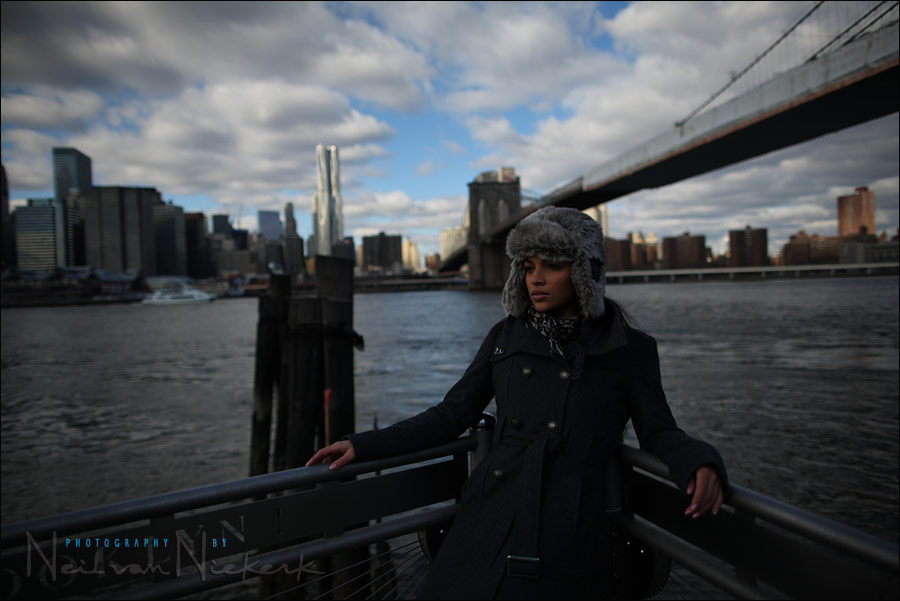
… and the shot with the flash disabled, so you can get a sense of what the available light looked like at the chosen settings of 1/8000 @ f2 @ 100 ISO
Another two pull-back shots showing the flash setup in relation to our model, with the flash firing, and one with the flash disabled.
Looking at that top image again though:
In using the four flashes like that without a diffuser, I saw that we got a double shadow in some images, depending on Angelique’s pose. Here is the 100% crop of the top image. You can see the double edge shadow there on her neck. Not that noticeable, but not ideal.
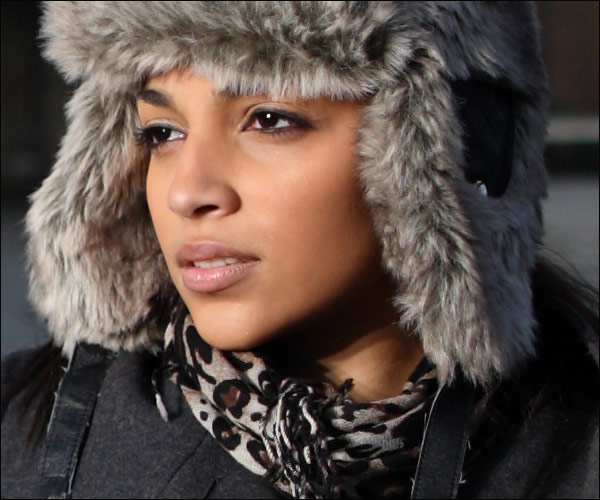
We then opted for adding a small shoot-through umbrella to diffuse the light a bit. This did cut down on the output, so I changed my settings to 1/4000 @ f2 @ 100 ISO to have the flash expose correctly. (This means we were close to the maximum output of the four speedlights.) The light was more even with the umbrella, and without that double shadow.
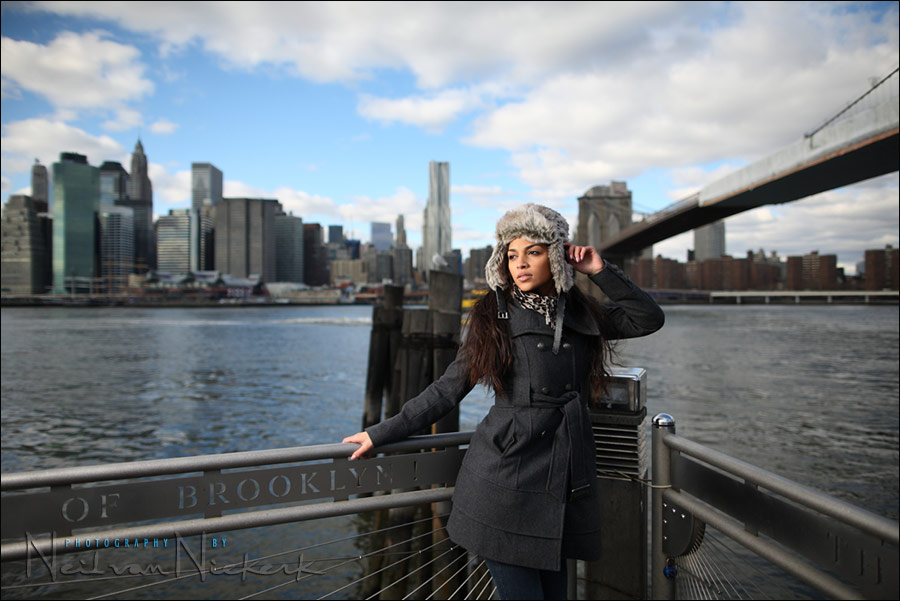
By bringing more ambient light in, the cityscape is less dramatically under-exposed, but the photograph still looks great.
summary
This was an interesting solution to working with high-speed flash sync and overcoming the limitation of loss of effective power. To get to maximum flash sync speed at f2 with this light, I would’ve had to cut down on 5 stops of light. The neutral density filter that I normally use, wouldn’t have been enough, and a filter like the Singh-Ray Vari-ND (B&H), would’ve been necessary to cut the available light down by that much.
A big thank you to Yishai for letting me play with these toys, and a big thank you to Angelique who was so patient with us on this freezing cold day.
related articles
- tutorial: Maximum flash sync speed
- Using a neutral density (ND) filter with flash
- tutorial: High-speed flash sync (HSS)
- Advantages of a higher max flash-sync speed
- Environmental portraits of a speedway racer
- Using a ND filter with flash to control DoF
Nice shot. I like the underexposed background.
That’s a pretty expensive rig of lights! Maybe 4 x $400 (580EX IIs) + 4 x $250 (RadioPopper PXs) + $100 (FourSquare) + 2 x $450 (Quantum 2x2s) = $3,600. But I know you can’t get the high speed sync with a studio flash.
Bob
Bob, it’s the first thing I did as well – a mental calculation. And that is why I mention the neutral density filters as the less expensive option.
Interesting setup Neil.. :P
Neil,
what time of the day did this shoot happened?
John .. the shoot took place between 11:30 and 1pm.
Neil, I understand your comment about the ND filter to bring down ambient exposure to within sync territory of the 5D (guessing about 1/200). However, wouldn’t this approach also cut down the flash exposure by 5 stops still requiring multiple flash units to get the power required to expose correctly?
However, using ND filters you could also use a more powerful portable studio flash head unit instead of speedlites as the high-speed sync function of the latter will no longer be needed.
Carlos … the ND filter cuts down both the ambient light and the flash. So you don’t lose flash power relative to the ambient light, when you use an ND filter. However, by going to HSS you do lose flash power relative to the ambient.
And that is why a ND filter will be a more efficient and a more cost effective way of using wide apertures in bright light.
Neil,
That is an expensive setup, but this article confirms all the other articles on high-speed flash sync. I remember reading a few of Joe McNally’s articles, where he ran eight or more speedlights to take shots in the middle of a bright day.
If you ever get a Singh-Ray Vari-ND filter, I hope you can do a review of that.
Cool setup and great images (as usual), but like others have mentioned, also crazy expensive. I question the use of ISO 100, though. Why not work at higher ISO to increase the flash power?
How about this for a solution, using only one Speedlite (maybe two):
Fader ND variable ND filter (up to 8 stops of ND): – $192
Pocketwizard MiniTT1 and FlexTT5 (ControlTL has optimized HSS, gaining back about 1.5 stops of flash output) – $428
Use ISO 400, which is completely clean on a 5D, thereby gaining back 2 stops – free
Consider the background exposure: 1/8000, f/2, ISO 100. Using 3 stops of ND filter (which is moderate enough to have a useable viewfinder and AF system) gets you to 1/1000, f/2, ISO 100. Going to ISO 400 puts you back to 1/4000, f/2, ISO 400, but makes your flashes twice as powerful. With the umbrella, where you’re losing a stop or so, you’re back at 1/8000, f/2, ISO400, but now your flashes are twice as powerful as before. And with the new Pocketwizard system, you’ll gain back even more flash efficiency. Heck, you could even add a second Speedlite to this setup and still be WAAAY under the cost of the other system.
You could also have opened that lens up one additional stop, if you needed to.
As cool as this solution is (and it is), I would suggest that you could get equivalent results for a whole lot less money.
Annnnndd of course, as soon as I posted my last comment, I realized the fatal flaw: the ND filter also cuts down on effective flash output by 3 stops. So it’s a bit more complicated that my method would suggest.
Nevertheless, I’m certain that this type of shot could be accomplished with a system that costs a whole lot less than ~$3.5k.
Mike .. you gain nothing by going to a higher ISO, since this bumps both your ambient exposure and flash exposure in tandem with each other. So your proposed method falls apart at that point.
I’m not familiar with the optimized HSS of the MiniTT1 and FlexTT5, since I only played with the units until the drawbacks of using it with a 580EX II become obvious. So I can’t really comment about the optimized HSS mode … but I do wonder if there isn’t some resultant loss of power as a result. I suspect they are playing around with the waveform of the flash pulse to get the majority of the power of the flash … but it does seem to imply there will be a slight loss in power.
Ultimately, a ND filter will be your most effective and most efficient and cheapest solution to working in bright light with flash, while still trying to maintain a wide aperture.
I do agree with the idea that a ND makes the most sense … but dammitt, this is one cool setup! Very sexy to use.
I just ran across a similar setup for sports photos:
https://www.youtube.com/watch?v=cP6a47BQA70&feature=player_embedded
Neil,
If you bump the ISO, yes, you do increase ambient and flash exposure. BUT, I’m making that up by lowering shutter speed, which ONLY affects ambient.
Re: Pocketwizard’s ControlTL system, what they appear to be doing is firing the flash much closer to the actual open/close of the shutter, thereby not wasting flash power. HSS is still less efficient than normal sub-X-sync flash, but it’s optimized relative to Canon’s system.
Mike .. I’m not following you there. If you bump the ISO, you would have to INCREASE the shutter speed to compensate, not lower the shutter speed.
Neil…if this particularly setup is something you want to pursue, you might want to check this out:
https://strobist.blogspot.com/2010/12/hangin-eight-with-dave-black.html
Thanks for your reply Neil.
Although I do partially understand your rationale for the ND filter use, I am still a bit confused regarding the flash exposure here. By using an ND filter ALL the light reaching the sensor (film) will be reduced equally by the amount of the filter strength; just the same as changing the ISO affects both in tandem as you correctly pointed out on your response to Mike above.
To bring the shutter speed down to sync you will need at least 5-stop reduction of the ambient exposure (1/8000 to 1/250), if you set up your sync at 1/200 this will bring the power output of your flash back to full but the total flash output that will actually reach the sensor will be equally reduced by a total of 5-stops. From what I have read from different sources over the years, HHS on an 580EX II will reduce the maximum power output by 2.5-3.5 stops (depending on where you read).
So here is my assumption…
The way you stated in the article the multiple flash setup is quite expensive so a cheaper way to achieve same result would be to use an ND filter to bring the ambient exposure closer to max-sync speed, and eliminate the HHS power penalty. I am assuming you meant using the ND filter with ONE speedlite rather than the four head setup (if I am wrong then please correct me).
If that is the case, my calculations suggest that with it an exposure of f/2.0, 1/200, ISO 100 (using 5-stop ND filtering), and flash at maximum power, the amount of flash light that will actually reach the sensor(film) will be only about 1/32 of the original. If you use a light modifier you may loose an additional 0.5-1 stop or more. That might not be enough to expose the main subject at a comfortable working distance from the light source itself.
Am I wrong in my thinking… I must admit I have never tried using an ND filter to balance flash exposure; always used HHS.
Thanks
Carlos, indeed with the ND filter, I am thinking of it as a means to use just a single speedlight, and still maintain a shallow depth-of-field in bright ambient light, while using flash.
Let’s step backwards through the settings.
(And we’re assuming a 1/250th sync speed here, just to work with full f-stop changes and round figures.)
Let’s say we have manual flash, and we have a specific working distance between the flash and subject, at which we are at full power on the flash, and just getting correct exposure for the diffusing / softbox / umbrella that we’re using.
Working with full sunlight, we have:
1/250 @ f11 @ 100 ISO … which is equivalent to Sunny 16 rule.
So in the scenario we’re looking at here as a theoretical example, we have a speedlight in a softbox, and it is just barely capable of giving us f11 @ 100 ISO for that distance, at full power.
(Manual flash exposure is controlled by aperture, ISO, distance, and power.)
If we desired now to shoot at f2 we will change aperture and shutter speed in tandem by 5 stops each.
1/250 @ f11 now becomes equivalent to 1/8000 at f2
Great so far.
But now we still want to add flash to that. The same softbox at the same distance.
But we lose around 2 stops of light.
The numbers you mention there of 2.5 to 3.5 stops sound right. It will change depending on shutter speed. That’s why the report-back by other photographers might vary. But they could all be correct, for their settings. So … let’s work with a 3 stop loss of light from our flash because of our need to go to high-speed sync.
Ooops .. we’re already at maximum output here with our flash for this scenario. We have nowhere else to go here. There is no more juice in our flash.
We now have a few options … gang up a number of speedlights to start compensating for the loss of light. And a 3 stop reduction in light would mean we’d have to gang up EIGHT speedlights!
Or we can move our flash much closer … but it might not be practical.
So let’s resort to our last option here … a neutral density filter. And we use the nifty Singh-Ray Vari-ND (B&H), that can give us a 5 stop reduction.
So now looking at ambient light,
1/250 @ f11 @ 100 ISO becomes …
1/250 @ f2 @ 100 ISO.
(our aperture has to be opened by 5 stops because of the 5 stop loss of light.)
So far, so good. But what happens to the flash output? It gets cut by 5 stops! So instead of getting an f11 exposure like we needed previously, we get an f2 exposure from our flash. And that is right bang where we need it for the shallow depth of field we wanted!
We cut both our ambient light and flash exposure by 5 stops. They moved in tandem.
So we’re still at max sync speed … and we are still working with the regular flash dissipation, and not going into HSS range. So we still have that full output from our flash.
We now neatly side-stepped the loss of light that HSS implies. If had decided to use HSS we would be 3 stops short of the flash exposure we needed, and this is way out of range.
Neil vN
There are potential drawbacks to a ND filter, such as the viewfinder becoming darker.
For what we were doing here, I would agree that a ND filter would make more sense … but this only works for when you need a narrower depth of field.
If you need to have a fast shutter speed, eg for action and sport …. then a ND filter is going to work against you.
So having a multiple speedlight setup like this still make sense in that you have a LOT of power when you need the juice and can manage to stay below max sync speed.
So you have lotsa juice available as manual flash and as TTL flash then.
And wirelessly controlled.
So I think if you wanted a flexible lighting setup, you could still justify to a large extent this set-up shown here, although there might be less expensive options out there.
But just for shallow DoF, a ND filter is a simpler and cheaper option, because you remain with a more efficient flash vs ambient ratio.
Neil, your response in #18 really clarified the whole argument and reason for use of the nd filter in situations like the example shown in today’s post. Brilliant and thanks so much for the detailed explanation!
So you were shooting at 1/8000 at F2 ISO 100.
which is the equivalent of 1/125 F16 ISO 100,
and it looks like your ambient was about 2 stops underexposed
meaning your ambient sky that day was: 1/125 F8 ISO 100 – which is less powerful than sunny 16 even.
I can’t believe that a $3600 rig can’t underexpose a less-than-sunny-16 sky by 2 stops if you use an umbrella.
I’m not a big fan of this system for portraits. The only way I could see it being handy is for high-speed sports
” … at that distance between the lighting and subject.”
Nick, I just added that line to make your sentence complete. For if I had moved the light closer, I could’ve had the faster shutter speed again.
So what do you propose then as a flash system that will offer you:
– the ability to go to HSS mode,
– more power than a single speedlight when in HSS mode,
– freedom from line-of-sight limitations,
– TTL control,
– fast recycling.
Part of what I was trying to illustrate with this article, is the massive loss of power when going to HSS mode when you do need the fast shutter speeds and wide apertures. One way or another, you have to work against that loss of power.
This setup is insane, with wonderful results and excellent explanations. Congratulations!
Thanks for your response neil. I completely overlooked some of those other benefits — TTL + remote power control, etc. — and focused on the power issue
I guess it’s not going to be for everyone, but it is a unique tool set that will undoubtedly play to the strengths/style of photographers who work that way. And, who am I kidding? If I had piles of money laying around, I wouldn’t mind having one of those in the back of my car!
Thanks for the post though – it definitely highlights some of the benefits and drawbacks of speedlights/HSS
Neil, What did Yishai have to say about why he doesn’t just use an ND filter? I’m sure you discussed it with him?
Seeing as he’s just shooting portraits what is his need for the high shutter speeds?
Also in your description you forgot to mention that you can zoom the flash heads to give you quite a bit more intensity to your lighting. Full power on a Speedlite means full zoom too in my book, makes all the difference when working in sun – you just need to aim it well.
Thanks!
George, as I mentioned in comment # 19, a ND filter doesn’t help you if you need a high shutter speed. It only helps with a shallow depth of field. So there are limits to a ND filter’s usefulness, even though it would’ve been my first choice for this specific shoot.
You’re correct about zooming the flash-head to squeeze more range out of the flash.
Thanks very much for the clarification Neil.
I will go out next week to shoot using ND and flash to practice this technique since I have never done this before… theory is great but in photography doing is the best way of learning.
Happy Holidays for you and yours Neil…
Hi Neil.
After reading your response I spent a lot of time going over it to make sure I fully understood… until I finally got my “Aaah! moment”. Now it all makes sense and most importantly, works out well mathematically. For the benefit of those still on the fence, here is how I finally got it.
The original setting called for exposure of f/2.0, 1/8000 at ISO 100, this required the use of the expensive multiflash arrangement using HSS to provide enough flash power to expose for the model appropriately. My question was if it was possible to replicate the shot using ND filter to bring down ambient exposure to 1/250 sync speed and then expose the subject using a single speedlite. Here is how it works out.
As you correctly pointed out, the equivalent ambient exposure here is f/11, 1/250 at ISO 100 -> a 5-stop decrease in shutter speed with a corresponding decrease of 5-stops of aperture yielding the same EV. So now that HSS is no longer in play, the problem is reduced to calculating correct flash exposure at f/11.
Using a Canon 580EX II, I choose for this example a flash head zoom value of 70 mm to provide an approximate field of illumation of 14ft in diameter with 10ft flash-to-subject distance(*). For zoom factor, the guide number (GN) decreases to 164ft(**). So for a GN of 164 at f/11 we can get a correct exposure at about 14ft(***) at full power, giving a flash coverage of 17ft at 70mm zoom, more than adequate to illuminate the model.
The problem here is the increased depth of field with f/11, a lower depth of field being needed for creative purposes. So a 5-stop ND filter is added to the lens decreasing all the light hitting the sensor by 5-stops. To compensate the loss of 5-stop created by the filter, the aperture is opened again 5-stops going back down to f/2.0.
So now we have three equivalent exposures:
1) Original: f/2.0, 1/8000, ISO 100
2) X-Sync: f/11, 1/250, ISO 100
3) ND filter: f/2.0, 1/250, ISO 100, ND 5-stops
So what happens to the flash exposure, since all the values were changed in tandem, the flash exposure remains the same as illustrated by these tables.
Flash Reaching Sensor Flash Needed For Exposure
ND(stops) Flash Power f/stop Flash Power
0 1 11 1
1 1/2 8 1/2
2 1/4 5.6 1/4
3 1/8 4 1/8
4 1/16 2.8 1/16
5 1/32 2 1/32
So is entirely possible to use the equivalent ambient exposure of f/2.0, 1/250, ISO 100 with a 5-stop ND filter, and get correct exposure of the model using a single 580EX II at full power 14ft away, thereby saving a substantial amount of money on the setup. This example doesn’t take into account any light modifiers which may reduce flash output by 1-2 stops and need to be factored in the calculations.
So how did I do?
————————-
* Minimum light coverage angle at 70 mm is about 64 degrees.
** GN information available from tables on flash user manual.
*** Using the formula GN = f/stop x distance (subject to flash)
Once in a while, someone comes along and articulates a point so well, that you say “I wish I had said that!”.
Carlos’ post above is exactly that, I think.
Carlos, you have it!
May I also thank Carlos for his excellent work on the maths! Now this may seem a stupid question, but, double shadows aside, would the two images – the one taken with the multiple speedlights and the one taken with the single speedlight with and 5 stop ND-filter – look identical? Or would there be some other subtle differences?
Just a point on the finance issue. If I could afford to own four speedlights, I would much prefer to use them individually in different positions to create a variety of lighting effects rather than to have them all bolted together. But then maybe that’s Yishai’s trademark? (Are we talking about Yishai Shapir?)
John … for these portraits, the HSS image, and an image taken with a ND filter (and a single speedlight) would look the same.
With an action photo, you’re obviously not getting the action-stopping shutter speeds anymore. But for simple portraits like these, there would be no difference.
Keeping this all connected together as a unit, makes setting up much faster than it would if individual speedlights were to be set up.
I pray for the day canon will invent a unit which is as powerful as the elinchrom quadra but with HSS and ETTL built in.
Wishful thinking? :)
Neil,
I think your argument overlooks the fact that once above sync speed (and having forfeited 3 to 3.5 stops of flash power), we can then knock down the ambient by up to 5 stops with no reduction in flash power as shutter speed is now only controlling ambient.
So in your example above, f/11 at 1/250 to f/2 at 1/8000 gives us 5 stops extra flash exposure due to larger aperture opening but we lose 3 stops when we go to HSS, so overall we’ve gained 2 stops flash power.
Similarly, going from f/2 at 1/250 with 5-stop ND to f/2 at 1/8000 with no ND but -3 stops due to HSS, we gain 2 stops of flash power.
So, would it be correct to say that up to 3 stops (or whatever power loss you flash’s HSS causes), you would be better off using an ND filter to avoid HSS, but beyond 3-stops, you are better off taking the hit on HSS power loss?
Brian .. nope. No free ride here. The hiccup in your reasoning is that when you do go into HSS mode, shutter speed does actually affect the flash output as well. Not just the ambient light.
Thanks for clearing that up, Neil.
So once in HSS mode, all three camera controls (ISO, Shutter Speed and Aperture) affect both flash and ambient equally.
Neil,
This is very cool. I’ve used the new Quantum Turbo 3×3 and it fried my brand new 580EX as soon as I plugged it in. I didnt even start the shoot yet. I’ve seen this happening to many other people on various forums. Now I’m hesitant to use external battery packs for fear that this would happen again at a future shoot. Have you had experiences like this? I see you were using the 2×2 but that is no longer available and I liked that you could plug 2 flashes into the 3×3. Thanks for your help. I know this blog was originally posted a long time ago.
Steve,
I had the exact same thing happen, brand new 580EX II, opened out of box, plugged in the Turbo 2×2, with my brand new cord that I also ordered for the 580, turned on, zzzzzzttttt, burning smell, kaput!
Sent back to B&H, new flash sent back to me no questions asked [great B&H service btw] and I have not tried using a Quantum external again, on either the Canon or Nikon flashes I have. I have 2 Quantum flashes, the TD-5R and the Trio and they are of course great.
Just could not risk it.
Trev
i really like the narrow dof and flash in bright daylight, when I look at this setup I see at least $4000 worth of lighting (speedlights + poppers battery packs + rechargeble batteries + bracket) isn;t better if I consider something powerful like profoto? That would take a lot less to setup too..
(How many set of batteries are in there OMG that would drive me nuts just keepin up with those !:)
Dear Neil, this is great stuff, thanks a lot!
One question: have you ever tried out to use only one or two HSS flashes with increased ISO (-> and faster shutter)?
Could that work or is the HSS power loss with faster shutter speeds just proportional?
If not, we could just switch to ISO 400, use one HSS speedlite and crank up the shutter speed …
thanks a bunch in advance,
Tom
Tom, changing the ISO changes nothing in terms of the balance between ambient & flash. A change in your ISO affects both ambient light value and flash exposure.
The only thing that changes the flash / ambient ratio, is
– a change in shutter speed (while we work below max sync speed), or
– adding more flash power.
Hi Neil, thanks .. right, got that!
Hm, but if I have a hss setting with 1/4000 and ISO 100, could it be advantageous to switch to 1/8000 and ISO 200? (=> getting more flash impact)
all the best
Tom
// lovin’ your blog!
Tom .. go over this article about what happens during high-speed flash sync.
back to your question – I don’t know what “more flash impact” means.
Again, you’re changing your ISO in the hopes that it will affect your ambient / flash ratio. It doesn’t.
And in HSS, your shutter speed affects the flash output in a nearly linear way.
2012-04-12
Alright, thanks to Neil and his patience, I think I got it.
If we want to change that setup from 4x HSS speedlite to 1x non-HSS speedlite + Neutral Density filter, this is how it should work out.
Note: We are talking about this setup: 4x Canon-580 EX II in HSS on maximum power (the last thing I feel free to postulate, because we could change the power setting to lesser power anytime). Neils settings: 1/8000 s, ISO 100, f/2.0 with four flashes on HSS
Now how can we get the same exposure and the same effect without HSS?
1.) Calculus for ambient light exposure
The steps all sum up to the same exposure.
We want to get down to a non-HSS exposure time:
1/8000 f/2
1/4000 f/2.8
1/2000 f/4
1/1000 f/5.6
1/500 f/8
1/250 f/11
=> So we get the same exposure on ambient (= the same influence of the ambient light) with 1/250 second and f/11. Why is this interesting, especially at 1/250 second? Because it is the flash sync speed, … the optimal and shortest time for this application, if we want to use a non-HSS flash (to be honest, it’s 1/200 second for Canon flashes, but with 1/250 the calculation is easier).
Now we want the same aperture, too, to get the same nice background blur. This works with a neutral density filter:
1/250 second, f/2.0, –5 stops neutral density filter
2.) Calculus for flash exposure (= a check, if the ND filter setup fits for the flashlight, too)
We know:*
Flash on standard mode, 1/250 second, f/11 = flash on HSS, 1/1000 s, f/2.8
This means:
1/1000 f/2.8
1/2000 f/2.0
1/4000 f/2.0, two flashes 1/8000 f/2.0, four flashes
Note: This fits really nicely. If not, we could also change the flash power or the number of flashes (if necessary also the distance or the zoom angle of the flashes).
* Why is that? Because switching to HSS means -2 EV light loss and furthermore because we have to calculate with the flash in HSS like with a continuous light source: @1/250 second this means -2EV, @1/500 second this means -3 EV, @1/1000 second this means -4 EV (f/11 > f/8 > f/5,6 > f/4 > f/2.8).
—–
@ Neil: what do you think? Is that correct? I’d love to test that, but cannot afford the four flashes and rf transmitters :-/
thanx
Tilo
Neil, I would like to say first that I really see your approach, and the willingness to reach artistically. In fact if I had any equipment at all, I would have done the same thing. You made your technical decisions in way that brought as much drama to the shot as possible. All the other naysayers, can assume the aeronautical position and take a flying leap. One thing I’ve consistently noticed over the last 20 years, everyone else in the “industry” seems to have a better idea, or none at all thus being the other side of the coin and very standoff’ish. Keep on, keepin’ on.. Cheers!
Hey there, thanks for this one, i had a 3 bracket setup until i saw this one, I was working with the quantum slim batteries, so i;m going with splitters … works great with a 4 flash.(also with with the phottix ttl now)
i wanted to ask you about the case where you keep the whole system without taking apart the pieces, cant find something on the pelican line up) thanks in advance, roberto.
Hi Roberto,
I kept the whole setup ready to go. With the 4 flashes mounted and the quantum batteries, for that I used the Pelican 1610 Case. Best, Yishai
thanks Yishai, indeed the 1610 “the monster” for some reason i was expecting to be a model less heavy, thanks for the answer and thanks to Neil too.
I all the recalculation of the set-up with the ND filter, the equipment cost decrease was lost in the shuffle. At standard full synch speed, manual flashes work fine so (4x$90 Yongnuo/Vivitar etc.) verses (4x$500 for tt/l flashes). TTL radios are no longer needed so one PW X or Cybersync radio ($200 for receiver and transmitter) verses (4x $250 radio poppers). Standard batteries verses the battery packs, etc. A 4x manual flash rig is now in the $600 ballpark verses the $3600 (2010 dollars) range. All with the use of a silly ND filter. Economy to the masses.:).
BTW. I wish the big boys would provide some portrait length Leaf-shutter lenses for DSLRs. Flash sync of 1/1000 to 1/2000 should not be a stretch. What would you pay for a Nikon/Canon 100mm f2 DC lens with a Leaf shutter and 1/2000 synch on your D800/5DMkIII?
A very valid observation, if the only desire is to chase shallow DoF with flash. Do keep in mind that this shoot was more of a technical exercise to work through the settings and see how the flash behaves.
In this case, we achieved shallower depth of field and a faster shutter speed. Obviously, in photographing a static model, the advantage of a faster shutter speed is lost. But when you do need the faster shutter speed, this is the solution.
I’ve now amended the text to more clearly explain the intent with this shoot. I feel that in the eagerness of some photographers to rush in and explain how this could be done better and cheaper, or how this was unnecessary (with the use of a “silly ND filter”), the actual value in this article’s explanation is lost.
Neil, my comment on the cost of alternate equipment wasn’t an intent to dis the article, which was great by the way. Using a high shutter speed to get shallow depth of field also has the added benefit of killing secondary blur (clothing and hair in windy conditions). Even 1/250 may not be enough to freeze flying hair close in. Tools in the tool-kit is the real name of the game. What I have found working with folks starting out with flash is the hype around ttl flash leads to discouragement with the cost of entry and the inconsistent results. I try to get folks to understand the basics and find the great results can be achieved with inexpensive equipment. Actually I believe the counter proposals and the explanation of the exposures and effects of different approaches actually added to the post and the discussion, which has almost become a mini tutorial. I think the whole was great and your service to the community invaluable and, in my case at least, greatly appreciated. THANKS!.
I apologize for my comment which was unnecessarily snippy. I was probably just hungry. :)
I do agree that the info in the comments by others add a lot to all the articles, so they are always welcome.
I have the lightwave 4 square and would love to know what exactly is that red piece that goes on the light stand and where to get one.
Great information Neal, as well as all the feedback.
I’d also like to know at what point it gets hard to see through the viewfinder with the ND filter, and isn’t this also a big plus for the HSS when going for the shallow DOP?
I meant DOF… must have been thinking phield ;-)
This page has intrigued me for a long time. There’s one thing I feel is not grasped by some readers.
Shutter speeds beyond X-Sync may not ‘stop’ action like you want. Focal plane shutter simulates the exposure of ‘shutter speeds’ beyond X-sync by adjusting the size of the slit between the two curtains in a focal plane shutter. The duration of the two curtains’ travel is stable from X-Sync to the max shutter speed. It’s just the size of the slit that changes. HSS turns a flash into a constant pulse of light that lasts during this X-Sync duration. So, a picture taken at 1/8000 sec. shutter speed is really exposed over 1/250 sec, with different parts of the image exposed at different time (‘rolling shutter’ effect). Flash or no flash, all pictures taken beyond X-Sync with focal plane shutters are subject to this limitation.
“Shutter speeds beyond X-Sync may not ‘stop’ action like you want.”
And yet, faster shutter speeds are what you use to stop action. That smaller “window” allows less subject smearing because it becomes a shorter time interval that the “window” is open to the moving subject.