
Auto FP setting for Nikon D300s & D700 – high speed flash sync
The Nikon D300s and Nikon D700 have a custom setting to enable high-speed flash sync – custom fucntion e1. However, you have the option of setting it to either 1/250 Auto FP, or 1/320 Auto FP. I’ve often been asked which is the preferable setting … and you know, I never quite knew either.
So it was time then to systematically check this out and see what actually happens at either setting – 1/250 Auto FP and 1/320 Auto FP – for both the Nikon D300s and D700 …
related articles:
a bit of homework first if you’re not sure what all this refers to:
– understanding maximum flash sync speed
– tutorial: high-speed flash sync
I used a simple lighting setup for this test:
The only light source was a 60″ umbrella into which an SB-900 was bounced. All mounted on a light-stand, immediately to camera left. The slaved speedlight was then either triggered via an on-camera SB-900 with its own output disabled …. and then for a non-CLS comparison, the speedlight was also triggered by a PocketWizard Plus II unit.
I set the slaved speedlight to maximum manual output. This way, if there is any reduction in the flash’s effective output, we will immediately notice.
And then we have a favorite model, Anelisa, as a subject.
1/250 Auto FP
So let’s look at how the two cameras behave at various shutter speeds, when set to 1/250 Auto FP
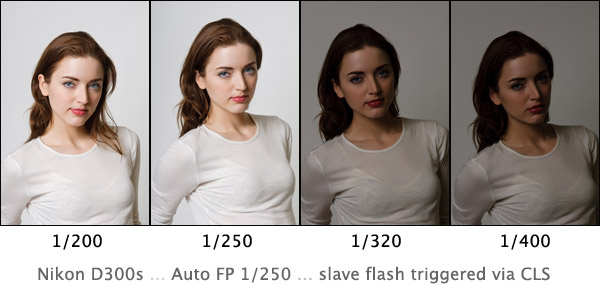
Pretty much as we’d expect. The moment we go over maximum sync speed (1/250 in this case), into high-speed flash sync territory, then the flash’s output is dramatically reduced.
The D700 behaves exactly the same:

1/320 Auto FP
Taking the max flash sync speed one notch higher:

For the D300s (or perhaps it was just this one particular copy of the camera), the flash’s output is ever so slightly reduced at 1/320th of a second. Not much. But what is noticeable, is that we are getting a distinct darkening to the left-hand edge of the frame. So with the D300s, if I had to choose between 1/250th or 1/320th Auto FP, then I’d go for the 1/250th setting. The increase in shutter speed is marginal compared to the image quality that is suffering due to uneven exposure.
The same thing happens with the Nikon D700 when set to 1/320 Auto FP.
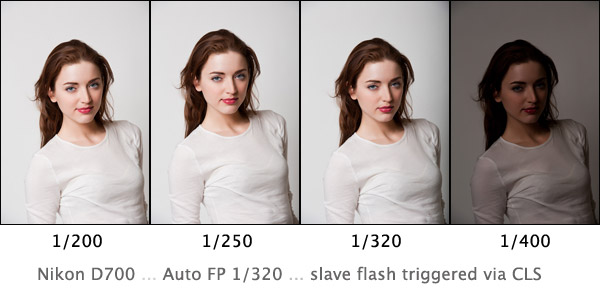
The same thing happens with the Nikon D700, except that the darkening of the frame happens to the right-hand side of the vertical frame.
using non-CLS capable wireless flash:
Just out of curiosity, I decided to see if the change in the shutter speed at which the camera kicks into high-speed flash sync, would affect the flash’s behavior when used with the older PocketWizard Plus II units. Since these radio senders / receivers don’t have any automation of intelligence between the camera and flash, we’d expect the flash exposure to be consistent with the actual maximum flash sync speed of either camera .. 1/250th
Let’s have a look:
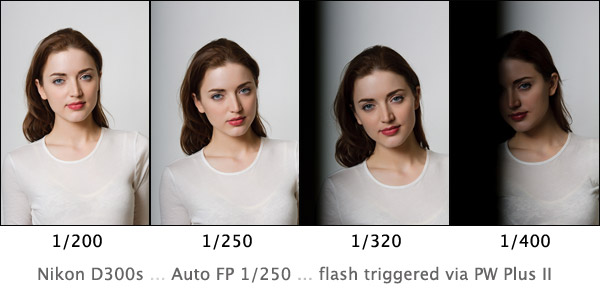
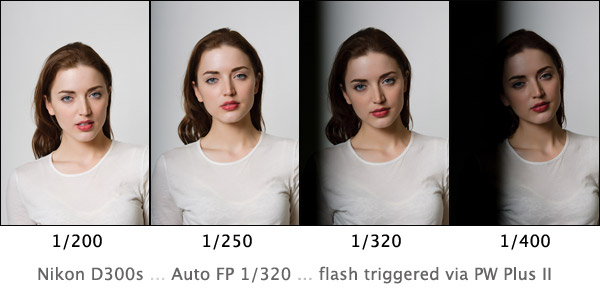
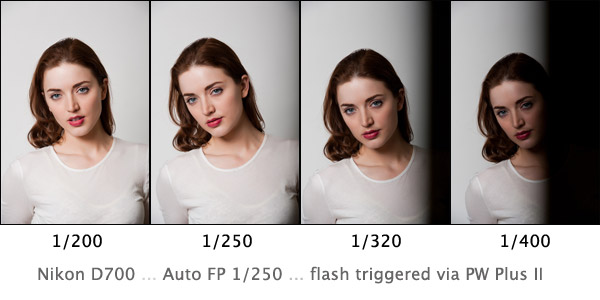
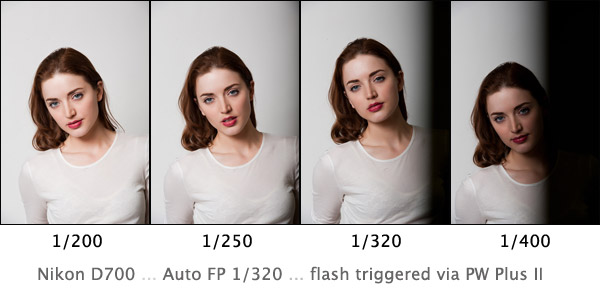
In all four sequences, nothing is gained by setting the camera to 1/320 Auto FP. We can’t cheat the actual maximum flash sync speed of either camera. No wriggle room there.
In fact, if we look at all four sequences, we will see a darkening of the edge of the frame even when we work at 1/250th, due to propagation delay.
An interesting observation here (which is also similar to how the edges of the frame starts darkening at 1/320 when using CLS to trigger the slave flash) … is that the D300s and D700 show a difference in when the shutter curtain moves in relation to the flash’s timing. The D300s shutter starts cutting the flash exposure from the left-hand for the vertical image, (ie, from the top for a horizontal image). The D700 shutter starts cutting the flash exposure from the right-hand side of the vertical image, (ie, from the bottom of the frame for a horizontal image.)
final conclusion
Set your Nikon D300s and D700 to 1/250 Auto FP, since there isn’t much to gain by going to 1/320 Auto FP.
Also, if you’re working in a studio environment with older radio slaves, then keep to below maximum flash sync speed. This will give you more even exposure from edge-to-edge, than you’d get if you worked at maximum flash sync speed.
Thanks Neil for this clear explanation.
Man, you put alot of work into it. The least I could do is to thankyou for this.
Gracious
Neil, here’s something that I’ve noticed happen with my d700 and 320fp using the new pocketwizards. Using the pw mini and flex I still get the darkening of the frame at 320. Hypersync enabled, 320 is the only shutter speed affected. Not 250 not 400, just 320. However, when using the 250fp I do not get darkening of the frame at 200, 250, 320, or 400. For hypersync to work, auto fp has to be enabled. So I’ve set up my d700 to be at auto fp 1/250.
Cheers!
You can also use the light falloff in creative way like in this video:
http://strobist.blogspot.com/2008/10/great-video-on-overclocking-your-sync.html
Nice article – what is the difference between ‘normal’ 1/250th and 1/250th (Auto FP)?
I’ve just read some of the comments following David Ziser’s video (on the Strobist link, above) and the same observation had been made regarding the difference between the D700 and D300 shutter curtain shadows. The conclusion was that the shutters run in opposite directions. (D700 shutter travels top-to-bottom, with the second curtain obscuring the top of the sensor/bottom of the image?)
Neil, could the D300/D700 left/right difference be due to one camera is on first-curtain sync and the other on second-curtain sync?
Thanks, hope all is well.
-Blake
Neil, is that information in the exif data? (It’s there for Canon images viewed in DPP.)
Hi Neil,
I was under the impression that the use of AUTO FP HSS was used while using Nikon’s CLS. The use of a PW Plus II breaks the chain of the CLS system and doesn’t allow the HSS go beyond the Auto FP 1/250 or 1/320. I thought that is why PW came out with the Flex TT5/Mini TT1 to maintain the HSS and i-TTL capabilities.
I thought while using the on camera flash in command mode and firing the SB-900 remotely, you could achieve higher sync shutter speeds without the dreaded “black line of death”. I thought as long as you maintain the CLS chain, you can achieve maximum shutter speeds.
Have a good day!
Thank you for the clarification Neil. I appreciate all your efforts in keeping us informed! Keep up the great work. Take care.
It is strange that Nikon would even offer 1/320 Auto FP as an option, when the instruction manual for both cameras explicitly states in the specification page that the maximum sync speed is 1/250. Maybe Nikon thought nobody would notice the edge darkening at 1/320 using CLS.
It is good that you were able to take some shots and show that 1/320 doesn’t help very much.
I too had wondered which of these FP settings was optimum for my D300… so this info was incredibly useful. Thank you!
Hi Neil,
Yes, I see what you mean about the loss of power and the resulting slight underexposure. I did not think of it like that until you pointed it out. I still have much to learn. :-)
Using Cybersyncs (on 2 D700s and a D3) I get a very clean frame at 1/320, and at 1/400 I get less banding than your 1/320 shows, so clearly your Plus IIs have some lag that is causing inefficiency. It stands to reason the new PW models with hypersync adjustments would give you at least that 1/3 stop efficiency boost.
Hi Niel, Good article. I have the D300 and I also have the D70 with its 1/500th sec. flash sync. I thought the whole idea of the 1/320th of a sec. flash sync was for shooting outside. That’s primarily where you would use FP sync because the ambient light was too high and you also would like to use a wider aperture for shallower depth of field. With your darker examples at the higher shutter speed in FP mode, you would open up your aperture to give proper exposure. In daylight in full sunlight , it’s difficult to use fill flash with a slower sync, that’s why the higher sync of the D70 is better for outdoor fill flash just as the Hasselblads with there leaf shutters could sync at 1/500th sec. as well. With FP sync though and 1/8000th of a sec. sync you can open up your aperture and get a nice shallow depth of field portrait all properly exposed. In a studio setting though, FP is pretty useless. Regards, Gerry
Nikon Europe states that the 1/320th setting is there to allow on-camera flash to be used beyond regular sync speed. Since they can’t use FP sync, there is a distinct advantage for on camera flash users (perhaps using for fill flash out doors).
Hi Neil
I love the way that you’re so inquisitive and that you are continually experimenting and researching things reading your blog always inspires me. I like this post it is very informative and I too have noticed the same using my Nikon D700 but all is not lost. There is a way of using the Nikon D700 and also some of the other Nikon cameras above 1/250 of a second and still get clean photographs. I don’t know if you’ve heard of it yet but there is a hack for Nikon cameras that allows you to shoot clean photographs up to 1/1600 of a second and up to 1/8000 of a second with a very slight line at the bottom of the photo. This is how you work the hack for the D700 connect your pocket wizard to the Flash as you normally would then connect the other pocket wizard to the PC sync socket of the camera as you would normally then put a speed light in the hot shoe of the camera turn all items on as you would normally do set the Flash connected to the pocket wizard to full power then you need to put the speed light that is on the camera into master mode and set the master not to fire set camera to auto FP mode and then set the aperture and then the shutter speed to 1/400 of a second then take a shot. The first shot may come out with a line on it then take another shot this shot should be perfect (for some reason it sometimes takes one-shot to calibrate.) . You can now shoot between 1/400 of a second and 1/1600 of a second with clean frames.
You don’t have to use pocket wizards. I use this hack all the time with RF 602 radio triggers using the half button press trick that keeps a transmitter in ready mode all the time with the green light on making the response time quicker
the off camera Flash that is used with the transmitter can be a studio light or any manual speed light that can be plugged into the radio transmitter (cheap strobes with longer Flash durations would probably be a benefit in this situation). I have used Canon 580 EX 11 an old Vivitar 383 SB 800s SB 900s all worked well as long as they were on full power
The restrictions I found with this hack so far are
• You must use full power on your strobe as this has the longest Flash duration.
• You get black line at 1/320 and 1/250 of a second this seems to be the same problem as pocket wizard has with their Flex tt5 and tt1 that on the jump from normal sync to high-speed sync seems to have a glitch with the Nikon cameras.
• From 1/2000 of a second to 1 8000 of a second you get a 5 mm black line at the bottom of the frame about the same as 1/320 of a second.
• The Flash output reduces by about two and half stops between 1/250th and 1/1600 of a second and a further stop between 1/1600 of a second to 1/8000 of a second.
• You need to use one Nikon dedicated Flash that can be set as a cls master
I hope this can help you in some way or that you find it of some interest and use
Thank you so much for maintaining such a wonderful interesting blog
Please excuse the spelling and punctuation as I am dyslexic and use voice recognition software to type
Hi Neil
I am so glad that you found this hack interesting. Did you try it for yourself? If so, did you use the D3 or a D 700? I would be interested to know if it works with the D3 as well as it does with the D 700
I think I made bit of an error on the post above. When I said (you need to use one Nikon dedicated Flash that can be set as a CLS master) I think I should of said you need to use one Nikon dedicated Flash that is capable of. I TTL FP Flash sync.
As you don’t have to put the Flash into master mode for this to work, you can use it with normal. ITTL/ FP or manual FP Flash sync as well. I use in master mode and set not to fire so the on camera Flash does not leave a catch light in the eyes and I also use the creative lighting system in conjunction with this method they play very nicely together when you know how to use them.
I came across some information about this hack in a post on the flicker strobist site and then just played around with it until I found a system that works for me .
Thank you for your feedback.
Jason
@ Jason,
How were you able to trigger the camera and the flashes with the RF602 triggers–did you connect the TX unit via the pc-sync port of the flash or via the pc-sync port of the camera? I’m trying to figure out how you did it so I can get the right cables.
I’m trying to create a low-key portrait using the D300 and the SB700. The SB is set at 45degrees on remote. The D300 is set to Commander mode with the pop-up flash set to (–) and the the A group set to 1/1 or full.
First, I shoot at f/7.1, 1/200 to locate the absence of ambient light. I then flip open the pop-up in order to get the SB to fire. But, the pop-fires regardless and the image is barely visible regardless of the SB firing at full. The SB700 is no more than three feet from the subject.
What am I doing wrong? How do I disable the pop-up? Why doesn’t the flash give me a stronly lit portrait?
Neil,
I am curious what your exposure mode was set on during these tests. In the Nikon manual for the D700 it says the camera needs to be in exposure mode P or A for the auto FP high-speed sync to be activated. Did you find this true, or were you able to shoot on M (manual exposure mode)?
Thank you,
Sara
Obrigado compartilhar o seu conhecimento.