

Bokeh – quality of lens blur
The way that a specific lens renders the out-of-focus areas in the background (ie, the bokeh of the lens), is always an interesting aspect of any lens’ behavior. If the out of focus areas show hard edges, or highlights with a kind of double edge, then the bokeh can appear intrusive. Then it is called harsh bokeh. If the out of focus areas are smooth without the edges being defined, then the bokeh is described as being pleasant. And then on occasion, you get bokeh that is … well, let’s just call it ‘interesting’.
I noticed that the Nikon 105mm f/2.8 VR macro (affiliate) can at times show a weird circular swirl in the background. It is especially noticeable if there are bright out of focus highlights. The photo at the top shows this clearly, even with a background that should appear smooth. In comparison, we can see how the famed Zeiss Makro-Planar T* 100mm f/2 ZF (affiliate), renders the highlights. Smooth. Just as you’d expect from a lens with such a reputation. (Both images were shot at f/2.8 although the Zeiss is capable of f2 which is exceptional for a 100mm macro lens!)
Just for interest here, I thought of showing how a few other lenses compare in how they render the background. The simple portraits here of Jessica, my assistant, aren’t as controlled as they need to be for specific comparison, but will still give an idea of how these lenses perform in terms of their bokeh. Jessica stood still, and I tried to maintain more or less the same distance and point of view. Next time, a tripod for sure. To make the comparison here, all the lenses were used at f/4 in the following examples. With the zooms, I tried for an 85mm focal length.
Just a quick note – keep in mind that shallow depth of field is NOT the same thing as bokeh.

The Canon 85mm f/1.8 (affiliate), is a gem of a lens. Affordable, and with speedy auto-focusing and great optical quality … including stellar lens with a very good reputation for speed of auto-focusing. On top of that, this lens has superb bokeh. Just look at how smooth the out of focus areas are!
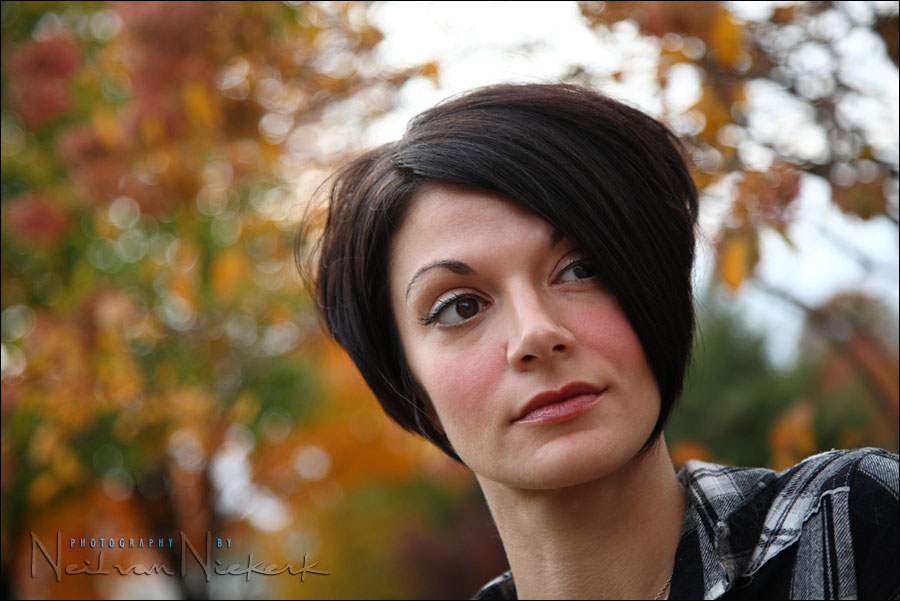
The Canon 24-105mm f/4L zoom (affiliate), has superb image sharpness for such a wide-range zoom, but typically of the wide-to-tele zooms, the bokeh can be intrusive. You can see the background is more noticeable here when compared to the Canon 85mm f/1.8

The Nikon 24-120 f/4G VR II (affiliate), exhibits similar bokeh – little too busy, and not as smooth as some of the prime lenses. You can see it in how the circular highlight appear. Neat little lens though as a general purpose lens.

Here is the new Nikon 85mm f/1.4G (affiliate) … and as expected from the update to a lens renowned for superb bokeh, the background appears smooth. The circular highlights are smoother than shown in the two photos by the wide-to-tele zooms.

Out of interest, I wanted to see how the Nikon 70-200mm f2.8 VR II zoom (affiliate), performed compared to the 85mm (used at f4), but something odd happened. With the new zoom’s known ‘focus breathing’ issue, the focal length at such a short distance had changed and the angle of view was wider than the 85mm focal length I was trying to maintain for this series of images. So I had to zoom to around 130mm to get approximately the same portrait size … but now in comparison, this lens has a much softer background. From this, the bokeh looks incredible, but I wonder how one would be able to make a fair comparison if the focal length changes.
Summary
This wasn’t a scientific or controlled test by any means, but hopefully the examples shown here will give some idea of how good and poor bokeh compares .. and of course the “interesting” bokeh of the Nikon macro.
Related articles
- How to get a blurred background in photos
- review: Canon 50mm lenses – bokeh
- Using lens bokeh as a design element
- Bokeh vs shallow depth-of-field (DoF)
- Review: Canon 135mm f/2L vs. Canon 70-200mm f/2.8L IS II
Thank you for yet an interesting blog post! :-) And the photos of your extremely beautiful assistant made it even better! ;-)
Interesting finding about the 70-200 VRII. Can one safely assume that by using a lens with focus breathing “problem” you can achieve FX kind of DoF on a DX body?
I’d be interested to know how the focus breathing in this lens affects the wide end. If it behaves like 50mm then it would be awesome on DX bodies.
I thought the focus breathing was noticeable on long focal lengths.In other words, if you are close to your subject and shoot towards the 200mm focal length, the focus breathing would be very apparent. I didn’t realize focus breathing was that noticeable at 85mm. Interesting.
Stephen … the Nikon 70-200mm f2.8 VR II shows that ‘focus breathing’ at every focal length. The reason why you’d only really notice the effect in an actual shoot, is that you’d zoom your lens as you need to WHILE shooting … rather than look at the actual focal length. In this way, you’d only notice coming up short in the reach of the lens at closer distances, when you’re at 200mm or thereby, and can’t zoom in closer.
thank you for this helpful blog post.
Well the new telephoto zooms are designed to focus very closely (compared to older models) so to achieve that, their actual focal length decreases while focusing very close. So to focus to 1 meter, on the long end lens isn’t actually 200mm but less, but that’s what you get for the ability to focus close. It’s just a smart trick in lens design.
Hot dang Neil, you may have just sold me on the 85 1.8.
In my opinion the bokeh of the Canon 85 f1.8 looks better.
Hi Neil,
I am reading your Tangents blog for a while and found it very interesting and useful in educational terms (Don’t give me an F-Stop!, make me think how I get to specific settings). I find your explanations always to be clear. That’s great. Thank you for sharing your knowledge and experience. It’s invaluable!
IMO: new Nikon 85 F1.4 can’t compare with Canon 85 F1.8 in terms of bokeh beauty. Unfortunately.
Most modern lenses with aspherical design elements are over-corrected for aberrations and as a result – they have poorer bokeh than traditional ones. BTW, Canon 85 F1.8 and Canon 135 F2.8 SF are “Bokeh Dream Machines” which I full-heartedly recommend to anyone. They are great instruments that just work, affordable and (the best recommendation proof) – I own both and use widely for portraiture.
Neil,
What about the Nikon 85 f/1.8?
Hi there Neil,
Thanks once again for an interesting article. I noticed something from the two images at the very top of this article. The first image has better saturation and contrast than the second one. I presume that no post processing was done to either image. I must say that I like the top image.
I’m not sure if you indicated which lenses were used on those two images at the top. Maybe I missed something in your details, but didn’t pick it up.
Could you give an indication of which lenses were used on those images and what the settings were at the time of shooting them? Not sure if that is appropriate to ask.
Thanks a ton.
Hi Rory,
I think the top two images (Jessica with green scarf) are shot with:
(1) Nikon 105mm f2.8 VR macro– note the “weird circular swirl”– and (2) Zeiss Makro-Planar T* 100mm f/2 ZF.
I agree with Eduardo B. about the Canon 85mm F/1.8 bokeh.
I’ve noticed that same weird circular swirl bokeh on the newer Nikon 50mm 1.4G. Wonder if if has to do with something Nikon is doing in its new designs?
Regarding the Nikon 85 f/1.4, an earlier comment implied earlier that the lens has aspherical elements, but it does not. I’d hesitate to draw direct comparisons between lenses based on these results since, as Neil said, it’s not exactly a controlled test. I don’t think that directly comparing lenses was his intention here, but rather to show examples of good and bad bokeh. In particular, the shot taken with the Canon 85 f/1.8 seems to be pointed slightly lower and to the right of some of the other shots, and thus has fewer of the distracting out of focus highlights that most of the other shots have on the left side. Also worth keeping in mind: f/4 is used here for comparison purposes, which is fine, but people don’t buy 85 f/1.4 or f/1.8 lenses to shoot them at f/4 for this kind of shot.
I want to echo itai’s reminder that this isn’t a controlled test. 130mm at F4 versus the 85mm at F4 won’t help you make any valid lens comparisons.
However, Neil’s post was extremely useful in that it shows how the rendering of bokeh can vary from lens to lens. Understanding how your particular lens renders bokeh is useful knowledge when choosing backgrounds.
(for example, you wouldn’t try to throw something with a ton of specular highlights out of focus with a 50mm f1.4 – but you might risk it if it was something with flat, even tones)
I just made the switch from Canon to Nikon and I gotta say that I will miss the 85 1.8.
Trying to figure out what prime I want…i really like a good 50, but an 85 is tempting.
the illustration with sample images sure is informative
as popular of a lens as it is, the canon 50mm f1.4 actually has really harsh bokeh. it’s one of the main reasons why i switched to sigma’s 50mm
Neil, great article!!!
What do you think about Canon 135 f2?
Here is a comparison between the Canon 135mm f/2 and the Canon 70-200mm f/2.8 IS II, specifically looking at the bokeh of these two lenses.
Hello Neil,
I don’t know if you see new comments on old blog entries or not…
I can’t find much info on the web,so I’m hoping you can shed some light:
Strictly an amateur, with a fairly recent interest in portraits. Longtime Nikon D90 user, just moved to D7000.
I also recently picked up a pristine Canon 50D, cheap, in order to take advantage of different lenses (eg: Canon’s 70-200 f4) that I can’t necessarily get an equivalent to get with my Nikon. I’ve since picked up the Canon 85mm 1.8. I really like it so far and it wasn’t very expensive used.
Can you, or anyone, offer me an opinion on Canon’s 85mm 1.8 vs.Nikon’s new 1.8G?
Mainly interested in the bokeh of these lenses relative to one another, but interested in a general comparison. I’ve read your bokeh article which strongly praised the Canon’s bokeh, but an article of yours on the 1.8G was also very favorable. I think the word you used for both was “superb.”
I’ve been on a waiting list here in Canada for the 85 1.8G since May. My camera shop just called me yesterday, that they have one for me. Of course, I could buy it and see how it compares to the Canon, but I’m hoping Neil, or someone else, will have experience with both. I hate buying and returning items if I can avoid it.
Thank-you very much for any help!
Corey
Thanks Neil. Surprised and delighted to get a response, and a quick one at that, on such an old thread, thank-you.
The 50D is a bit of a tryst, I suppose. I have a number of Nikon lens already, so the smart money would buy the 1.8G, and sell the 50D and 85mm. Running two systems probably isn’t wise for an amateur.
I already miss some Canon features when I shoot Nikon and vice-versa. Owning two systems may be an excellent recipe for never again being fully happy with either!
I knew from your postings that you didn’t own the 1.8G or the Canon 1.8. But you had tried them obviously and had posted very positively on both, particularly with regard to bokeh.
Maybe someone else will chime in. Thanks again.
Hi Neil, thanks for the great article! I actually really want the 24-105mm, but I did a test shoot before buying and when I uploaded the photos to my computer, I noticed how harsh the bokeh could be! Do you have any tips to make them smoother with the 24-105mm? It’s a used lens and right in my price range, so I wouldn’t mind going the extra length to achieve a creamer blur, if it’s possible.
Hi Neil,
I’m wondering if you have used the Nikon 105 or 135 DC lenses? And if you could comment on those?
Thanks,
Mike
Thanks for the feedback Neil,
I’ve found that on my APS-C sensor body (a D7000) that a minimum focal length of 70mm is too long. I have the 70-300VR and ended up getting a Sigma 50-150f2.8, eventually I’ll jump to FX but as a hobbyist I’m in no rush.
-Mike
“Nikon 105mm f2.8 VR macro can at times show a weird circular swirl in the background” I have to admit that the swirl draws me in to the subject of the photo. I like the effect enough that I will try to master it.