review: Canon EOS 5D Mark III – high-ISO noise performance
I have to confess something first – whenever an important camera is announced, I have just a cursory interest in the specification sheet. The difference between 40 AF sensors and 70 AF sensors … you know, that’s just a number on the paper. It never really tells you how the camera performs. And with the announcement of the details of the Canon 5D Mark III (B&H / Amazon), there were a number of websites eager to list the detailed specs. Yay! Well, not really.
There might be some interest in the nomenclature, but what does it really mean that the 5D Mark II has the DIGIC 4 processor, but there’s a new DIGIC 5+ on the 5D Mark III. Those are just names to me. I can’t get excited about it, or even feign interest in the actual name. I’m much more interested in how the camera will actually perform. You can name it anything you want … but does the camera deliver?
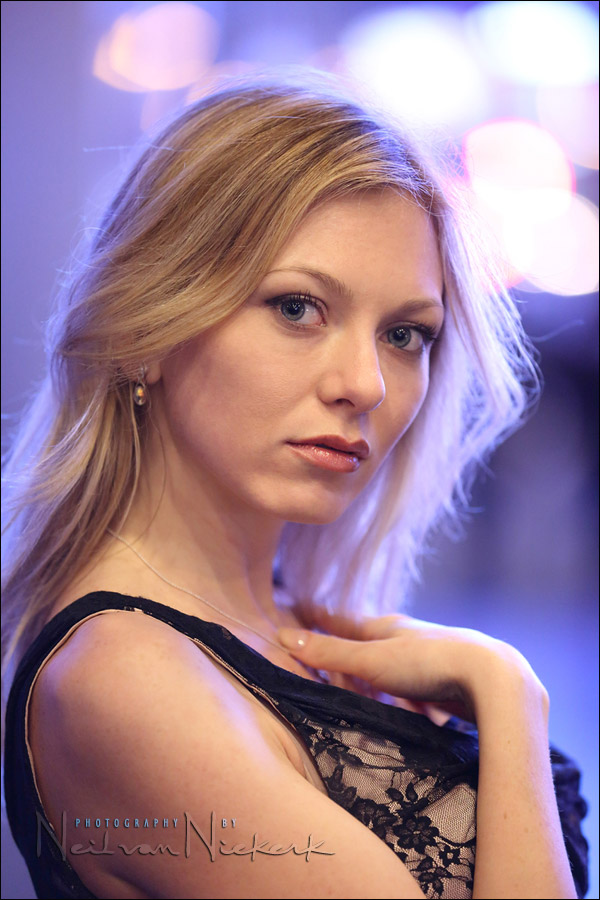
Details for the photo at the top:
camera settings: 1/160 @ f2.8 @ 6400 ISO
Canon 5D Mark III (affiliate); Canon EF 70-200mm f/2.8L IS II (affiliate), used at 170mm
There is real excitement about the Canon 5D Mark III (affiliate), since everyone is curious if it is that much of an improvement over the 5D Mark II. I have to say, I really think it is. It’s a massive improvement. The AF is more responsive. The camera *feels* better in my hands. The controls are better laid out … although the right forefinger still does too much work, stretching here and there, all over the top plate.

The first thing that I was curious about, was the high-ISO performance. As a wedding photographer in NJ / NYC, I often deal with low-light situations. In using cameras that allow for superb high-ISO performance, you can really get results that look far more natural than just 5 or 6 years ago. You can shoot with just the ambient light, or blend a touch of flash with the available light, and still have it look natural. The technique is now really much more flexible … all due to the improvements in camera and sensor design.
I met up with a model, Elmira, in Times Square last night to see how the Canon EOS 5D Mark III fares in low light / high-ISO settings. In short, beautifully.
Times Square has an incredible mix of light sources. It can be surprisingly bright there, depending on the billboards that are flashing. But this also means the lighting is erratic. So, with that, keep in mind that this is not a studio test, nor a controlled test. This is just a real indication of how the camera performs in mixed lighting that isn’t all that bright.
We rained out a little bit and had to take shelter under an awning. There were Incandescent style lights, and I adjusted the WB as well as I could via the Kelvin setting.
The image at the top was shot shot there … at 6,400 ISO. The White Balance of the RAW file was slightly adjusted in DPP. The lighting was pretty funky though.
Camera settings: 1/160 @ f2.8 @ 6400 ISO
I used the Canon EF 70-200mm f/2.8L IS II (affiliate), used at 170mm
When the rain eased up, we went back to the open areas of Times Square, and I took this photo of Elmira, with the rain spattered street in the background. But this time, just for fun, I cranked the ISO up to 12800 ISO. I used the Canon EF 70-200mm f/2.8L IS II (affiliate), used at 85mm.
I was shooting at 1/400 @ f/4 at this point because of the bright lights there. So I didn’t actually need that shutter speed, and could’ve used a lower ISO if this was a real photo session. But I was curious about that insanely high ISO:
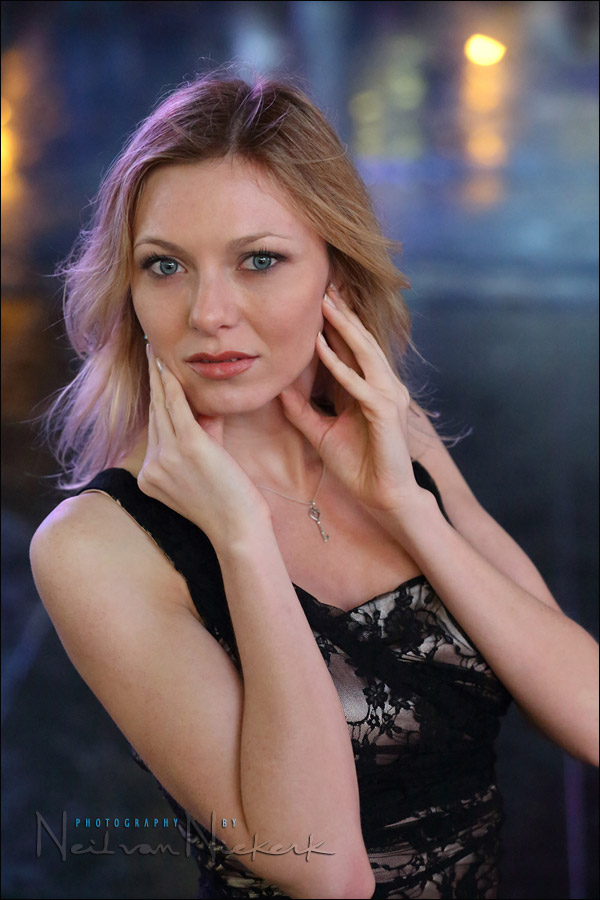
camera settings: 1/400 @ f/4 @ 12800 ISO
Canon 5D Mark III (affiliate); Canon EF 70-200mm f/2.8L IS II (affiliate) at 85mm
I think it looks quite good!
But this is how the image looks as it was resized for web use … and this easily masks the lack of detail that is a side-effect of noise reduction.
Instead of showing 100% crops of various parts of the images, I decided to make the high-resolution JPG files available as a download from this link. Right-click and save-as will get you the file.
Keep in mind:
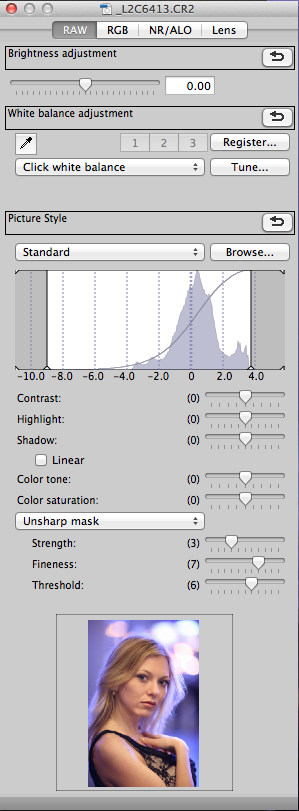
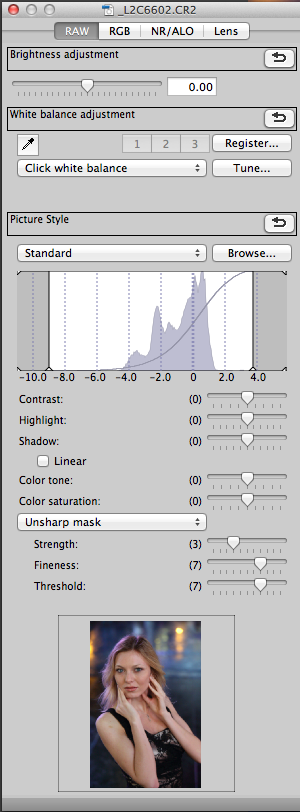
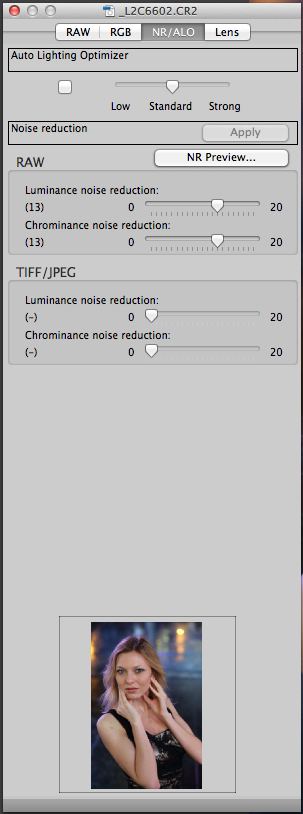
– these are the JPGS from the RAW files as processed with Canon’s DPP software. Both images had the WB tweaked a bit. Since DPP follows the camera picture settings, this as close to an in-camera JPG as you’ll get, while still having the flexibility of the RAW file.
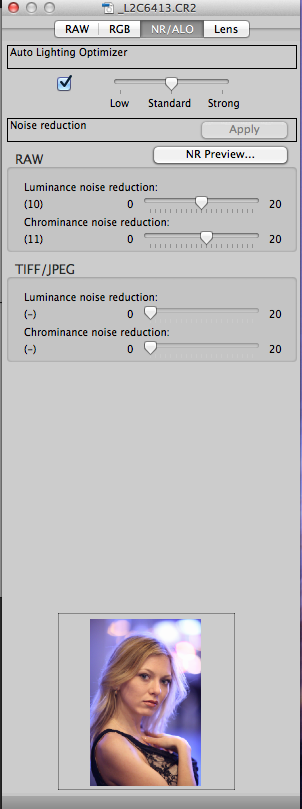
– these images had noise reduction applied to it at the default settings in DPP. (See screen-capture below.)
– the images had sharpening applied at the default settings in DPP. (See screen-capture below.)
– I used the Healing Brush in Photoshop to remove a few skin blemishes. (I don’t think it would be fair to anyone to have 22 megapixels show every slight flaw.)
These two high-resoluton files should make it quite apparent – Canon has a winner on their hands with the Canon 5D Mark III (affiliate). We have a camera that gives surprisingly good results at ISO settings that would’ve been regarded as insanely high, just a few years ago.
You can order a Canon 5D Mark III via these affiliate links: B&H / Amazon
Reviews of Canon gear
- Other Canon photo gear reviewed on the Tangents blog
That is indeed impressive. Of course, the next question is how it compares to the D4 or D3s.
And now you’ve made me really want to spend money I don’t really have!
high iso performance is great but can it be counted on to catch focus in low light?
Hi Neil, I’ve been a fan for quite awhile. I love reading your critique as it’s very self explanatory and much needed for me. Question…do you prefer to use the DPP in reference to the noise factor. I’m curious how bridge and/or lightroom would be? Do you prefer DPP for the post processing vs. lightroom/or bridge?
Hi Neil,
Thank you very much for your review. It means a lot knowing how much you like Nikon gear to say nice things about Canon :)
Thank you for the reliable review Neil!
There is no point to compare it to nikons, canon finally manage to make a truly competitive camera, for us with a large investment in the brand.The pixel peeping I leave for those with free time to kill :)
it’s amazing. According to your samples 5dm3 can be the best high iso performer until now:) And your model is just like a dream:) Thanks for your review.
Hi Neil very impressive. Now one question, say I want to make a 20×30 print of that photo, what recommendation as to size, file type etc can you give so that we can get the best print? I shot a photo at 6400ISO, and when I made it smaller for web use it looked awesome, but the printed version looks almost like it was out of focus (fuzzy) with all the noise.
Thanks Neil, but I see you shot in in Jpeg do you shoot raw? I ordered the 5D III and really am excited to receive it, now from what I have read the 5D III raw have been improved also but jpeg more is what I read, thanks again;)
Neil,
Your approach with a review is such a refreshing alternative to most of the other, soulless/hyper-technically obsessive reviews out there on all the latest camera bodies released the past month. And thankfully, you’ve steered clear of all the Canon/Nikon wars.
Here’s a novel idea in relation to much of the other stuff I’ve been reading that endlessly debate micro details between the latest Canon and Nikon offerings. (high iso noise preference, etc):
It would be intriguing to start a new article reviewing not the equipment that captures an image, but… the end viewer who consumes it (NOT counting fellow photographers)
Result?
While I wish clients would, hardly any will care about or notice all the supposed micro-differences (again, fellow photographers and tech peeps don’t count)
Instead, even with beautiful imagery captured with the costliest equipment they’ll most likely end up simply saying things like:
“Can you delete that one? I hate my double chin!”
?“She’s got her mother’s eyes.”
?“Look at that lake! Reminds me of our vacation last year in British Columbia.”
or worse yet… “Cool” and then just walk on.
Summary:
1. Unfortunately, hardly any regular customer will notice the difference in real world applications.
2. If a photographer enjoys the micro-differences that he (or she) himself can detect, then by all means spend the extra money on the costlier equipment but at least honestly acknowledge this fact ($30,000 medium format, $10,000 parabolic umbrellas, etc)
3. In the end, it’s all hardly worth the electron microscope (and valuable time) it takes to come to this simple conclusion.
Is it fun to analyze and conclude in the mind’s what makes for perfection?
Of course.
But is it ultimately profitable in the real world apart from tech debate?
Not so much.
Mr Niel,
The question number 4 is great. Waiting to see your answer.
Is the 70-200 f2.8 still needed with that high high iso capability, or is f4 enough?
Very impressive results. Canon shooters should be very glad with these results. Couple this with the AF improvements, and the 5D III should do a very nice job under demanding situations.
Awesome Neil… What lens (even 3rd party) would you suggest that’ll be suitable for the 5DIII on the wide-angle side?
Were you able to play with the 600EX as well?
Dave
Hi Neil,
Do you think this camera is better than the D3S high iso performance?
Thanks.
@ is f2.8 still needed?
– f2.8 should enable better AF-options – the cross sensors are not always available (depends on Camera)
– the picturequality of the f2.8-lens at f4 could/should be better than the f4-lens at f4 (the optimal aperture is usually a few stops down)
Sadly I have none of them, so these are pure theoretical arguments for me.
But since I used the 50mm f1.4 on my 7D, depth-of-field is the only relevant argument…
btw:
Thank You Neil!
Thats the kind of cameratest I was waiting for: What does the Numbers mean to the result?
Greetings from Austria
Neil,
when you do a more rigorous comparison, it would also be interesting to understand how much of an improvement the 5DIII is over the 5DII at high ISO. I currently hold the view that ISO 6400 on the 5DII is really on the borderline, and probably only should be used in a real pinch.
The images you have shown from the 5DIII seem to show quite usable output at ISO6400.
Thanks so much Neil..great to know. I think I need to find my disk for the DPP..(LOL)..it may be in the box. I need to seriously consider this!! Thank yoU!!
Neil,
Sorry if I missed this somewhere, but did you use a touch of flash here? If so, what were your settings there?
Thanks a bunch!
so, the question is, is it canon’s camera or processing software that is brilliant? :-)
Great pics & the camera obviously does what it says on the tin.
Neil, Just wondering if you saw any softness with raw files in edit window with DPP software using mark III camera.I have read about some issues with this being a problem. Thanks.
Neil there is a ACR beta update that can already open 5D Mark III raws I installed it it works fine…
Niel…Once again you have given an excellent report. The camera looks fantastic
and it will be my next one. The photos at those ISO’s are truly remarkable.
I would never dream that you could achieve such beautiful results at tose ISO’S.
Neil,
I’ve just finished (more like devoured) both your books and really enjoy your blog & photography.
Hoping you can help with some guidance…
I have a D7000, which is a fantastic camera, but was thinking of moving to full frame mostly for better high ISO, but also improved AF, depth of field, etc. I was eagerly awaiting the D800, but now it seems the 5DMIII might be better suited to my needs. 99% of my images are portrait-based. Specifically, candids of adults, my newborn and 3 year toddler who never stands still. I have a basic, low-cost studio for my newborn photography, but the rest are candid photos indoor and out, with and without flash. I own the 70-200 2.8 and a few primes today, SB-700, and accessories.
For my style of photography, do you think the D800 is appropriate or would I be better off switching to the 5DMIII? (yes, I know switching is painful, but if I going to bite the bullet, now is the time it seems)
Unrelated, but wondering also why so many flock to the 24-70 2.8? Is it pure convenience? To me, it seems a great 35mm or 50mm prime at 1.4/1.8 provides several advantages, but you just need to plan on being a bit more mobile (a step or two back & forth).
Thanks again & really appreciate your work!
Hi Neil,
Good to read about your thoughts on the Mk3. I got mine last Saturday, and shot a wedding the next day (3/25). After just a few shots, it was clear this camera was ‘special’ :) Hi ISO was very impressive to me…..iso8000 in the church, getting 1/200th @ 2.8 was fantastic :) and the images are looking great as I’m processing the days work. Very happy camper here.
All the best, and thanks for your blog.
It is refreshing to see Canon taking a sensible and meaningful approach to model refresh. Thank you for your time Neil.
DON’T WASTE OUR TIME BY SHOWING US SHRUNKEN-DOWN PHOTOS!
You can take the shittiest, poorly-exposed, noisiest, most poorly-focused photos and make them look better by shrinking them down.
That’s not what we’re after. ESPECIALLY for a camera like the 5D Mark III, which doesn’t have a lot of “extra” resolution to be shrunken away for the purpose of adding image quality. For a 22mp camera, you should be showing us the actual pixel-level performance. Even at high ISOs.
Albert,
You really do take the cake mate. That’s the most obnoxious thing I have seen posted to this forum especially from a guy like Neil who not only spends an enormous amount of time doing this, he also imparts his knowledge free to help make better photographers of us all, from the happy snappers to the professionals.
Honestly, I can appreciate you missing something when reading a post, but to then really bombard Neil in this way is totally uncalled for.
btw, here is the text you are looking for, even down to the fact Neil did say a small web size can mask noise, etc.
But this is how the image looks as it was resized for web use … and this easily masks the lack of detail that is a side-effect of noise reduction.
Instead of showing 100% crops of various parts of the images, I decided to make the high-resolution JPG files available as a download from this link. Right-click and save-as will get you the file.
Man, you need to chill.
Trev.
I agree with Trev,
Neil goes out of his way to give us tons of great tips and techniques for free.If your not happy with this site, spend your time elsewhere, Albert. Thanks for everything, Neil. Did you get a chance to work with the D800 yet? Im on the fence as to buying either the 5D mark III or the D800. I mainly do portrait work. Any suggestions? I now have a Canon 40D and only a few lenses so it wouldn’t be a big hit if I switched to Nikon.
Once again thanks for the information you always provide. I also bought both of your books and their excellent!
Charlie
Hi Neil,
I too was able to get the 5D III, 4th in Atlanta, ;-). My preliminary testing has me comfortable up to ISO 2,000 vs. 1250max on the 5DII. Most often on the 5DII – I tried really hard to stay at ISO 400 or less. Shot twice with the III. I had some unexplained softness in the ISO 640-800 so more structured investigations needed. User failure? Maybe need to send the body in w/my most used lenses to get them calibrated???
Neil did you do any calibration or just using it out of the box?
Neil,
I have been a fan of your tutorials especially the ones related to wedding photography. I love the way you simplify things but not too much. I have been looking around at a few 5DIII reviews and in near future may get one to compliment my 5DII.
-Cheers.
Neil, probably the best review I’ve read. And I stumbled on this accidentally. Your last photograph (L2C-6739-edit-full-rez.JPG) is beyond stunning. I’ve never seen anything this sharply focused in any of the web reviews. Notice also the superb variation of color and reflection on the eyes. Of course, kudos to your model too. Was this straight out of the Canon 5dmkIII? Would you mind letting me know the settings (esp the WB)? What were the lighting conditions? Definitely a wedding picture!
Neil, Very good review, thanks. I have just had my 5D mark III for two weeks and love it. I took hockey photos in the evening under floodlights (that were not so bright), and obviously had to use fast shutterspeed because of the fast action on the field. I cranked up the ISO to around 10000. After some noise reduction in photoshop on my RAW files, the results were still incredible. My question is regarding the in camera noise reduction setting. I took these photo’s with the setting on standard. I am booked to shoot a fashion show at the school and all the advice on the internet is not to use flash. Do you think it will be wise to change the high iso speed noise reduction setting to high? What setting do you reccomend? Thanks!
Thank you Neil.
Neil,
buddy, you did great here on the showing what this new body can do..
also i know you are a Nikon guy, and that you steered away from brand bias.
it is a pleasure to read your stuff.. haha (facebook rants too) your a true pro’s pro..
it is wild to think we have camera bodies that can shoot at ISO6400 and expect a good print.. that just blows my mind.. i picked one of these bodies up for my next years wedding events and will be enjoying the high ISO capabilities in the dark churches and event halls..
one thing to mention is the door hinge from the 5DMK2 had a creak when pressed in the palm of your hand, but on the new body they completely fixed this issue.
anyways.. see you on the flip side..
phamster
Nice review.
One thing that I think is a pity (since the article is about High ISO performance): You applied Luminance NR in DPP.
DPP is okay at chroma NR, but it really isn’t quite good at luminance NR. As can be seen in the HR files: All fine detail is smeared.
IMO, it would have been more useful to show the raw files converted without any NR (or sharpening) applied.
I have the 5d mark III, when I use F22 for max depth of field and a high ISO, the shutter speed is too slow in the AV mode, and manual. Any suggestions on how to get max depth of field with a shutter speed of 125/sec. Digital is a whole new ball game as with film. Also shooting weddings, focus is a problem even in AL servo mode, and auto focus.
Regards
Pearl
For correct exposure, you need to balance these three things – shutter speed, aperture, ISO.
So if you’re not getting the aperture you want, at a shutter speed that you’re comfortable with .. and you’ve run out of headroom in terms of ISO … then you need to add more light. That’s all there is to it.
And if you can’t add more light, then you’ll have to accept a compromise on those three settings.
Great comparo, Neil, and thanks for going to the trouble of posting it. I shoot a lot of bands in local bars and so I pretty much live at ISO 6400. If you look on my site, most of those pix were taken at ISO 6400 with a 5D3. I’m generally happy with them, and so are the bands. But I can’t get anything useful above that; ISO 12,800 doesn’t come out nearly as well as your model. Could it be something about the stage lighting–all the darkness surrounding the subject? I can’t figure it out. Not that I’m complaining. . .much. I just want it all!
The difference most likely comes in that the images I show here don’t have much dark shadowy areas. In comparison, concert photos tend to have dark backgrounds. This most likely is where you’re seeing the noise?
Thank you for your kind review. I’ve only had my 5D mark III for few days, but I’m already in love with it. I took hockey photos in the evening under dimly lit floodlights, and because of the fast motion on the field, I had to use a fast shutterspeed. The ISO was set to roughly 10000. The results were still outstanding after some noise reduction with Photoshop on my RAW files. My question is about the noise reduction setting of the camera. These photos were taken with the normal setting. I’m scheduled to photograph a fashion show at the school, and all of the online advise says to avoid using flash. Thank you for sharing such an informative article. I will waiting for your next article.
Hi there — First step — shoot in RAW. Then none of the settings such as Noise Reduction, Contrast, Saturation, etc etc, are baked in. You can then change it as you need, in post-processing the images.
Then set the noise reduction to normal so you have an approximately correct idea of what the image will look like.