photographic composition – finding and framing your best shot
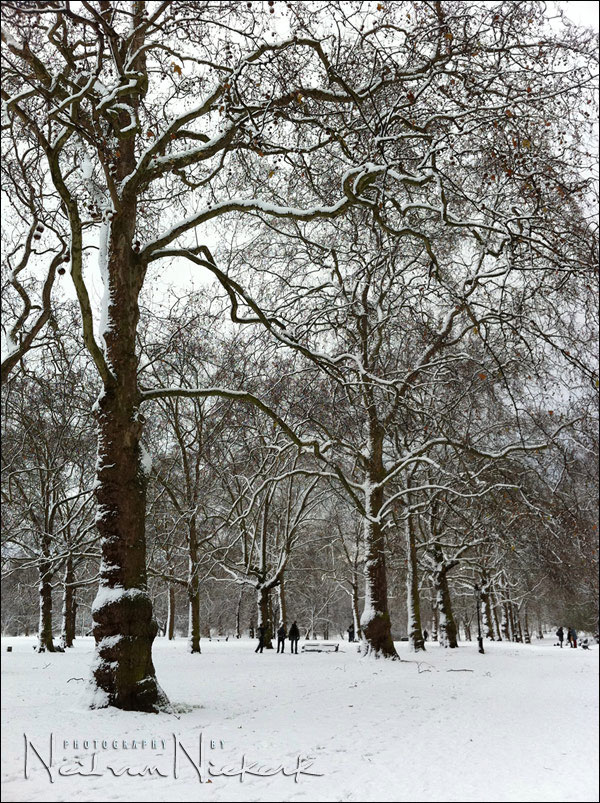
Strolling through Green Park in London, I saw these rows of winter-barren trees. The way the snow clung to the trees and branches from the morning’s snow storm, white against dark brown, gave a posterized effect already – the crazy patterns of the branches starkly etched against the white snow.
I took several photographs, finally liking this photo above the most of all. Aside from resizing, it is straight out of camera … my iPhone 4. And therein was a lesson for me that I mulled over the rest of the day, while further exploring the urban landscapes of London …
When I first saw the rows of trees, I pulled out my Nikon D3 and 24-70mm f2.8 lens. I tried to encompass as much of the landscape as I could at first, shooting horizontally and vertically, and changing my viewpoint. But keeping to 24mm focal length, in an attempt to “get it all in”.
Here is a straight-out-of-camera version from the Nikon D3:

… and juiced up a bit with Nik’s latest HDR software they just released. I like this version:

After several frames with the D3, I decided to take a shot with my iPhone to upload to Facebook to show family and friends. However, the iPhone has a fixed little lens, and not as wide as the 24-70 lens is capable of portraying. So I had to more carefully frame my shot to make it meaningful. I couldn’t just rely on the expansive landscape to look impressive. My composition had to be more precise now. I then took the photo at the top with the iPhone, and liked it most of all.
And there-in was the lesson I relearned on this day. Not to let visual laziness and entropy over-take me. I shouldn’t just revert to the widest or tightest focal length that a zoom lens is capable of. Instead, I should *look* at the scene – the landscape – and *see* what it is that I want to portray. What are the essential elements that will hang together with a visual coherency?
Using the fixed focal length of the phone’s camera, forced me back into this mode of thinking. A little shocked at realizing how easy it is to slip into a lazier way of taking photographs, I undertook to approach photography during the rest of my trip with the same sparseness I was accustomed to when I shot slide film years ago. Barely being able to afford film and processing, I had to make every shot count. I would meter carefully, and frame carefully. I put thought into it. The 9 frames a second pro digital bodies have gradually changed how I shoot. Digital allows you to shoot multiple frames “for free”, so there is no apparent cost to taking many more photographs. (We tend to ignore the ‘cost’ of the extra time in front of the computer.)
So that was the lesson relearned – make every shot count by putting thought into the composition and timing. Look and consider. Breathe.
Exposure metering for snow scenes:
Exposure metering when you have a snowy landscape that is evenly lit with soft light, is dead easy. It is a simple study of tonal placement. As such, the metering technique is closely aligned to how I use the histogram to get correct exposure for the brightest relevant tone. In this case, I push the histogram to the very edge for the snowy landscape. Sunshine with this snow landscape would be a touch more complicated, but on this overcast day, it is really a simple matter to get correct exposure. There is also this earlier article where I explained how to achieve correct exposure, photographing a dog frolicking in the snow.
Even on the iPhone, you shouldn’t have to bear under-exposed images with a snow landscape. If you touch the screen of the iPhone, you can tell the camera where to focus … but also what it should meter off. So you could pick a mid-tone … or as in this case, I touched the screen where there was a big snow-covered tree trunk in the foreground. The dark and light tones averaged out, and I got pretty close to correct exposure for the iPhone photograph, in camera already.
Neil,
You’ve been specializing portrait photography for so long now that you were “out of practice” for landscape shots. It’s like asking expert landscape photographers to take portraits. Different skills for different subjects.
The last photos that were non-portrait that you’ve shown on this blog were the photos for that “Alive for 365” project, most of which were taken back in your film days.
I had this same sort of experience when I started shooting with a Holga camera about 10 years ago. I picked it up on a lark because I was seeing so many poor images from this ‘toy’ camera that people were calling art photographs just because of the camera used. My goal was to take the Holga and make good photographs with it. With no settings and no focus I found that I was liberated in my vision. I would just shot whenever and where ever I pleased. No sophisticated equipment and no worries about all of the typical camera settings. It taught me a great deal, or should I say refreshed my memory. I guess your iPhone experience was similar. Photography never ceases to amaze me.
I switched to digital in 2007 and to this day I forget that I’m not shooting film. I don’t take enough pictures, but like you said, it’s less work at the computer. Everyone tells me to shoot my camera like a machine gun, but I just won’t do it. Don’t want to lose sight. Great article, Neil, I’m going to show this one to my friends.
Thanks for this post Neil
It just reaffirms what Edward Weston said: Composition is the strongest way of seeing.
The emphasis is on “seeing” – something one can forget when taking photos like a machine gun.
I do enjoy digital – but I still tend to “shoot” as if I was using film… just an old habit that dies hard.
Now I wonder if I should file this post under: iPhone beats Nikon D3….?
Best, P:)
Have to say, I like the dSLR shots more than the iPhone. On the dSLR, the person sitting on the bench provides the right amount of balance to the image where as the iPhone photo has too much tension with the people so close to the right edge of the frame. The lesson is an important one however. I will often only travel with my 50mm 1.4 so I am forced to consider composition and can’t rely on zooms.
I do remember the salad days when I was young and had little money for film and associated processing costs. I was very judicious with each shot, making sure I had the best possible composition that I could get. Since the digital revolution I do shoot away, although I am finding myself concentrating more on what is in my frame and shooting less. What’s old is new again…
Don’t know if you have an iPhone 4 or not but with iOS 4.x the camera has an HDR mode. I have mine set to record both the normal photo and the HDR version. Sometimes the normal one is better and often the HDR one is best. I wonder what it would have done with the top picture.