off-camera flash photography: what are your camera settings?
What are your settings? – a question that I am often asked about various images.
Sometimes, the answer is surprising – it doesn’t really matter.
Sometimes the specific settings are of importance, but usually much less so than the method of getting to correct exposure of the ambient light and the flash.
This is the photographic equivalent of teaching someone to fish, versus just slapping a fish down on a dinner plate. Just telling my settings will reveal very little about the how. And yet, the how is far more important than just a listing of seemingly random figures.
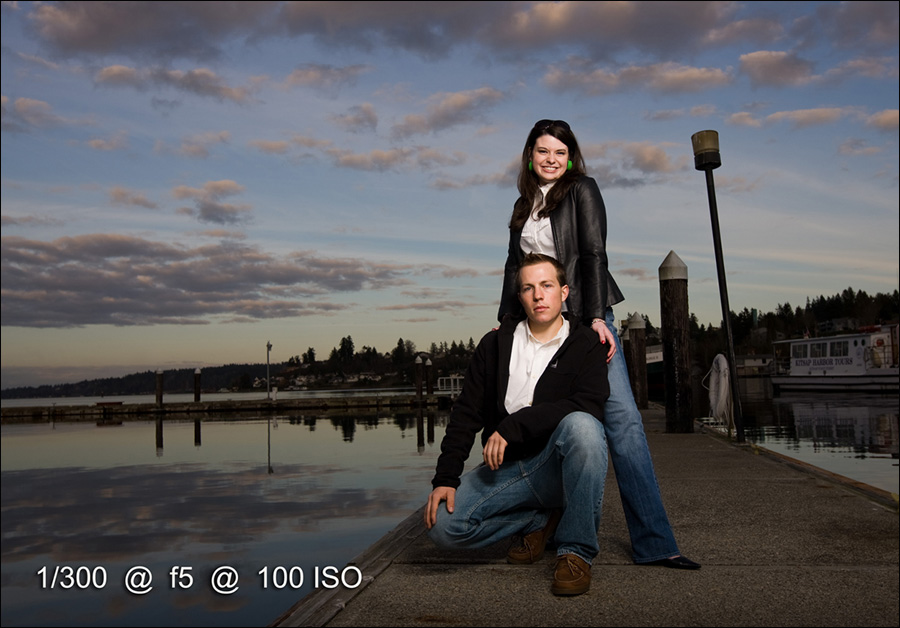
Let’s look at this recent image from one of my workshops on flash photography – especially since it is exactly the kind of thing which I teach during the course of the day.
settings for manual flash exposure
In this instance, I used manual flash – a speedlight in a softbox. Since the flash was manual flash, there were then 4 factors controlling the flash exposure. This topic was covered in this recent post: manual flash vs TTL flash.
Now, those 4 factors that control our manual flash exposure are:
- power setting on the flash.
(I kept this to 1/2 of full power, so the recycling would be fast enough for everyone at the workshop, even though each Speedlite was powered by a battery pack.
- distance to the subject.
(Since the flash was in a softbox held aloft on a monopod by my assistant, the flash exposure could also be controlled by the assistant bringing the softbox closer or further away on instruction of the photographer. This is our one variable at this point with which we can control flash exposure independently from ambient light.)
- ISO
- aperture
.
invariably we start with the ambient exposure first
The sky was still fairly bright, therefore 100 ISO made most sense.
The actual ISO could’ve been higher, if I needed more depth of field.
Since ISO affects both ambient and flash exposure, any ISO would’ve been okay as long as we didn’t run out of apertures.
Whenever we shoot a subject in shade against a bright background, we get most efficiency from our flash at max sync speed. For many cameras this is 1/250th. Check for your specific camera.
Now an appropriate aperture was chosen to expose correctly for the sky. Or we could, as in this case, create a dramatic sky by underexposing slightly. We’ve now established correct ambient exposure.
And then the softbox was held close enough – or far enough – for proper flash exposure. (ie, we controlled the distance between flash and subject.)
For that image, there were two speedlights, each with a softbox, that were triggered simultaneously – and pointing at each model. But the same thought process holds as in the explanation.
about the decision to go to maximum sync speed
As mentioned in the tutorial on maximum flash sync speed, shutter speed is the independent control for the ambient light exposuret, and has no effect (directly) on flash exposure. (This is true while we don’t go into high-speed flash sync.)
When you work in bright conditions, the maximum flash sync speed is hugely important.
Think about it this way:
You want more range on your flashgun, since you rarely want to work riiiight up close to your subject. Or at least, not be forced to work right up close.
So you need more distance / range on your flash. This implies that you need a wider aperture.
Since your ambient light is constant, you have a whole range of shutter speed / aperture combination’s to work at.
Let’s look at an example of bright sunlight outside. The Sunny 16 rule implies that in bright sunlight, our exposure for the ambient light is around: 1/100 @ f/16 @ 100 ISO.
This can be translated to the same ambient exposure:
1/50 @ f22
1/100 @ f16
1/200 @ f11
1/400 @ f8
1/800 @ f5.6
etc.
Your flash is going to have a hard time at f22 to dump enough light to match the sun.
It is going to have an easier time at f16 .. but even better at f11.
But then you hit the ceiling at max sync speed … over that, you go into high-speed sync mode, and your flash’s output drops considerably.
So you have a sweet spot at max sync speed.
Therefore, when you work in bright conditions,
you might as well just go to max sync speed immediately, since this is where you will have
– your widest aperture (and hence the most range / distance from your flashgun),
– for the most juice from your flashgun.
This is crucial in understanding how to balance flash with daylight.
It becomes an easy shortcut then:
Bright conditions? yup .. immediately go to max sync speed.
You might as well then go to 100 ISO. (Or 200 ISO on some Nikon D-SLRs.)
Find your aperture for correct ambient exposure for these other two settings.
Now find your correct (manual) flash exposure.
You’re done. And it was easy because you immediately went to max flash sync speed. Simple. These are fundamentals of lighting techniques. You can’t escape them.
getting to the specific camera settings used here
We start with the ambient exposure.
Broadly speaking, we have three areas here of similar brightness:
– the sky
– the reflection of the sky
– the jetty (which is much darker)
It makes most sense here to expose for the sky. Holding the camera up, you can take a meter reading and a test shot to get to the best exposure. As explained, it makes most sense to stay at maximum flash sync speed for starters, when we use flash with bright light.
In this case, I used the Canon 1D mk III, which has a max flash sync speed of 1/300 … you will have to know your own camera’s max flash sync speed. But the thought-process remains exactly the same.
Now, at max flash sync speed, we find our other two settings – aperture & ISO. If we couldn’t get to values for aperture and ISO that made sense for us, we could always change the shutter speed. But max sync speed would be a solid starting point here.
With that, we now have three settings – shutter speed, aperture & ISO.
Since we are using manual flash, we still need to find two other settings: distance & power.
The distance is whatever is the closest we can have the light sources / softboxes, without interfering with our composition. All that is left then to figure out is the power of the flash.
summary
In this way, most often when we work on location with off-camera flash, our settings fall into place one after the other. Instead of feeling overwhelmed with “where do I even start!?”, you can systematically work this out so that every camera setting is a good choice.
related articles
- camera & flash settings: what do you want to achieve? (model: Ulorin Vex)
- flash photography tutorial – balancing flash and ambient light
- using the histogram: exposure metering for the bride’s dress
Thanks Neil,
I know you’re a big proponent of the max-sync speed “sweet spot”, but I’m wondering about high speed sync. I know flash output drops considerably in HSS mode, and I’d expect 1/320th to be the worst, but in your experience, does the ability to go to 1/2000 @ f4 on a sunny day compensate a bit for the lowered flash output? I generally like to underexpose the ambient a bit, and I have this illogical fear (or guilt) about shooting at f16 or above with flash. Maybe I just need to get over it?
Neil,
You have a bad link in your blog entry. The link that is in the sentence, “Let’s look at this recent image from one of my workshops on flash photography – especially since it is exactly the kind of thing which I teach during the course of the day,” goes to a non-existent page.
Otherwise, great post as usual.
–Stephen
“It is just simpler staying with the proven method here.”
Very true. Thanks for the response, Neil. And, I really wasn’t going to ask what aperture you used… honest! :)
-Matt
Neil,
Your techniques are almost textbook for me, and I have learned so much from reading about how you do things and combined with my practicing of them, i’ve already gotten better results.
However, I do have a question on one item. Given that you are shooting with flash outdoors, have the max flash sync speed, lowest ISO, would the only expense be to adjust the aperture accordingly to achieve a correct exposure?
My reason for asking is that when I started shooting outdoors, I noticed that I have to “give-up” the ability for a shallow depth of field to keep from simply overexposing. I needed some flash to keep some shadows off of the model’s face, and, of course, using a smaller aperture the flash is less effective.
What would be some tips for these particular instances? Am I doing right by keeping ISO 100, shutter maxed at 250, and only changing F stop?
Thanks!
Bright conditions? yup .. immediately go to max sync speed.
You might as well then go to 100 ISO.
Find your aperture for correct ambient exposure for these other two settings.
Now find your correct (manual) flash exposure.
Neil,
You say “Now find your correct (manual) flash exposure”. Can you use TTL in this situation as well?
Rob
Thanks, Neil! All of these tutorials and ground-up tips are very helpful, considering I just bought a new speedlite and am trying to learn the ins and outs of flash photography.
There was something that I don’t quite grasp yet (or maybe I do)? I’ve read that the key for balancing ambient light and flash for outdoor shooting is to meter the ambient with the shutter speed and the aperture for the impact of the flash lighting in the final picture. So if this is true, that means when I adjust the shutter speed the flash impact is unaffected, but doesn’t that mean when i adjust the aperture it changes both flash and ambient light?
Today, for example, I was in a tricky situation that I wasn’t sure of. This is one of the results of my shot:
Basically, my technical info was as follows:
60mm
1/250
f2.8
FEC was dialed to about -1
bounced off of the wall to my right
The background still seems to be blown out despite me being at 1/250 and 100 ISO, my trouble came with my aperture. Do I change my aperture to meter correctly for the background ambience (as to match my 1/250, which seems to not be enough) and simply use more FEC to get the foreground, since the aperture change will affect the model’s ability to be lit by flash? Do I keep the F stop and go into high sync mode? This just seems like a balance that I have a fundamental misunderstanding about.
Thanks, Neil!
this was informative. so much so that i have to bookmark it and return to read again.
Thanks from A Coruña, Spain, Europe ….. Neil.
I am reading all your articles and I like much.
I have learned many things.
I have put the connection so that you see the invention that I have done so that the direct light of the flash is not so hard …..
has to take It an assistant, but the results are very good.
Thanks again ….
Hi Neil.
I have been reading your site for several weeks and now and am constantly amazed at the amount I am learing. I have a quick question. Yesterday I was shooting a parade and decided to practice some of the techniques you’ve talked about. I kept my metering mode to manual and tried to expose for the ambient light while riding my FEC. I’m using a Nikon D200 and SB800. If I understand the Nikon CLS system, in TTL mode the camera meter and flash metering systems are independant but in TTL-BL mode the flash takes the camera metering into account. Does that mean I should turn off the SB800 every time I need to re-meter? (lots of sun and shade variations). In other words if I manually meter for the ambient light while in TTL-BL mode with the flash on will I not blow out my images. ( I generally took the safe route and kept turning off my flash beofre taking a reading of the ambient light.) I got some beautifully exposed shots but some that were blown out and not sure what caused it.
I also discovered something when using this technique. I was shooting with my trusty old 80-200 2.8 (the non-vr version) and the D200 would not let me increase the shutter past the max synch speed in manual mode (obviously) so when balancing the flash with the ambient light in some shots I can see distinct camera shake at 100% crop. I guess the 200mm is equivalent to 300mm on the D200 and 1/250th wasn’t fast enough to avoid shake with this 2 lb monster. I will have to be more careful with my technique.
Thanks again for a great site. I’m shooting a wedding next week and can’t wait to try out some more of what I’ve learnt here
Thanks Neil
With regard to the auto fp high speed, I read (on the Nikonians site) that this function significantly reduces the power of the flash. Is that a real concern? It would be nice to be able use the wider apertures so I would certainly use this feature if it works.
Thanks for the prompt reply to my earlier post. I will let you know how the wedding goes with the new techniques I’ve learnt here.
Keep up the good work.
Hi Neil,
Just thought I would drop you a quick line and say thanks for the advice the wedding went well and I got some really nice images. The weather was quite overcast so using a little fill flash went a long way to popping the pictures. I shot the entire wedding on manual and my exposures were pretty consistent but did get the occassional under or over exposed image due to me not paying attention to my meter. Just wanted to say thanks again.
If I may I would like to pick your brain about another little assignment I have coming up. I have been asked to shoot a large group (roughly 30-40 people) it will likely be indoors and on location so I will be using just 2 SB800’s on light stands. I read a post on Nikonians about doing this very thing but would be interested in your advice on set up. Given the size of the group and how relatively small each individual will be in the overall frame do you still recommend the higher ISO setting on my D200. What about flash placement. There will be little or noopportunity for bouncing the flashes.
Ross
Neil in one of your posts, you mentioned “manual metering”. I am not sure what you mean by thhis….is it a terminology for a specific type of camera? Thanks!!
Hi chuck,
it’s not a specific terminology for types of cameras, but it would be only possible with SLR cameras because of their fnctions and possibilities. For further information check this out:
https://neilvn.com/tangents/flash-photography-techniques/exposure-metering-techniques/
Chuck .. “manual metering” is simply where YOU set the aperture and shutter speed and ISO .. instead of allowing the camera to set one (or two) of those settings for you.
In deciding on specific combination’s of settings, you use various metering techniques, as Mika posted there.
Let us know if this doesn’t quite make sense yet. This might make a good future blog posting.
In other words, you are saying putting the camera in manual mode and you control all the settings rather than automatic or semi-auto-matic mode. Is my understanding right? Thank you Neil & Mika. Your forum is a great teaching experience and has helped me a great deal.
Can you please explain… or direct me to the location on your site that already goes into depth… why my camera limits me to 1/200 when using my 580 Speedlite in certain situations. I was in manual mode and shooting comfortably with a 50mm at 2.8 with 800 ISO. But, for experimentation purposes, I wanted a faster shutter and a smaller aperture… but the camera wouldn’t let me go beyond 200. I know there is a reason…. can you help?
Thank you!
Sorry, Neil… upon rereading your lesson here, I see my question was answered… 1/200 is the max sync speed of my camera (duh!) Now, I just need to learn how to put my Canon into high-speed sync mode and learn how to use it properly….
sorry for the “wasted” post… I think it was a matter of coming across the obstacle in the read-world and then associating this lesson to it…. whatever, but now I’m off to read more of your info on high-speed sync!
thanks again….
It’s been a year and a half since I first landed on planentneil and have learned lot.
I decided to read up again on your flash + ambient topic and have a quick question.
The four factors that control manual flash exposure are power, distance, aperture and ISO. All three I understand perfectly but my uncertainty is with ISO. Are you referring to the camera ISO setting or the flash ISO setting when using off camera flash ?
I set my camera ISO to 200 for example, set my shutter speed to max sync speed, determine my aperture for my ambient exposure, I normally start my SB flashgun to 1/4 manual power and adjust accordingly until I can build it up or down to compliment my ambient exposure. The only other thing I fiddle around with the flash is the zoom. Just so you know, the manual flash ISO set on the SB flashgun is set to 200. I never change it even if I change the ISO setting on the camera (which I’ll change to ISO 400 if I ever do. I don’t even think I’ve used ISO 800 just because it’s too grainy for my taste ).
Are you saying that the camera ISO and flashgun ISO should ALWAYS match ? Thanks in advance.
Angelo
It becomes an easy shortcut then:
Bright conditions? yup .. immediately go to max sync speed.
You might as well then go to 100 ISO. (Or 200 ISO on some Nikon D-SLRs.)
Find your aperture for correct ambient exposure for these other two settings.
Now find your correct (manual) flash exposure.
** Neil, based on the above entry, should I use “S” mode so when I enter my sync speed, my camera will automatically set the correct aperture and be done with the 3rd step of your above shortcut ? Then I can switch to Manual Mode and go from there to find the correct ( manual ) flash exposure ? It is a long road but would that work instead being in manual and struggle to find the correct aperture for those settings ?