
Canon’s TTL flash vs Nikon’s TTL flash
One of the frequent topics on the various forums is the Canon vs Nikon debate … and one of the usual replies is that Nikon is better in certain ways, and Canon is better in other ways. And the common wisdom that Nikon’s flash system is superior to Canon. And this seems to be accepted as one of those general truths.
Now, having shot primarily Nikon for a few years (D100 / D2H / D2x), and then Canon (mk2 / mk2N / 5D / mk3), and now Nikon again (D3) … I have this observation about Canon’s flash system vs Nikon’s flash system … they are different.
Disregarding wireless TTL flash, where Nikon is ahead in simplicity of operation and how much control you have – if we just look at TTL flash in various situations – I honestly can’t say the one is better than the other. Just that they are different. So I have to go against the common wisdom there.
But they are different in ways that aren’t easy to quantify. Where I’m used to Canon’s TTL flash responding in a certain way during different situations, the Nikon flash needs different flash exposure compensation. So it responds differently, and I have to get used to it again.
This is going to be a long post and I’m afraid the point of what I am trying to say might get lost along the way. So here it is right at the start already: When it comes to any particular TTL flash system, just become familiar with it. You can then make it work.
As simple a point as this … get used to how your particular camera and flash respond, and adjust your technique accordingly.
So, down to business …
One thing I noticed during the workshops that I present, where everyone has a different camera, is that Canon and Nikon responds differently with fill-flash. And I wanted to explain some of the differences that I observed, in a blog posting here, so I took a series of images of one of the models, using a Nikon D3 and a Canon 5D mk2.
But before we get there, here are a few disclaimers:
1. This is not a Nikon versus Canon argument.
2. I have no idea how any camera handles TTL flash while the camera is an auto mode of any kind. I also have no desire to learn about this and figure out how the engineers wrote their algorithms for flash when using your camera in Aperture Priority etc.
I use TTL flash in a fairly simplistic way:
I figure out what my ambient light is doing, and figure out what I want my ambient exposure settings to be, and then set my camera accordingly in manual exposure mode … adding some amount of TTL flash to this, whether:
a. fill-flash to a certain extent, or
b. flash liberally mixed with the ambient light, or
c. have the ambient exposure low and then over-riding it completely with flash.
These decisions usually translate to these broad methods of adding flash to ambient:
a. get a good base exposure for my ambient light, and then add fill-flash to some degree, or
b. get an ambient exposure that is decent, but still under-exposed to a small extent, and then add a fair amount of flash to it.
c. under-expose the ambient light because it isn’t ideal, and then have my flash as my main source of light, over-riding the ambient light completely.
This simplicity of using manual exposure mode, and then adding a certain amount of TTL flash to it, works for me. I decide how much ambient light I want to record, and then add flash to it.
With the workshops, there is a certain technical exercise that I have the attendees do, in order for them to get grips with metering techniques, including selective in-camera metering; the use of the histogram; and then finally adding TTL fill-flash to reduce the contrast.
Here is some images from what would be a typical sequence of images:
To start off with, a window-lit portrait of the model with the exposure determined with the histogram for each camera.
As you can see, exposures are good in that I am not losing detail on her shirt.
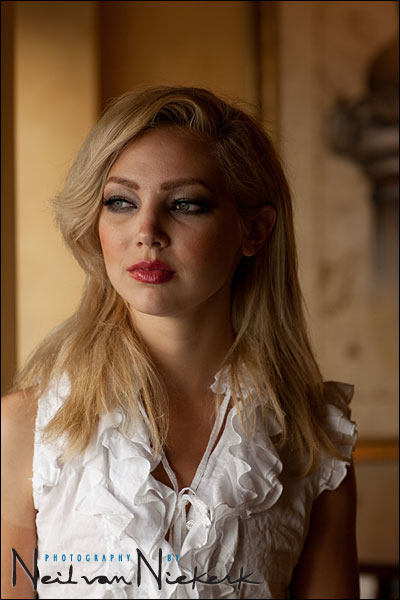
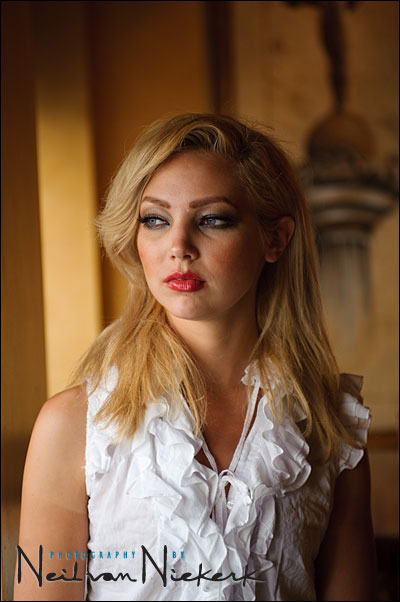
image on left: Canon 5D mk2; Canon 85mm f1.2 II; 580EX II
image on right: Nikon D3; Nikon 28-70mm f2.8 AF-S; SB-900; TTL BL
There is going to be some contrast differences and color differences between the two cameras – mainly because I haven’t properly set up ACR yet for my tastes for the Canon 5D mk2. Therefore the 5D mk2 images might lack some punch here in comparison to the D3, but that is entirely my doing. But the difference in color, etc, is not the discussion here.
Also, with these images, there is 1/3rd stop difference in the settings, but I went by the histogram to get correct exposure via the brightest part of her shirt.
The particular sequence that I do, is with the model looking straight at the camera, with the one side of her face lit by the window-light, and the shadow side of her face lit by varying degrees of flash.
Here is the sequence for the Canon 5D mk2 and 580EX II, changing no settings other than FEC:
The flash metering was set to Evaluative in the camera. In my experience, Average flash metering makes the TTL flash too strong with the 5D / mk2 / mk2N / mk3 bodies that I have used, for times when I want fill-flash.
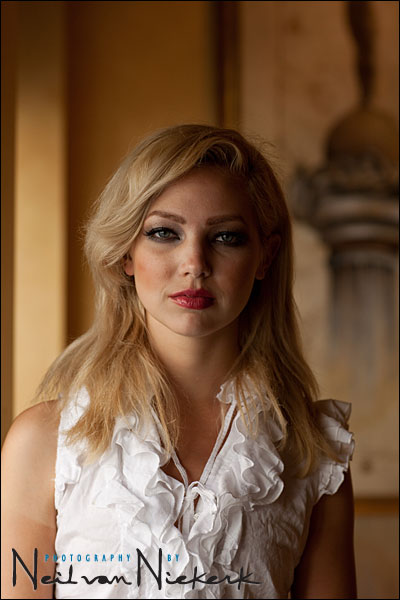
Canon: no flash
So here there is a lot of contrast because of the inside of the room not reflecting much ambient light back onto her.

Canon: FEC -EV
The bounced flash lifts the shadow areas a little bit. Just perceptible.
This, imho, is where -3EV FEC needs to reside .. adding just a touch of fill-flash without being obvious.
I like this.
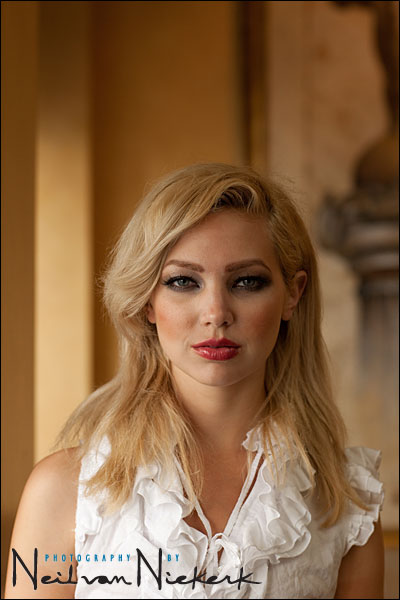
Canon: -2EV FEC
This looks the best to my eyes .. the contrast is lifted juuuust enough without anyone being wiser that flash was used.

Canon: -1EV FEC
The shadow areas are now significantly brighter.

Canon: 0EV
The flash is now adding nearly as much light as the ambient. (It will still be about a stop lower than ambient because of the brighter tones of her shirt and skin pulling down the automatic-metered TTL flash exposure.)
OK .. so far so good.
There is a linear progression here that is predictable within the usual constraints of TTL flash exposure. Meaning, we have to keep in mind that the tonality of the subject and scene WILL affect our exposure. But .. we’re wise to this and can compensate and even pre-evaluate this with some experience.
Let’s see what the Nikon D3 does.
Here’s the D3 with the SB-900 in exactly the same situation, with -3EV dialed in on the flash in TTL BL mode:

It looks good, but imho, is too much flash for a setting of -3EV.
Where I think it should’ve been is around here with what I get at -5EV cumulative FEC + overall exposure comp.
See? Now we’re getting back to where the flash is barely perceptible .. which, again, IMHO, is where -3EV FEC should reside.
I want flash to be juuuust perceptible at this point.
Placing the relevant images next to each other:
left: -3EV FEC .. Canon 5Dmk2; Canon 580EX II
right: -3EV FEC .. Nikon D3; SB-900; TTL BL
.
left: -3EV FEC .. Canon 5Dmk2; Canon 580EX II
right: -5EV FEC .. Nikon D3; SB-900; TTL BL
Ideally, I would want the Nikon to respond here like the Canon.
-3EV FEC should be barely perceptible. No, really. That’s how it should be.
Why else have a -3EV FEC setting then if it is meant to be as bold as the Nikon has it there?
So there it is. It is repeatable. I’ve seen this on other random cameras .. D300 / D700 / D3 that various of the attendees to my workshops have used. What I don’t know yet, is whether this is something pertaining to the SB-900 only. I haven’t tried it with the SB-800.
But back to the original point of this post … there are differences between different camera makes and models. Figure out how your equipment responds, and adjust your technique accordingly. You can make it work for you.
Comparisons between Canon and Nikon should be done by folks like you who have used BOTH systems EXTENSIVELY to provide useful information such as this :) Thanks for sharing.
Wonderful, as usual, Neil!
One question, on the D3, did you use matrix metering as well? Do you find that you do that more often than not when using fill flash?
Thanks for all you do – such an inspiration!!!
Great comparison! I love it when people talk about the 2 systems being different rather than better or worse. Very well done!
Thanks for responding Neil!
Wouldn’t the metering affect the ttl flash though?
Thanks!
Your information with your experience is greatly appreciated. I’d be curious to hear your knowledge to the wireless TTL differences.
The other very commonly heard plus to Nikon is their focussing characteristics. I would love to hear your view on this as well. I do a fair amount of landscape but need to consider a digital system for commercial application as well. I’m not opposed to having more than one system but would prefer one for now. Your input is helpful.
Thanks for all your sharing Neil.
Great post Neil. I am a Canon 1DMkIII/580EXII user and I have always been of the opinion that Nikons flash system was far superior to Canons. I must agree with your notion that they are really just different. I too, have been getting better flash photos as I have “learned” the system.
As for the focusing comments, I own a 1d3, nuff said.
Ken
Thanks for your reply and hint taken. I ignore the fanboys. I own what works for the desired results.
Thanks for this post, Neil. I really love the way you explain flash here – it is very easy to understand.
Thanks Neil,
its good to see the two systems side by side in an unbiased manner.
Love your site, it is bookmarked next to McNally’s, Hobby’s and Kelby’s on my fast dial.
Like I said, thanks heaps.
Do you have the Nikon in TTL-BL mode, which is more of the fill flash mode?
Gotcha – thanks :)
Interesting and useful, like the rest of your site. I found particularly interesting the progression you showed of the varying effects of the different levels of flash compensation for the Canon. I’m wondering if the Nikon system shows the same “logical” progression of changes as you vary the flash compensation levels (e.g., none through -3, or +3).
While I shoot with a “third” system, I find your methods and techniques easily transferable (as they should be). Your “fix” for adding additional flash exposure compensation to the Nikon image is now something I’ll need to explore with my own system (where all flash compensation is camera controlled, but which also offers the option of having “main” exposure compensation set for either ambient only (my usual setting), or ambient + flash, while also having a separate flash compensation function – the question being if main compensation is set for ambient + flash, is it additive (like Nikon) to the flash compensation to increase the amount of compensation possible, or not).
Finally, I would note that in talking with other photographers the reason I think most have felt the Nikon flash system superior is a greater consistency of TTL flash exposures in varying circumstances without having to apply compensation compared to other systems. I get the sense that you don’t necessarily agree with this, but then I wonder how many others have your extensive knowledge and experience with flash with both systems.
Thanks again for all you do with your site.
My comment is about Amy’s question about metering in the camers for TTL. There is a blog called Nikon CLS Practial Guide. This blog is full of very useful Information. Google it and you’ll find it. The blogger, Russ, explains that the metering system in the camera does nothing for your flash. So, it doesn’t matter for flash, what method you use. The flash is read by another method. Not the camera body meter. If you remember Hasselblad (film) with TTL, the flash was read from a small spot in the center off the film. Obviously if you had a meter prism on the camera the meter in that prism had no effect on the flash exposure. I suggest reading that blog. I think you will learn more there that what I can explain here.
Hope this helps.
Joe S
Thanks Neil. Glad you agree on this blog. By the way I forgot to say how much I enjoy your blog.
Joe S
Thank you so much Joe and Neil! Off to check it out :)
for nikon, it also depends on how you select your metering method.
Thanks for post Neil and it’s great as usual. I have a question… I use a D300 and the pictures looks very good on the LCD but when I see them on the monitor it lacks the punch. I always shoot them in RAW and use adobe CS3 and bridge. I color calibrated the monitors and tried them on different laptops but still the same problem…pictures looks different than on the camera LCD. In this topic you mentioned adjusting the ACR for the camera and I’m just wondering if you can explain it briefly or give me any useful web site and books regarding this topic. Thanks again
I’m so grateful for having stumbled across this man Neil’s wonderful website –
I’ve always been struggling with my flash exposure and now everything seems to be less intimidating.
I agree with Bennet – my Nikon does the same (or is it me?)- the photos seem much crisper on the LCD than on the screen
Thank you Neil for your prompt reply. Now I know the reason…I always thought it was a color calibration problem…
Hi Neil,
I don’t want to go too far off topic but I just wondered if you discuss your post production workflow in your book? I’ve never been on any courses on Lightroom/photoshop so am salf taught but I think I lack something because I never get the lovely images that you post so frequently.
I look forward to the workshop in Birmingham, UK, in July by the way!
Thanks
Steve
Is the fill flash direct or bounced from wall/ceiling?
Thanks for the info. Now it feels like there’s a completely new world to me with window light portraits, as I haven’t previously used (or to be honest, even thought about using) fill-flash in those situations. As an amateur photographer I would’ve been happy with the ambient only shot, but the shots with -3EV and -2EV flash (with Canon) really look better to my eyes as well, so I’ll definitely have to try this technique next time.
Now, however, I’m going to spend some more time going through your flash photography techniques pages which seem very interesting. Thank you for all the information and examples you’ve put on your site!
I really like the step by step comparisons – much easier than being told a list of settings to use for different situations . With regard to the use of TL-BL I have found it can be unpredictable – indoors with a white wall behind the subject it is actually brighter than plain TTL flash – though it actually is more accurate then !
I was also playing around with ‘natural light ‘ plus fill flash last weekend and wondered at how bright -3 in TTL mode actually was [ with an SB800 ] , I would say it was the same as your results for the SB900 here .
Thanks for the very informative post !
Thanks for your sharing!! I really learn a lot!
but I still have a question. can you help me?
sometime, I take photo in a sunny day, and my model stand inside a shadow. In this case, the background is shined by the sun, and the model is flash by my speedlight. after taking a picture, I find that the feeling is not “good”. It seems to be a fake picture. Just like I paste the model into the background. can you get the meaning? and can you give me sth suggestion?
Many thx~~!!
Neil you are the greatest.
You are probably the best teacher i ever had.
Thanks!
@Bennet and Lydia
I also find my raw camera LCD is much brighter than the same raw on my PC LCD. I think since we are looking at raws, it should be quite similar on both. Of course my software will brighten the raw->jpg stage, but I want the exp. ‘correct’ to begin with, which is difficult when I don’t have a bell-curve scene – I can trust neither histogram nor LCD?!?!?!
Hi Neil!
Many thanx for sharing your huge knowledge.
Some questions :
1) When you talk about FEC compensation : -3ev, -2ev, etc…, is it a flash setting, or a camera setting?
2) Did you use the “*” button which generates a short lightning ?
3) Where do you point your camera for exposition (face or white shirt ?)
Thnx Neil!
Neil, how can get -3EV FEC on the canon? My 5D only goes from -2EV -o +2EV !!!
Hi Neil,
You made the following comment on March 25 @ 7:55pm
“The way the SB-900 (and the SB-800) works with wireless TTL is that you control the output of the individual slaved channels. With Canon you work in ratios, which for me, is less intuitive and less direct.”
Unless I’m misunderstanding your statement I’d like to point out that the individual slaved channels can also be set independently for the Canons. Accessing it through the menus is very much a pain but by setting the Canon flash mode to ‘M’ you can then control the output of each channel. It wouldn’t be TTL as there’s no longer any pre-flash to measure.
Thanks for sharing the knowledge.
Hi Neil,
This is a great comparison work. Thanks for sharing.
I’m sure, you have previously seen this, but the only resource on Internet describing Nikon’s TTL system (and BL as well) that I could discover so far is Russ MacDonald’s blog; i.e.
https://nikonclspracticalguide.blogspot.com
As far as I see, using BL feature in such a lighting may lead to the results you get.
I’ve to quit now, I’ ll write in detail a few hours later.
Cihan ULUSOY
Great info Neil.
I just tested with D700 and SB-800.
Works differently in one aspect compared to Neil’s D3+SB-900.
Specifically, the cumulative effect of cameraFEC+flashheadFEC works in TTL but not TTL-BL.
TTL-BL seems to be limited to a total of -3 (as seen on actual exposures-viewing the images) even though you can dial in FEC on both cam and flash to an apparent -6, you never get -6. You can combine cameraFEC+flashheadFEC (or use each by itself) to reach -3 but not go any further.
e.g.
camFEC -3 = total -3 FEC
flashFEC – 3 = total -3 FEC
camFEC -2 + flashFEC -1 = total -3 FEC
camFEC -2 + flashFEC -2 = total -3 FEC **note never passes -3 limit
flashFEC -3 + camFEC -2 = total -3 FEC *note never passes -3 limit
It would be very useful to have TTL-BL work for very tiny touches of fill, but doesn’t seem to work that way on D700+SB-800 combination.
Kevin
Neil,
Great post. I am trying to do self portrait using one flood and 580 ex off camera in Av mode. May be I have setup something wrong but it seems like the camera is always shooting at long shutter speeds (I would have thought because of ttl camera would know and set appropriate shutter speed?). I am a beginner so might be a dumb question.
Thank you for all the great information you are sharing.
pk.
pk, this is because in Av mode, the flash acts as fill-flash and so, in dark scenes the shutter-speed will still be very long. Av mode with flash can be used with good results use outdoors (make sure you set your flash on High-Speed Sync).
Indoors, always shoot with the camera on manual (Flash on ETTL if mounted on camera).
Goodluck! :)
Hi Neil,
I frequently bounce my flash indoor esp. at night to act as the main light. My example would be typical house ceiling height, where my setting normally would start at 1/60, f4, iso 400. I always find that with my 40d & 580ex I need to compensate around 2/3 to 1 FEV to get a good exposure, whereas with Nikon I normally need not to use any FEV.
I also found that with AWB, using flash indoor with Canon is always less consistent in accuracy compared to Nikon. What do you think?
One question I have about the above comparisons: in what direction did you bounce your speedlites for these shots? Also, was there a white wall somewhere to bounce off of?
Hi Neil,
Superbly demonstrated comparison between the 2 systems.
You ‘nailed’ the argument in your opening paragraphs:
“As simple a point as this … get used to how your particular camera and flash respond, and adjust your technique accordingly.”
So, understanding your own kit is key, experimenting with the different modes and finding that ‘happy medium’ where you can predict great results for yourself.
I have seen amazing photos taken on Nikon, Canon, Fuji, Olympus and now Sony equipment. Some specialist kit will give you specific capabilities to achieve outstanding results, but there are other ways to achieving the same.
1.> So, be proud of what you have invested in
2.> experiment, play and test your camera kit
3.> have fun, enjoy and aspire to improving upon your expertise.
Neil – thanks for this, I will now crack-on and learn more about how to get the best out of my Canon gear.
“Amy, thanks!
I usually just keep my camera to matrix / evaluative metering. Since I shoot in manual exposure mode, the actual metering mode has no effect on the exposure itself.
Neil vN ”
With regard to this reply I must mention that though metering mode has no effect on ambient when in manual my tests have shown that it does have an effect on TTL/BL output . I did a video on it https://www.youtube.com/watch?v=pfONFdXhO8o and learning this helped me understand that TTL/BL ‘watches your meter” to determine where the ambient exposure is and how much flash to add so it can back off as the ambient is increased . using CW metering in this case may have caused TTL/BL to back off further .
Hi Neil, thank you for this information and tips. I work with Nikon D3, Nikon D700, Canon 5DII and the two SB900 and two 580EX. I can’t say, why – but I found, the Nikon flash looks/feels better. The sharpness with the SB900 is better. The Flash is faster than the 580EX and so I work with Canon 5DII and Nikon SB900, with beauty dish and softbox. Regards from Cologne, Dirk
Hi Neil,
Stumbled across your website a few months ago and has changed my photo knowledge for the better. Anyway reading your article on TTL vs TTL/BL has been helpful with understanding what the BL shown in my flashes users(actually useless)manual actually means.
Right now I’m using an SB600 with a Nikon N80 SLR, but I’m planning on getting DSLR in a few months. I’ll have to stick with what I have until I have the $$$$ to spring for it. So as regard to the difference between TTL vs TTL/BL. Does this apply the same way to film cameras. Which setting should I be using? or does it make a difference. My old flash was TTL/TTL MATRIX. Which I used the TTL MATRIX pretty much all the time.
Also with going digital, which DSLR could you recommend. I the like pics done with the D90, D80, D200. It’s been said shooting with these cameras they are not sensitive enough for shooting in low light being they have DX sized sensors. What lenses would you recommend for shooting in low light on a budget.
Thanks
Dan
I’d like to come back to the article on Nikon CLS practical guide https://nikonclspracticalguide.blogspot.com/2008/03/ttl-and-ttl-bl-study.html There is about coupling TTL-BL metering system to focal distance raporting by the lens. Turning flash head other direction than on model makes lens raport useless. We can only guess what flash will do in this circumstances. Accordind to Russ theory flash should keep small account of light as the distance between model and camera is short. Propably focal distance isn’t the only aspect taken to account by flash, because your tests proves that is moore light, and you had to put -5 FEC to proper results. What is your experience, does focal distance afect flash light?
Regards, Tad.
Hi Neil
I’m a little late to the party here, but I’m about to switch to NIkon and have been doing a lot of reading about Nikon and the CLS system. I have one question, and it seems from reading the d3 instruction manual online that the answer is “yes” but I’d like to have it confirmed my a Nikon user. I often light receptions with two lights on opposite corners of the dance floor and one more on camera dialed down a lot providing a little bit of fill light bouncing off the ceiling and also throwing a little light forward off the bounce card. I would love to be able to set my off camera lights on M and control them on the camera, and then have my on-camera light set in iTTL set at whatever FEC value I choose, probably -3 or -5. Is that possible with the CLS system?
You can’t quite do that with Canon (mixing and matching eTTL and M between the strobes in the groups). At best you have to put everything in manual, but that’s not ideal.
Thanks
Nathan
Hi Neil, thnx for this article.. just a question, have you explained in any article on how to judge and get right exposure and settings (approx) by looking at histogram, and if yes where can I find??
Regards
Guru Saini