Video tutorial : Direction & Quality of Light
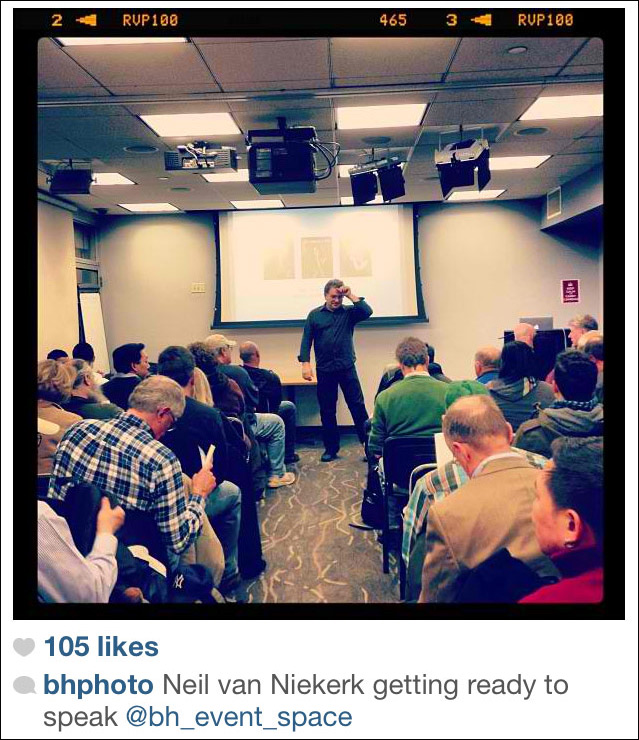
Thank you to everyone that came out to the presentation at B&H’s Event Space. It was jam-packed! That’s always a big compliment. The photo was on B&H’s Instagram feed, and was taken in the minutes before the presentation started. And no, it’s not my doh! facepalm realization that I’ve forgotten something.
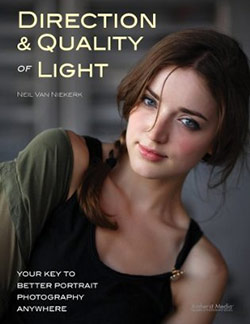
The topic of the presentation was – Direction and Quality of Light – and it is based on the material in my new book. I do think this presentation was solid, and going by the stream of questions, very well received. So thank you for being there and participating.
Click on the image above to watch the video on Youtube.
But as the saying inevitably goes, the book is always better than the movie. So in case you haven’t seen the video clip yet, it is a good introduction to the book, while also taking a few detours along the way. If you liked the video clip, the book contains even more, and for about $20, you can own and hold and touch and smell the book. All yours!
And for those of you who have already bought the book, a big thank you! The support is always appreciated. And if I could ask a small favor – a nice review on Amazon always helps.
Direction & Quality of Light
I wanted to distill the essence of what we, as photographers, work with – light! Before we can truly grasp on-camera flash and off-camera flash, and really, any kind of photography, we have to be aware of the direction and quality of light. We need to observe the light that we have, and then decide how best to use it, or enhance it.
With this book, I try my best to share those “aha!” moments with you, and I do believe this book can make a difference to your photography.
The book is available on Amazon USA and Amazon UK, or can be ordered through Barnes & Nobles and other bookstores. The book is also available on the Apple iBook Store, as well as Amazon Kindle.
Related articles
- Direction & Quality of Light – book
- The black foamie thing
- How to bounce your flash
- Video light for photography
- For more videos, follow me on Vimeo / YouTube
Photography workshops
- More info about upcoming photography workshops.
- Recap of previous photography workshops.
omgosh..thank YOU! I have all your books and so appreciate you posting this….can’t wait to watch it.
This looks awesome Neil. Just watching it now. Thank you! You are so generous with your knowledge.
Thanks for sharing this Neil… it delayed my bedtime by an hour and a half but worth it…. :-)
Fantastic Neil. Never short answers – just perfect answers!
…and, it did not disappoint..FABULOUS! Learned so much…as usual. Very helpful to see you demonstrate what you have taught us through the blog.
Thank you so much for posting this! So much great information.
Thank you so much, master! This is so useful for those of us overseas who can’t share the luck of attending your lessons!
well, I watched the entire video, great job! I loved it. :)
Really enjoyed the chance to hear you talk about all the things I’ve read in your books. Thanks for sharing with us.
Great! Thanks for sharing your knowledge. Looking forward to your new book! Regards from Spain.
Neil,
Been a fan of your work for years (found you on POTN). Got a quick question… I really love the lighting you create but I was wondering if it would be possible to bounce off a white reflector if I got an assistant to hold one?
jo .. that would work too.
Wow this video was so instructional! Many thanks for sharing!!!
Just saw your presentation at B&H, learned a lot, thanks for the first class tips and inspiration. Greetings from Lisbon.
Excellent lecture – thank you. Just one complaint – 90 minutes isn’t long enough! Want more!
Thanks for that, very informative (although some questions from audience members make me think they weren’t listening)
Bouncing flash of exterior surfaces when doing outdoor portraits… nice
I’ve getting great results using the bft and bounce flash in suitable locations. I was also thinking about using a large reflector on a stand in locations with dark ceilings/walls. Especially for quick event type jobs in confined spaces, such as at a restaurant where there’s not space for a softbox on a stand and there are other restaurant patrons/wait staff milling about.
Thank you Neil for posting this up to watch. 90 minutes well spent. Loved the last section the most, video lighting looks so dramatic and relatively for so little effort and outlay. Great clip!
I have to say that I was very happy to see the B&H video! You are a great photographer and you really care to share the knowledge to others. Well done! Kudos!
Hi Neil, I have your books but it was still nice to watch your video – thank you so much for sharing your knowledge. I have learnt so much from you – and yes, it’s true….if only one had known all of this when one was younger!!! The video lighting is quite awesome and looks so easy……?
Awesome information! Thank you for sharing, I had never thought about how important the direction of light is during an overcast day. This makes so much sense trying to avoid unflattering shadows under the eyes by simply avoiding light hitting the subject mostly from above.
Really enjoyed this video. I never really thought about how positioning a subject under something would eliminate the overhead sunlight and make it directional. Your grasp on photography and the ability to explain it, is incredible. You have helped me so much. The concepts and tutorials on your site are very unique from other blogs and forums and make a lot of sense when I apply them, or try to any way.
This is one of the best instructional videos out there, Neil. Your generosity, and ability to communicate the essential points, is very much appreciated.
Hi Neil
Thank you so much for this video clip – would you not consider making available more of these clips of your other photography work shops, for those of us who do not live in the USA – maybe @ an annual subscription fee – PLEASE
I’m with Lindie in that it’s frustrating that we don’t have access to these workshops living outside to US (I’m from England)
The video was great! Even though I have your “on camera flash” book from which a lot of this video’s content is taken its great to hear it explained fully and in person, so to speak.
I am impressed with your patience at the repeat questions! Especially when they’re about the exact topic you’ve just explained!!
Thank you for sharing such an instructive video through the net, and I felt I were learning from you in person. A bft greeting from Tokyo.
Hi Neil,
I was not able to create an account in the forum so going to ask question here. If there is no white dress or no other white that one can use to meter than how do one meter using histogram method or is there any other method that can be used.
Another thumbs up from me Neil, very well explained and loved every bit of it. Video light next on the shopping list.
Jaswinder,
2 things you could do, have a piece of white cloth/towel and just get someone to hold to meter off that, making sure it’s in the same light as subject.
But the best trick I used to use in film days, no LCD luxury, was to meter off some grass in the same light as your subject and zero the meter out since grass is a perfect 18% Reflective Grey which you are trying to achieve for the midtones anyway. [Not of course the whites]
No grass! I’d then meter off anything I think is midtone, concrete footpath, lightish brick wall, etc.
Also remember if outside, the Sunny 16 rule. ISO 100, Shutter 125th f16 which means you can also have 250th, f11; etc. Of course if using flash you’d need to take into consideration the max sync speed. If 200th, you’d be around ISO 100; Shutter 200th, f11/f13.
For those who stated they hadn’t thought of positioning the subject under something, you might want to google “subtractive lighting” to find more info and examples.
Thank you so much, Teacher! This great stuff for those of us overseas who can’t share the luck of attending your lessons! Like already set in another post. It’s another dimension of learning. Reading your books and blog and looking at the video works in to the brain in two different ways an really give understanding. Now I understand broad and short lighting! Of course also the language had to do something with this late understanding. If English is not your mother language and you don’t understand the meaning of broad it become more difficult to understand but now I get it! It was one of mine ahah moment. Of course there were other interesting things in your explanation!
This video for free it’s unbelievable thank you!! I have learned a lot this night!
Evert
Thank you very much for this video, you are really great teacher !
I have a question about the exposure metering part. Just to make it simple:
Your opinion is to expose for the most important highlights. Since we have them correctly exposed then shadows are correctable in Photoshop and RAW conversion.
Georgi .. Yes. However, we can affect the contrast by how we use light, and how we use our lighting. We can lift shadow detail with fill-flash, for example.
So there are ways – in fact, preferable ways – of affecting our shadows, before we have to adjust them in post-processing.
Hi Neil,
I really enjoyed the BH lecture you gave. Your black foam method of blocking the light from touching makes a lot of sense when bouncing light from behind or the sides, but is there ever a time when you not only take off the flag, but actually use the white bounce card (or perhaps a flip-it, Joe Demb, or other white bounce card) WHILE bouncing the light from on camera flash? (I know it’s a different story while using those off camera with someone holding it).
For example, you decide that the the ceiling above the subjects would be the best (or perhaps the only)location for the bounce but you also want to either have a little extra fill. From what I saw, I would guess no since you seem to like to pose your subjects to either face the light when it’s above (the recessed light example you gave earlier in the lecture), but was curious about your views on bounce cards in general.
When there isn’t an easy way to bounce flash off other surfaces, then I do use an on-camera diffuser. Usually a white card to throw light forward from the camera’s position.
However, when there are bouncable surfaces, then on-camera flash diffusers work against you.
Thank you for sharing this! This was really awesome. As I look at my pictures, the ones that I really love have directional light, even though I’m not sure I was really planning it. This video helped me see this and now gives me something to really work on and I feel I have more direction on where to take my work. Thank you!
I do have a question or 2… You touched a little in this video about bounce flash in bigger areas. How far can you feel the bounce flash works? I know you’re not expecting the flash to do the whole exposure, it’s sorta like a kiss of light where you really need it, so the power may not be as high. But do you tend to have your flash going off at full (or close to full) power a lot in bigger areas? I’m concerned about fresh rates of my flash.
Hi there Tim …
Your questions are thoroughly answered in these articles:
– Bounce flash and the inverse square law
– Bounce flash at wedding receptions
– Manual mode bounce flash
wonderful presentation. I´ve just got one question concerning what you said about metering.
As you already mentioned in your first book (besides -I love both and am looking foreward, getting your 3rd one), you are metering for the brightest part in your picture, you want to have texture in (is this the correct expression??) and then adjust the metering using the histogram of your camery. I just wonder, why you dont meter for the skin tones using spot-metering, as it is most important, to meter correctly for the skin tones. Wouldnt it make things easier – skin tones are close to 18% grey (as long as the person you are photgraphing is not afro-american)?
With slide film, I metered off a grey card, or selectively metered off areas with a similar tone.
With a histogram though, you can’t easily place where a mid-tone will fall. The edge of the histogram – ie, white – is easier to see. And as you mentioned, skin tones vary a lot.
There isn’t a single specific method that is correct above anything else – it’s a matter of working with what you have in the scenario that you are in. You adapt.
Neil, After following you on FB for a long time, it was great to see and hear the man behind those great books you wrote. Thanks for the B&H Video.
John Parker
Seattle
Hi Neil,
Do Quality and Direction of light go together ? Meaning if the direction of the light is good, is the quality good? Or is the quality of the light something independant from its direction, and it’s more about geling the flash, video versus flash light …?
A side comment as well, You Rock !
Thanks,
Ced
Hello,
I just watched the video, but would need a little more clarification. I know that you use a histogram for your correct exposure. But how do you do your process in order to get the correct exposure?
Do you test shoot your subject in aperature priority. See if the histogram is right. Take the settings and use the same settings in manual mode?
Where i dont get is where you say that you pull up the stops when metering white dress. Are you pulling it up in manual mode? Or are you using exposure compensation setting in aperature priority?
Thanks
Hi Neil,
thank you for this video which reassured me in things that I have already learnt from you. I must say that it was you, with your website, who lit the bulb in my head when it comes to using flash. Before that, I had no idea – mixing the intensity of flash with ambient, setting the exposure, equalling the color of various sources of light… I was lost in it and had no idea about what could be done and how it could be done. With the information from you, it all makes perfect sense. A big THANK YOU from Slovakia!
Juraj Dorko
Here is how I use the histogram to get correct exposure.
No need to go the laborious route of using Aperture Priority / Av mode first. Do it all in Manual Exposure mode, and look at the camera’s meter display in the viewfinder.
My book, on-camera flash photography, deals with this topic too.
And here I am again, Neil, this time actually with a question that I forgot to mention in my previous post. I know how you keep your exposure constant – by shooting in manual mode. Even if you have to adjust the exposure a bit in PP, you have your histogram in Lightroom which tells you where you are. BUT, how do you keep your WHITE BALANCE consistent? Do you shoot in auto white balance mode, or do you adjust it during shooting according to ambient light? Sometimes when I process a group of images, say 40 or 50 (I’m just a hobby shooter), I discover that my white balance differs throughout the group. I try to achieve the correct white balance in every picture, but when I compare, say, the 1st one with the 40th one, they are different – and I only spot the difference when they are side by side. So how do you achieve consistency here? How do you shoot a thousand pictures at a wedding and make the white look exactly the same in every single one of them?
Juraj .. if you’re photographing groups with off-camera flash in manual mode, the lighting (and hence the WB), should be very consistent.
I adjust my WB in groups of images that are similar. The moment you fall into adjusting individual images for WB, then there will be obvious discrepancies between images.
Hi Neil Just been watching your video on direction of light It is really very good. I have a question. When you expose for the brides dress manually Do you then add the exposure value after by using your cameras exposure dial by up to by say one or two stops so the histogram then shows were you want it to be off the right.. cheers Pete
I shoot in Manual exposure mode, so I adjust either the aperture / shutter speed / ISO (or a combination), to get to that 1.7 (or so) EV, to get to proper exposure.
It’s explained in detail here.
How do you accommodate the color of light returning off of a wall or ceiling that is something other than white? You can gel for incandescent, fluorescent, etc.so your white balance works, but I’m fairly certain adjusting for an orange (for example) wall is kind of tough. Any suggestions on dealing with your flash coming back with a hue/color shift due to the surface bounced off of?
This article should answer your question:
bounce flash & white balance settings.
Thank you for your response. I was refering specifically to bounce flash. How does white balance adjust color shift for random colored walls like for example, a random shade of purple, red, brown, etc.? Wouldnt you have to know the RGB components of the hue the bounce flash takes on to remove that color cast from the entire image? It seems that a white balance adjustment will only effect certain colors (or ranges thereof), not any possible color you might find on a wall or ceiling.
The problem kicks in with colors like blue or green, especially when they are deep colors. Then the light that is returned by bouncing your flash, isn’t a continuous spectrum. There are gaps around the warmer tones – the yellows and orange and red tones. Then it could be difficult to get a nice skin tone out of the bounced flash.
With off-white and warmer toned surfaces, this usually isn’t a problem.
Have bought all three books, it is really worth! The video is very good as well, but I think it is always better to have a book. Neil, if you write a fourth book, I will buy it! Thank you!
Cheers
One thing that I can’t get my head around …
When you explain bouncing the on-camera flash standing outside (photographing the bride and groom @ 1h:12m), the wall obviously becomes the light source, but doesn’t the majority of light escapes into space, towards the skies?
I always thought the angle of incidence equals to the angle of reflection…? Could someone correct me please? How come they still get some light? Is it because of high enough ISO?
@Artur: what you describe is reflection off of perfectly flat surfaces, like mirrors, windows etc. and is called specular reflection. The scattering of light in all directions, which causes the reflected light to be soft, is called diffuse reflection. This type of reflection can be obtained from rough structures, like that wall. This difference is also the reason why bouncing into a mirror won’t make the light soft, as you probably would have guessed, despite the fact that you light up a large area of it. See also https://en.wikipedia.org/wiki/Diffuse_reflection
Cheers!
Artur … here is the original blog post with more details:
Using on-camera bounce flash outdoors at night.
Bounce flash is inherently not the most efficient way of using flash. Most of the light is lost with the ceiling and walls absorbing the light. Even more so in using directional flash where the flash is pointing away from the subject, or as in this case, is spraying a large surface with light in the hope that enough light will return.
But in using a high enough ISO (1600 in this case) and a wide enough aperture ( f/2.8 in this case), the light that did fall on my subjects are enough for proper exposure.
“… for $20, you can own and hold and touch and smell the book.” No offense, Neil, but I prefer to just read it and practice what you teach ;-)
Excellent book – highly recommended to everyone I know who wants to learn and master flash or just better understand and work with light. I own all three of Neil’s books and I think this is the best one yet – your writing style and the way you teach are even more clear and concise in this book. I love your shooting style and the way you explain methods and concepts just clicks with me.
“Thank You” simply does not say enough to you, Neil, for all you have taught me.
Phil
I do own the book, now I need to see the video. I’ve also seen it live at After Dark.
Thanks for the link to the video: I haven’t watched it yet, but I’ve read the book over and over, and I can say that it’s the most useful book that I’ve ever bought on the subject of photography. I just had to stop by and say thanks to Neil for putting this information out there. I had always been intimidated by my flash, but now I find myself using it intuitively. Not only that, but you’ve also given me the skills to understand when not to use it. My photography has gotten much more consistent, and I feel more capable of capturing great portraits regardless of the available light.
I can’t wait to watch the video, because I’m sure there will be something new to learn.
Great book(s)…have all three.
Question…when you meter for the white dress to hold your highlights and then add fill light do you then need to adjust your ambient light down a little more to compensate for the additional light added thru fill? Or is the amount negligible that no further adjustment is needed?
Here is the article on metering for the bride’s dress and using the histogram:
exposure metering for the bride & the bride’s dress
A fairly simple way to get accurate exposure, is to use the histogram. I place my brightest relevant tone at the edge of the histogram. All the other tones will fall into place. In this way, you simply expose correctly for your subject – the bride in her white dress.
Now if you add fill-flash, let’s say at -2 EV, then the bump in exposure is fairly minimal. At -1 EV fill-flash, the bump in exposure is becoming more pronounced but is still well within what the RAW file is capable of handling.
While it is good to have a methodical approach and a solid technical understanding, it is very often better during the shoot, to keep the momentum. To stop and fine-tune settings at 1/3rd stop or so, breaks the concentration of the person you are photographing. So most often, I would just keep to my correctly metered settings, and then adjust the RAW file later if needed. Or … you can just take the ambient exposure down by 1/3rd stop if you are working at -1 EV fill-flash.
When you get to the point that you are adding as much flash as ambient, it makes sense to pull down the ambient exposure accordingly by a stop.