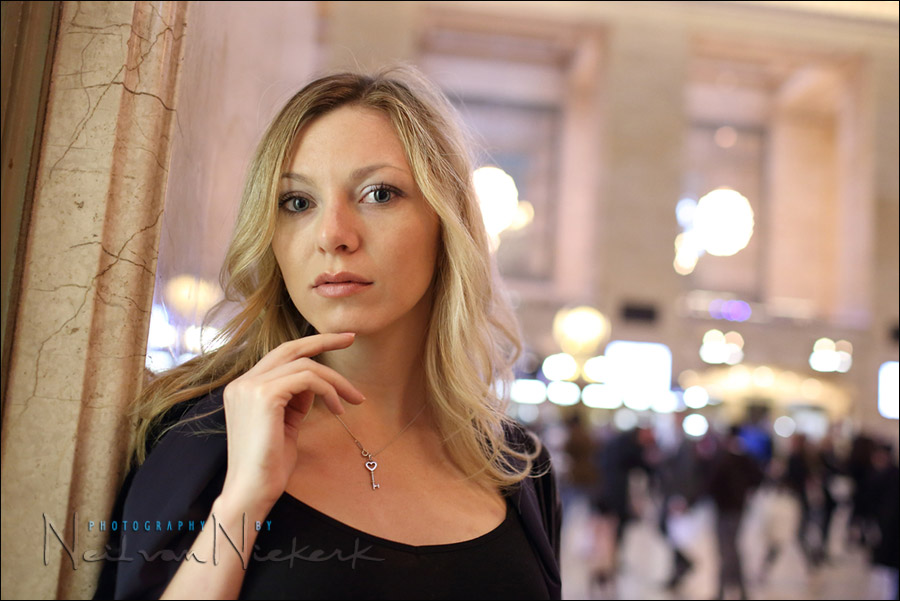
Even with high ISO settings, you still need good light
Still having fun with the Canon 5D Mark III (B&H / Amazon), I met up with Elmira again in New York. Elmira is the model I used in my initial tests of the Canon 5D Mark III high-ISO performance. Being a delightful model to work with, I decided to use her again as a subject. New York was cold on this day, so shooting indoors just seemed a lot more attractive. We went to Grand Central Station – a grandiose building, but with light levels quite low. Low enough that I was glad that I brought the Canon EF 35mm f/1.4 (affiliate) along on this photo shoot.
camera settings: 1/100 @ f/2 @ 3200 ISO
Even with a high ISO like that, I had to use a fast aperture.
An approach that I strongly believe in though, is that “using the available light” is not random decision. It needs consideration of what your light is actually like, and whether it is flattering. What I did here was to pull Elmira towards a light source, so that the light would come in from an angle over her shoulder …
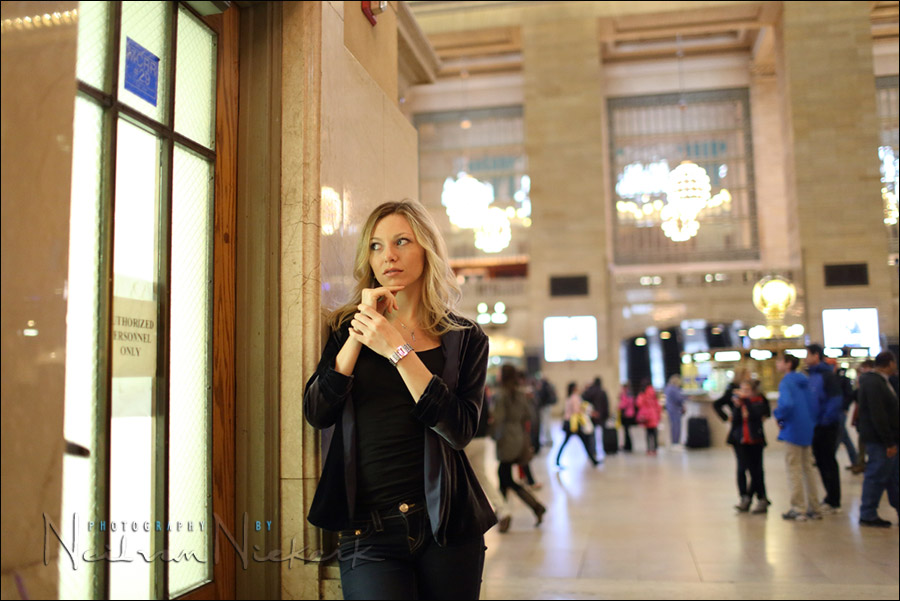
With the fluorescent light coming through the frosted glass on the door, I knew I had a large light source there .. and I used it. This way, I purposely controlled the available light falling on her. It’s a conscious choice.
Hopefully with the medium-wide angle of 35mm, and the fast aperture, it lends the image a certain cinematic look.
I did crop the image slightly to remove an unwanted highlight in the top right-hand corner. If anyone wants to look at the photo close-up, along with the other images from the Canon 5D Mark III high-ISO test, the high-resolution JPG is available as a download. The photo is the JPG generated from the RAW file, via DPP. Therefore it is as close to an in-camera JPG as you will get, while still allowing me to adjust the WB of the RAW file.
Lighting & Design for Portrait Photography
Lighting & Design is a follow-up of sorts to Direction & Quality of Light. It’s a slightly eclectic mix, discussing the thought-process with various scenarios shooting portraits. The examples use available light, bounce flash, off-camera flash as well as studio lighting.
The idea is that in every one of the 60 sections, there is something to be learnt and applied, regardless of your level as a photographer or where you shoot – all shaped to form a cohesive narrative arc throughout the book.
You can either purchase a copy via Amazon USA or Amazon UK. The book will also available on the Apple iBook Store, and Amazon Kindle.
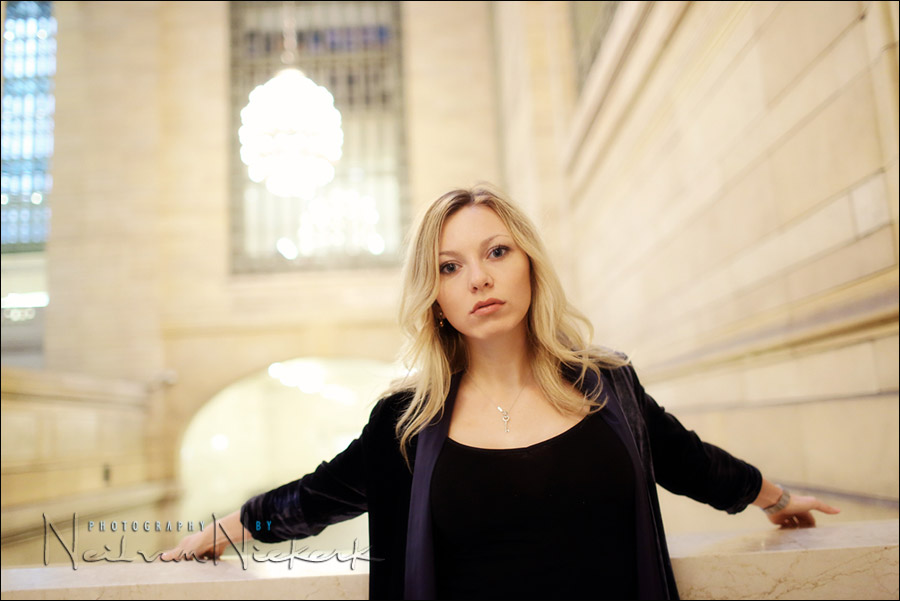
- camera settings: 1/80 @ f/1.6 @ 3200 ISO
- Canon 5D Mark III
- Canon EF 35mm f/1.4
The same idea was applied here in using the available light. I scouted around until I had a place where the light fell on her in a flattering way.
Buy your photo gear through these affiliate links
You can order a Canon 5D Mark III via these affiliate links: B&H / Amazon
Other reviews of Canon gear.

For the first image, where the model is leaning against the office door with the fluorescent light, did you set the camera WB to fluorescent, tungsten, or some other value?
I get confused when there are mixed lighting sources. I usually set the WB to the dominant light source.
So, Neil, are you just testing the Mark III a lot for the blog’s sake, or are you thinking about going back to Canon as your dominant camera again?
Dear Neil,
Is the noise level related with ambient light for the same iso level? I mean that “high iso performance level photos” (first samples) are taken with great light (1/400, f4, 12800 iso), whereas your last samples are taken with less light (1/80, f1.6, 3200 iso) There are 3-4 stops differences i think. If you compare both of them according to the noise levels, is there any quality differences in raw files? It’s difficult to understand from jpegs. Thanks.
Hello Neil; when do you plan to share some impressions on the new D800/D800E as well? I think a lot of us are really waiting for that insight too.. Greetings!!
A major take-home for me from this post is: keep an eye out for natural-occurring softboxes, such as the frosted glass door with light coming through it. Not a surprise that this message comes from Neil, who has given us the “virtual softbox” in the form of bounce lighting from an on-camera flash, shaped by the black foamie thing.
Hi Neil. Yes I read some of your posts about the troubles with Nikon NPS for the latest cameras. I hope they sort it out as soon for you. Regards!