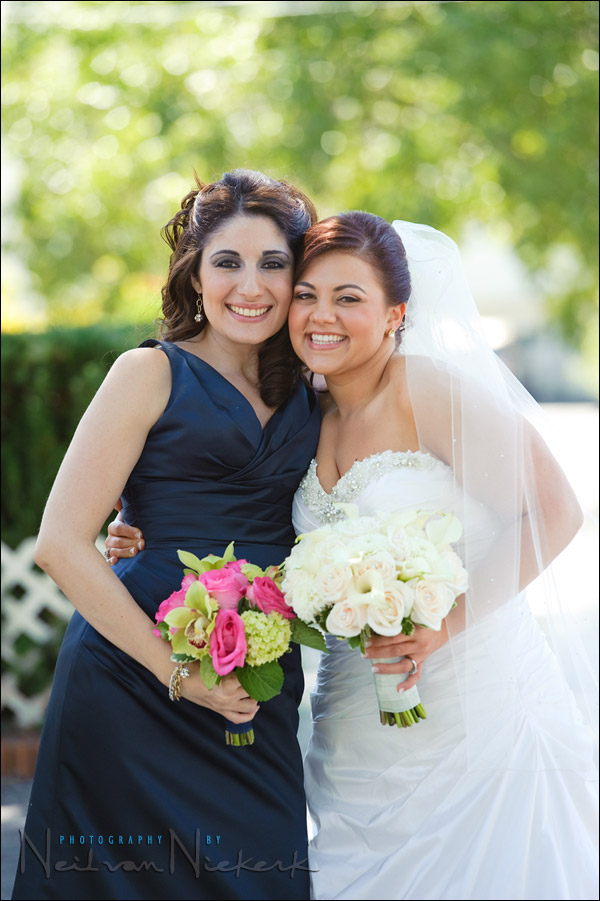
Portraits of the bride and bridesmaids – location and direction
One of the series of photographs that I like to “have in my pocket” are the individual photos of the bride with each bridesmaid. This is the kind of photograph you can hammer out very quickly, one after the other. The bride with a bridesmaid, hugging each other. I always make time for this. One stumbling block might be a lack of place to do this. But there is usually somewhere to do this, by isolating your subject with a long lens against an out-of-focus background.
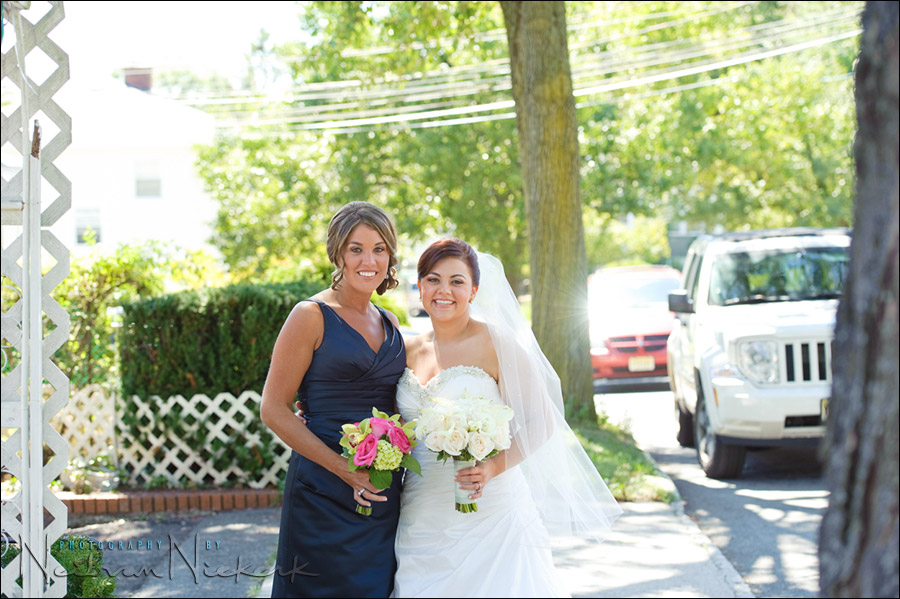
Still at the bride’s house, we had a few minutes before the limo had to leave. Inside the house there wasn’t really space to do this. So I looked outside. It was the usual New Jersey suburban clutter – cars and utility poles and houses and just things! Looking around me outside the house, I saw one direction I can shoot in that would give me a backlit image, with just out-of-focus trees in the background. Perfect!
Here is the pull-back shot to show what it looked like …
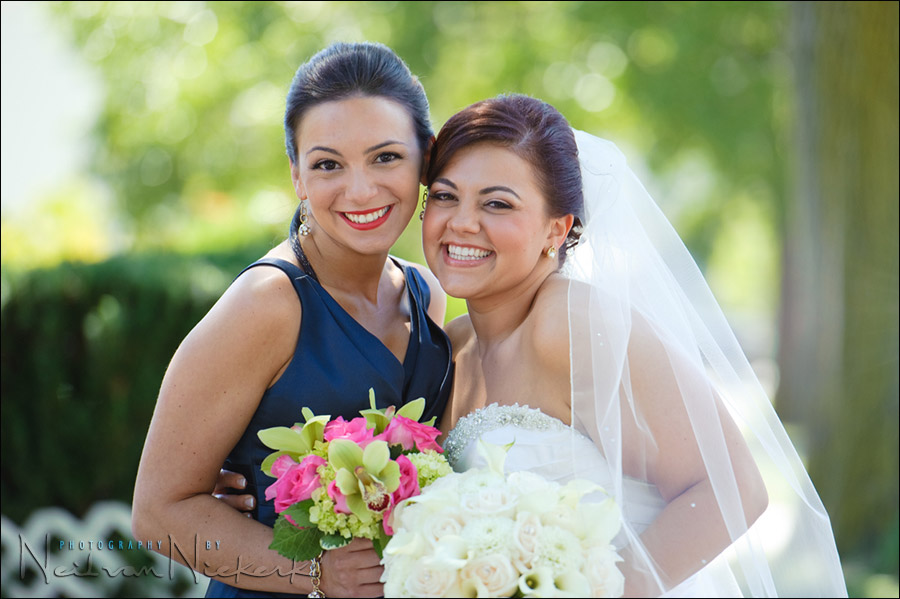
.. and with carefully selecting my background, I get the typical on-location portrait with an out-of-focus background.
By considering where I place my subject(s), and moving myself and my subject(s) in relation to the background .. and carefully framing with a long lens … I can get photographs where the viewer’s attention isn’t distracted by unnecessary elements within the frame.
Related articles
- Simplifying composition with a fast telephoto zoom
- Wedding day portraits – simplifying composition for effect (bride: Jaime)
- Effective on-location portraits (model: Anelisa)
- Composition – finding your background
- Portraits with just a touch of on-camera fill-flash.
There is a repeatable method here that works every time! Even in a pinch. Actually, especially when you’re in a pinch to get the job done quickly.
With these images here, there was no editing in Photoshop. I just changed the WB slightly before processing to JPGs. With wedding photography, a fast workflow becomes necessary.
Hi Neil,
Just a quick question : when you shoot people like in photos 1,2,3, are they in the shadow in order to use your fill-in flash?
Thx for your reply.
So you shoot in front of the sun to create a particular shade on the face and shoulders. OK!
How do you avoid the flare ? Are you in the shade too, to avoid it ?
Hi, Neil, thanks for this one. I find it great to see what can be done in an area that looks initially uninspiring. Those kind of shots inspire me so much because I know that when I have an awful location there is still hope!
Hi Neil
I’m a newcomer to your blog and a relative newcomer to photography but am enjoying the clear way you teach and answer questions. Thankyou. I like very much the simple, foolproof technique you describe above. Its great “bread and butter” photography. I have a Nikon D40 and just leave the Nikon 18-200mm VR lens on it all the time for now while I’m learning. It seems pretty good at getting the sort of shots you show here. Thanks again for the wonderful resource that is this web site. I’m hoping to be in NYC God-willing later this year so might have to join in one of your classes! I’ve ordered your book so looking forward to that too.Best regards from Perth, Western Australia.
Thank you for sharing not only the images, but the surroundings, it helps to know what you were dealing with and what you were able to achieve.
Hi, Neil.
Just asking (not critiquing): Would you normally correct your finals for the blue-ish hair highlights from the shade? Thanks!
Thanks for enlightening us!
Why not create your own background and super impose post
Commenting on Bret’s question about color correcting the blue-ish highlights on the hair – I used to spend hours editing for that sort of thing – I now realize that only other photographers notice it, the clients ‘never’ do!! As Neil said, I stick to removing tints from white dresses in any final images the client chooses. Apparently some wedding dresses are sprayed with some sort of protective fabric coating, which can sometimes have a reaction with UV light and particularly with flash light – ever noticed a bizarre color cast on the bride’s dress but not on other white objects in the same shot? That’s it!
Neil, this is an excellent post and reminds me of the necessity of using my long fast lenses. Your teaching method is outstanding. Thanks.
great lessons and wonderful pointers and examples!
just a quick question, are the above shot with a handheld camera?
thanks!
mona
thank you for your reply. :)
Genius.
(takes notes.)
Please keep this up!
Hi Neil!
Beautiful photos! Inspiring, as always! And I think that the real touch of your teaching way is the simplicity and the pull-back shots! Thanks!