spacer
spacer

Tangents

spotlight interview

June 8, 2008

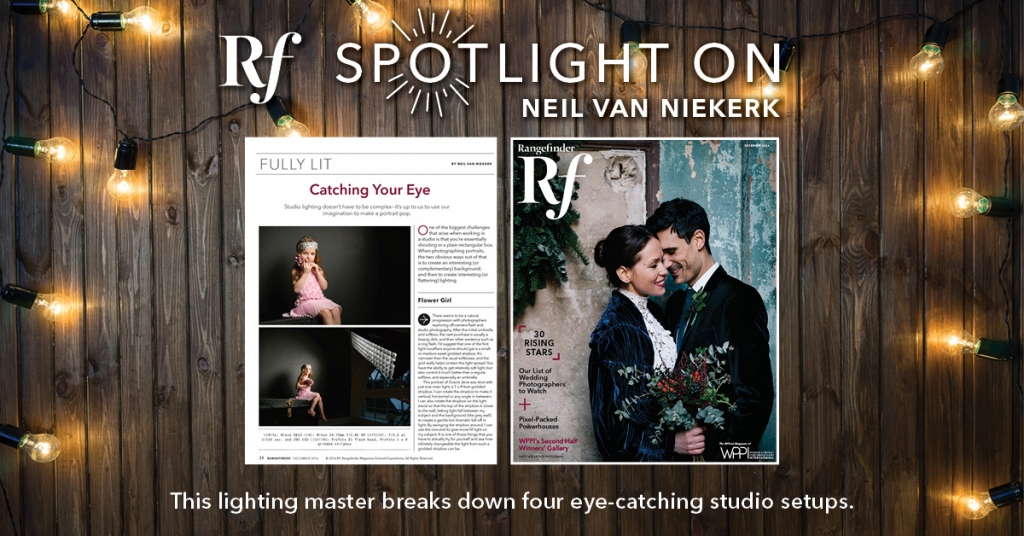
Every week James Robinson features an interview on his blog with a photographer that has caught his attention.  And this week the privilege is mine – and you can read it here:
spotlight interview – photographer Neil van Niekerk.

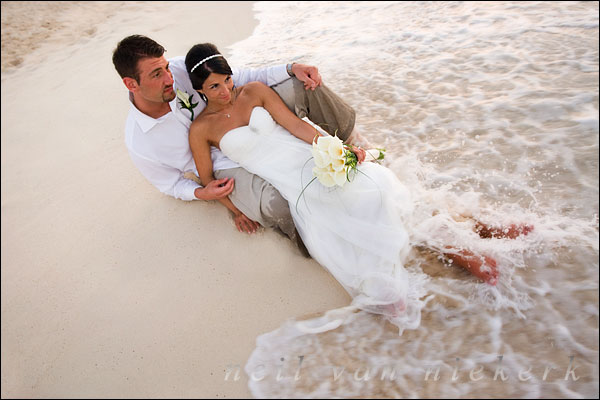
And for no other reason than to spruce up this quickie post, here is one of my favourite images from a destination wedding I photographed in the Bahamas recently.

       Comments (1)


PlanetNeil en Français

May 29, 2008

The pages on this website that deals with on-camera flash photography have just been translated into French by Melina BarralsPlanetNeil en Français ~

Melina thank you for the hard work on this.  Hopefully your efforts will affect and help inspire other non-English-speaking photographers.

The French translation joins the other translations of this website:

Chinese - translation by Tom Lan
Italian – translation by Sandra Luoni
Polish – translation by Bartosz Jastrzebski

       Comments (3)


Now also available in Polish …

November 5, 2007

These webpages on flash photography have kindly been translated into Polish by Bartosz Jastrzebski, who must have spent considerable time and effort to create a slick looking version of these pages.

There is also a Chinese version (translated by Tom Lan), and an Italian version (translated by Sandra Luoni),  which have been created prior to this.

Thank you to everyone for their input and hard work on this.

Neil.

       Comments (1)


finding the light

September 12, 2007

.

This web article was first posted in April ’06 on the DWF, as a tongue-in-cheek reaction – or sarcastic response then, if you will – against the numerous articles and seminars where we photographers are urged to just look for the light.

What triggered me to write this article in the first place, was that there seems to be a trend where use of flash is disdained in favour of only using available light.
As if it is always that simple.

(This article was also published in the Sept ’06 issue of Rangefinder magazine.)

Finding the light …

I’ve been so inspired recently by the various photographers at seminars and magazine articles, telling everyone to just look for the light and to find the light.

So many photographers just use available light, and make the rest of us who aren’t blessed with perfect light like they have in la-la-land, feel so inadequate. It is our failing as photographers if we can’t find the light and use it properly.

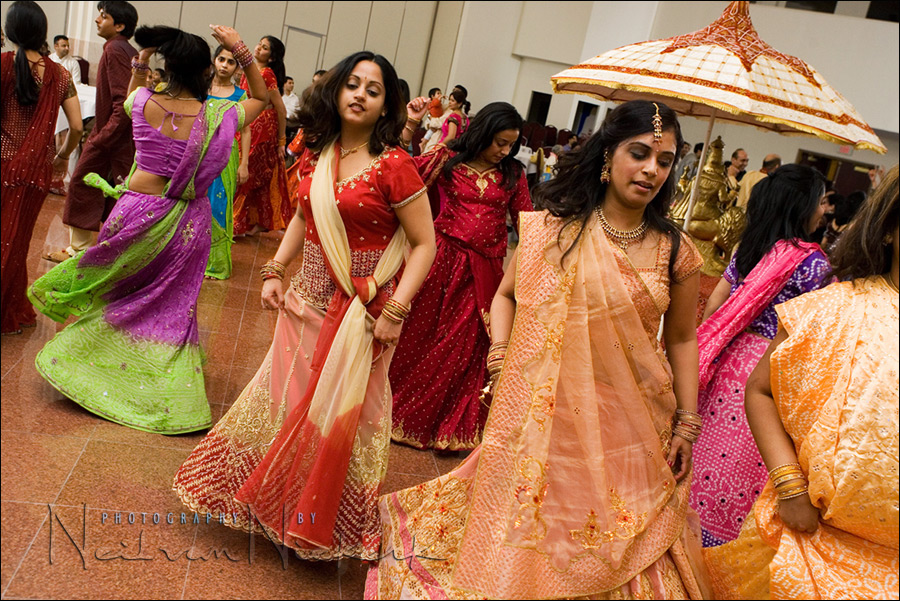
I felt I had to rise up to this and push myself as a photographer, and just look for the light.  It is there to be found!  Inspired like that, I approached this very colourful Hindu ceremony (April 2006), with a fresh mindset …

The temple itself is beautiful and imposing from the outside, in a blocky New Jersey kinda way.

.
The late afternoon light was incredibly harsh, and I knew I had to do something here so that my portraits wouldn’t look like the few candids I had to shoot outside in the sun. So for the portraits, I moved the bride (and others) into the open shade between the pillars in the front. The strong vertical lines behind them helped to make the simple portraits more striking.

Speaking of striking – isn’t she an incredibly beautiful bride?

.
Well, I was happy at this point. I was able to get lovely portraits using the light and the setting … but walking inside of the room where the guests were going to dance, my heart sank.

The ceiling was high, with only fluorescent lights, which meant the light was top-heavy and dim.

Light levels were low – 1/60th @ f2.8 @ 1600 iso.
Hmmm .. just not enough to stop action. And the client wouldn’t be too happy with hundreds of impressionistic colour smears for photographs.

But .. I just had to look for the light.
Nevermind that this is a dimly-lit New Jersey room, and not a brightly lit la-la-land venue.

This would be MY failing for not looking for the light,
and finding the light,
and finally .. getting to USE the light.

I scoured the place … and .. sure enough .. there it was .. light!

But .. was it available light?
I looked around .. and sure .. no one else was using it.
It was available! I could use the light!
I saw it and found it, and now I could use it!

And boy! Am I impressed! Just look at the light! Look at the colours pop!
People were dancing around me, and I could stop the action if I chose to, and have faces recognisable. The bride would be able to recognize herself and her friends and family.

.
So, a genuine thank you to everyone here who inspired me so to rise above my own inadequacies as a photographer, and just frikkin LOOK for the light.

Thank you, thank you, thank you.

Neil van Niekerk

technical info:

The additional strobes that I put up in the corners of the room, were Quantum T2 strobes. They were powered by Quantum 2×2 batteries, and triggered by Quantum 4i radio slaves. The stands are Red-Wing stands. These strobes were run in manual mode, and at 2/3rd stops down from full output, to ensure consistency in exposures in faster sequences of shots.

I also used an on-camera flash which was turned around and slightly bent backwards, with a Stofen with the top cut open. This meant that most of the light from my on-camera strobe was thrown upwards and slightly back .. but because of the Stofen, enough light spilled forward, to ensure there were no raccoon eyes, and that the lighting was as even as I could make it under the circumstances.

Exposure info .. all shots at 1/125th, and 800 iso.
The aperture varied between f4 and f5.0
I diallied the flash exposure compensation down in certain areas of the room.
The on-camera flash exposure was varied from +0.3 to -1.0 EV.
The on-camera strobe was in TTL mode.

More articles on off-camera flash …

If you found this and other articles valuable, then using these affiliate links to order equipment & any other goodies, would be a welcome way of helping towards the cost of hosting these webpages.
Thank you!

       Comments (55)


flash photography & fireworks

June 14, 2007

photographing fireworks, using flash

Photographing people with fireworks in the background, is just an application of the technique known as dragging the shutter.

I had the couple in an area where there wasn’t much ambient light, so that I could light them mostly with flash. The strobe was a Quantum T2 with an umbrella, used in manual.

My flash exposure was determined in that I wanted the couple correctly exposed .. but my actual settings were dictated by my choices made in how I wanted the fireworks to register.

For my fireworks exposure, which is considered the same as ambient light,
I had to juggle the three controls again :
shutter speed / aperture / ISO.

That particular photograph was 1 sec @ f6.7 @ 400 ISO

You don’t necessarily want a high ISO setting, since you do want your shutter speed to be slow. Slow enough to record the fireworks as streaks of light. There is a lot of leeway here, and a quick check of your camera’s preview will tell you whether you need to adjust your settings. Therefore your is range should be 100 to 400 ISO. Then your shutter speed is in the region of 1 second or slower. In other words, you need a tripod.

Recording multiple bursts of fireworks by blanking out the frame with a black card is a great idea. This photograph was a single exposure though.

By checking my camera to see how other firework bursts recorded, I found that f6.7 @ 400 ISO @ 1 sec gave me enough firework trails and the fireworks itself weren’t over-exposed in the shot.

So using f6.7 @ 400 iso, I set my Quantum T2 to an appropriate power level, to give me that exposure. (Manual flash in this instance, since my subject was in a specific position in relation to my strobe.)

f4.5 @ 200 ISO @ 2 seconds .. would’ve given me exactly the same exposure, but the firework trails would’ve been longer. There is a lot of leeway here, and you shouldn’t be bound by specific settings. But my suggestion would be to start at 1 second (or slower) and 400 or 20O iso, then then chimp to taste.

Rear-curtain sync would not have had any effect here, since the couple was static in the frame.

More articles on off-camera flash …

If you found this and other articles valuable, then using these affiliate links to order equipment & any other goodies, would be a welcome way of helping towards the cost of hosting these webpages.
Thank you!

       Comments (5)


wedding photographer's handbook

October 4, 2006

Bill Hurter, who is a well-known author of photography books, asked me earlier this year to rewrite my web article on raw workflow, for an upcoming book of his.

The book is the Wedding Photographer’s Handbook, and has just been published by Amherst Media. It is a stunning book, featuring photographs and articles by photographers who are among the very best in the industry. So it is a thrill to have my name and images appear alongside them in such a fine book.

       Comments (0)


another article in Rangefinder Magazine

September 7, 2006

A second article that I wrote for Rangefinder – the official magazine of WPPI – appeared in their September ’06 issue. And of course I am really proud of this. For me it’s quite an honour to appear alongside the best in the industry, in one of the premier photography trade publications. (The previous article appeared in their April ’06 issue.)

This article first appeared on my PlanetNeil website under the same title – Finding the Light. The topic is on using lighting where the conditions aren’t ideal. Even though the tone of the article is tongue-in-the-cheek, it will hopefully be informative, and maybe even inspire other photographers looking for ideas on using photographic lighting.

Here is what the opening page looked like.
(To read the article, click on the link above.)

Finding the Light

       Comments (0)


Rangefinder Magazine

April 5, 2006

It’s a huge point of pride for me that the April 2006 issue of Rangefinder – the official magazine of WPPI (Wedding & Portrait Photographers International) – features a 5 page article that I wrote. The subject is Digital Photography – Raw Workflow. Six of my wedding images accompany the article.

The article is a streamlined version of the online tutorial I wrote on raw workflow in digital photography.

The timing is very fortunate for me as well, since this is a huge confidence booster for when I present the seminar in Vegas in a few days at the Digital Wedding Forum convention. :)

Here is the link to the article on Rangefinder’s website

… and this is the opening page of the article in the magazine:

rangefinder article

       Comments (1)


All Rights Reserved © 2006-09 | Client Login