composition in photography
In composing an image, it isn’t just a matter of placing your subject somewhere in the frame. This is true for whether you go by the rigid restrictions of the Rule of Thirds, or whether you like a more central composition .. or a composition with a lot of negative space .. or whether composition is more in the way you instinctively react to the scene and subject in front of you.
Equally as important as where you place your subject, is what you include and what you exclude in the frame. With photographic composition you have to look at the edges of your frame.
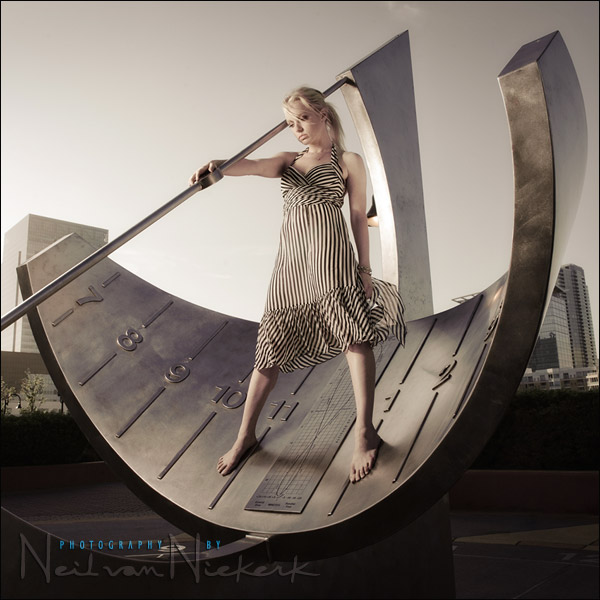
I really prefer getting it right in camera – composing for that 3:2 ratio. But it isn’t always possible. Sometimes a different crop works better .. say a square crop. With this image of our model, Catherine, standing inside this massive sundial, it made visual sense to use the shape of the sundial to dictate what the final composition should be.
(This was photo taken during the most recent workshop on flash photography
held in New Jersey and New York.)
So let’s look at what was excluded in the crop …

What I had to crop out was the softbox which provided the light on our model.
balancing wireless TTL flash and ambient light
Here I used wireless TTL flash. I had my on-camera speedlight (master), pointing to the speedlight mounted outside the softbox (slave / remote). I needed line of sight for the master to control the remote flash. The master’s main output was disabled, and it was only used to control the remote / slave speedlight.
I had to move the softbox close enough to give me the 1/250th @ f10 @ 200 ISO that I needed for this exposure. I still wanted a little bit of detail in the sky, and this dictated a small aperture at a low ISO … at maximum sync speed. The softbox does pull down the output of the speedlight, but it gives me light that is soft enough for my liking.
I knew I would crop out the buildings on the left anyway since they didn’t add much to the image I had in mind. So it wasn’t a problem to move the softbox within shot.
With this image, I had my flash exposure compensation (FEC), set to + 1.33 EV to compensate for the brighter tonality of the scene. The metal reflects a lot of light, and would cause the camera to think there is more light from the flash than there actually was. So I had to dial up my FEC.
To overcome the drop in power, I would’ve had to use a more powerful flashgun .. or use two (or more) speedlights in tandem. I could also have used bare flash. This would’ve been powerful enough to have moved the flash back, and out of shot. But the light would’ve looked different.
The rest of the success of the image then depended on a fantastic model … and a great architect.
Neil,
This photograph has a very interesting composition. At first, I didn’t even notice the sundial the model was standing on. Because you cropped off the base of the dial, the image looked like she was wielding (or magically holding) a giant metallic scythe from some kind of sci-fi/fantasy/anime TV show. :-)
Fantastic shot Neil, really like the composition and the almost dream like feel post processing work!
David
Neil, fantastic shot. Great post on seeing where you want to go before you get there. Would love to see a post on how you processed this image.
Ty … The post-processing is mostly just a preset I generated in ACR / Bridge while playing with some settings. (It would be the same for Lightroom). I used the Split Tone tab, and I also desaturated the image. That’s the majority of the post-processing.
Fantastic photo Neil – amazing compositition – you just keep getting better – am I right in detecting a slight Doornhof influence?
Pasquier .. perhaps, in the sense that we all pick up bits and pieces from everything we see, and from other photographers.
However, the image there was shot with a softbox (my preference), and Frank prefers a smaller harder light source.
Also, the styling and posing was mostly the idea of the model and my assistant, Jessica.
first thing i saw… wow, nice scythe! :D
Great shot Neil. Did you get your ambient exposure by metering off the sky?
Thanks
Jay .. not quite.
I didn’t point my meter at the sky and zero the needle. You can see the sky isn’t dark, there’s just enough detail. So the sky is still relatively bright. But I chose my settings so that I wasn’t losing detail in the sky.
Is that an Equatorial Bow Sundial?
Hi Neil,
Have you had any success with the high speed sync setting on your flashes?
I’ve been able to shoot my Canons at low ISO’s at 1/1000 sec. (with the flash positioned close to the subject) with good results.
I am wondering if it’s possible to do that through a softbox?
Bill .. you lose so much light by going to high-speed sync, that it is only of use if you really need shallow depth-of-field.
HSS would still work through a softbox though. But for this image, it wasn’t necessary.
Neil,
Uma obra de arte.
Luz, composição, enquadramento nota 10
abraços
Ricardo .. obrigado!
What a difference the crop made. Thanks for all the great info you offer here (not to mention your great book!!)
I had a chance to try this lighting technique and it worked quite well. It gave me a fairly dramatic effect. The explanations that you give are very clear so once out in the field it’s pretty easy to follow your set up.
Thanks again,
Bob
I was commenting on lighting from the following days post, which tied into this post.
This photo is amazing Neil!
Cracking shot- love the feeling that this lady has a hold on time itself.
When you coming to Ireland again.??
I was walking through the Exchange Place area of Jersey City, and I saw this sundial by the Hyatt hotel. I was like “I’ve seen that sundial before…” :)
Beautiful photo. Using a small aperture to get more detail in the sky? Interesting, considering I always use wide open apertures. TTL seems to work great though.. I’ll have to try it out this weekend.
Hi Neil,
I just found your website yesterday, I’m so impressed by the work you do here.. I am a student and will be here a lot I am sure!!:)
I read someone here asking you when you go back to Ireland and thought I might write now to ask if you’ll be in London at some point.. Would love to have a private session with my husband who is studying Photography too.
Best,
Cris