Here is a simple technique which some of you might already know of – shooting from the hip without looking through the viewfinder.
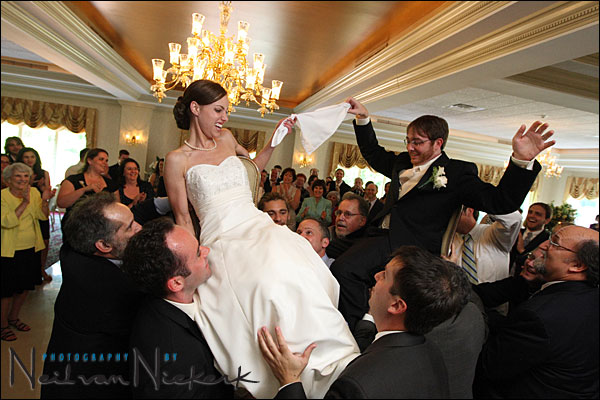
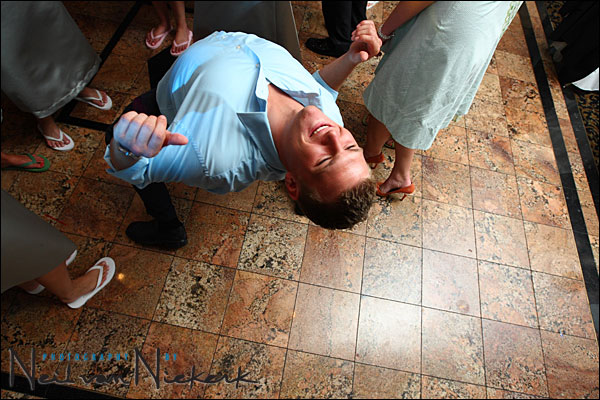
At weddings, when photographing the party and dancing during the reception with a wide-angle lens, I often don’t hold the camera up to my eye. Instead I rely on the infra-red beam from the speedlight to show me what the camera is focusing on. Then, using the focus-lock-and-hold method, I keep focus and reframe the shot if needed. This way I can shoot from the hip without looking through the viewfinder, but still have images that are well composed.
Here are a few images from recent weddings I photographed:
(None of them were cropped to post them here.)
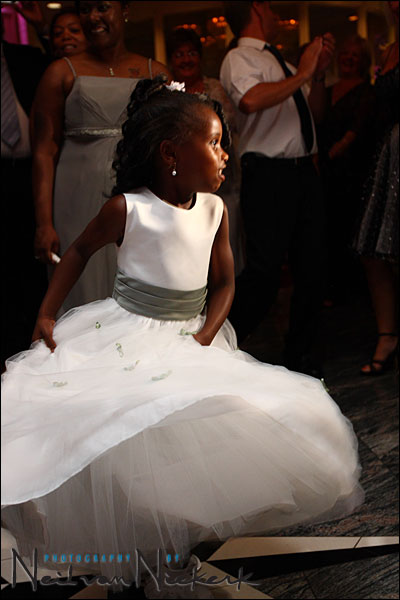
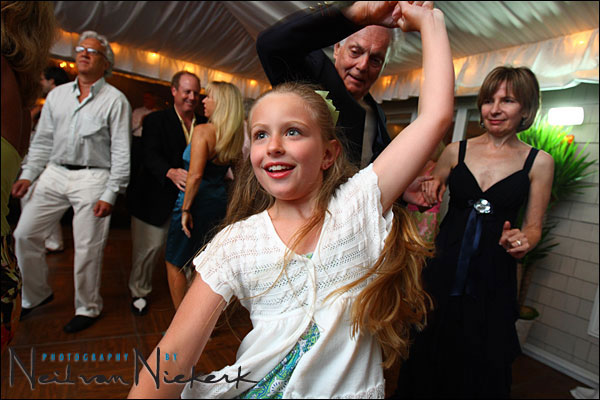
When moving between the guests like that, it is imperative that I don’t annoy anyone by blasting flash in their faces. This is a large part of the decision why I use this particular method to bounce my flash – using a piece of black foam to flag my speedlight.
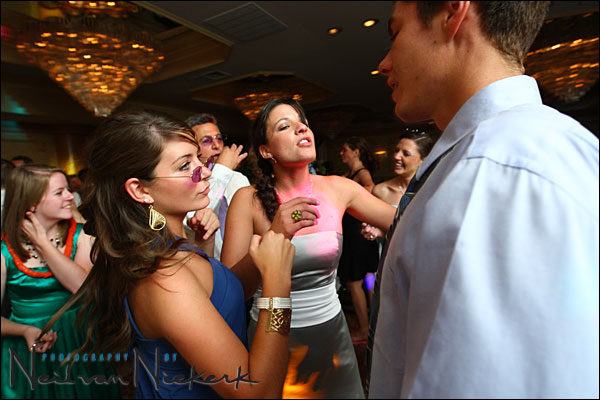
At the same time also note in this image above, that there was no dodging and burning – yet, the lighting on the guests dancing here is quite even on a number of planes. And the guy in the foreground isn’t more brightly lit than the girls he is dancing with.
.
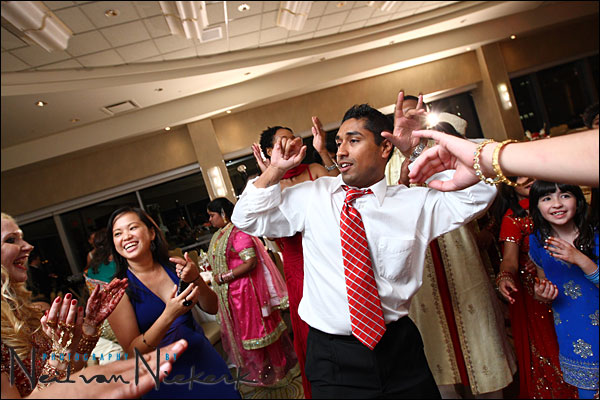
.
Of course, it is the same technique when holding my camera overhead.
.
It isn’t simply a matter of hoping for the best and blindly firing away – with a bit of practice there is actually a fair measure of accuracy here in framing the images even when not looking through the viewfinder.
Incredible stuff… While we see “hip-level” shooting discussed often for street photography, seeing how well it can be applied during a wedding is amazing.
May I know how you bounce the flash (even with the black gobo) in a way where you don’t blind the folks that’s in the path of the flash head?
It seems to me that if you’re going to be bouncing flash on these from-the-hip shots, you’d have to see the scene coming, or have lighting fast reflexes for re-aiming the flash. Perhaps it’s a 6th sense, or gambling on the shot playing out as you hope it will.
How does it work for you, Neil?
Thanks Neil, gotta practice more… (sorry for saying gobo instead of snoot hehe).
Hi Neil,
Did you gel your flash and set white balance to tungsten in some of your sample images?
Thanks a lot for sharing. I continue to learn from you. God bless.
Hi Neil,
How do you see the infrared beam from the speedlight? Infrared is not in the visible light spectrum that the human eye can see. I never see the imperceptible infrared “pre-flashes” my Nikon speedlight gives out prior to the flash firing (according to the manual). Can you clarify?
Neil, me again…
I have a question when it comes to bouncing, how do you tackle issues with colored walls (especially if all the walls are colored). A lot of places these days have pastel or far-from-neutral walls. I’m having issues balancing ambient daylight with funky wall colors, even.
I tried to shoot from the waist a couple of days ago and the green/marble-like wall casted a nasty green shade while the maroon ceiling has a hint of color onto the white shirt of my subject.
Thanks again for your generosity in sharing your knowledge.
Hi Neil,
Thanks for the response. I mounted my SB-900 to my camera, and I never noticed the reddish AF illuminator on the flash until now. Since I had been using the flash in brighter environments, so I never saw this before. Now, I understand how you were shooting from the hip. Thanks for the link that describes Nikon’s flash sequence.
Hi, Neil:
First of all, thank you for your generosity to share your expertise with us.
I love how the lighting on the background of your ‘flash’ images is fine-tuned to a proper level. Was there a second strobe to light up the background or was it done by your manual exposure settings?
Yes, you’re perfectly right about looking for direction of light in your images. I’ve learned a lot from doing this on your excellent images.
Once again, thanks for your in-depth technical discussions. I’ve been a fan of your site.
Best regards,
QL
Thanks for your detailed answer, Neil.
BTW, when is your book coming to the bookstore? Will it be distributed by Barns and Noble or Amazon.com? I’ll grab a copy right away; they’ll be sold out, otherwise :)
Enjoy the weekend,
QL
Niel,
Just discovered your site (searching for on-camera flash techniques). Awesome! Thanks for providing such great, real-world information.
When you talk about the “focus-lock-and-hold” method, do you just mean holding the shutter button down half-way and re-composing?
Hello Neil,
sorry to use this article for this post but I’m not sure if you read comments on older articles…
First of all, thanks for your site, I love it. Finally someone who explains everything step by step in a clear way! If I received a frequent flyer mile for everytime I visited your site I could’ve made the trip from where I live (Netherlands) and ask you the following question in person…
You have some excellent images where bot the sky is perfectly shown as well as the people in the foreground. F.e. the image from the wedding (afro-american people), positioned next to eachother (i think on a bridge). Both the foreground, the people and the sky are metered perfect. When I try this, I either get silhouttes or a completely white sky. I know about taking 2 images and merging them into a HDR-image but this is (nearly?) impossible with a large group of people?
Thanks again, and thanks in advance for any reply.
Joost
Ps: I own a Nikon D300 & SB-600 (maybe I should change some settings with my camera?)
Joost, I think it is this image you are referring to?
In this instance, the flash is just very subtle fill-flash, of around -2EV or -3EV flash exposure compensation. Therefore my exposure is pretty much only ambient light, and that is how I metered. The flash didn’t figure much.
I therefore had to base my exposure on the couple. (In this instance I used the histogram method while metering off the bride’s dress.)
This meant that the sky simply is the color it is. I made NO attempt to control it or darken it, whether:
1. in post-production, or
2. by having my basic exposure such that the sky is well exposed and then having to expose correctly for my couple by using stronger flash.
This second option is usually the best way to control how deep you want the sky to be … but it rarely looks good doing to with direct flash, and would need a fairly strong flash unit with a softbox to look good.
Cool stuff!
I tried what you said here, today, but in manual mode my Speedlite doesn’t seem toe fire the infrared beam…
Do you know why that is?
I use an EOS 40D with an EX 580II on top.
Greetz Jonas
Hi Neil
I checked it, but I had the camera in one shot focus mode like most of the time.
Could it be a mallfunction of the camera cause I searched the manual for it and they don’t mention how to turn it on anywhere …
Greetings
Hi Neil,
As always, beautiful! Even though this post is about focus and composure, i can’t help but gawk at the beautiful lighting! Thanks for the inspiration. Can you tell me how wide your lens was for the second photo?
I hate to be dense but I am back to the first question, if the camera is waist high, how can you possible not have the flash go into people’s eyes. I am 5’10” +1/2 (that’s important you know) and it would seem that unless the open side of the BFT was down (not an option) then the flash would be in my eyes. What am I missing?