RAW vs JPG – the final discussion
The RAW vs JPG debate has raged on to the point where pretty much every photographer has been worn down, or left confused. It’s been done. But bear with me on this one. It’ll be quick. And convincing. Then we really are done with this. Here it is:
There is NO photographer on this planet who is good enough to get:
– correct white balance,
– correct exposure,
– correct brightness level,
– correct overall and local contrast,
– correct saturation,
– a good black point,
– or anything else you’d like to add,
DURING the moment of capture, for EVERY situation they are likely to encounter.
You have no excuse to shoot in JPG (only) format, unless perhaps …
– you’re out on assignment in Afghanistan and need to wire your images through, or
– you’re shooting hundreds of portraits on location to be printed out immediately, or
– you really really really need the small file size of a JPG, or
– you shoot with the Fuji S2, that JPG machine, or
– your phone’s camera is your choice of artistic expression, or
– unless you have some other truly specialized need to shoot in JPG.
Other than that, there is no reason not to shoot in RAW. It has to be RAW. Always.
If you shoot in a studio, and have absolute control over the lighting, and colour balance, and have fine-tuned your in-camera settings … then sure, shoot JPG. Knock yourself out. You are all set to shoot within one specific scenario. Great.
But let me emphasize my previous statement again:
There is NO photographer on this planet who is good enough to get every aspect of the image quality correct during the moment of capture, for every situation they are likely to encounter.
This implies that you will have to do some kind of adjustment on your selected images in post-processing. And then you might as well use the file format that gives you the most latitude and control for your initial edit and adjustment … RAW.
[ / discussion ]
You might hear the rebuttal that if you are good enough, you wouldn’t need to rely on the latitude of RAW. Well, that insult is disingenuous, since it assumes we are always in control of our environment. We usually aren’t.
Here is a typical scenario I encounter as a wedding photographer. During a key moment, guests will whip out their cameras, and blast away with their point & shoot cameras. These are often set to red-eye reduction mode. So there’s a lot of flash going around.
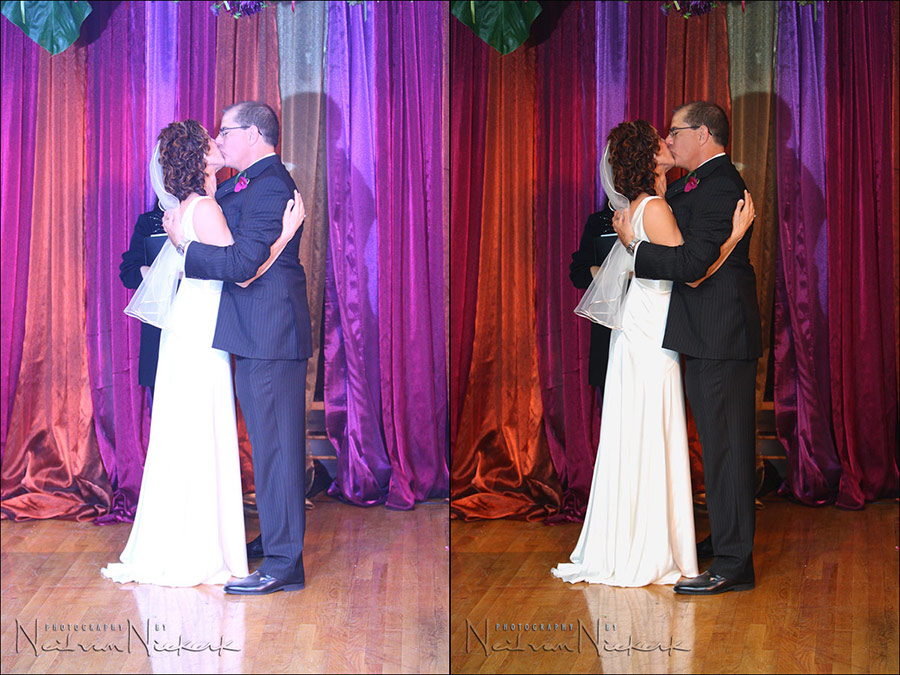
During this wedding ceremony, I was trying to retain as much of the ambience as possible, shooting with only the available light. My camera was set to Incandescent WB. This meant that during the key moment – the kiss – my shot was severely over-exposed by a guest’s flash going off. This also means that I had the wrong WB set. I had Incandescent WB, not Flash or Cloudy WB.
Here is the comparison to what the JPG-only shooter would’ve started off with in the editing of the images. On the right-hand side, is the JPG that I very easily generated from Canon’s DPP software. I pulled the exposure down by more than a stop, and completely changed my WB.
My starting point, as a RAW shooter, is the JPG on the right. The JPG-only shooter would’ve had to deal with the problem image on the left. I have no idea of how to go about fixing that as a JPG. And honestly, I have no intention of ever finding out how to fix that JPG. For me, it is irrelevant.
To finally reiterate this point – all the discussions and arguments you’ve seen about RAW vs JPG are trivial, because the one format is clearly superior.
related articles
- So I shot in RAW format, now what?
- Lightroom tutorial – local adjustments
- Workflow: Dealing with color banding in photographs
- Using interesting available light & white balance options
- review: Fuji X-T1 camera – the out of camera JPGs are over-sharpened
- review: Sony Alpha a7R camera – the out of camera JPGs are mushy in shadows
I made the switch to shooting in RAW from jpg awhile ago, and the results are amazing. That said, it does take a more powerful computer and more storage. The only time I go back to jpg is when I need the really high burst rate / speed (i.e. Shooting backwards on a speedboat at 1/3,200 of a second for action photos).
Neil,
This has to be the most concise and compelling explanations as to why one should always shoot in RAW. Not too long after I got my first DSLR I took photos of a kids program my wife put on for several hundred MS-HS kids. I had many excellent shots which looked good on the Canon 20D view screen. When I got home and loaded them on the screen I realized I had the wrong white balance set. The best pictures I got looked like the left hand one in your example except that the exposures were closer to what they should be. I believe that is the last time I shot in only JPG.
I think that once someone misses the shot only because they shot in JPG and then sees or is shown what could have been if they had shot in RAW they will never go back.
I can’t stress the importance enough of this article. If you’re a photographer who wonders if they should be shooting in RAW (meaning you haven’t made the decision and you still shoot in JPEG)…
I know it can be daunting to learn RAW.. but please, please do yourself the favor and learn it :) it makes life so much easier in the end. Especially if you are being paid for your photography. You owe it to your client to be able to create the best work possible. Framing and composition and light recognition are half of the equation during the event. The other half is raw, raw, raw! Even with the Nikon D3, D700, and ideal conditions and experience, there’s been many a picture that would have been lost to my own personal standard that I show to my clients if it weren’t for raw.
Don’t let the pro’s out there who act tough fool you. No one is capturing shots perfect on jpeg setting every time. Most pro’s in fact are extensively tweaking every setting we can in raw mode to appease our own standards.
Just my two copper!
Also, great article as always Neil :)
I thought this was settled quite a bit of time ago really. While getting everything as close as possible shooting time is highly desirable, stuff is pretty far from perfect in the wedding world. We’ve had churches in which the combination of lighting is so bad not even RAW will save the day. That’s what B&W is made for :)
Besides RAW will almost always allow extracting more detail than JPG.
It was case closed for me 6 years ago.
Cheers!
I wonder who could shoot in JPG after reading this post. I believe there is also a different “before and after” in photography – as time. Before-JPG, after-RAW.
Hah, I just posted about this ~ three weeks ago, and even used a similar title. :-)
Tell me what you think of it:
http://betterfamilyphotos.blogspot.com/2011/05/raw-vs-jpeg-myth-or-fact-definitive.html
Neil,
another reason why to shoot in RAW, nowadays more than ever, is that Nikon invented “compressed, lossy RAW”.
The short: you get 98% of RAW-capabilities at the expense of 150% JPEG file size or 75% “standard-RAW” file size.
The long: there is a theoretical difference that is well explained on the Net (Google will help) by some math geeks…
Conclusion: hardly visible difference – none to my eye.
Regs,
Roel
Field experience: during a recent city trip i discovered after a full day of shooting the sunny city of Barcelona that I was on spot metering rather than matrix…
50 pics of that day well overexposed. Luckily I was shooting RAW. Pulled back data from 3.5 stops over !
Admittedly, I had to do more in post than I regularly do, but I still have usable shots…
Lesson learnt
Roel
Hi there Neil,
Yeah man…. so glad you nailing this one to the wall. We’re tired of the narrow minded attitude of guys out there. I think it is a combination of all the stuff you said and the fact that some guys are a bit lazy and of the old school.
I spoke to a pro once about his photos. He was very good in the old days of darkroom processing and so forth. He said that even though he now has gone digital, he likes his images “natural”, straight out of the camera. He is living in a totally different photographic environment and so he just has to catch up….
Thanks once again for a great article….
Well done….
When I bought my first DSLR almost three years ago, the salesman said that I should shoot in JPEG since I was a novice; but even from the little I’d read at that point his advice didn’t make sense. Since that time, I’ve never shot in JPEG for all the reasons (and more) that you stated (not saying I never, ever would) … I tagged along once with a guy who does a lot of weddings (or, at least, he’s done probably 100 and I’ve done zero), and I was very surprised that he shot in JPEG (and he was surprised that I shot in RAW!) … and wouldn’t you know it: there was a weird mix of light in the church I was able to handle much, much better b/c I used a custom white balance and made a slight white balance adjustment (while my friend was frustrated and stuck with what he had; he’s now re-thinking shooting in JPEG). In a way, this RAW vs JPEG is similar to the question of when one should shoot in manual: as I read lots of Internet discussion, I’m surprised by the number of people who, it seems, purchase a DSLR and use manual shooting almost as a last resort. Sure, if you’re shooting a fast moving event that Aperture or Shutter setting is of big help … but even then I’m always on the lookout for those moments where I can work manually.
Agreed +9000
Shooting in RAW not only allows you to save “bad” photos (and every photographer has had one in a almost every photoshoot), but it also allows you to get creative with your photos. Sometimes, the camera’s JPEG is not my starting point. It’s easier to apply the modification to the RAW than it is to a JPEG, especially since RAW edits are non-destructive to the image integrity. Lastly, every modification to a JPEG is destructive, so your final image may have lost too much fidelity to make a pleasing image.
For me it’s not that black and white. Personal images (holiday snapshots) I shoot in jpg. I don’t feel like post-processing each and every image and they’re for my personal use anyway. If there’s not enough contrast, wrong exposure etc I’ll fix it with the jpg. But, as soon as I shoot for a ‘client’ (meaning anyone who’s going to expect images from me), I’ll shoot raw to deliver the best I can.
Please also note that there are many professional photographers out there that do not agree with this.
I learned to shoot Fuji RVP50, and back then we had to know what we were doing the moment we pressed the shutter button-if not, tough luck! There was no “photoshop” to bail us out. The advance in technology is not meant to make us sloppy, we still have to do our job at “the moment it clicks”.
I shoot jpg’s the same way now, like I am shooting slide film. I only use RAW on very tricky situations (very dark, high ISO, almost “impossible” shots) but on most occasions I can’t see the difference. Please also note that I don’t care for “correct” white balance because I am not shooting painting reproductions, white balance for me is another tool to express a feeling or a style, like shallow depth of field or slow shutter speed.
I am happy working like that, and as I am getting paid for the results of my work, a few photo editors and private clients feel the same way.
Somebody might criticize me for not being “professional” enough, but I decide to spend more time behind the lens and less time in front of a computer, and I have never proved to myself that there is a meaningful gain in shooting raw files in broad daylight as opposed to properly shooting fine jpgs. The bottom line: I am judged by the final image that I deliver-if it is good enough to be published, it doesn’t matter how I shot it.
I am not preaching my own gospel, nor am I trying to convince anyone to shoot jpgs only, and certainly I don’t mean any disrespect to Neil vN. I am only saying that photography is a creative thing and not a purely technical: Neil with his iPhone will always shoot better than 100 monkeys shooting RAW files at 10fps on their D3s with prime glass.
Many people start out in photography and spend too much time counting megapixels and learning photoshop techniques, instead of learning to see and shoot.
Costas
Hello Neil,
One thing which i find RAW a lifesaver when there is challenging ambient lights and you have to use flash. Correcting the WB in RAW format is an easy pie. Jpegs give hard time correcting WB.
I think saying you must “learn” raw is what turns people off from even attempting to try it. If anyone has ever done post processing, even on jpegs, they can pick up raw conversion very easily. It’s not difficult, nor should it be portrayed as some secret photographer’s language of editing. If you have something as simple as view nx, which comes with every nikon camera, free by the way, you can convert raw files into jpegs. It’s as simple as moving sliders to get the desired color, exposure, shooting mode (vivid, portrait, etc.)
This is a must read article. I whole heartedly agree with Neil that shooting raw will save you, as it has everyone else who cares enough about their pictures to want the best possible product.
And it’s easy!!!!!
With all due respect but I have to agree with Costas point. As a film shooter years before digital I learned to get it right ‘in camera’ and I still follow those same techniques today. I shoot nothing but jpegs and have had nothing but complements on my images.
I think the “raw only” folks got hardned in their position back in the early 2000’s and have not bothered to keep up with the technology. Perhaps in 2001 with 1.3 Megapixal cameras it was true that if you even sneezed at a jpeg file it became pixelated but not now.
Again with all due respect, its not an either/or issue. The mere notion that jpeg shooters are turning out inferoir pictures is like me saying that raw shooters are akin to the folks on that reality show “Hoarders”….afraid to throw away those 1967 copies of Newsweek because “they just might need to refer that article some day.”
– correct white balance,
– correct exposure,
– correct brightness level,
– correct overall and local contrast,
– correct saturation,
– a good black point
can ALL be adjusted with jpegs with no major problems with the photos. Perhaps not to the COMPLETE latitude that raw affords (thus the humoungous files sizes containing all sorts of ‘old newsweeks’) but pretty darn close.
The issue I find in telling folks that raw is the ONLY way…especially with new shooters is that they tend to view their DSLRs as point n shoots and thus don’t have to be too concened with getting it right the first time. I still like to think we are doing photography here and not computer programming. The only button I want to spend a majority of my time pressing is the shutter button and not the mouse button.
To each his own. Its not that black in white.
Love ya Neil!
I agree, the augument is silly to each is own.
I never said jpeg was superior, I just don’t think 99.99% of folks can see the difference between the two. Thus, I don’t think the amount of time and resources spent adjusting and correcting each and every raw image is worth it.
I did see the example above. I’ve had the same thing happen to me and I was able to adjust it to where it was acceptable to my client. If it winds up being totally “out of wack” that’s when I change it to a b&w preset and get all “artistic” on the photo ;)
Sometimes the most iconic photos are the most “perfect”
https://upload.wikimedia.org/wikipedia/en/f/ff/Capa%2C_D-Day1.jpg
I just notice that the raw shooters keep bringing the arugument up. Like I said to each their own.
A few points worth considering:
1. NeilvN must deliver absolutely perfect skin tones everytime, but I do not, because I am not into wedding photography. This might explain a difference in opinions regarding white balance tweaks.
2. If you know how to use Curves on a properly exposed jpg, there is nothing that you can do that is not on a par with a raw-converted image. If you screw up while shooting, then, yes, you need raw to bail you out.
If you shoot a correctly exposed image in good conditions, e.g. at 250/f8 at ISO100 whith the white balane that you wanted in the first place (usually “cloudy” for me) then I bet that you cannot actually see any difference between the raw-converted image and the jpg that you have fine tuned using “Curves” for 15-20 seconds per image. I am talking about an actual two-page spread printed in a glossy magazine, not something that you could noticce at 200% magnification in your computer screen.
3. If you have to shoot in very dark conditions e.g. at 1250iso at -1.5EV, then, yes, the raw image will be technically superior. Let’s not forget, though, that you first need to do your job and make the image in the first place! Technical merit follows.
4. “Editing a raw file is easier and faster” if you don’t consider all the trouble and time of using so many cards, having to transfer so many Gbytes to your disks and needing to have the hd room and computing power to handle raw workflow, and then archive and backup maybe six times as much data as compared to jpg.
5. Jpg’s in professional cameras are not the same as compressed jpg’s in point-and-shoots. I urge anyone interested in this debate to try a little experiment and not take my word: set your jpg setting to the best quality possible and shoot a nice image as “RAW and jpg”. Do your job properly and then process the two files side-by-side, print them and compare the results.
As I said before, Neil runs a very specialized workflow streamligned to work with raw files and get perfect skin tones every time, and I am not saying that he should change-absolutely not. But there are people shooting only with old view cameras, others that only shoot with Leica rangefinders, and others that shoot art with cheap russian Lomo cameras. Some only use zoom lenses and others carry a bag of primes and never ever touch a zoom-every photographer has different needs and priorities, and we are not all on the same page. This is normal, let’s accept it and keep on shooting, according to our needs and priorities.
Costas
P.S. I know a few things, but I don’t know everything. For example, I didn’t know how to properly bounce flash using a large area on a wall as if it were a big lightbox, using a shade in order not to spill direct light onto my subject, and this I learned from Neil. I am grateful for this, it is a technique that has helped me create a few images that I am very happy about, so thank you Neil!
The point is that you have much more latitude with a RAW file than a jpeg. My example = shooting my daughter playing in her cot (crib) before, during and after we converted it into a bed. I was under exposing by a good stop (and then some) due to changing lighting conditions and my eagerness to get the shots.
If I shot jpeg’s then there is no way I could have raised the exposure to ‘correct’ without severely impacting on the quality of the file and final result. Raw allowed me the head room to get in there and get the ‘once in a lifetime shots’ without having to sit back and fine tune everything as a result of the constraints of a particular file type.
I’m all for get it right in camera, I am, but if that is at the expense of capturing the moment then I’d rather be in the ball park with RAW than have to nail a ‘correct’ shot of nothing due everything moving on while I was gray carding my WB and fine tuning my exposure to suit a jpeg file. In this case its not about being lazy it about actually getting the shot.
I’ve been doing this for only a year or so. I need the RAW head room (see above). Neil shoots RAW for the reasons he stated above. We both shoot RAW for its superior flexibility to another file format, in this case jpeg.
Chris
i shoot wedding,
even though i made it correct before clicking shutter, at the end, i always make it perfect thru pp.
always RAW
For me, programs like Adobe Lightroom have allowed me to change to an almost 100% raw workflow. Lightroom allows me to work with raw files as easy as I was able to work with jpgs.
Before Lightroom, sitting and converting files or working with batches of raw photos in Photoshop was less then fun. It was a waste of time in fact.
But with Lightroom, I’m just as fast, perhaps even faster, with a raw workflow.
From my experience RAW offers much more possibilities when processing than JPEG. It allows for greater recovery (if needed) or a greater change in white balance (if required).
In my opinion it really is that simple. Shoot for Client – RAW always.
As always each to their own, but seriously and simply RAW out performs JPEG when it comes to processing your images.
I understand the whole “don’t always rely on RAW to bail you out/get it perfect in camera first” – we all try to do that, or at least should be trying. But as Neil points out we all need that extra help/buffer some of the time.
I switched to shooting RAW not long after I made the switch from film to digital because I wanted to spend less time in front of the computer and more time behind the camera. As a seasoned slide shooter I pretty much had the “getting it right in the camera” concept nailed. Yet, I found I was struggling to get the quality that I wanted when shooting JPEG’s so I figured I’d give RAW a go and have enjoyed a significantly faster workflow ever since.
Whilst I agree with Costas above that if it’s good enough to be published then it doesn’t matter how it was shot, I can’t help but wonder how much better the image quality from a “perfect” JPEG photographer would be if they started shooting in RAW.
If a photographer can consistently achieve perfect exposure and perfect white balance as they are shooting, then there is nothing to correct, so why not just shoot in JPEG instead of RAW as has already been discussed? For me there is one other overriding reason which I haven’t seen discussed yet and that is bit-depth. JPEG-only shooters are stuck with an 8-bit file. Whilst that may be fine for their style of working (and for most of the rest of us too), the improvement in image quality and the additional post-processing capabilities available as a result of the greater bit-depth in a RAW file is a compelling enough reason to shoot RAW. The extra bit-depth is particularly useful when creating monochrome images or if shooting high-key with fine tonal gradations, where an 8-bit image can quickly lead to posterization.
I agree with Thorsten.
The greater bit depth is a valid reason to shoot raw. I don’t need it often because the difference is invisible in editorial assignments (newspapers and magazines), and when I want to shoot high quality monochrome, I prefer to use real print film. But if you want to shoot digital high-quality monochrome images, you really SHOULD use raw.
To explain myself better:
-I shoot jpgs almost exclusively when I am shooting editorial assignments, most private customer assignments and personal projects, I might shoot raw in difficult low-light situations when I feel that I might need it.
-I usually shoot raw when I shoot anything that will be used in advertising or very large print
-I might process some digital images and turn them into monochrome after a shoot, but when I know that I will be shooting monochrome, I use my EOS-1N and shoot real print film. I like the results better and there is no need to argue about this-I don’t care for raw but I will spend more time and money inside a darkroom-it might not make sense, but it makes sense to me, and I am not preaching that this is the best for everyone.
-For old times’ sake, once a year I shoot something on Velvia 50 (but I can’t find drum scanners in use any more, so I can’t scan the images properly…)
-The reason that I am not shooting raw all the time is the very big difference in file size (cards, HD drives, download delays, copy, backup etc) and NOT speed and ease of actual editing. If you shoot a lot of images, this makes a real difference.
My own personal bottom line (applies to raw-vs jpeg, prime vs zoom, f2.8 vs f4, MkIV vs MkIII, softbox vs diffuser, assistant vs tripod, and all similar debates):
IF I REALLY NEED IT, THEN I WILL USE IT.
But if and when I REALLY need it, not because I “have” to.
Costas
This topic is not even funny.
1. Those have ever tried printing from their negatives would know that in the Dark Room you’d have to give each individual shot their individual exposure, correcting for overexposed areas with feathering and masking and so on.
2. Lots of photoshop tools are named after dark room equipment. Believing that any camera will bake you a perfect Jpeg every time is nonsense!
Regard your Raw Captures as old days Negatives and treat Camera Jpegs as a commodity that can be used in emergencies.
Whilst you make some valid points, I think you do come across as dogmatic as those anti raw devotees.
Also, I think readers should note the type of photographer that you are because this no doubt colours your judgment. If for example, you were shooting with a camera that has an excellent JPEG engine e.g. Olympus cameras, and you were either in control of the environment or the environment didn’t change much then there is no reason why you can’t ALWAYS shoot JPEG. Still life, macro, and other types of shooter may well be happy shooting JPEG.
You on the other hand, being a wedding photographer, have a very difficult time of it with changing light levels, varying light types etc etc.
You also use the term “correct” quite a lot. Well, the photographer may not necessarily be concerned with technical correctness but rather the overall aesthetic of their work.
And in any event you, and other pros, may well be using JPEG (the latest variant, developed by Microsoft and ratified by the JPEG about 18 months ago) in all your cameras, all the tiem, in future. So you better start loving it from now ;-)
Warm regards,
plevyadophy
for those that are set on the fact of storage size. you/we (hopefully) spend a small fortune procuring equipment that is considered top of the line to capture that once in a lifetime moment that so often is cited as, can never be redone.
why then short change yourself and risk even as a pro-jpg photographer, the slightest possibility of garnering a jpg of such low quality for whatever the shooting conditions may have been, as to jeopardize the quality of that image to your client.
time is equally just as valuable and precious as the money poured into our equipment. Do like I do. Aim to get it right in the camera. But have an insurance protection plan. I shoot RAW + Fine JPEG. If the JPEG comes out spot on with only a few curves adjustments needed, to the recycle bin goes the raw file (of course not fully deleted until I’m completed with the project in full).
we can’t seriously argue to ourselves after spending so much time and money investing into this level of equipment for paid work assignments that we should limit our creative flexibility based on the size and price of a few storage mediums.
if you’re shooting for an unpaid assignment, or personal pleasure, I don’t see the point in conversing over that at all. I believe Neils post to be exclusively concerned with commercial photography. or photography used in trade (i.e free photos to models for their time)
Otherwise, I doubt Neil or anyone really minds that you’re shooting in jpeg for your own personal pleasure.
I personally simply cannot fathom not shooting in the very least RAW + Jpg for paid work, simply because it gives me more options at my disposal. I love having the jpegs there instantly to download and review. But the comfort of knowing that raw file is sitting there on my camera when I click the shutter, *just in case* is something akin to knowing that my house is protected by flood, fire, and tornado insurance. I may not ever need them, but boy does it feel good to know they’re there.
Cheers,
Jon
also Neil – hope you don’t think I go to far as to speak for what you personally think. I was just taking my best guess on what you were thinking based on your article. Who truely knows the inner workings of a photographers mind ;)
Just wondering: do you guys keep your RAW files forever or do you delete them after you have a suitable JPG?
I have 27GB of JPGs; in RAW format the size would be 16x that.
I keep my RAWs, but not my JPEGs. As software and technology improves, I can always go back to the RAW image and perform different things to it. Then, export to JPEG. I have done this as I learn new things about post-processing.
If you keep only your JPEG, you won’t be able to modify it much further. If you think you will never go back to work on an image after getting your “perfect” JPEG, then stick to what you have.
I always keep my RAW files. But this is more of a personal choice because I constantly find myself looking back on images I took 3 months to 1 year ago, and realizing after having learned new techniques, ways I could make them better or adjust them differently as I grow.
I’m not sure about down in the U.S but here we have a company called Tiger Direct and if I wait for big sale days I’m usually able to snag a 2 terabyte external hard drive for 150.00 or so, and that holds a healthy amount of backed up raw files. as a backup i keep the finished JPEG files from any paid events on burned DVD discs.
Agree with Jon 100%. Keep both sets, you went to all the trouble of finishing a file be it in ACR/LR and/or Photoshop, only to keep just the RAW and not the final product, the jpeg, that would not enter my head at all.
I have had in the past whereby the bride came back to me wanting an enlargement of an image 2-3 years down the track, and shows me the small one she got, the chances of me replicating an “exact” copy from RAW again would be virtually zero unless I’ve kept the jpegs. Regardless of how RAW is superior, you still have to manipulate it and 99% of the time take it into Photoshop to tweak, and you have to print jpeg, you cannot print RAW so keeping both Masters and ‘finished’ copies is crucial to me.
Discs are cheap enough for peace of mind, and now with Blu-Ray up to 50G, no worries. A normal Blu-Ray of 25G will usually hold 1 complete set of wedding files for me, RAWS, jpegs, enhancements, etc. etc. I burn 3 copies. Time? Sure it takes time but I’d rather spend $4+ on a disc than worry about what to keep or throw away, and they take up a hell of lot less room than larges boxes of film negatives do believe me.
Speaking of storage, I keep 3 copies, 1 in my house, 1 up in my shed, 1 at my in-laws place. [FIRE/THEFT INSURANCE].
After a wedding, immediately burn the masters onto discs, then when finished, I still burn the ‘total’ files, RAWS again + jpegs. Safer than sorry.
Cheers,
Trev
Hi Trev
I am new to RAW shooting only started this week and haven’t had much time to play with editing photo’s that I have taken yet. Do I understand you correctly that because you can not print in Jpeg I will have to convert my RAW image to a Jpeg to print it.
I did have a photo that was overexposed and was pleasantly surprised that I could “save” the photo without any hassle and within seconds, something that I wouldn’t have been able to do if it was a Jpeg. I am not a professional photographer so for me the choice to shoot in RAW where I can fix all my mistakes, till I get to know my camera better and get it right with the camera, is the obvious choice.
Neil thanks for a great site and all the great info.
Gillian
Hi Gillian,
Yes, once you’ve manipulated your RAW images, you have to ‘export’ them selecting jpeg format and a setting of either High Quality or 10-12, depends on program, always select the highest setting to get the best quality you want.
Also when exporting, check change resolution to 300ppi, this is different to quality, since you can export at say 8 Quality, but still have resolution of 300ppi to print, but a majority of labs require that 300 ppi size resolution to print. Some may print 240ppi but up to you, check with your lab. Usually Quality 12/300 ppi is the way to go.
Of course if you wanted to show your images via web, then setting of around 5-6 and 72ppi are sufficient, since you don’t want to be uploading massive files. You will have to experiment to get a setting you are happy with.
There are options to do all images at once from either ACR or Lightroom, you are in for some reading on how to set. Once you select a setting, and before you export, you can ‘Save’ that setting so you don’t have to go through it each time, simply click the setting you saved.
Cheers,
Trev.
Gillian,
I’m personally so glad to hear you’re choosing to learn raw while still new to everything else. You won’t look back in my opinion. If it makes you feel better, I’ve been shooting for almost 10 years (only 8 years of that truely counts since 2 years was film..) and I’ll tell you that I still get photos to this day from every single photoshoot that for some circumstance or another (shooting fast paced, etc) that are under or overexposed or had some other element I didn’t really notice at the time.
It’s times like those I say to myself… thank the stars that I shoot in raw. It feels so good to be able to slide that exposure, WB, and contrast bars and have a nice photo.
No matter how much experience we get, our shooting enviroments (for non studio photographers) are just like mother nature. Extremely unpredictable and unkind most of the time.
Jon
Hi Trev & Jon
Thanks for the feedback and help, I really appreciate it. From now on I am going to shoot in RAW. It just makes sense.
Regards
Hi Guys
Another question. I got the view NX 2 package with my Nikon D7000 to edit Raw photo’s. What program would you suggest is the best to get to do editing of photo’s in.
thanks
Gillian
Gillian,
That’s a subjective answer, some like the supplied programs that come with the camera, [NX2, and Canon’s DPP – Digital Photo Professional] some like ACR [Adobe Camera Raw] which is part of Photoshop and no need to pay for it, others Lightroom, or Aperture if you are on a MAC, or Phase One’s Capture One [great program].
I’ve tried NX2 and it’s way too slow personally, but that was a good while ago, I also am not fussed on Lightroom, and I’ve used Capture One, which I really liked, but lately I just stick to ACR, and not because the controls have been upgraded to mimic Lightroom to a degree, just simply to get my exposure/WB correct for the type of file I want, [flat, with all the details in the file] then I use Photoshop itself to bring out the image, with actions.
Why don’t you try the NX2 that came with Nikon, and ACR, play around for a while before you decide to purchase anything else. That way at least you can get the hang of it for a while without outlaying money.
My best advice, google the hell out of your browser looking for tutorials, information, etc. plenty of stuff out there free, just like this site with Neil’s information on flash, etc.
Cheers,
Trev
Hi Neil,
I love your work and blog. You’re consistent and produce “classic” works. Your knowledge and experience obviously shows through and you’re an asset to the community.
However, this post has put me off (although I won’t stop reading). I don’t think there is any point to this post, as you stated there is no argument here. I just can’t understand why you would put so much effort into trying to “convert” people and how defensive you’re being. Did you recently have it out with someone which caused you to write this article? Also you say that editing raw is quicker, I disagree. These days it’s about the same time to edit a raw and jpg, it’s just different.
One thing that you didn’t cover was image delivery. Raw vs. JPG (done right) should have no effect on the ability to sell and deliver an end product to a client. You post a single example of recovery, but I don’t think it’s fair to use this as an example. Where are the shots before and after this single image that were no doubt unaffected by a random flash? Lets say this was the only image for what ever reason. Claiming that you don’t know how to work with it isn’t what I expect from you. I have a feeling you know exactly what you could do with that image, regardless of the raw vs. jpg debate (although I know what you’re driving at).
Cheers,
Spencer
I have to highlight the article that Mohammed Shafik posted earlier on:
Raw vs JPEG – the definitive guide.
Great job! I know how much time it would take to compile all that.
Nice find, Neil. That article is very informative. I’m going to bookmark it.
Ah, the link was a link earlier in this blog post. I can’t believe I missed that. Reading comprehension for the win! Sorry about that.
I like this post: https://www.slrlounge.com/workshop/dynamic-range-and-raw-vs-jpeg/
Neil:
I enjoyed reading this article (linked from a conversation going on over at FredMiranda Forums). I covered this topic recently in my blog as well (you did a much better job of staying short :) ), and I’ll only quibble with you on one aspect of your article. For wildlife/birds in flight photography, your buffer might be a limiting factor if you shoot RAW and are shooting at high frames per second. The “buffer” for film cameras used to be 12, 24 or 36 exposures :), so I know it is possible not to machine-gun and still get a good shot, but those guys are using the modern tools to get their shot, and in that case the longer continuous-shooting capability with JPEG is important.
But mainly, I shoot RAW, too. It gives me the best chance for the final image I want, and it is just as easy to edit.
My full blog on the topic can be found here:
https://enthusiastphotographer.com/2011/11/07/jpeg-vs-raw/
A couple of the comments here have inspired me to do an experiment I was thinking about when I was writing the article above – I’m going to do it now over the Christmas break.
Lastly, the SOOC comments drive me nuts. You’re ignoring his first and completely correct point, and it is exponentially more applicable the farther down the experience/capability scale you go.
Thanks!
Lee…
“There is NO photographer on this planet who is good enough to get:
– correct white balance,
– correct exposure,
– correct brightness level,
– correct overall and local contrast,
– correct saturation,
– a good black point,
– or anything else you’d like to add,
DURING the moment of capture, for EVERY situation they are likely to encounter.”
A pretty arrogant statement don’t you think?
“During this wedding ceremony, I was trying to retain as much of the ambience as possible, shooting with only the available light. My camera was set to Incandescent WB. This meant that during the key moment – the kiss – my shot was severely over-exposed by a guest’s flash going off. This also means that I had the wrong WB set. I had Incandescent WB, not Flash or Cloudy WB.”
Perhaps one would have second-guessed there would be others shooting with P&S
cameras?
“I have no idea of how to go about fixing that as a JPG. And honestly, I have no intention of ever finding out how to fix that JPG. For me, it is irrelevant.
To finally reiterate this point – all the discussions and arguments you’ve seen about RAW vs JPG are trivial, because the one format is clearly superior.”
Another arrogant statement.
Tut, tut. Firstly maybe one should learn about other formats before sounding off about whether it’s irrelevent or not. RAW shooters need to learn an important lesson – read the instructions before you set out. Us Jpeg shooters are getting tired of your excuses.
This comment above is typical of the mis-informed.
While I have for the large part let these kinds of comments just be, I’d like to use this as an example .. specifically because it is so pointedly insulting.
SteveF, to counter your observations:
I have to ask … who do YOU think is good enough to get every aspect of image & camera settings correct for every possible situation?
Mine is a sweeping comment. But arrogant it isn’t.
The reason why it can’t be seen as being arrogant, is because I am setting myself up there to be proven very wrong … by anyone who could mention that one single awesomest-of-all photographer who could in fact do that. Do it *all* correct in camera, with no need to adjust images afterwards.
Onto your next barb …
Yes, I do second-guess that there might be other photographers with P&S cameras .. hence I shoot in RAW.
You just underlined my view, Mr JPG-Shooter.
I knew I’d be facing an unpredictable situation.
RAW is the only choice. Really it is.
Mr JPG-Shooter, let’s see what else you have there …
I do know about other formats. I know JPG very well. And hence I am very familiar with its limitations.
My views about RAW vs JPG aren’t borne from lack of knowledge, but rather, the opposite … I know what I am dealing with.
I have a choice … and by rational decision, I made the best choice for every situation.
Finally, RAW shooters don’t use “excuses”. Just rational observation. Even if it did include a grand sweeping comment … which, as I mentioned, is yet to be refuted.
The underlying point to this article, is that RAW vs JPG is not the same as:
– Pepsi vs Coke
(that’s a matter of personal taste, although Coke does taste better, hands down)
– Mercedes vs BMW
(that’s a matter of personal taste, although I didn’t even consider a Mercedes)
– Canon vs Nikon
(again, a matter of personal choice / taste)
So while those things can be discussed and argued in comparison, it mostly just boils down to personal taste.
RAW vs JPG is not the same as those kinds of discussions.
There are very specific reasons why RAW are superior.
They can’t be argued away.
Not even with insults.
Neil, I don’t leave comments to insult but to simply inform. You seem to imply that RAW shooters are by default the only ones to be those who can deliver images that are the ‘right’ ones and jpeg shooters are inferior. We are not inferior and you are not superior to us jpeg shooters and you will not be superior to me under any circumstances even tho you own this ‘blog’.
You imply I might make ‘insults’ – no, I simply have exercised my opinion you have allowed by offering comments to your blog.
I wish you the Best Wishes for 2012.
Steve .. it’s telling that you didn’t reply (in a rational way) to any of the points raised in the original article, or my reply to you now.
There is a reason for that – RAW is the superior file format for the majority of photography situations. It’s not something that can be argued away. It just is.
As I mentioned, this isn’t Pepsi / Coke … Merc / BMW … Canon / Nikon
That RAW is the superior file format is NOT a matter of opinion.
And that’s the reason why arguing against it is trivial, as you proved now.
Neil vN
PS … calling me arrogant isn’t being “informing”. It’s an insult.
Steve,
Having outlined your argument for jpeg shooters you have not exactly put across a valid argument to offset Neil’s *arrogant* statements, but just merely slammed him for making such statements without any form of why jpeg is fine. [We are talking about important files here, being a wedding.]
Let’s break this down.
1] His quote of: There is NO photographer on this planet who is good enough to get:
– correct white balance,
– correct exposure,
– correct brightness level,
– correct overall and local contrast,
– correct saturation,
– a good black point,
– or anything else you’d like to add,
DURING the moment of capture, for EVERY situation they are likely to encounter.
This . . . IS . . . totally correct. Note his emphasis of ‘DURING’ & ‘EVERY’. Obviously meaning 100% of the time. Mission Impossible.
That is an irrefutable and inescapable truth, no question at all whatsoever, and certainly is not arrogant to make such a statement. Shoot RAW, get all the data, shoot jpeg, it’s processed, data thrown away and compressed.
The only way to capture a perfect jpeg image is if you are working in a controlled environment, studio, or an environment in which there are not harsh contrasts with highlights and deep shadows, open field, slight overcast, etc.
Can you capture an image totally acceptable, even very darn good, in jpeg format? Of course you can. Under optimum conditions.
Can you capture a fast moving, massively contrasted scene in a wedding scenario in which the above post was aimed at in jpeg format?
Not totally, you can if there is a great background, perfect lighting, probably 40% of the time, but we are dealing with weddings here, and there is not often perfect situations at all to deal with, in fact as wedding photographers we deal with all sorts of crazy situations, lighting, backgrounds and cannot for love nor money get it right first time, every time in jpeg.
You stated: Perhaps one would have second-guessed there would be others shooting with P&S cameras?
Now that is just plain silly, I will bet you the keys of my house that you cannot anticipate the precise moment a ‘P&S camera’ will be fired, so you can avoid shooting at the same time. Of course there are going to be other cameras at a wedding, no questions, and you have to deal with that, hence, yeah, RAW!
You also stated about Neil’s phrase “I have no idea of how to go about fixing that as a jpeg”:
Another arrogant statement. Tut, tut. Firstly maybe one should learn about other formats before sounding off about whether it’s irrelevent or not. RAW shooters need to learn an important lesson – read the instructions before you set out.
Really! Bit like saying a Formula 1 car driver should learn how to ride a motorcycle as well. Not valid. Mate come on, read his statement again.
When he said about how to “fix that as a jpeg”, he was talking about that particular badly exposed shot and WB.
Another bet, you could not fix that in jpeg format with blown dress, no way in hell, to the extent it was via RAW.
I see by your sig link you shoot sports. Well, so do I, I used to do it massively big time, Cycling, MotoX, Go-Karting, BMX, Soccer/Football, Hockey, etc.
What did I shoot in? Jpeg, yep, not crucial for ‘perfect’ aspect on every single image. As long as the person/player was exposed correctly, WB set fine, jpeg all the way no question at all. I am talking about 1000s of images here, so shooting in RAW for them would have been massively time-consuming. Last event alone, a 4-day soccer carnival I shot over 4500 images, so jpeg for sure.
That type of shooting lends itself to jpeg format, I don’t care about backgrounds, don’t care about what ‘perfect’ composition I may achieve by moving focussing points around, it’s action, I need to have the person/s sharp and correctly exposed, and done bloody fast. Nothing at all like a wedding, where you need to control backgrounds, or are shooting in less then desirable conditions, full sun/shade mixture.
I’ve worked for years in an industry where my main job was image manipulation, with 17+ years experience on Photoshop, and you just cannot get details back in blown whites, nada, zilch, zip.
Once your little Info Palette Box in PS is reading 255/255/255 in the whites, forget it. Not going to happen in a million years, [under present jpeg format] well not to an acceptable extent, as I’ve seen jpeg shooters trying to drag details back into blown whites with the Shadow/Highlights box, and other ‘creative means’ and the result is a dirty, stodgy, artificial look, and still no details really in fine lace, embroidery, etc. in a wedding dress, nor any whites for that matter.
So for weddings, there is no alternative, believe me I learnt the hard way, did a ‘quick’ wedding a few years back, only a 2 hour gig, thought, she’ll be right mate, shot jpeg, and I instantly regretted it upon opening a couple of the files, dress blown in sections under direct sunlight. I would not have needed to work so hard trying to fix them if I’dve shot in RAW in the first place.
Your statement of “Us Jpeg shooters are getting tired or your excuses” was an ill-conceived notion that somwhow your jpeg shooting buddies and yourself were being maligned against, not the case at all.
Simply a matter of fact. RAW [under present format] retains as much info as it can; jpeg does not.
Go bake a cake, taste it, then say, oh damn, should have added less sugar, then try to fix that. It’s the same as jpeg shooting, it’s been baked/cooked/processed/compressed/data thrown away by the bucketful compared to a RAW file.
Ain’t no going back to re-cook that cake. BUT, with RAW, you can cook it a 1001 ways and still have no data loss/damages/changes to the original RAW.
You merely have to look at the file sizes to see that, no need to ‘prove’ there is more data in a RAW file, then in a jpeg.
As stated, there certainly can be areas of shooting in jpeg. Several in fact, Neil was simply stating the bleeding obvious that RAW is so much the format needed to get the *optimum* results, he did not slander/ridicule jpeg shooters, of which I still shoot for sport, happy snaps, etc.
You want to shoot jpeg, knock yourself out, it was simply a case of pointing out that shooting in RAW format gives you ALL the data, not a processed version.
Bit like owning a V8, then saying it ‘chews up lots of gas’ so you pull the leads on a couple of the cylinders, see how it runs then. Like a drunken duck.
You may not want to have the RAW capabilities it offers, but you certainly *need* it if you are to fully edit an image shot under less than ideal conditions.
Ignorance is bliss!
Trev.
Hi Neil
As far as SteveF comments go, well let’s just say ……
It would be inappropriate for me to outline.
Your website is one which teaches and allows newcomers, and even pro’s to learn and rehash techniques.
Techniques which you have perfected and now pass onto others via a media called the WWW.
You don’t hold back info, in fact you even share your post editing secrets ie: secret sauce etc.
So why would SteveF enter your site to start.
Why would he use your site as a forum to insult someone who shares their work with the world.
I’m sure he has even traded insults with other sites !!!
I wonder if he has asked you for advice in other tangents ??
Never bite the hand that feeds !!!
From me personally, my work has improved immensely with your techniques.
It’s a shame that I just can’t get in my car and drive to your workshop.
But, I am considering a trip to the US next year !!!
Keep up the great work Neil.
One rotten apple in the bag doesn’t spoil the lot.
Angelo
Australia
Great article. With memory and processing so cheap. Why would you shoot with less when you can have more.
If your dependent on RAW files to save your photos then your time is better spent on learning how to do photography better. And you can edit a jpeg non-destructively
Question “With JPEG, isn’t a lot of information discarded permanently?” Answer: Yes, and so what. Once you have the JPEG what are you planning to do with the RAW data? If you’re doing this for a living, you will deliver the final image to your client and never again touch the RAW file. If you’re a hobbyist, OK, you may want to reprocess the file as an educational exercise or to try out new techniques. It’s like baking a cake – once you have the cake, what do you need the ingredients for? With digital you can make an infinite number of identical cakes.
Question: “But what if I’m not happy with the camera’s processing?” Answer: Then by all means shoot in RAW and tweak away. But with the horsepower in the latest generation of image processors and the flexibility of in-camera options, I find it hard to believe that a proper image can’t be produced in camera. Remember Kodachrome when we were happy with Kodak’s processing? Same thing.
RAW -vs- Jpeg nothing but the new age digital snobbery yet another way for one side of photographers to act better then others and feel superior to them. All the mean time shooting raw or jpeg yields the very same results a picture.
What a peanut Al Whitemna is !!!!
.
That’s my 2c worth.
.
To use the term “snobbery” is just arrogant. You obviously know zilch about PS.
Yup, it’s very obvious that Al didn’t bother to read the article, and especially that he didn’t look at the example images I posted. That alone would surely dispel the insulting comment: “If you are dependent on RAW files to save your photos then your time is better spent on learning how to do photography better.”
And again, the example images I posted will clearly discount this uninformed statement: “All the mean time shooting raw or jpeg yields the very same results a picture.”
That’s part of the problem of this specific topic – too many of the anti-RAW faction are mis-informed … and refuse to be informed.
In reply to some recent posts regarding RAW Vs Jpeg, I can see that a couple are not reading the article properly, and the theory should be ‘get it right in camera’; ‘learn how to edit a jpeg’ or ‘there is no need to shoot RAW’.
Is there a case for not needing RAW all the time? Sure, like photojournalism, sports, happy snaps etc., but in dealing with important events like weddings, most definitely there is.
However, the discussion was based on the simple, but TRUE philosophy of:
“There is NO photographer on this planet who is good enough to get every aspect of the image quality correct during the moment of capture, for every situation they are likely to encounter,” which is a true statement. There is NO denying that for the following simple fact:
a) By the very nature of digital, the sensor, no matter the camera, has a lousy dynamic range and getting those crisp highlights and shadow details in 1 shot at the moment of capture is impossible in very high contrast situations or flat and lifeless scenes overcast.
b) Then, add to that the fact that if you shoot jpeg, those very items that make an image, Highlights/Shadows, are then compressed and data is simply thrown away.
If you think otherwise, you are deluding yourself.
Obviously you can have a ‘studio’ scenario with lights, backdrop, custom WB, metering, etc and shoot jpeg, as I do some times with deb balls, etc. but even then, I have a setting which tweaks all images across the board in 5 seconds in LR which helps define the image even more. But that’s in a controlled environment, not in real life situations like thousands of professionals deal with every event.
Anyhow, as they say, a picture is worth a 1000 words.
DISCLAIMER: The image sample shown here is **NOT** my image and therefore not taken by me personally, this was available as a download from the net a couple of years back as a sample file for testing in getting highlights/shadows to pop.
So in thinking of what to show re RAW Vs Jpeg I dug it out and edited it.
IMAGE: 01_AS_SHOT in jpeg.
This image shows the direct extraction of the jpeg from within the RAW file.
No life, yet in theory according to some, should be ‘correct’, after all it was shot ‘correctly’.
So much for ‘getting it right in camera all the time’.
The jpeg [obviously as an extraction from the the RAW] was shot correctly exposure-wise, but shadows not clean, highlights less then desirable, and not really crisp/sharp because of those factors.
Just looks plain muddy and dull.
IMAGE: 02_AS SHOT in RAW.
This image is the RAW file, with default settings.
Shot correctly but as you can see the highlights/shadows are not detailed, they are there, but need to be brought out.
This also shows how when compared against the extracted jpeg, the shadows/highlights of the jpeg were compressed trying to get contrast, yet failing to impress as a final shot ‘out of camera’.
IMAGE: 03_AS EXPORTED from RAW. (ACR)
This image is the direct result of me exporting as a PSD file out of RAW.
Edits: Only things done was I dropped exposure by -1.60 Ev to bring back cloud/smoke details knowing I could bring back the shadow details. I also took off all forms of contrast out of the Tonal Curve TAB.
(try doing that with a jpeg file and see how badly the Shadows then become adding compression to an already compressed file)
IMAGE: 04_FULLY EDITED.
This image is the final edit, all in Photoshop, layers/masks, Highlights, Shadows, Midtones, Sharpening, ‘shaping’ the clouds/smoke; shaping the foreground, etc.
No plug-ins/add-ons were used in Photoshop, all via Photoshop itself.
Now compared to the ‘as shot’ jpeg, this one is now crisp, clean, vibrant, pops out from background.
I know which image I would rather have made into a canvas hanging on the wall.
Trev
Sometimes the obvious is not stated, and I have yet to find some comment where the simplest thing is said:
Each and every JPG image out of a camera is the product of a RAW image transformation.
So the original is the RAW image, the JPG is a smaller, simpler version of it and that is it.
I should end the argument here as Neil has done but I will elaborate a little bit.
Smaller because instead of 12/14 or 16 bit depths, JPG depth is limited to 8 bits.
Smaller and simpler because a lossy compression is used during the transformation (even with fine JPGs).
So, saying that JPGs can be better than RAW images is like saying that a carbon copy can be better than the original. Just impossible.
You can say that you don’t need the original (your choice), but you can’t say that the copy is better.
And the difference between the original and the copy is not small : in our digital era loosing 4, 6 or 8 bits of depth has a lot of consequences on your ability to get the best from your images.
So I am still dumbfounded at the ability some people have to pick fights over non existent issues.
(and I am 100% with Neil on this one ;-) )
Luc,
Very eloquently expressed, love the ‘Carbon Copy’ analogy, going to ‘pinch’ that when dealing with the some of the detractors I meet sometimes.
That is exactly what is happening as the camera sensor is retaining the full details [still has a lousy dynamic range, you have to bring it out] but then it interpolates that RAW data down to the jpeg format thereby throwing away the very data you were striving to achieve in the first place.
As they say, ‘Go Figure’. :)
Trev
I like the cooking analogy I found recently:
“Imagine that the RAW image is actually dough and, instead of being a photographer, you are a chef. You add different ingredients to the dough and then place it in the oven to bake. By the end of the process, you have a beautiful cake.
The cake looks and tastes good, but it will always be a cake—you cannot make it into a pie or a dumpling simply because it is a cake. But, if you start again with the dough, you can bake or cook anything you want. The only limit is your creativity and talent”.
https://www.phototraces.com/photography-basics/raw-vs-jpeg/