
review: Canon Speedlite 600EX-RT
Summary: Right off the bat, let me say it – this speedlite, the Canon 600EX-RT (B&H / Amazon), is going to change the industry. Nothing is going to be the same again.
A speedlite that has radio transmitters built in, has been anticipated for quite some time now. It just makes sense. So it was just a matter of time before one of the big camera manufacturers did this … and Canon is the first. And they didn’t drop the ball on the rest of the speedlite’s features, or with the functionality of this piece of gear. It’s easy to use, with an obvious menu – even for a complex flashgun like this.
Before the Canon 600EX-RT, we had various options how we could trigger our Canon Speedlites, but right now our option is clear – it’s the the Canon 600EX-RT Speedlite (B&H / Amazon).

I attended another of the shoot-outs arranged by the Hudson Valley Click group. (I’ve used images from their past shoot-outs in various articles here.) This weekend the theme was a Retro-Futuristic CyberPunk, and I had the pleasure of photographing Karyn. And as you can see, her outfit was in fact full-body paint, courtesy by Kelly Torres of NY Body Art.
We were shooting at a disused foundry, which turned out to be a great setting for the theme. I chose to isolate Karyn with a longer focal length, in the one open factory area. There was enough distance to have the background completely melt away.
camera settings: 1/40 @ f/3.5 @ 1600 ISO
Canon 5D mark III (affiliate); Canon EF 70-200mm f/2.8L IS II (affiliate)
The majority of the light on Karyn was from the late afternoon light streaming through the windows. I purposely posed her into the light … and then used a Canon 600EX-RT (affiliate) for that rim-light around her and to create a subtle hot-spot behind her. This really helped etch her outline against the out-of-focus background. With the dust in the area, it gave that slight halo effect around her body.
Here’s the pull-back shot where you can see the windows, and where the speedlite was positioned on a breeze-block.
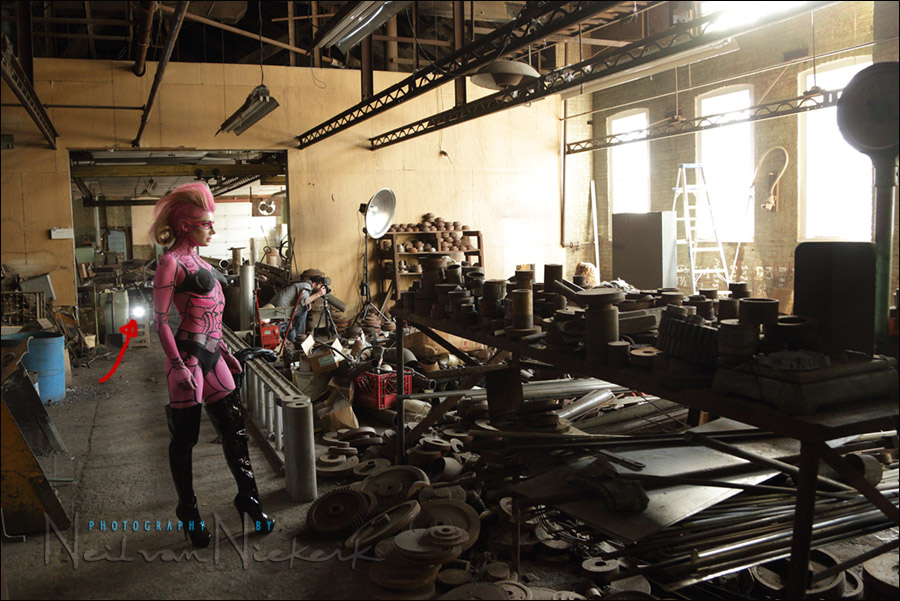
The speedlite was controlled by an on-camera 600EX-RT as the Master. I had the Master flash’s output disabled so it doesn’t add any light. I just wanted to fire the flash in the distance behind her.
This is the kind of set-up where just using the built-in optical wireless system of a flash like the Canon 580EX II, would’ve been a limitation. It might be just out sight there. Which meant, I would’ve had to use radio transmitters of some kind. This always implies more cables, connectors, cradles, batteries, settings. It’s complicated. With just two Canon 600EX-RT Speedlites (affiliate), I have the same kind of control … but it is much easier to set up and control.
I didn’t have an Canon ST-E3 Speedlite Transmitter (affiliate) yet to try out, so I used the on-camera speedlite as Master. I’m a little ambivalent about the separate Speedlite controllers like the Canon ST-E2 or Nikon SU-800. It just seems like you’re half-way to buying a speedlite anyway. Besides, you could always use another back-up speedlite.

I used the speedlites in a basic way here, just so I could enhance the available light.
Related articles on using flash and ambient light: flash photography basics.
An overview of Nikon and Canon speedlites
When I moved from the Nikon system to the Canon system several years ago – Nikon D2x to Canon 1D Mark IIN – the one thing that truly revolutionized my photography, was that the Canon 580EX Speedlite could rotate 180 degrees to either side. The Nikon SB-800 was limited to 90 degrees in the one direction. That extra90 degrees had a huge impact. I could now be specific about the direction of my light when I used on-camera bounce flash. As I said .. this was huge!
Then Nikon updated the SB-800 to the phenomenal Nikon SB-900 which brought in a lot of extra features, but most importantly, allowed the flash-head to rotate 180 degrees to either side.
Then Canon updated their flash to the Canon 580EX II, and honestly, it felt like a step backwards. The 580EX was so easy to switch from Master to Slave, and back to normal. With the 580EX II though, it felt like I had to relearn how to do this if I didn’t use the flash like this for a few weeks. It was obscure.
Equally obscure was the menu system of the 580EX II. Well, the 580EX was also obscure with the various custom functions which you needed the manual or a cheat sheet to know what they affected. The SB-900 on the other hand, was dead easy to set up with beautifully clear and obvious menu system.
So with the Nikon SB-900 and Nikon SB-910 Speedlight (affiliate), it really felt like Nikon was steps ahead of Canon in terms of the ease of use of their speedlights. Definitely in how Nikon allows you to control the individual Slave flashes in discrete levels, made more sense.
But the one area where both systems were hampered, is that their built-in optical wireless systems were limited by line-of-sight constraints. Bright sunlight also affected how well they worked. So you had to resort to various wireless radio triggers to get past these constraints. Until this bold step by Canon!
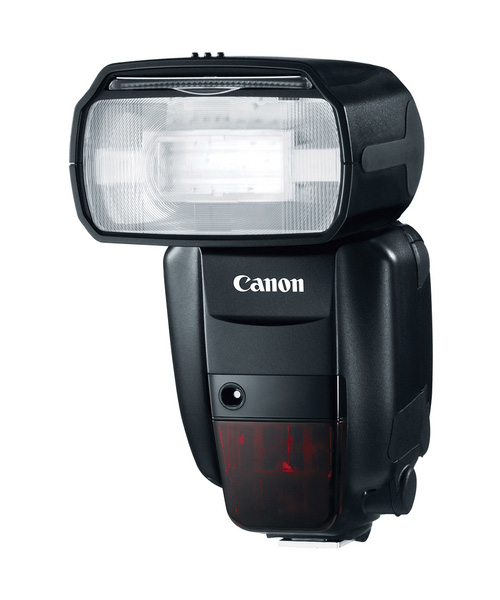
Better yet, the Canon 600EX-RT Speedlite (affiliate) has an obvious menu system with obvious controls. This is important!
Canon Speedlite 600EX-RT features
1. Ease of use.
As mentioned earlier, the previous Canon speedlites where a pain when you had to change custom settings, and had to refer to the manual or cheat sheets. The Canon 600EX-RT changes all that with a clear menu systems, and clearly marked controls. Surprisingly, for such a complex machine, the speedlight is easy to understand if you have some knowledge of the previous Canon speedlights. I was able to set the two speedlites to Master / Slave modes, and be sure that they were linked, without reading the manual. I like that. Basic functions need to be obvious.
2. backwards compatibility
Another wonderful thing about the way the Canon 600EX-RT works, is that you can use it with cameras prior to the Canon 5D Mark III. It works just as well with the Canon 5D Mark II, and the other Canon SLRs.<
Also good is that the Canon 600EX-RT works with the older optical wireless controlled speedlites like the 580EX / 580EX II. However, you can’t have it work with both the radio and optical modes simultaneously.
3. High-Speed Sync
On p.51 of the manual it states that for cameras prior to 2011 then the max flash sync speed is one increment lower. I assume this means that for cameras like the Canon 5D Mark II , the max flash sync speed with the 600EX-RT is now 1/100. In fact, a (!) warning signal appears on the speedlite’s display at any shutter speed higher than that. The manual also states that HSS isn’t possible.
Well, I can confirm that HSS is indeed possible. And from a few tests I have done, it seems like the output takes a small knock at 1/200 and HSS .. perhaps 1/3rd of a stop by the looks of it. At 1/250th, there is a distinct drop in flash output. This is consistent with how speedlites work in HSS mode. So I’m not sure if I am missing something here, but I would have to disagree with the manual on this. HSS is indeed possible with the 5D Mark II, and quite possibly then with other previous models as well.
4. Group mode (Gr)
With this mode, you can control up to 5 groups of flashes, and each group can be set independently to E-TTL or manual. This is only possible with newer cameras, such as the 5D Mark III and 1D-X. I haven’t tested this mode yet, but will try it out and update via future posts.
5. color filter / gel holder
Similar to the Nikon SB-900 / Nikon SB-910 the Canon 600EX-RT offers a holder for a filter that corrects for Tungsten light. These are keyed to the camera’s AWB settings to adjust the WB of the camera if it detects a gel on the speedlight.
6. flash firing restriction due to over-heating
When shooting in bursts, the flash may overheat. The 600EX-RT limits the tempo with which the flash can be fired, is slowed down to help prevent the flash head from damage from over-heating.
Summary
As I mentioned earlier, I used the speedlites in quite a simplistic way here just to enhance the available light. But as an indication of how well the speedlites work and how easy they are to set up, I am quite impressed already. The options and capabilities are endless. This is going to be an interesting piece of gear to explore, and I’ll continue to add more articles relating to it.
My final verdict might be quite a bold statement, but for me, this is an automatic upgrade from the Canon 580EX II. There are so many improvements in the handling of the flash, that it is much easier to use and set up. And then, the cherry on top of it all is the radio control of the slaved units.
Purchase these items via these affiliate links
Neil,
Great review. When do you think Nikon will step up and have this feature in their speedlites? While I really like these, it’s not enough to send me back to Canon.
Best,
Tim
This is a great review. Hopefully, Nikon will make a similar unit in the near future, so I can drop the PocketWizards. I’m surprised it took so long any major camera manufacturer to integrate wireless trigger transmission. Third-parties have been in this market for so long.
Tim,
IMO, I think the Nikon flash SB-900 (currently out of bussines) already had most of the options this flash have. I’m a Canon user for not so much time, but you don’t have to be blind to see that. The SB-900, I think, is the best speedlight in history, period.
Sergio.
Great write up!! I just ordered three of these and looking forward to seeing how they handle!! Can’t wait to be clear of the PW’s mini and flex 5 and just have everything in the one place!
Canon deserves big kudos for this. Pocket Wizard / Radio Poppers will have a tough time competing… Their only claim to fame will be integration with monolight systems…
How’s the recycling time on these new Canon units compared to the SB900 units? Just curious…
Hi Neil. When you were testing with your 5D Mk II, were you testing its HSS capability as a single on camera flash or with a second unit as master and (radio controlled) slave? The reason I ask is that the first line on p51 states “When performing radio transmission wireless flash shooting”. From that, I inferred that its on-camera HSS performance would be normal.
Also, after stating that the max. sync speed IS one stop slower, it goes on to say “… UP TO a maximum of one stop slower than the sync speed”.
These restrictions will certainly test the integrity of sales staff – assuming they’ve been trained!
P.S. The “NY Body Art” link needs a bit of a trim.
I ordered 3 of these and I’m currently waiting delivery. After reading what you have to say Neil and what Sly Arena thoughts are I’m confident I made the right decision even though they are quite expensive. I was getting sick and tired of using Poverty Wizard TT5’s and TT1’s as they are just more stuff to plug in and carry and set up, plus during a wedding when I wanted to switch back to bounce flash it was a chew to remove the PW’s and put a flash back in the hotshoe. I cant wait to have a 600EX RT permanently in my hotshoe that can be used as normal and to fire slaves via radio!!! It seems too good to be true. Also the PCB in my PW TT1 failed 2months after the warranty ran out and pocket wizard refused to fix it unless I paid a rediculous amount. ( almost cost of a new one ) I argued that a PCB shouldn’t fail in that short space of time and that it cant be anything I had done but hey mine are all going on ebay now anyway.
Can’t wait to try these out these new 600’s and look forward to more info from you on them Neil.
RE, “Well, I can confirm that HSS is indeed possible. And from a few tests I have done, it seems like the output takes a small knock at 1/200” was the flash set to 1/1 power? have u tried shooting at 1/500 of a sec,? from what i understand the reason they say max sync speed is 1/100th is b/c the flash duration at full power is longer than the amount of time that the WHOLE sensor is exposed (at any speed faster than 1/100)thereby cutting off the tail of the pulse of light being emitted from being recorded
Thanks for the review Neil!
Let’s hope Nikon follows Canon’s lead on this one!
Hi Neil
Are you aware of any other radio triggers which will fire the flash. PW Plus II or ????
Cheers
Angelo
IMHO this flash is far overpriced.Better buy 2 580’s and a set of phottix odins.
580EX II = $500 // Phottix Odin = $450
So, two 580EX II speedlights and a Phottix Odin = $1,450
600EX-RT = $630 // Canon ST-E3-RT = $320
So a set of the new Canon stuff = $1,580
That would then be $130 more than the set you describe. Not quite “far overpriced”.
And if you add things like the larger LCD screen, and the much improved menu system, and other features, then suddenly the new Canon system is much more attractive.
Hi Neil – thanks for the review! I’m considering dumping my 580EX’s and PocketWizard ControlTL units in favor of the 600EX system. HOWEVER, in low light party situations, I fear losing the ability to perform rear-curtain sync off-camera. (let the ambient mood lighting expose, then fire the flash to stop the action).
Is this not a concern for you, or do you use another technique for this?
Thanks!
-Chris (from SF workshop last year)
Are you going to make a SB 910 review?
thanks.
hey cris, there is a myth that using rear curtain sync enables u to get brighter backgrounds by firing the flash at the end of the exposure rather than at the beginning. this myth is FALSE. rear curtain sync would only make a difference in a situation where u r bluring motion and u want the ambient blur to be behind the subject as opposed to in front, for instance taking a picture of a car in motion at night at 1/15 of a sec, in rear curtain sync the photo will apear natural with the light trails of the headlights behind the car, in front curtain sync the car will be frozen with headlight trails on top going through it, however if the photo of the car and it isnt moving there will be no difference in exposure from using front curtain or rearcurtain sync (obviosly using the same shutterspeed)
@naftoli – indeed, I am talking about the need/desire to freeze the action (such as dancing) at the end of the motion, resulting in greater clarity and more natural trails.
In your opinion, Neil, do you think a person starting out lighting for weddings could use one 600ex-rt and 3 580exs only? Will the 600 on the camera act as the master for all of the 580s well enough? Or would you recommend getting additional 600s (ouch)?
Christina .. you can only trigger the other 580’s with the optical wireless system if you do it that way.
To get the full benefit, you’d need the 600EX.
But you could offset a large part of your cost by selling the 580 flashes.
Honestly, I think the 600EX marks a monumental shift in flash photography, where it makes sense to dump any other wireless triggers and go just for the 600EX … if you don’t use other flashes than just speedlites.
I just got hold of the ST-E3-EX, so will post a review soon, using multiple 600EX speedlites, controlled by the ST-E3
Thank you so much! I am in the process of buying things now and really only have two off brand speedlights. I was going to buy one 600 then 3 used 580s. I need to upgrade since wedding season is upon us and this is the first year I am in full swing business. I think I might have to break the bank and get 3 600s and just work with that for now. Thank you for your advice. I’d rather spend more money wisely now than have to upgrade and lose money later. I love your blog and refer back to it often (and share it with others). Thank you for your time!
Hi Neil,
I am so happy to hear you say that you are confused about the manual stating that the 5D MkII will only sync at 1/100 second. When I saw the TV! error on my new (2) 600’s, I nearly passed out when I discovered that the sync speed is so slow, way slower (on paper) than my PW with 580s. Then I decided to give it a test and see for myself and I discovered the same thing you did. I could take the 5dmkii shutter to 1/200 and not really see an appreciable problem… I certainly don’t see any vignetting across the bottom of the frame from shutter/flash sync issues. So I started searching the internet to try to figure out what I am doing wrong.. or misunderstanding.
Let me repeat, I am SO happy to see that you addressed this very question in your post.
Thanks,
Matt
That HSS/X-sync warning only applies to radio triggered off-camera flash in HSS mode or applies to X-sync one f-stop lower when radio triggered off-came. Also only to cameras prior to 2011 (e.g. everything but 5D3 and 1Dx). When you use the flash on the camera, you can sync up to X-sync and HSS without any trouble as usual.
I have two of the 600EX-RT’s and also the ST-E3, and while many see the ST-E3 type transmitters as something you don’t need, the reality is it’s just like having a 600EX-RT as a master and not using flash for light. For the first time ever the ST-E3 does all of the things that the 600EX-RT does except emit light, to me the ST-E3 is the bargain in the system (unlike the flashes themselves!).
The glitch, there’s always got to be one, the ST-E3 cannot control the older 580EX II et al lights since it has no way to send pulsed light out.
Brian
I just got hold of an ST-E3 so will add a review of that in the next week or so. Check back.
Can we jump back to the picture at the top of this thread for a second (Karyn from behind, with hands over her head)?
Was she dancing to music when you did this, or was she posed? A really great shot!!
Great review – I’ve just ordered two. I presume you were using manual flash for a shot like this, but wonder if you can shoot wireless radio ETTL using a pair of 600EX-RTs on a 5D2.
Trying to get my new pair of 600EX-RTs to work wirelessly on my 5D2, as Neil appears to have done here, but can’t figure it out. Actually, the manual suggests it isn’t possible if I’m reading correctly.
Great review. However at the price they are selling for in the UK, currently £640 (a few dollars shot of $1k) it is just not cost effective for me, already owning Pocket Wizards. However as I upgrade gear I suspect I will make a move towards these or their successors.
thank you for this clear and elegant review :D
Hi Neil,
I’m a bit late to the party, but wanted to say, I picked up two 600EX-RT Speedlites and a ST-E3-RT transmitter just a week ago, before reading your review here. I can most certainly concur your statement about these units being a game changer.
My wife and I put the new system through their first wedding gig, last weekend, and we both came away with huge smiles. My wife even commented “That was so awesome, how easy are they to use, even from an assistant’s point of view”. When the system was being used, they were off-camera, all of the time. I’m ordering two more, right away, they are that good!
All the best,
Peter
I consider myself a seasoned disciple of your speedliting method, that you expounded on so well in your two speedliting books. I know it has elevated my work, and hope that it is noticeable on my site, though I know that even fashion magazines sometimes deliberately use the on-camera, direct-flash, paparazzi look occasionally and lots of “pros” still fire away direct as their default and seem to get away with it.
Anyway, I got used to the manual gels on the ex580II and the settings that you mentioned but now, with the 600EX II-RT, I’m wondering if you have written about how to control colour balance with that new flash, because you said that you often use the Daylight setting on your camera when bouncing off wooden walls, for instance, and the flagship flash now requires the AWB setting or Flash I think it may be. Anyway, so can we still do that with the new gels that the camera reads automatically, set it to a custom WB? What happens? Can I still tape a green filter on the speedlite for fluorescant and set it to fluorescant? Thanks!
Also, I put gaffers tape on the sides of the tungsten gel cap to prevent direct flash from hitting my subject and i’m wondering if that effects the electronics? I’m basically hoping to find a little tutorial on this but thought I would ask the Man himself, who taught me all this in the first place and was wondering if you have gotten around to experimenting with the latest iteration. Thank you!
Tommy, you’re over-thinking it to an extent. Shoot in RAW, and finesse the WB in post.
With the Canon 600EX and the colored gels, it will change the WB to the appropriate WB … if your camera is set to AWB. That’s fine too. Just shoot RAW.