Review: Lightstands – Manfrotto 1051BAC, 1052BAC and 1004BAC
I recently updated the lightstands that I regularly use, to the three of the Manfrotto range of light-stands,
– the compact: Manfrotto 1051BAC (affiliate )
– the medium-sized Manfrotto 1052BAC (affiliate)
– the taller, heavier tall: Manfrotto 1004BAC (affiliate)
They have a few interesting features. They are:
– light-weight,
– air-cushioned,
– stackable.
The air-cushioning helps prevents damage to equipment, or injury to fingers if you forget to fully tighten the section locks. However, that these light-stands could be clipped onto each other, and stacked that way, really caught my attention. You can clip several of them together, and this makes them easy to carry. (I can easily carry three light-stands in just one hand, and I can easily sling a stack of 5 of them over a shoulder and carry them. Since they are stackable like this, it also means you can stand them upright in the corner of a room or sideways on a shelf.
Of these three light-stands, I prefer the medium-sized Manfrotto 1052BAC (affiliate)
It rises to 7.75′ (2.34 m) high, and has a footprint diameter of 3.6′ (1 m). So it’s quite tall, with a large footprint, yet it only weighs 2.65 lbs (1.2kg).
The more compact Manfrotto 1051BAC (affiliate ), is 6.75′ (2m) tall, but has a footprint diameter of only 2.3′ (70cm). This makes it ideal if you need a light-weight tripod to use in a hotel room, or elsewhere indoors where space is limited.
The taller 12′ (3.65m) Manfrotto 1004BAC (affiliate), has a footprint diameter of 3.5″ (1 m), which is pretty much that of the medium size 1052BAC. It is heavier too, at 6.6 lbs (3 kg). Here’s an updated review of the Manfrotto 1004BAC lightstands.
So that’s the spec, and each light-stand has its own use, depending on where you’re working.
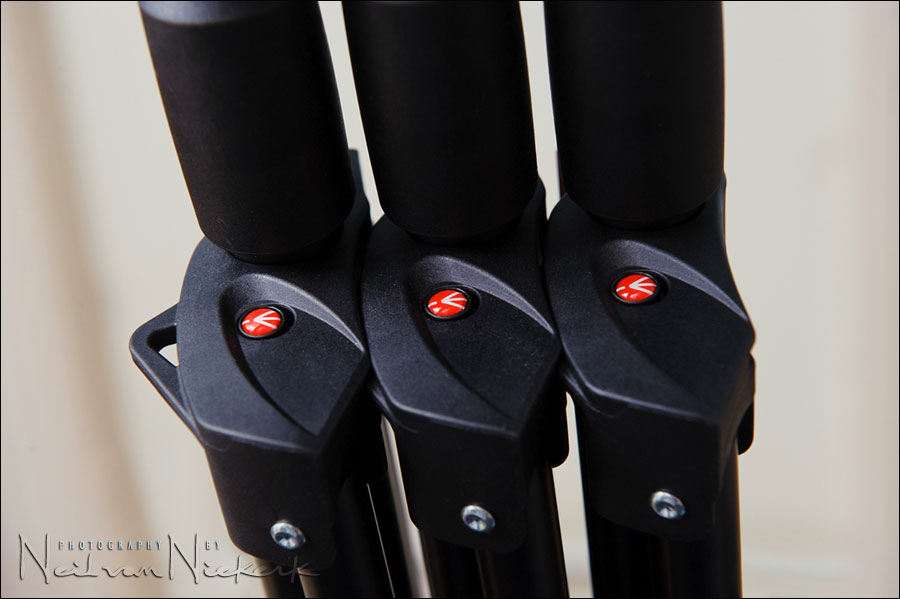
Detail of three light-stands clipped together, and a detail image showing one just uncoupled from the others. The other clip is in the foot section.
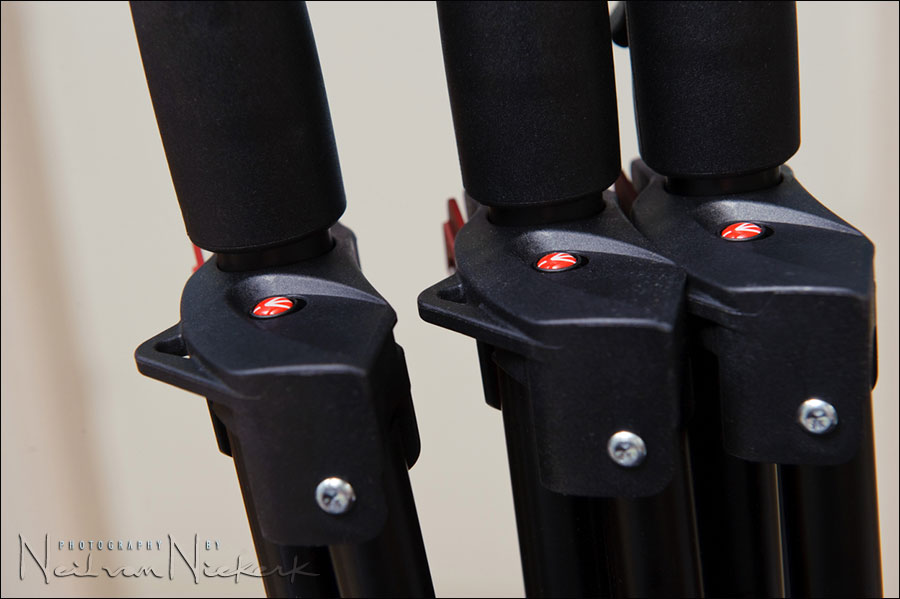
The reverse side of the three light-stands stacked together. That red clip you see there is the knob with which you tighten the legs to the center pole of the light-stand. Quite elegant and compact.
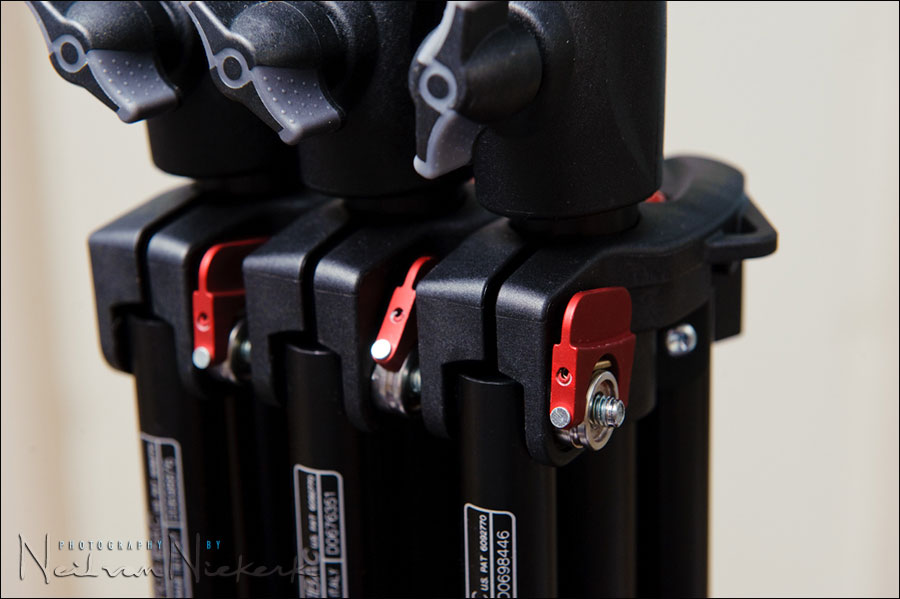
Detail of the light-stand with its feet extended.
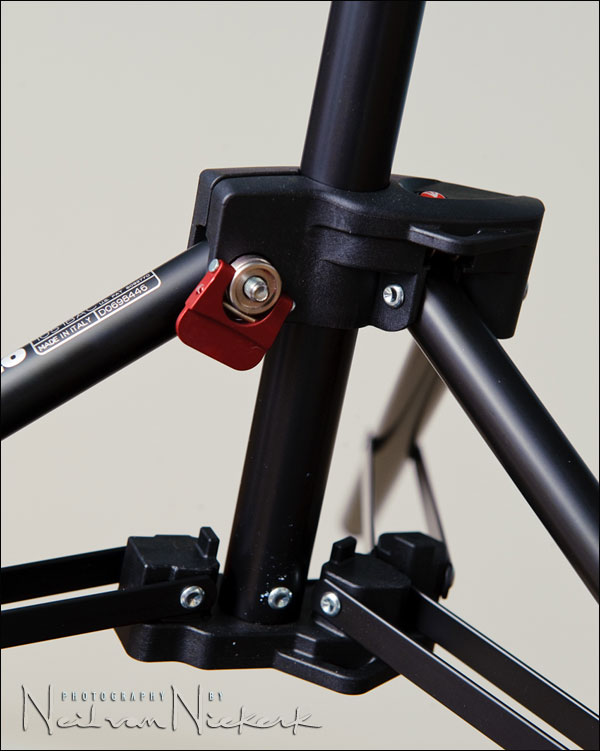
That connector you see there in the middle, becomes the foot of the light-stand when collapsed.

Here are three 1051BC units clipped together.

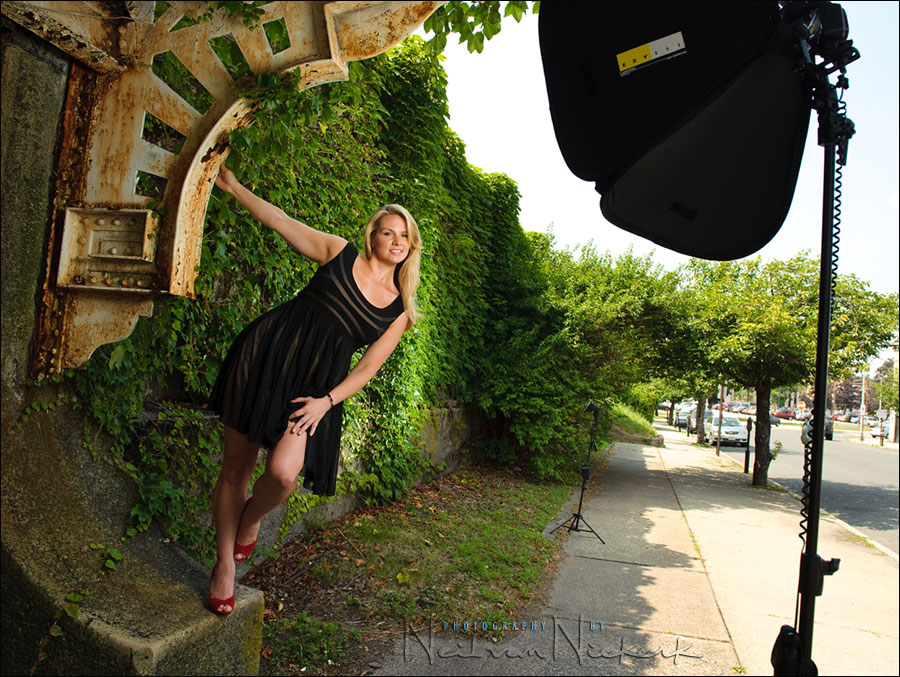
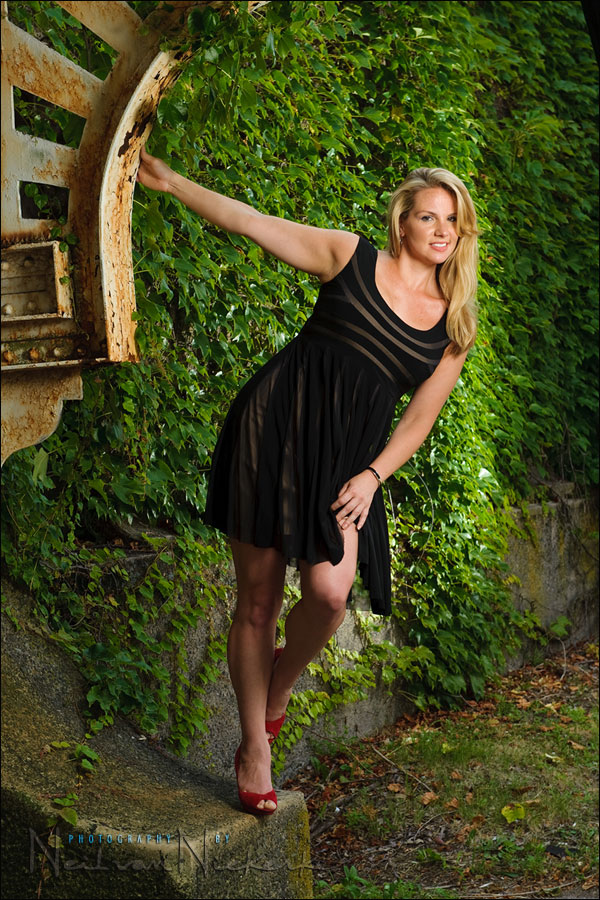
In this image shown at the top, I used the larger 1004BAC unit to hold the Lastolite EZYBOX 24×24″ softbox (affiliate) to the correct height. Since our model, Carrie, was standing on this ledge, I needed more elevation than the smaller light-stand could give me. I also needed something a little more sturdy against the softbox being blown over in the wind. The light-stand in the background is the smaller 1051BAC since it just needed to hold up a single speedlight (with battery pack), to light up part of the background.
To order these light-stands for yourself
If you’d like to see more about the specifications of these Manfrotto light-stands, or order them from Amazon, please use the following affiliate links:
– the compact: Manfrotto 1051BAC
– the medium-sized Manfrotto 1052BAC
– the taller, heavier tall: Manfrotto 1004BAC
The light-stands I used prior to these Manfrotto light-stands
Previously I had used the self-collapsing Red-Wing light-stands. The Red-Wings aren’t made anymore, but the clever design has been taken up by the Cheetah Stand. (I think the Kwik-Stand was a similar design.) These self-collapsing / self-expanding light-stands are an innovative design that makes the moving of the light-stands a breeze. You pick one up, and it collapses. Great. The only problem is that the center column of the stand, which acts as the opening mechanism, acts like a 4th support to the stand. Now, the entire idea why a tripod is stable on uneven ground, is because it has three legs. You add one more, and work on uneven ground, then the light-stand is wobbly. Super-annoying. (As an example, check my comment #25 in the review of the Canon 200mm f2 IS lens, where I used a tall Red-Wing stand.)
Details about the images
And for those who would love to see what the final images looked like:
Our model is lit by wirelessly controlled TTL flash – speedlight in the softbox;
the background is lit by direct off-camera manual flash, triggered by a PocketWizard Plus II unit.
With the background light disabled.

Why did I choose wirelessly controlled TTL flash to give enough light on our model .. but used manual flash for the background. Because I could. And wanted to. It all works.
I admire your intelligent curiosity to test things out. Even light stands become cooler through thoughtful review.
But even better than the thoughtful review, it’s great to see another peek at the Lastolite Ezy Box in action.
Hello Neil
I like the color and contract in your photographs are you using Nikon ” Portrait” picture controls with your own adjustments? Would you mind sharing with us your settings?
Anoop
Neil, are you shooting in manual for this as usual, and if so how do you tell the TTL flash to be the key light. ie how do you get it, one or two stops over the ambient?
If you set your camera at say F5.6 does the flash not just put out F5.6 worth of light, and if you go say +1.5ev is the image not then over exposed.
Many thanks John.
I found this TTL and Wireless setup, works great for 1st dance shots!
Neil, showing the lighting set-up behind the camera is idea inspiring.
It adds a whole ‘nother dimension to an already excellent site.
Thanks – Fred
P.S. Can the PocketWizard Plus II unit fire strobes TTL?
Hi Neil,
So the backround is manual and triggered with PW. So you have a PW transmitter on the camera hotshoe. How do you then also wirlessly trigger the iTTL for the main light?
Thanks!
Scott
And I just ordered one of the Cheetah Stands (the smaller version). Are the Manfrotto legs easy to collapse in case you just want to hold it like a pole? With the RedWing design, you just has to pick it up from the floor to get the pole form.
If you put a Manfrotto stand on a sloped ground surface as shown in comment #25 of that Canon lens review, wouldn’t you have the same potential instability? (i.e. tipping over if it’s too heavy in one direction)
I don’t think a 4th leg in and of itself is the cause of the stability, but the fact that in the RedWing/CheetahStand design, the 4th leg controls the opening and closing of the other three legs. If you put the RedWing on uneven ground, the ground pushes against the 4th leg, causing the other three legs to contract, which is not what you want.
Neil, every post is like a continuation of the next, brilliant. I think the answer to Scott’s question is that a wireless transmitter (SU-800 or additional SB-900) is on the hotshoe and the PW is fired from the chord connected to the PC outlet on the camera body. My question: Is the additional SB-900 better to use instead of the SU-800 because the 900 rotates to face the flash on the light stand guaranteeing the beam gets where it needs to go?
Hi Neil,
I see what you are talking about now. I am looking at the CheetahStand pictures on their website, and the bottom end of the center column is not at the same plane as the bottom of the three legs. So, if there was a bump or rock right where the center column is, there would be the see-saw motion that you mentioned. I mistakenly thought the bottom end of the center column was at the same plane as the bottom of the three legs.
Are your RedWings permanently retired now in favor of the Manfrottos?
I must need new glasses, because I obviously was not viewing the Cheetahstand picture correctly. :-) Sorry for the misunderstanding.
The Manfrotto’s center base is above the plane of the three legs, so if there was a small bump in the ground underneath the Manfrotto, the tripod would not see-saw.
Once I receive my CheetahStand, I will see this see-saw firsthand. :-) I’ll have to decide whether to keep it or try to sell it. The fact that the 3 Manfrottos can snap together is quite compelling.
Neil
from one of your answer from this page you said “if the the ambient exposure is correct at f5.6 then I could set f8. .. and the flash exposure will follow, and hence be the key light”.
How do you measure the Ambient light with camra builtin meter? so what you you adjust to get the exact exposure Shutterspeed,ISO,or F stop adjust them untill you get the camara meter exactly “0” ? if want to keep the Shallow depth of field should i go Shutterspeed 2 Stop higher and get the same effect of F8 and give a touch of flash to highlight the Subject
Thanks
Anoop
Anoop .. check this series of articles on light metering using your camera’s built-in meter. As well as this page on metering techniques. It should be a good start.
Neil
I would like to get into off camera flash, would i be better to start off with an umbrella to shoot thru and shoot into or would i be better putting the money to a softbox, i would only be using speedlights at the moment. A lot to learn. Great posts as usual, i do enjoy the diagrams helping us to have a go. Thanks.
[ placeholder ]
How is the stability of the smaller stand? The specs say it has a footprint of only 28 inches! The nano stand goes almost as high and has about a 42 inch footprint. It can’t hold as much weight, but it’s fine for a speedlight/softbox.
Hi Niel
I have a quick question
I’m considering purchasing the Manfrotto Nano Stand
How do stand up in the wind with a softbox or umbrella.
Not even the large light-stand shown here will stay up during wind with an umbrella attached. You’d have to sandbag it to keep it down, or have someone hold it upright.
So the Nano Stand would be even less suited for this purpose.
Hi
Can the 1051, 1053 and 1004 be clipped together or do you have to have 3 of the same?
Thanks
Marc
They have to be the same size (i.e., height) for them to be able to clip together.
Hi,
are the 1053 and 1004 the same size so. you can clip them together? ore are they also different sizes? The 1005 and 1004 are locking quiet the same. do you know if they can stack?
No, these are different sizes, so won’t clip together.