spacer
spacer

Tangents

black foamie thing to the rescue – bouncing flash forward

September 7, 2011

bouncing flash forward without getting that direct flash look

When bouncing my on-camera flash, I rarely point the flash straight-up. Most often the flash is pointed behind me or to the side to a certain extent. This way I get directional light. I want that off-camera soft-box effect. However there are those times when it just isn’t that practical.

With this recent wedding, the indoor ceremony was held in this large room. As you can see here in this test shot, the ceiling isn’t white, but is a light brown, with wooden beams. The thick cross-beams have the effect of blocking flash when bounced, containing the spread of light.

Bouncing flash behind me just about killed the light from my flash, so little of it returned to light my subject. So for the ceremony, kneeling down in the center aisle, I had to get light onto the bride and groom. The most logical way to do this, and still get good soft light on the couple, was to point my light forward at an angle to get enough light there … but I still needed to block direct flash from hitting them.

(more…)

       Comments (28)


using on-camera bounce flash outdoors at night

June 29, 2011

using on-camera bounce flash outdoors

With wedding photography, when doing the night-time romantic portraits of the couple, the pressure is usually on. The only opportunity to whisk the couple away for a few minutes, is during dinner time, when the party is at a lull. The pressure is on because you have even less time than you had during the earlier part of the day, and you also don’t want to lose the attention of your couple who wants to get back to their guests at the reception.

I usually scout a few places before-hand, getting a clear idea of what I want. When setting out with the couple, I rely on bounce flash and on video light. There is rarely time for carrying around a soft-box. You need to move fast, set up fast … and still come up with the goods.

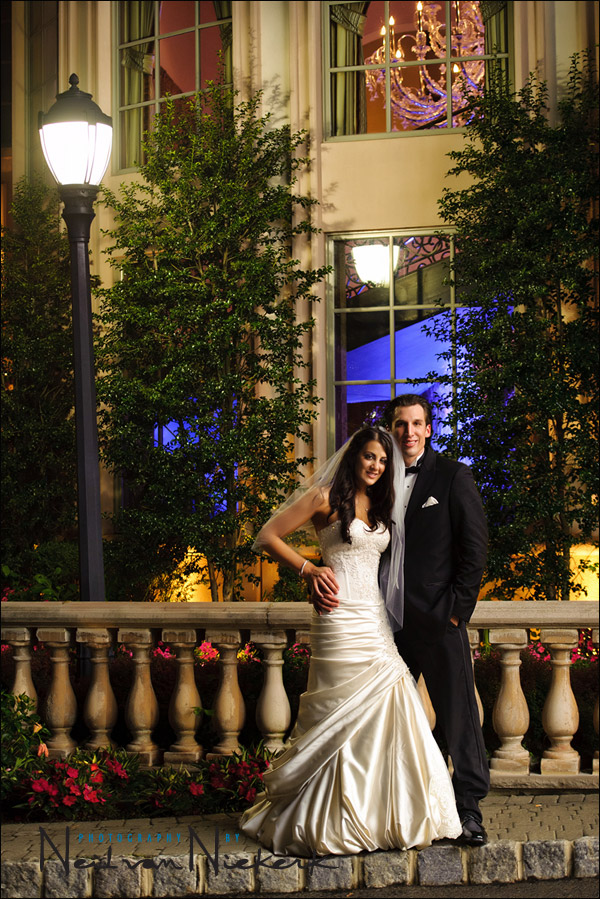
With this wedding from the past weekend, I wanted to capture two specific portraits of the couple with the outside of the venue as a backdrop. I would normally have used video light here, but I had the idea that I wanted the compression from a longer lens … the 70-200mm f2.8 … and then the person holding the video light would be in shot. So the solution was to get flash in there. Where we were working outside there, I fortunately had part of the building to bounce my flash off.

(more…)

       Comments (41)


New to flash photography? Where to even start …

April 12, 2011

New to flash photography?  Where to even start …

In preparing the material for the just-completed webinar, Don’t Fear Your Flash, I had given some thought to where I should start with the material. Flash photography on one level is so simple once you “get it” … but from the outside, it can look intimidating and complex. I feel that flash photography is one of those subjects which start to make sense once you grasp a bunch-of-things simultaneously. But how to explain it all at once so that it makes sense?

So I wondered about where exactly I should start the material for the webinar. What should I start a seminar with when I have a 90 minute time limit? Camera settings? Aperture, ISO and shutter speed settings? Manual flash vs TTL flash? Metering for flash and ambient light?

During a test run with the Clickin Moms team who had arranged and hosted the webinar, I had to check voice levels, and was told to say something. I just started riffing on the idea of starting the webinar … and as I said, “where do we even start?” to the imagined audience, it hit me .. that’s exactly what we need to do. We just have to start. We just have to take those first photos!

We can spend too much time caught up in first trying to understand all the technical aspects and all the nuances of lighting. We can be too intimidated by all that to actually use a flash … when all we need to do as a start, is to actually start using the flash!

(more…)

       Comments (30)


flash ‘on top of’ ambient light

January 14, 2011

adding bounce flash to ambient light

Using images from a past workshop, I want to explain a simple concept with flash photography on location. In workshops and seminars I quite often describe the flash as ‘riding on top of’ the available light exposure. It’s just another way of describing the usual technique of under-exposing the ambient light somewhat, and then using flash to give correct exposure. We can thereby control the final look of the image by controlling the direction of light from our flash.

By using flash like this, we can use the flash to ‘clean up’ the light in the photograph.

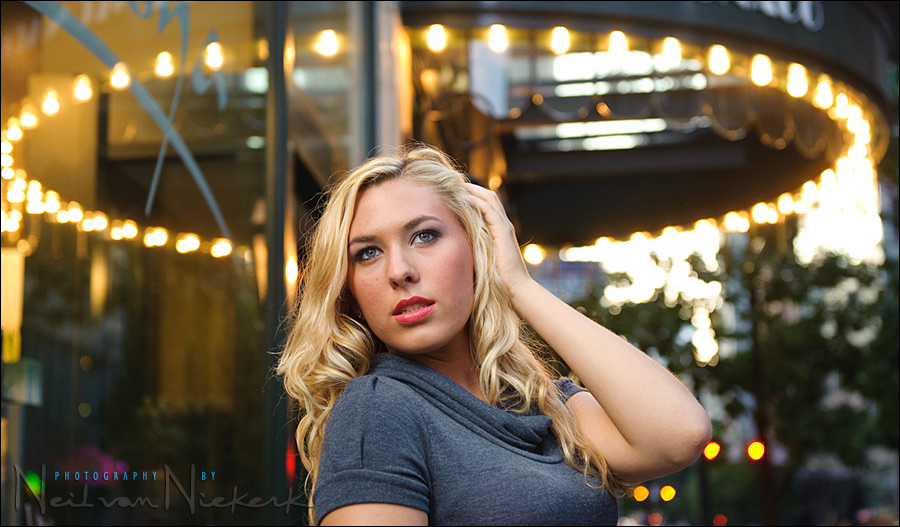
This photograph of Crystal, our model at this workshop, was taken during the early evening. We were working outside, using some of the found surfaces to bounce flash off.  The trick here is to find that combination of bounceable surface, a good background, and then to position your model so that the additional light from the flash adds to the final image. What I like about this specific image is how the sign (and the reflection of the sign) outside the hotel creates a halo around Crystal.

Here is the image without flash, and also a pull-back image to see what surface I bounced the flash off ..

(more…)

       Comments (17)


updated article: how to bounce flash

January 2, 2011

updated article: how to bounce flash

The flagship articles on flash photography techniques was (and probably still is) the backbone of this blog. But since I posted the first few pages on flash photography on planetneil back in 2006, my own understanding and technique have steadily improved, as has my writing style.

Part of my list of things-to-do this year then, is to update the older pages. The images especially needed to be updated. Stronger images, and with less of a wedding bias. Although the techniques can be applied to pretty much any field of photography, I think that some people might have been dissuaded from reading further when they saw the site predominantly featured wedding photography. For this reason, I’ve also made an effort in the past year or two to bring a much wider spread to the range of topics here.

And with that, first up for a face-lift is the page on how to bounce flash. While much of the material will be very familiar to regular readers of this blog, hopefully with new images, and adjusted text and links to other articles deeper in the site, it will be a welcome refresher on the topic.

If you find these articles interesting and of value, then you can help by using
these affiliate links to order equipment & other goodies.   Thank you!

Stay informed of new articles via the monthly newsletter.
Also join us on the Tangents forum for further discussions.

       Comments (11)


combining flash and ambient light

January 4, 2010

combining flash and ambient light

Going by the emails that I receive, one of the areas that many photographers struggle with is that of combining ambient exposure and flash exposure.  This question  is also expressed in other ways.  It can be a frustrated, “where do we even start?”  I also often see it expressed as an involved step-by-step deconstruction of technique, making the entire process more complex than it is.

In reply to that, and many other emails I’ve received in the past few months, I’d like to offer an analysis of a few images from a recent shoot.


[ click on the photo for a larger image ]

One of my favorite clients has the most adorable baby boy that she wanted some portraits of.  I had to shoot fast, since his attention span was .. oh, zero.   He’s still a baby!  I also wanted to be able to cover myself in getting some available-light only portraits, and some with bounce flash.  I didn’t want the flash to be overwhelmingly bright.  And in bouncing the flash, there was also less chance of disturbing the baby.   So I had to mix it up in order to get some variety, and be sure of images that worked.

The image at the top was shot with the Nikon D3 and the Nikon 70-200mm f2.8 AF-S
Lighting here was a combination of available light and bounce flash.  And as usual, I used the black foamie thing to flag the flash so NO light from the flashgun fell directly on the child.

My camera settings:  1/100 @ f4.5 @ 640 ISO, using TTL flash
The FEC was not recorded, but would’ve been around 0EV because my flash isn’t merely fill-flash here, but fairly dominant.

Now where the settings look like they might be informative, I also often feel that these numerical values are a diversion.  Too many photographers will get hooked on the choice of f4.5 over another aperture.  Whey 1/100th of a second?  Why 640 ISO?

The truth is that this could’ve been a different combination of settings.  What is important here, is the quality of light.  It is our major concern here, and should interest us more than f4.5 at this moment.

The light on the baby’s face is directional.  There is more light coming from camera left .. and from this you should be able to deduce that I did indeed bounce my flash to my left.  Using that piece of black foam to flag my flash, I was able to get directional light like that.

The light is soft.  Since I bounced my flash into the room, and it bounced off the walls, and furniture, I will have soft light.

So those two aspects of the light from my flash is easily understood – soft directional light.

Now let’s look at how I chose to balance my flash with the available light …

(more…)

       Comments (46)


why use a light modifier that is black?

December 22, 2009

This question repeatedly comes up as response to the various articles here on my favorite light modifier – the black foamie thing.

For anyone new to this, here are the two main articles on how I use a piece of black foam to flag my on-camera speedlight:
- the black foamie thing,
- my choice of flash modifiers

The question invariably comes up:
why a piece of black foam and not a white card or a piece of white foam?

I have replied to this in the various articles here, using this image below .. but I think the reply tends to be overlooked as the articles are pushed deeper. So with that, I thought I’d resurrect my reply to this one specific reply to that question.

Looking at this image, which also appears in my book on flash photography:

I wanted to place my light source (ie, the area where I am bouncing off), at some point to the right of me, and above me, but also a little to the front of the bride. This way her arm and back to me, are under-lit compared to her face (which we see here as a reflection in the mirror.)  Instead of a plastic light modifier or something similar, I used a black piece of foam to flag the light from my speedlight.

An open card with white on the one side might have thrown too much light into the room again, flattening the lighting.  I don’t want that.  I want directional light.  I want that interplay between light and shade.  I want contrast.

And in an opposite way of reasoning, a snoot might be too specific, since I do need a fairly large area to bounce effectively.

I like this piece of black foam. I can roll it a little bit with my left hand, and turn it into a snoot if I want to.  I can also roll it back and open it up.  Ultimately, this piece of black foam is simple, yet flexible.  And this is what I use if I need to bounce my speedlight with a fair amount of control over the flash’s light.

Then there are also two other perennial questions:

- if there are no bounce-able surfaces, then you have to make other plans.  You either have to use different light modifiers, or use direct flash, or ideally, off-camera lighting.  You will obviously not be able to use a piece of black foam to flag yourself and your speedlight out of all kinds of impossible scenarios.  You have to be adaptable in how you use light.

- yes, I do use other flash modifiers at times.  But indoors, (and even outdoors), where I have surfaces I can bounce my flash off, this piece of black foam gives me the control I need.   And the results are there in the images that I show on this site, as well as my work as a wedding photographer in New Jersey.

As a summary, I want to emphasize this point again – there is no quick fix.  I am staunchly against the idea of a cure-all approach to lighting and flash photography.  Specifically, the idea that a single piece of plastic attached to your flash will give you the best results all the time – that idea will hold you back.

You have to constantly adapt your technique by considering your subject, the scenario you’re in .. and the results you’d finally like to achieve.

If you find these articles interesting and of value, then you can help by using
these affiliate links to order equipment & other goodies.   Thank you!

Stay informed of new articles via the monthly newsletter.
Also join us on the Tangents forum for further discussions.

       Comments (17)


using bounce flash outdoors

January 3, 2008

using bounce flash outdoors

While the bounce flash techniques described on these pages are heavily dependent on shooting indoors which provide those places to bounce flash off … it wouldn’t seem possible to use these techniques outdoors.  After all, you can’t bounce flash off the clouds.  (Although we’ve all seen photographers attempt this outside.)

So while there are obvious limitations in applying these bounce flash techniques outdoors, there are times when these techniques can still be quite effective.

As a start, an example that I show in the tutorial pages is of this image taken at a wedding that I photographed in Aruba.

Here I had my daughter hold up the gold side of the Lastolite reflector. And hopefully this gives the idea of light from the sun setting over the ocean. (It had just gone down, and the light was blandly grey.)

However, these bounce flash techniques do imply some kind of surface to bounce your flash off.  But you shouldn’t feel limited by not having an obvious area to bounce light off.  Have a look at this sequence:

Nice evening light:
Settings of  .. 1/125th @ f2 @ 1000 ISO .. exposed properly for skin tones and the dress.
BUT, the evening sky and the light from the lamp are lost.


1/250th @ f2 @ 320 ISO …
Nice enough detail in the sky and the lamppost, but the couple is lost in murkiness.

So this is (for me anyway), the kind of opportunity where a touch of flash would work wonders.
So I turned my flash-head 90′ to my left, and bounced light into the shop displays.
Not any particular surface .. just off the general shop displays.

And here are the results, still at 1/250th @ f2 @ 320 ISO.

It works for me, and I know my client will love it when she sees it.

To show you exactly what I was bouncing light from, have a look at the shop displays to the left in this test shot:

… and this crop from another test shot:

Yup, I bounced flash off that stuff.  Nothing in particular .. but, enough light will spill back from whatever is struck by the light from my flashgun .. to give enough light on my couple to enhance the photo.

Here’s another example :

It was really dark already. This was at 1/100th @ f1.2 @ 1250 ISO
Canon 5D and 85mm f1.2 II
I was really squeezing the last bit of light out of the setting we were in.  I wanted to use the tree behind them with the last remaining autumn leaves, but the evening light was also coming from behind them.  So their faces were shaded. Not good.

I therefore bounced flash off the brick wall of the temple.  I’d guess it was about 10 meters from where I was standing.  But enough light spilled back to register at that wide an aperture and high an iso.  Because the light from the flash is now coming in from an angle, the foreground doesn’t have that typical on-camera flash look to it.

Here’s another image from the same sequence.
(I did edit this though for the dark rings under his eyes from lack of sleep. )

But in this example and the previous one that I show here, I got lucky.
There was some kind of surface or objects nearby to bounce light off.

So, would these techniques work outside ?
Maybe.  Quite often not, but sometimes it will. It depends.
It will require some thought.

If you find these articles interesting and of value, then you can help by using
these affiliate links to order equipment & other goodies.   Thank you!

Stay informed of new articles via the monthly newsletter.
Also join us on the Tangents forum for further discussions.

       Comments (13)


All Rights Reserved © 2006-09 | Client Login