|
October 2, 2010

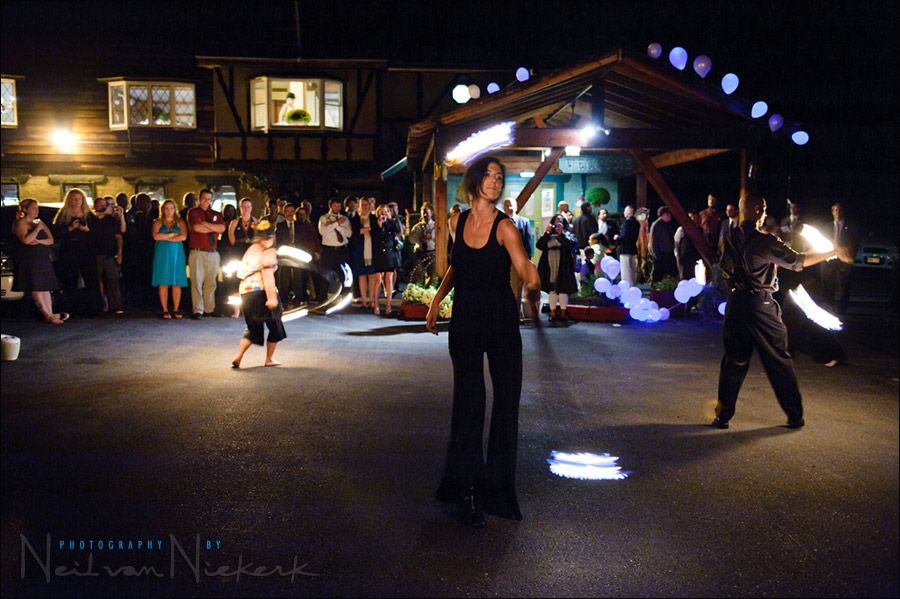
The bride and groom at last night’s wedding are veteran burners – people who attend Burning Man – and several of their guests are fire performers. Later the evening during the reception, four of the guests showed their skill in juggling and dancing with fire.
Photographing fire performers
Photographing the fire performers, especially in such low light – i.e. near darkness – was a challenge. A slow shutter speed to show the movement of the fire, would cause the performer to be completely blurred. But a fast shutter speed would not show enough movement in the fire. A fast shutter speed would also necessitate a wide aperture, which causes depth of field problems as the performers move.
(more…)
Comments (33)
April 17, 2010

style in wedding photography – anticipation and timing
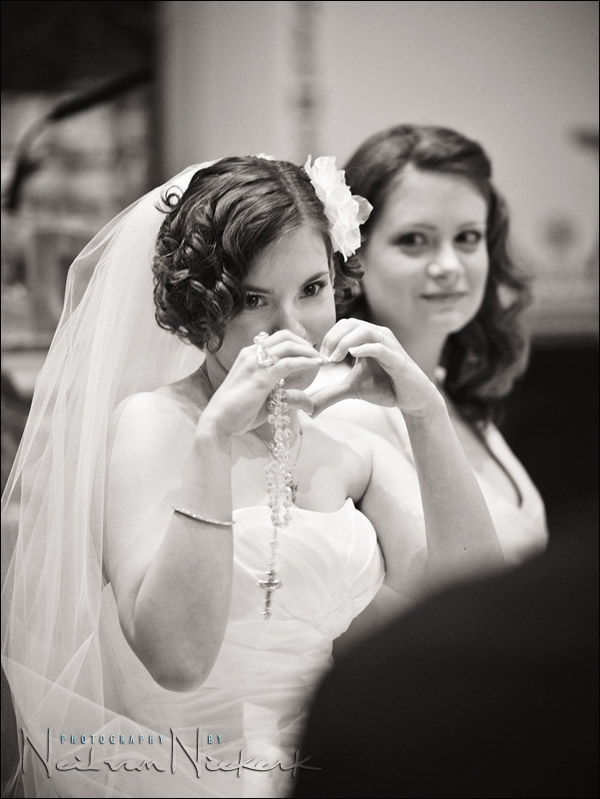
I’m sure every photographer has this experience, where your shutter trips, and you just know you have the shot. Something that you see – whether anticipated or just lucky timing – and you capture it. This is how I felt when I captured this moment between Marie and Andrew at their wedding this weekend. I got it!
A bit of background to this image:
During a Catholic wedding service, there is a short time after the exchange of vows and rings, where the couple are seated again for the Mass. With everyone’s attention now on the priest and the rest of the proceedings, this is usually the moment where a couple have their first nearly-alone time. From experience, I know that invariably the couple will then steal glances at each other, or lean in to each other to talk. Or they might reach out with a momentary fingertip touch. Just a little something where they spontaneously show their connection with each other.
And this is how I was ready for this brief moment where Marie shaped an I-heart-you with her hands for Andrew. 
In that sense this then is not a lucky shot. When you are photographing a wedding, or any other kind of event, whether news or sports or whatever it might be … the key to getting images that capture something essential about the event, is to be prepared, to observe, anticipate, and ‘read’ the event. It’s all about anticipation, awareness and timing. Those moments are there.
other articles on wedding photography
Comments (16)
January 11, 2010
flash photography in low ambient light
I’m often asked what I would do when I encounter a situation where you need to use flash, but there is no easy way to bounce flash. My answer invariably is .. you’re screwed!
Well, not really. My advice is that you have to improvise and find some way of finessing your light. In tough situations, you still want to try and shy away from using direct on-camera flash whenever possible. Direct on-camera flash as the main source of light rarely looks good. And I only use the word ‘rarely’ there as a hedge against someone finding that single rare moment where direct on-camera flash actually was aesthetically the best choice.
As an example of what I meant by improvising, here is a wedding I photographed at the Pleasantdale Chateau – a top venue in New Jersey for any wedding photographer.
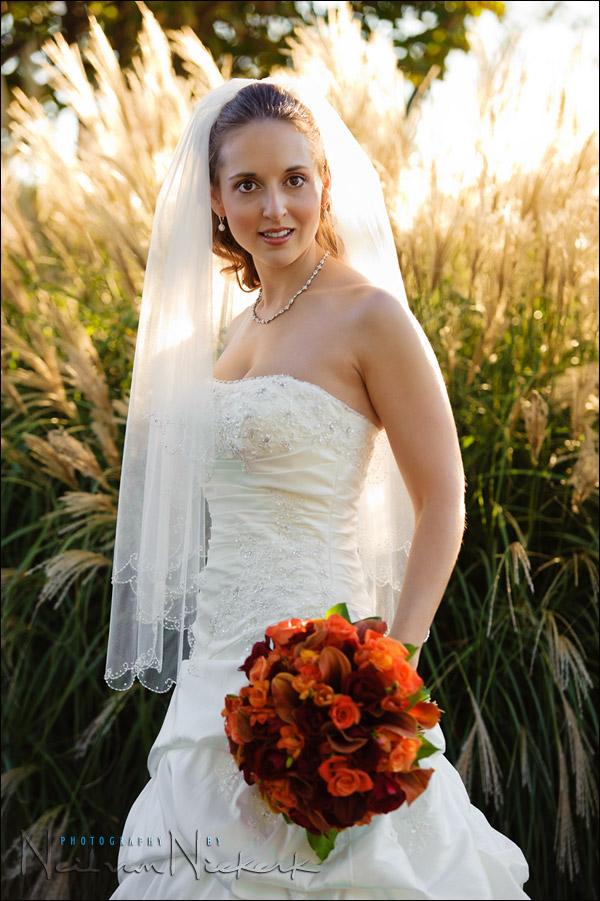
Earlier in the day, working outside with the couple, we had great light. There was a changing mix of dramatic light and soft light, which made it easy getting beautiful photos of the couple:


Later in the evening, just using bounce flash was enough to work with:

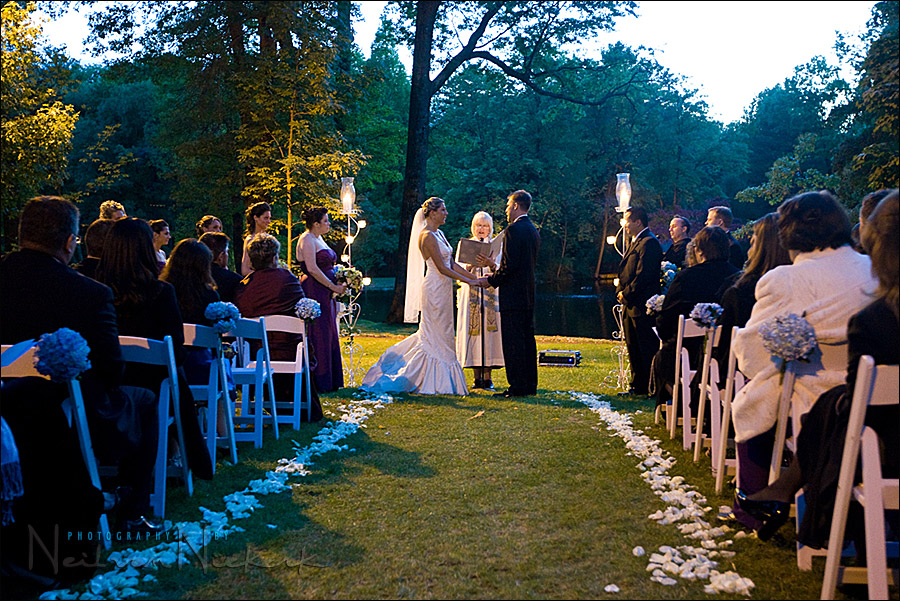
However, the outside ceremony was scheduled for early evening. I knew that even if the ceremony started on time, the light would gradually fade into darkness as the event progressed.
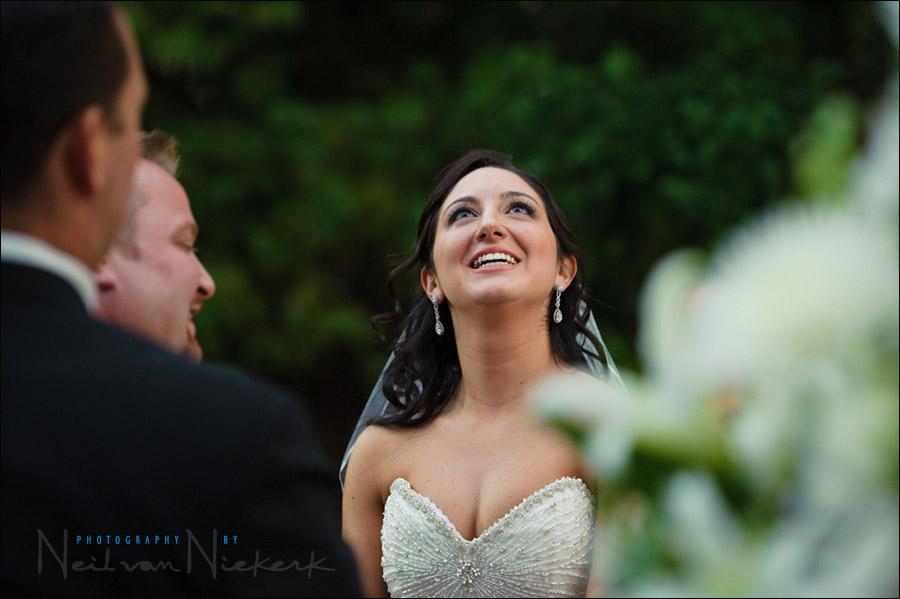
I now had to balance the practical consideration of getting sharp images, with the artistic consideration of retaining the mood of the setting and the mood of the ceremony. I couldn’t rely on there being enough available light to carry myself and my second photographer through the time of dusk setting in. Direct on-camera flash just doesn’t look that good, but there really was no way to bounce flash there .. we were outside next to a lake.
This is where panic set in. I desperately want to give my clients images that look as great as those they saw in my sample albums or on my website. But there were the practical matters to consider.
I wanted both these things - sharp images, but also images that retained the mood …
(more…)
Comments (41)
December 19, 2009
bounce flash examples – wedding receptions
Over the course of the past year or so, I’ve made a steady attempt to move this blog away from being wedding-heavy, and take the material more towards general photography, and photographing people.
However, since the most of my work is as done as a wedding photographer in New Jersey, I still get a large number of questions which relate to wedding photography - and specifically, photographing the reception. So I thought I would expand a little on the techniques I use in photographing wedding receptions.

A few years back, I would regularly use additional lighting to add extra light to the reception room, in order to avoid the dreaded black background which everything faded into. But I rarely do so these days, and haven’t used additional lighting at a reception in more than a year.
Somewhere around the time I started using the Canon 1D mk3, I decided to forgo the additional off-camera flash setups at a reception. I could now really make use of the high-ISO capabilities of the camera to bring in the ambiance. And now with cameras such as the Nikon D700 (B&H) and Canon 5D and Canon 5D mkII (B&H), incredibly good high-ISO performance has become more accessible.
Other reasons for not using additional off-camera lighting at receptions usually have to do with the logistics and space, and shape of the reception room. Quite often there just isn’t space to safely put down a lightstand or two. Also, more and more receptions venues are lately using up-lighting. This already helps create a more colorful and interesting background, and additional flashguns would just destroy the mood.
To show some examples from weddings this year:
(more…)
Comments (45)
October 7, 2009

The previous article on the topic showed a more static set-up in how I light the formal portraits of the bride and groom and families on their wedding day. But I try and get as many on-location portraits of the bride beforehand to bring in some variety to the portraits. It is also a very good idea to get as much done as early on as you can on the day .. just in case the time-line gets compressed and things don’t quite follow the original plan. Then you’ll be much happier for having some solid portraits in your pocket. So it definitely is a good idea to shoot some formal portraits when you can just after the bride has finished her preparation.
In this example, I had the bride in the hotel’s foyer, but I specifically had the bride stand in a place where the overhead tungsten spotlights didn’t fall directly on her, but there was obviously enough spill light to give a strong color cast. So she was relatively in ‘shade’ compared to the brighter background. This was done on purpose, so I could use flash to light her properly. In this case, on-camera flash in TTL mode. And to make sure I don’t get an ugly color cast in adding “blue” flash to the warmer tones of the tungsten+daylight mix .. I gelled my flash with 1/2 CTS gel and had my white balance set to 3700K. More about that on this previous post on using flash in a tungsten environment.
I bounced my flash to camera left, and used the Black Foamie Thing to shield any direct flash that would’ve fallen on the bride. I specifically want indirect flash. The moment that your subject can see any part of your flash tube, there is direct flash … and that would spoil the effect that I am after here … soft indirect light that is still directional.
(more…)
Comments (18)
June 13, 2008
photographing in hard sunlight, with or without flash
This is one of the toughest lighting conditions to deal with. Where I can, I try and position my subjects so that they are in shade, or at the very least their backs are to the sun. This way they are looking away from the bright light and less likely to squint and frown, and they will also have more even shaded light on their faces, with rim lighting around the sides.
But where you can’t position people and you have to deal with the lighting situation as it is, you have a few options:
You can get lucky with the angle so the features and details of most of the people are shaded, providing you with fairly uniform light on the essential parts of what you want to capture. Some parts of the scene will blow out, but hopefully nothing really relevant.

With this photograph, no flash was used. However, I did work things in my favor by shooting in the RAW format so that I have much more control over the image in post-production. I can more easily hold detail in the highlights while bringing up detail in the shadow areas.
(The examples in this posting assume that you are a solo photographer without the team of assistants to hold up large scrims and fill lights, but that you have to make do with what you have – a camera with a speedlight mounted on it.)
But if you’re stuck with full sun where part of the subject is in shade and the rest in sun, you have two options:
(more…)
Comments (38)
« Newer Posts
|
|