Using a macro lens for a photo session of a newborn
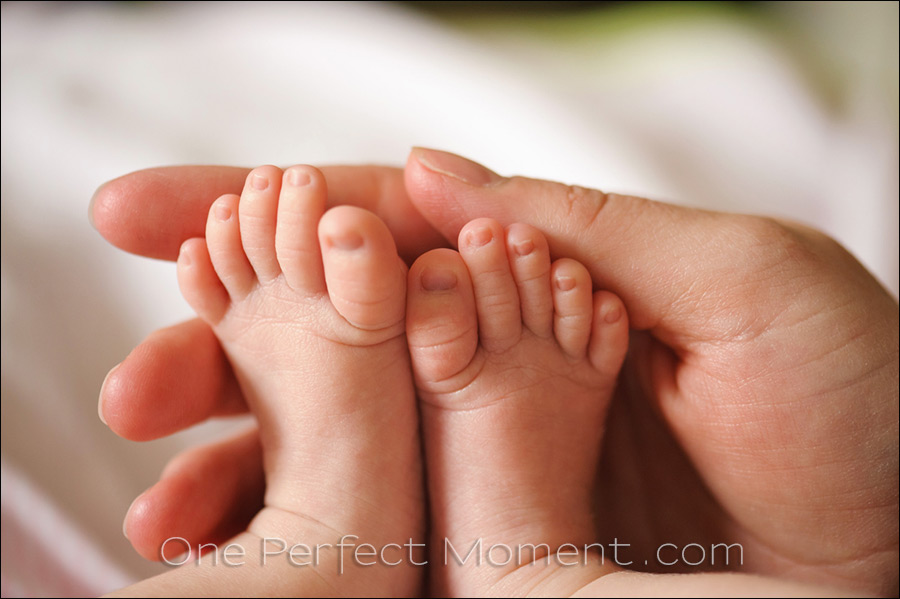
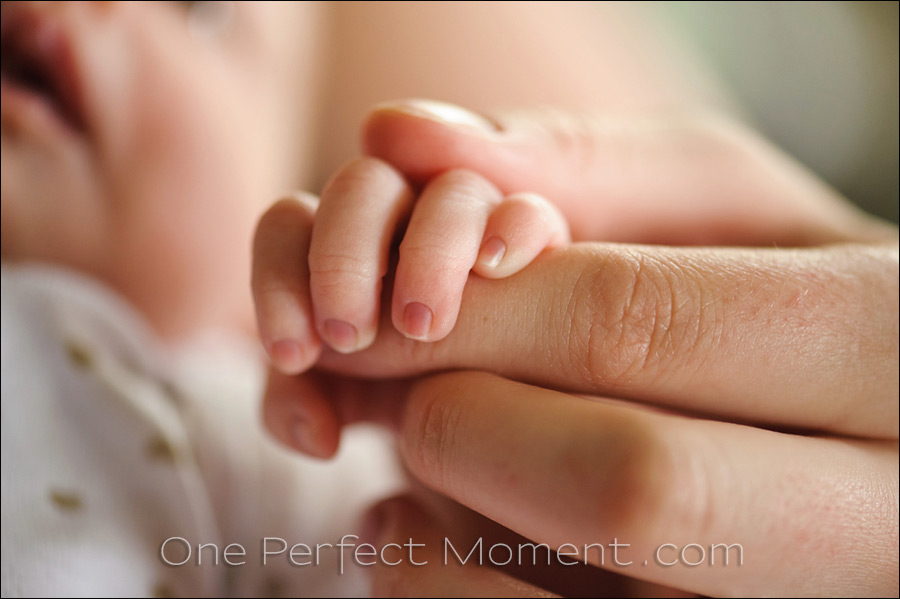
I had the pleasure of photographing Jen and David’s newborn baby. Aside from photographing the proud parents with their little one, it is also essential to get detail photos of the baby. With close-up images, you see even more clearly just how small this newborn baby is, when you show the scale. A tiny hand clasping a finger. Tiny toes gently flexing against her mother’s hand.
For this, a macro lens is an essential part of my camera bag.
Since I like to shoot newborn sessions with available light, the lens needs to be stabilized. Canon lenses have IS (image stabilization), and Nikon lenses offer VR (vibration reduction). This allows you to shoot at a much lower shutter speed than normal, and still get crisp images.
Both these images were shot wide open on the macro lens at f2.8 @ 1/100 @ 1000 ISO
Macro lenses – maximum aperture shift
Because of the way the optics shift when you focus very close, the maximum aperture shifts. Nikon shows effective aperture, and you can see your actual aperture. In this case, even though I had set f2.8 the lens gave me f3.5 and shows it in my display. Canon works differently. With Canon, the set aperture shows … but the exposure will vary as you get closer, meaning the aperture did actually change as you focused closer.
It is just something to be aware of. It’s just how the optical configuration of macro lenses work. I know than Nikon shooters who are new to using macro lenses, are often concerned that they aren’t getting the f2.8 maximum aperture. Canon shooters are generally not aware of this change in aperture, since the camera doesn’t show it.
Macro lens choices
I favor the 100 / 105mm focal length (on a full-frame camera) when it comes to macro lenses. This gives me a comfortable working distance on a full-frame camera. And it also doubles as a portrait lens if I need to.


The best choice here for Nikon and Canon shooters are the Nikon 105mm f/2.8 AF-S VR (affiliate), and the Canon EF 100mm f2.8L IS (affiliate) macro lenses. Here is my review of the Canon 100mm f/2.8 IS macro lens. It’s a beauty!
If you are using a crop-sensor camera, then there are other good choices which would effectively give you a similar focal length (if you frame the image the same):
- Canon EF-S 60mm f/2.8 Macro (B&H)
- Canon Normal EF 50mm f/2.5 Compact Macro (B&H) – it only goes to half-size
- Nikon AF-S Micro-Nikkor 60mm f/2.8G ED
- Nikon AF-S DX Micro Nikkor 85mm f/3.5G ED VR
Related articles
- Macro photography lenses: options and alternatives
- Wedding photography – Detail shots, bounce flash & macro lenses
- Review of the Canon 100mm f/2.8 IS macro lens
Hi Neil
Great to see this!
I purchased (on Friday) a new Canon EF 100mm f/2.8L IS macro for photographing a toddler and baby next weekend!
Super happy to see a post like this, shows I’ve made the right lens choice. Will be coupling it with a 24-70mm towards the 70mm end for the general portraits.
Looking forward to release of your off-camera flash book here in UK, still on pre-order with Amazon!
Colin
Hi Neil. I wonder why you never speak of third party producers. Tamron makes really amazing macro lenses for an affordable price. Concerning this article, the 60mm f2 and 90mm f2.8 would be great alternatives to the big names you are suggesting. What do you think about them? Keep up the great work!!
For that kind of photography I’d strongly recommend using a good quality compact camera like a Panasonic LX3 or LX5: max. aperture F2 and stabilized, it means you don’t have to use a very high ISO (ISO200 might be enough). Because of the high crop factor, the lens at the long end is very short (24 mm) and a shutter speed of 1/30 – 1/40 is enough to get a crisp image.
By the way, thanks for your excellent articles and books.
No doubt that it’s like you say Neil; you deserve the luck of not being in need of looking for best bang for buck!
I just purchased the Tokina 100mm f/2.8 the other day. I’ve used the Nikon 105mm, and I just don’t see any dropoff in quality in the Tokina. Great build quality, super sharp. Plus, it was half the price of the Nikon!
thanks for also including info about lenses for crop bodies, many times it is hard to decide what to use on those in comparison to FF.
Thanks for your expertise Neil! I am a Pentax shooter myself, have been for a number of years and my gear has never let me down. My clients have been happy which is the main thing!! My best lens for newborn shooting is either the 50mm f/1.4, 70mm f/2.4 and most recently I purchased a wide angle Sigma 28mm f/1.8 which is super sharp! It’s all an individual choice – go with what you can afford – what works and produces the best results! :-)
Hi there,
I am currently using a nikon d80 with 50mm/1.8. I would really love to get some macro images of babies/extremely detailed portraits. Can I achieve this with a zoom lens, or would you only suggest the fixed (100mm 105mm) ?
Great info Neil thanks! Would you also use 100mm macro EF for a crop body camera? I hear the quality is comprable?
Why don’t use Tokina 100mm 2.8 macro? Is good quality macro lens and not expensive.