Why use an on-camera flash modifier that is black, instead of white?
This question repeatedly comes up as response to the various articles here on my favorite light modifier – the black foamie thing. For anyone new to this, here are the two main articles on how I use a piece of black foam to flag my on-camera speedlight.
The question invariably comes up:
why a piece of black foam and not a white card or a piece of white foam?
The short answer: The idea behind the BFT is that it acts as a flag, not a bounce card.
On-Camera Flash Photography – revised edition
This book is explains a cohesive and thorough approach to getting the best from your on-camera speedlight.
Particular care was taken to present it all with a logical flow that will help any photographer attain a better understanding of flash photography.
You can either purchase a copy via Amazon USA and Amazon UK, or can be ordered through Barnes & Nobles and other bookstores. The book is also available on the Apple iBook Store, as well as Amazon Kindle. Also check out the Amazon Kindle store.
Learn more about how the cover image was shot.
Control over the direction of light
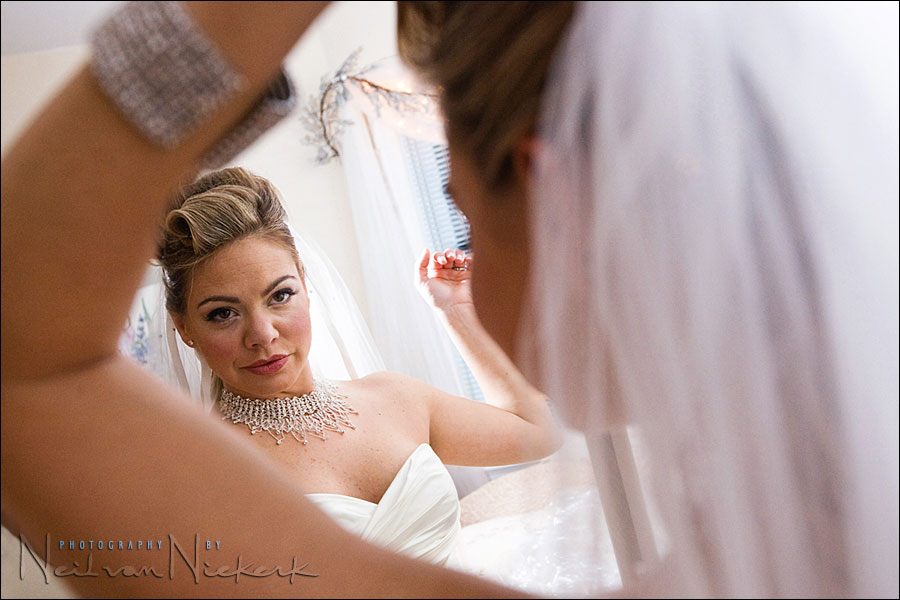
Looking at the top – I wanted to place my light source (ie, the area where I am bouncing off), at some point to the right of me, and above me, but also a little to the front of the bride. This way her arm and back to me, are under-lit compared to her face (which we see here as a reflection in the mirror.) Instead of a plastic light modifier or something similar, I used a black piece of foam to flag the light from my speedlight.
An open card with white on the one side might have thrown too much light into the room again, flattening the lighting. I don’t want that. I want directional light. I want that interplay between light and shade. I want contrast.
And in an opposite way of reasoning, a snoot might be too specific, since I do need a fairly large area to bounce effectively.
I like this piece of black foam. I can roll it a little bit with my left hand, and turn it into a snoot if I want to. I can also roll it back and open it up. Ultimately, this piece of black foam is simple, yet flexible. And this is what I use if I need to bounce my speedlight with a fair amount of control over the flash’s light.
Materials for the flash modifier used – the black foamie thing
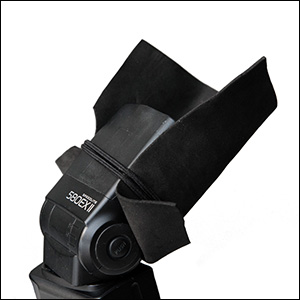
The BFT is held in position by two hair bands (Amazon), and the BFT is usually placed on the under-side of the flash-head.
The linked articles will give clearer instruction, especially the video clip on using the black foamie thing.
Summary
If there are no bounce-able surfaces, then you have to make other plans. You either have to use different light modifiers, or use direct flash, or ideally, off-camera lighting. You will obviously not be able to use a piece of black foam to flag yourself and your speedlight out of all kinds of impossible scenarios. You have to be adaptable in how you use light.
Yes, I do use other flash modifiers at times. But indoors, (and even outdoors), where I have surfaces I can bounce my flash off, this piece of black foam gives me the control I need. And the results are there in the images that I show on this site, as well as my work as a wedding photographer in New Jersey.
I want to emphasize this point again – there is no quick fix. I am staunchly against the idea of a cure-all approach to lighting and flash photography. Specifically, the idea that a single piece of plastic attached to your flash will give you the best results all the time – that idea will hold you back.
You have to constantly adapt your technique by considering your subject, the scenario you’re in .. and the results you’d finally like to achieve.
Related articles
- The black foamie thing
- My favorite lighting setup to photograph kids indoors – bounce flash!
- Bounce flash with and without the black foamie thing
- Bounce flash technique – mimicking soft window light (bride: Jennifer)
Hello Neil,
Thanks for the detailed explanation, I follow your excellent blog daily and always learn something new.
Thanks for sharing,
Roger
Jhb
Neil,
Thanks for the site and the book on flash techniques. I just picked it up.
I am a member of a photo sharing message board of over 100k members. “What diffuser should I get?” comes up at least once a week. I always refer people to your site and your book.
Your suggestions are practical, easy to understand and follow, and inexpensive. I have been able to completely change my approach to flash photography.
My pictures really do look like they weren’t taken with a flash!
From a basic physics perspective, black absorbs all colors of the visible light spectrum, while white reflects all colors of the visible light spectrum. Thus, a black foam piece is highly directional, since any light striking its surface is effectively absorbed, while the other light “rays” travel to their destination. With a white foam piece, the foam will reflect any light that hits it, which not only results in more light in the scene, but possibly unforeseen contrast effects, as you have light “rays” going off in additional directions.
Using a black foam piece does mean you’re wasting some of the flash’s power, but the directional light is more important than the wasted flash energy.
Hi Neil,
Do you bounce of colored surfaces and how to you correct color casts in PS?
Thanks.
Thanks for again explaining this, Neil. I disagree that the view that this technique “wastes” any light from your flashgun. Your subject receives the same amount of light weather or not you flag a part of it from your scene and that light that you do flag is already being wasted and people and other foreground objects that are NOT your subject. I see no difference. Cheers!
Hi Neil.
Stumbled across your website a couple of hours ago and have just ordered your book on lighting. This site has to be the most informative and enjoyable explaination of controlling flash that one could come across. Absolutely brilliant!
Hi Neil,
Thanks to your generous sharing of skills and techniques, I am now a committed user of the “Black Foamie Thing”. One of its great advantages, as I have learned, is that it is infinitely variable. Thanks to the bendy properties of the foam, it can be easily moved up, down and around the speedlight to customize each shot.
Thanks again and all the best for 2010.
Really great stuff here. I was feeling kind of stupid, now I realize I’m not stupid, I just have a lot to learn. I’m okay with that.
Thanks for taking the time to help this group understand the dynamics of flash photography. I’ll be at my computer for the next two weeks trying to absorb it all.
Neil,
I can’t thank you enough for the insight you have so willingly shared on your website. You are an inspiration for a young and enthusiastic photographer from New Zealand who is always experimenting with lighting. I can’t agree enough with you how you describe a photographer should be ‘adaptable’ with their lighting.
I’ve been trying to find one of these ‘black foamie things’ for a while now in NZ and can’t! Still on the lookout thought :)
Cheers Neil!
Sanele Chadwick
Congratulations on such a great and successful site! i just found it and cannot believe how much common sense info you so generously present.
Thank you for your sharing.
Can you give me an idea of material that the “black foamie thing” can be made from? What are the common everyday names which I can look for in local stores?
Many thanks.
ted
Loved your book. It gets you thinking. Hate it when I can’t bounce flash and have to use Larry Foo’s (cousin from China) peanut bottle, but it works. Have all of your recommendations: gels, white/black foam with velcro, stofen, and the peanut bottle. You are correct when you say that there is no one solution.
I am amazed how many photographers try to bounce flash off of a black church ceiling some 60 ft away. Canon system with 580 ex II gun, studio strobes. I personally don’t think that the thick piece of plastic in the can top allows much light upwards. I think it bounces it all over, sides, back, front and very little upwards. I will be using as many of your suggestions that I can during my weddings. thanks for the 411 A book worth reading and studing.
An add on to my comments. I was showing my wife the different flash modifiers in our bedroom with two large mirror doors. You can take a photo of your self and see how the modifiers reflect light. Gary Fong’s does indeed bounce light upwards to the ceiling as well as to the sides. The biggest problem is no contrast and total lack of control. This is sometimes a good thing.
Neil,
How can I purchase a similar product instead of having to make one up?
I have looked everywhere on the web and cannot find something similar to your invention, they all have a white backing.
Please help :-)
What thickness of art foam sheets are these? Do you have a Michael’s part number?
What is the final cut down size to fit your flash head?
how does the Velcro glue side stick if its going onto felt/foam?
anyone have a video on step by step instructions to make one?
Hi Neil
Thanks for all the great info, what’s your way to correct colour when bouncing off coloured walls, do you use custom white balance and a grey card ?
Thanks so much
shoot in RAW
I have found that the difference between a black foamie thing and a white foamie thing diminishes the farther away the bounce surface (ceiling, wall) is. If the bounce surface is fairly close, the black foamie thing reduces the light at the subject by 1/3-1/2 stop compared to white foam, and it reduces light spray, which generally improves contrast.
Hi!
So I am pretty good at off camera flash but always looking to get better…what do you suggest when you are in total darkness…let’s say a field with nothing to bounce off of. I have a lot off these kind of weddings, maybe they have a fire pit going and that is all. I am not a huge fan of the gary fong but do use it on occasion. Do you think the black faomy thing would work well in basically no ambient light or walls to bounce from?
Thanks!
Deb
What if there is nothing to bounce your flash off?
Finding something to bounce your flash off
What if your bounce flash isn’t strong enough?
Just found your site through Canon Digital Forum. Excellent ideas. I always bounced flash from ceiling – just tried bounce from the side as in a studio strobe & got excellent results. Next stop is to buy the black thingy for my strobe. You put all this in easy to understand terms & I am so grateful & excited to have found your site! Thank you very much for sharing your expertise! Happy New Year to you!
Hazel
Hi Neil! Thank you for simplifying flash photography for us. I have been following and saving most of your articles that is has given me a new dimension using your flash on camera techniques. I wish I had known them during film days.
You are a blessing to the photography world for your selfless contributions.
God bless you and your family!
Hi Neil, I have gone thru umbrellas, brollies and didn’t use them much, but am now waiting for a 24 x 24 inch softbox which i believe is what i really want.
Big Christmas party coming up in Dec. I want to use it there. Example Image: Groups in front of dim lit christmas tree…I’m pondering weather i should use the softbox (which would provide faster light falloff so it minimizes any spill light), or..using bounce flash off the the side (which might be softer yet, but would have quite alot of spill light everywhere, which i don’t want).
I hope to increase the ISO alot so i could minimize shadow contrast and use the softbox in most cases.
You’re correct, the softbox will help contain light spill. An off-camera flash with an umbrella, or using on-camera bounce flash – both of those would spread the light wide … and hence have less contrast / shaded areas. At some level, this becomes personal choice as to what look you prefer or think is best suited for your subject and location.
must it be foam?
No, this isn’t about the specific material. This is about the idea of how you want to control light. In other words, it is less about the “gear” than it is about technique.