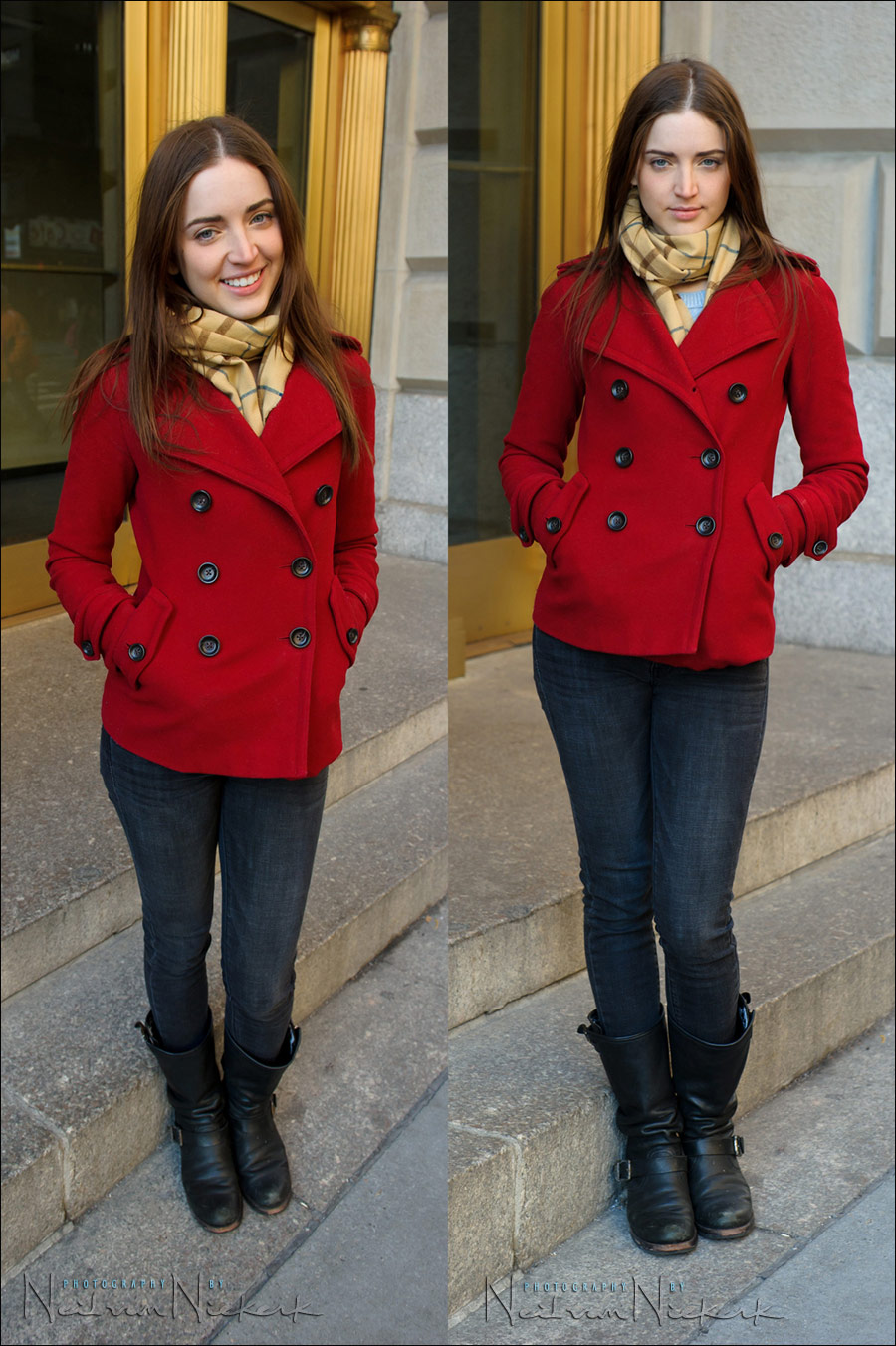
Composition for full-length portraits – step back!
A comment in the article on a simple lighting setup for the family formal photos, asked why I recommended that a photographer should step back rather than zoom wide when photographing a group. The reason is that the perspective distortion that a wide-angle lens will give to your subject, is not all that flattering.
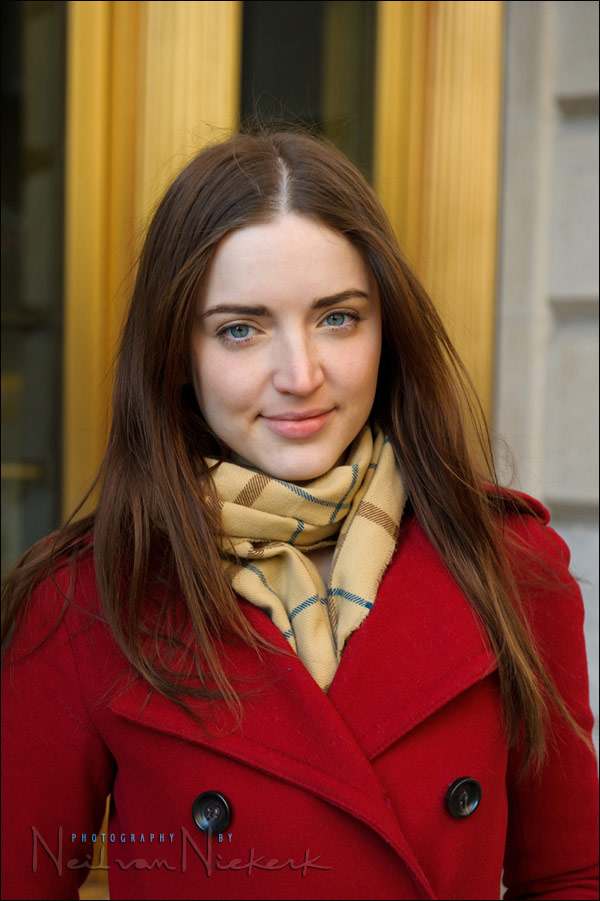
With this straight-forward portrait of Anelisa, I was shooting with the 24-70mm lens (on a full-frame camera), zoomed to 70mm. I wasn’t super-tight in my composition, so I was shooting at a distance where there is no distortion introduced on her face. (For example, Yes, that was shot at the 50mm focal length, but isn’t a close-up head-shot, will bring unfortunate distortion to your subject’s face.)
It is a simple, pleasant portrait. Nothing complicated.
I was shooting at this distance from Anelisa for that portrait.
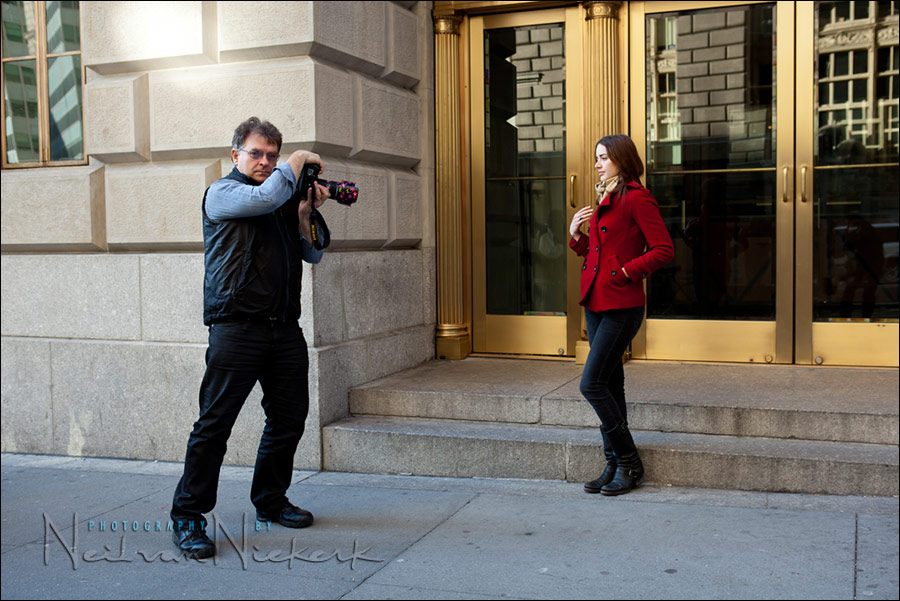
If I want to shoot a full-length portrait now, I have two options:
– I can zoom wider (and not move my position), or
– I can keep my lens to 70mm, and step back until I have her full-length in my frame.
Zooming wider and shooting from “above”, will give me this kind of bobble-head distortion, where her head is much larger, and her legs are much shorter. NOT flattering.
Stepping back forces a more pleasant perspective.
So when photographing someone, I fight the immediate urge to be lazy and just zoom. Instead, I keep to the longer focal length as much as I can, stepping back until I get the framing I want. Invariably, this is the more flattering perspective.
Only when I can’t safely or comfortably step back anymore, will I zoom wider. But my focal length then will still be more appropriate than if I had immediately racked my zoom as wide as it could.
And to give you an idea of the relative distances, I was standing this far from Anelisa when photographing the full-length portrait at 70mm.
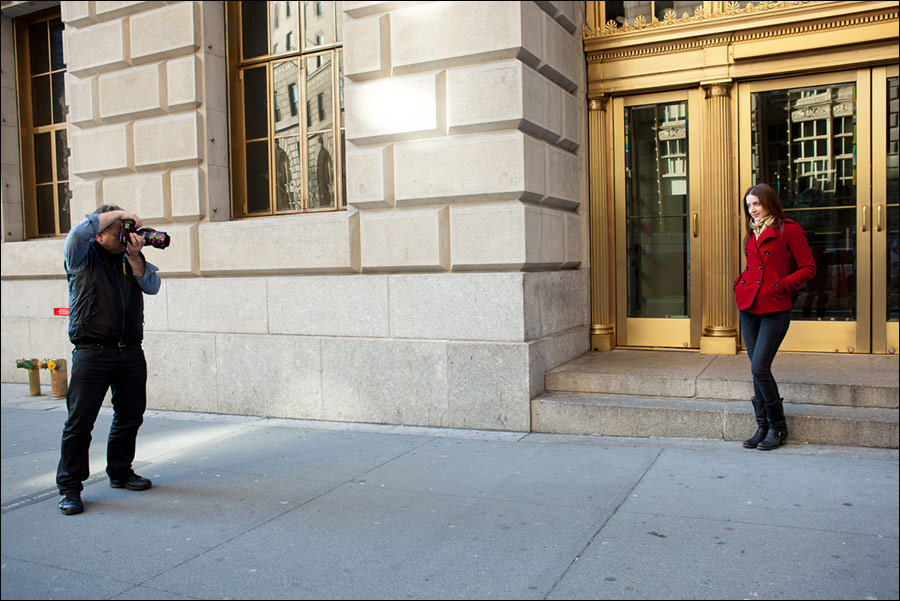
Obviously there will be times when you want a more dynamic composition, or you may want to go for the crazy wide-angle shot. But for a representative portrait, it is always the better decision to step back rather than being lazy and just zooming wider.

The entire motif behind this article then, is to be aware of your own position in relation to your subject, and see how this will affect your composition … and how pleasantly this might render your subject. This is one of those things in photography where it is a good idea to just get a camera in your hand and start playing. See how zooming affects your angle of view, and how this might affect your own position if you recompose.
- other articles on composition in photography
There’s an additional reason that I noticed in the comparison pic: The background is much less “busy” in the longer focal-length shot than it is in the wide-angle. The background in the wide-angle competes for attention with the subject. In this respect, choosing the longer focal length and stepping back is similar to the reason you might choose a more shallow DOF.
Thank you for sharing all this information with us Neil. I’ve been spending hours reading through quite a lot of it, with more to go. I’ll be looking to order your book soon.
Such a great example. I have to always step back as i mainly use the nifty fifty on a 500d. Not a big fan of the kit lens.
A simple but incredibly important concept!!
Nice comparisons, but you’re holding the camera wrong!
good post Neil, this is something I have been guilty of in the past and learned through trial and error. Another pointer that a shooter may want to consider is the relative camera height to their subject, for example waist, bust, eye and above eye level. At over 6′ 2″ tall and the majority of my brides much lower I have to not only step back but have the camera at the right height for what I’m trying to achieve. But as you say the most important point is stepping back.
Learned so much from your blog.
Thanks Neil!!
Simple and effective! It’s one of those things that make you go ‘duh! of course!’
Neil,
You posed well in the third picture. :) And you still have that lens skin!
Thanks for another good article.
Neil,
In a profissional photobook, do you like to “feel free in your creativity” (like, use wide lens, shoot “up to down” giving the idea of “big head, small body”, and etc..), or you prefer do not risk with it, working more with background, light, … ?!
(sorry any mistake with my english)
Victor Godinho
Another argument for using prime lenses. ;)
I’m kidding of course, but this is an important concept to understand. The availability of high-quality zoom lenses is a great thing for photographers, but they can lead to a certain type of laziness, of which the above is a good example.
“Another argument for using prime lenses.”
Not necessarily – Yes, that was shot at the 50mm focal length, but isn’t a close-up head-shot. Not good.
Just wondering too if this would be a good example for using a prime lens such as a 85mm. I currently have the 24-70 and do have to remind myself to step back. Wondering if a good quality prime would be a cure all or atleast just a good excuse to buy another lens!
another tip to minimize distortion would be two keep ur camera parallel to ur subject, yes u will have to bend down or even get on ur knees for full lengths
this article is very useful. thanks for sharing
I love using my 70-200 2.8 for portraits. The compression is amazing and the look it creates for portraits is stunning. Don’t leave home without it.
Good article Neil…one question…where your assistant with an attitude gone?
Another excellent post with clear examples of why you should keep your feet moving.
Thanks Neil.
Hi Neil,
What is the Picture Controls mode you use on D3s or does it matter?
Since I don’t use Nikon software to edit my RAW files, the camera’s picture settings have no effect.
What if we use a 35mm lens, if it possible to do full size portrait and headshot?
You’d be able to do a full-length photo of your subject, but you would still have that wide-angle perspective. Depending on your intent with the photograph, I still think a longer focal length would be more flattering.
A close-up headshot with 35mm? Entirely possible, but again, the wide-angle perspective distortion would be very noticeable. If that’s what you need for a more dynamic, even “funky” portrait, then go ahead. But for a flattering, representative portrait, the close you are to 100mm focal length (on full-frame), the better it would suit your subject.
I think every photographer should understand that perspective distortion ALWAYS depends on the distance. A wide angle lens does not “produce” perspective distortion. The fact that you need to get close to your subject because of using one is what causes it. In other words, if you shoot a checkerboard on a table and fill your frame with a wide angle lens, then you’ll have to get close. You’ll see very pronounced “perspective distortion.” Next, shoot the same exact shot with a 70-200mm zoomed all the way out filling the frame exactly the same way. Guess what? You’ll need to “back up” in order to do this! Hence your checkerboard will have much less distorted angles. Now… finally… shoot the checkerboard with your wide angle lens from the exact same distance as your 200mm. It will be really really tiny in your frame, but stay with me. Now go to your computer and download the images. Open the 200mm shot and the wide angle shot from the same distance. Now zoom in on the wide angle shot even if it goes well past the 100% point to where you start seeing pixels. Make the checkerboard the same size on screen as the 200mm one. Guess what? They will look precisely and exactly the same perspective-wise! Moral of the story: LENSES DO NOT CREATE PERSPECTIVE DISTORTION… DISTANCE DOES! ANd yes… linear distortion produced from super wide angle lenses is a completely different thing – don’t confuse them! Thank you. My physics lesson is over.
So Mike, you’re saying we should use a longer lens and step back for less distortion?
Ha! Yes, of course Neil. I was not in any way correcting you – your post was excellent. All of them are my friend! I merely noticed from some comments that there is a common misconception about lenses and perspective distortion. I think it’s important to know from a creative decision standpoint that the “closer” we move our camera towards the subject, the “greater” the distortion will be. Conversely, the “farther” the camera is away, the less it will be distorted. Choosing a lens is a creative decision: a short focal length “allows” us a viewpoint that produces perspective distortion (if you want it). A longer focal length lens “allows” us to get farther away to minimize distortion if you don’t want it… and yet still be able to fill the frame with a great composition. In any case, the viewpoint determines the distortion, not the lens (and I always hear photographers say “don’t ever use a wide angle lens because it distorts everything” – and that is completely incorrect. You can still take a great portrait with a wide angle lens (if it’s the only thing in your bag)… you’ll just have to step back and enlarge the heck out of it if you DON’T want any distortion. Okay… I think I beat this to death! hahaha
After reading Michael’s comments, I searched for “perspective distortion” on Google, and the Wikipedia entry has a very good explanation of perspective distortion, including photographic examples taken at various focal lengths.
https://en.wikipedia.org/wiki/Perspective_distortion_(photography)
Perspective distortion not only changes how your target object looks, but also changes the perceived distances between objects in the photo.
Hi Neil,
Quick question, did you use flash in these pictures? I noticed the reflection on the wall.
Just curious, how many comments you have and answer a day?
Thanks
Nope, no flash used. That hot spot on the wall must be a reflection from a nearby window or reflective surface.
About the number of comments .. I’d say there are about 2-5 each day. Not a big flood .. but I am running behind on some threads. But I have bookmarked them, and will get to them too, eventually.
What was getting out of control, were the emails I would get with questions – up to 20 a day. That’s an impossible load. And hence I created the Tangents forum.
Great tips as always Neil. I just saw you have a new book coming out and I can’t wait to get it!
Neil,
Do you use a wide angle lens for wedding party shots? Often, with ushers and all attendants, I have 20+ people to photograph, and I find that my 24-105 (or 24-70) makes me get back so very far and puts so many pews in the shot. I just went full-frame this year, but I in the past I always switched to a wide angle lens for the larger, full length group shots. Do you not reccommend this, even if I keep the camera parallel to my subjects? Will I notice more distortion with my full frame body then before? Thanks!
You adapt to where you are. If you’re forced to use a wider angle than is idea .. then that is what you need to do.
You can always partially correct for distortion in post-processing with programs like DxO.
Neil,
I have always intended to ask you this regarding this subject. Full frame sensors – do you feel the lowest focal length (on a prime lens) that you would use for portraiture would be a 85mm?
It has more to do with your distance to your subject. There are plenty examples of wonderful environmental portraits done with wider focal lengths.
Similarly, 85mm might even be considered too short a focal length if you work really close to your subject.
Neil vN
Neil,
What is your advice, when it comes to shooting group of people with wide angle lens ?
With groups, I compose for a 5:4 crop ratio, so there is some space to the left-hand and right-hand sides. This helps minimize distortion. Depending on the size of the group, I won’t go wider than 28mm on a large group, and even that is pushing the boundaries.
And for full length photos, can you tell what kind of lens is best ?
At some point you need to step away from the computer and take photos too.
believe it or not – ” aha” moment for me.
Excellent article; explains why most modern portraits look ridiculous – heavily distorted either wasit-up or waist-down. But that’s what is bound to happen when technology provides every ordinary person on earth a chance to shoot portraits. Even more funny is that people hardly recognize the distortion of their own faces and features. I hope the cases explained here would help folks understand portrait photography better.