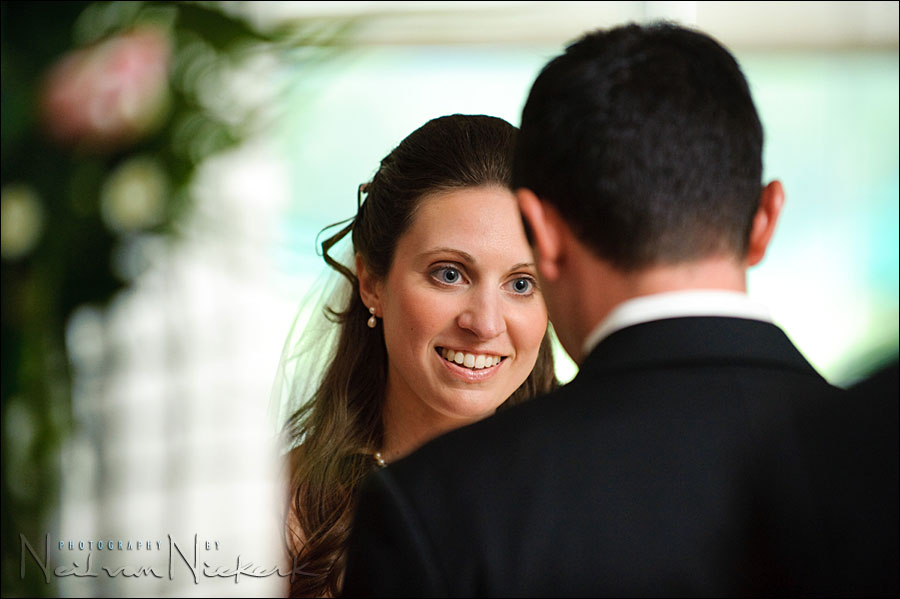
directional bounce flash
With this recent wedding – the same one as posted here– the ceremony was moved indoors because of the approaching thunderstorms. The ceremony was going to be held in the large reception room in the late afternoon, under the chuppah. I once again had no choice but to add flash to balance the shaded side to areas lit by window light.
I want to post this image as an example again of how I use directional light from my on-camera flash. Instead of using a generic light modifier on top of my speedlight, I used The Black Foamie Thing. I was using the 70-200 mm f2.8 to capture the bride’s expressions as she exchanged rings with the groom. Now, from my point of view where I was standing, I had more than a 180′ range in how I could rotate my flash-head to bounce flash to light up my subject. I also had about a 120 degree angle in how I could swivel & tilt my flashhead from right behind me, over & above me, and even tilting the flash-head forward here. So I really had a wide range in how I could bounce my flash.
But for me, only one direction really made sense …
I most often approach bounce flash photography as if I were in a studio and had to place the softbox to light my subject.
Which, with multiple bounceable surfaces like I had here with this indoors ceremony, meant that it just didn’t make sense to bounce my flash above me or even tilted forward. I can’t off-hand think of any situation in a studio where I’d have a single softbox directly above my subject for a portrait. It just doesn’t make much visual sense. (However, if you can somehow make it work like that in a studio … great! Knock yourself out!)
If I bounced flash behind me, or even behind me and to either side of me, then the light would be very flat. And I would light the back of the groom’s head better than any other part of the scene. And again, that just doesn’t make visual sense.
How I actually ended up bouncing my flash – and this is a near-instant decision – was to point my flash-head to the 2 o’clock position, and tilted about 45′ or 60′ up. In other words, my flash was pointed to my right and forward from the camera’s point of view. And tilted upwards by 45-60′. Not 90′ to my right, but instead, 30′ forward from that 90′ position.
The reason why I chose this angle, is that I wanted light to come from the side of the bride. That way I get that directional quality to my light. And this gives form and dimension to my subject.
I didn’t bounce to my left (10 o’clock position), since the chuppah’s structure was in the way. But mostly because there was a room divider to my right. A very easy surface to bounce flash off.
From this point on, it is just a matter of choosing my shutter speed, aperture and ISO so that:
– my available light registers to some degree,
– I have minimal depth-of-field,
– and at least a hand-holdable shutter speed with a stabilized / vibration reducing lens.
Settings: 1/250th @ f3.2 @ 1600 ISO
My flash was set to TTL, so that I could shoot fast, and not have to be concerned right there with getting the correct manual setting on my flash. I am quite happy with allowing TTL flash technology to make my life easier under pressure.
The bride’s expression is priceless.
Hi Neil,
Thank you for sharing your work plus its description in details. This is an excellent angle, a great view in addition to other conventional compositions of exchanging vows or putting on rings.
I already ordered your bounced flash technique book and can’t wait to read it.
Not that it’s important to the photo, but what’s the black shadow in the lower right? Was that a groomsman’s suit blurred out by the lens’s wonderful bokeh?
Neil
yes you have captured the brides happness, and you can feel that in the photo great job.
“I once again had no choice but to add flash to balance the shaded side to areas lit by window light.”
Was the brides left side of her face more shaded? and was that a influance as to were you bounced.
Thanks I was a little confused on this.
thanks again for all your help. I have ordered your book also and am waiting.
John
Great shot Neil.
At first I thought the light coming from the bride’s right was your flash but from your description it sounds like you flash was the key light lighting her left side.
Is it usual to allow use of flashguns during the ceremony in the states?
The only wedding I’ve been given the go ahead to use flash was a registry office.
Hey Neil, thanks for the great post!
One question: you mention that your settings were 1/250, f3.2, 1600ISO… Did you choose f3.2 (or 1600ISO) for a specific reason? Just curious as to why you didn’t go right to f2.8 and shoot with a lower ISO…
Thanks,
Chris.
Nice work again Neil. I really like this natural and unobtrusive use of flash to help tell the story of the day. For me this is a good reminder to think harder about the direction I want the light to come from. Thanks for sharing!
Good Day Neil,
Greetings from the Philippines!
I was wondering how long did it took you to react from the moment they start exchanging rings till you get the shot and exposure you wanted? I would imagine it to be fast and almost instantaneous but it seems (reading your explanation) there was a lot to think about before taking the shot.
Many Thanks,
-Haw
Hi Neil,
By pointing your flash forward of your position would the light not then becoming from the side and behind the bride? The catchlights in her eyes look like an umbrella to your right, above and in front of the bride a la studio lighting. I am lost as to how that is being achieved by bouncing the flash from behind her or is there some magic going on and large enough light source is coming back giving this look.
Hi Neil,
Again great post, thanks! I wonder if you use the zoom possibility on your speedlight in specific situations.
Jerry.
Hi Neil:
Thank you for sharing your wisdom with all of us. I would like to add my complement to your great work,
I am also confused as to how you got such a great shot with light seems to come totally from right side of the bride and groom.
If you stand slightly to the left of the couple (when the shot was taken), and you use on camera flash angled to your right as you mentioned, I would expect that the left side of the groom head would get the most light spilled from your flash?. How did you prevent this from happening? is it the black foamy thing that does the job?
Thanks
Roy
Hi Neil,
That’s a great shot!
I understand that the exposure is set manually, but are you set to spot metering to control the TTL flash reading or are you riding the exposure comp?
Thank you for such great information.
Anthony
Oh, Neil. YOu are the master! :) So loved taking your class in Denver a year ago. Come back! We’ll build a class for you. I am still using your flash techniques as is my sister. I want a second run through of your class, however, as i don’t always nail it….i feel like i’m experimenting at every wedding. THis shot you did is amazing. You make it look so simple and non-flash like, which is why i say you’re the pro! Come back to Colorado! Thanks for sharing.
Thank you Neil. I learn a great deal from you. I will order your book today. :)
Carlo
Very nice shot Neil. I don’t think you could’ve done a better job demonstrating the use of “on camera” flash and how good it can look if a little thought is put into it. As always, another excellent and unselfish post. /cheers.
Hello Neil,
Beautiful shot. I find it helps to read and re-read your posts over and over again.
You’ve probably answered this one somewhere; do you still bounce flash with the Black Foamie Thing if you’re shooting in a room with bright red or yellow walls (or other vibrant color).
Do you then resort to direct flash, perhaps with a Stofen or other modifier? Or shoot raw and try to correct later?
Cheers.
Ernst
Hi Neil,
This is a little off topic but I wonder if you use tungesten to daylight correction gels, for example in the case where the background temperature is a little colder than the flash temperature is. It crossed my mind when looking at the example pics on page 113 of your book. By the way, got your book last week here in Holland. It’s great! As is this blog. Thanks a lot for sharing your knowledge!
Jerry.
Every time I come to this site I learn something. Thanks!
Neil,
Shooting at the high ISO speeds of 800-1600 (+)with my D200 doesn’t that increase the issue of noise? How can I overcome that?
Hope you see this before you respond to my above question. You have answered the question elsewhere. Thanks.
As you are describing angles to choose from it reminds me of playing a game of pool (billiards), I imagine bouncing that ball off the edges. I know that analogy will help someone to think about it that way. Intentional directions. Physics anyone….
Hello Neil,
When you bounce your flash, do you use manual power settings or TTL?
and how about the ‘zoom’ on the speedlite? If you do set them, how do you determine their setings?
Thank You.
Neil,
I came across your website just recently and I thank you for all the information you have posted and continuing posting on photography. I like your style of writing and how you go in detail and give examples with pictures. You have been very helpful!
I’ve been reading lately on bouncing the flash off of surfaces around me/ the photographer. And you do give great instances. But there are still a few things I couldn’t find answers to.
I was recently at a wedding as a guest(but still took pictures) and there was a hired photographer who shot the event. I was paying attention when he was taking his pictures. Most importantly when he was shooting during the reception / party / dancing inside in a very low light room with high ceilings. His flash was tilted backwords with an able, away from the subjects he was shooting and actually blinded all of us who were behind him. I saw his final slideshow the other day and the pictures looked great – bright with color, no blur anywhere.
My question is – if the ceilings were high, what was he bouncing his flash off of?? Those were dance floor shots, people dancing and moving fast, bounced flash, the action was frozen- no blur like I said. If he was using directional flash, I would not be asking this question… but it just seemed an open space above, how could he have reflected/bounced his flash??( he did not use the black foamy thing at all) And one more question: When shooting outdoors with no ceiling or walls around you, how do you bounce the flash??
Neil, thank you so much for your time in advance!!
Elisaveta
Neil,
Do you ever use LED lights attached to the chuppah in addition to bounce flash? At my last Jewish ceremony, the chuppah “roof” was very low and I could not find a way to bounce flash and not get a shadow on their faces because the roof edge was barely taller than them. What would you do?
Thanks as always,
Cicely
Thanks Neil, I just wanted to ask the flash master to make sure I wasn’t overlooking anything :-)
Neil,
Great work and blog. Sorry I missed you at HV Click this past Sunday. I shoot with a D3 and sb-800. Dumb question but I don’t know the answer: how do you bounce flash off the right side (as in the top photo) when camera is in vertical mode (hot shoe / flash is on the left side)? Do you just hold the camera upside down (button on bottom) – not very comfortable.
Thanks for all your knowledge and sharing.
David
so these days I see you don’t use a flash bracket – how do you get the vertical shots bounced to the right (like the top photo, although the top photo is horizontal)?
Thanks.