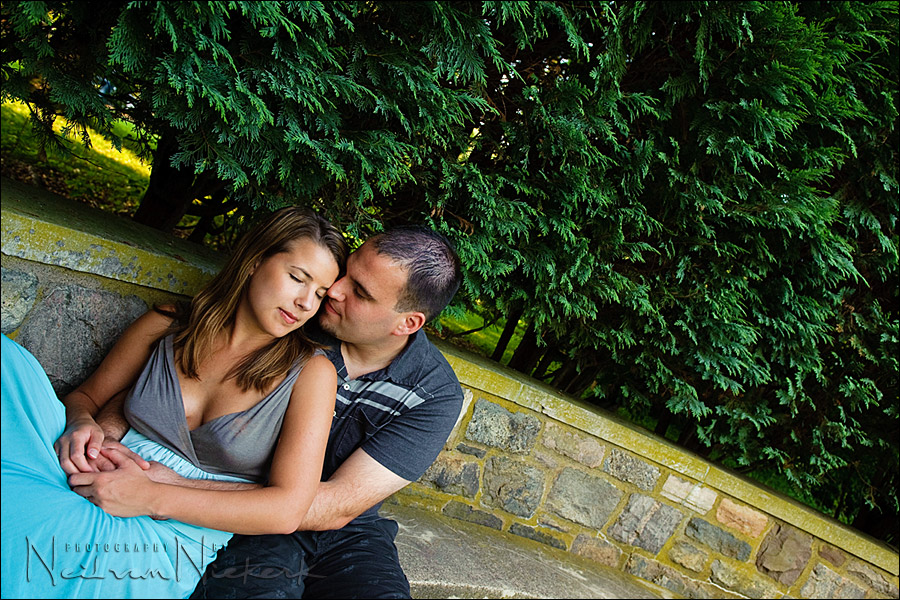
whether to use fill-flash, or not
With the recent video clip where I showed some of how I work with a couple, during an outdoor photo session, several people commented on not seeing my flash go off every time I take the shot. And the question was, when do I decide to use fill-flash and when not.
With the image at the top, you could see my flash firing during this sequence in the video clip. The light falling on them wasn’t even, although the light falling on Jen’s face was even. So I felt I needed to use a touch of fill-flash. Here I had flash exposure compensation set to -5EV on the Nikon D3. With Canon, I would most likely have been around -3EV compensation on my flash.
With this following image, I had positioned them (and posed them), so that the available light fell evenly on Jen’s upturned features. With the soft available light falling in on her like that, I simply didn’t need any fill-flash. The available light was perfect. So I switched the on-camera speedlight off. Actually, with the Nikon D3 there is a customizable function button that I use to disable the flash momentarily as I wish.
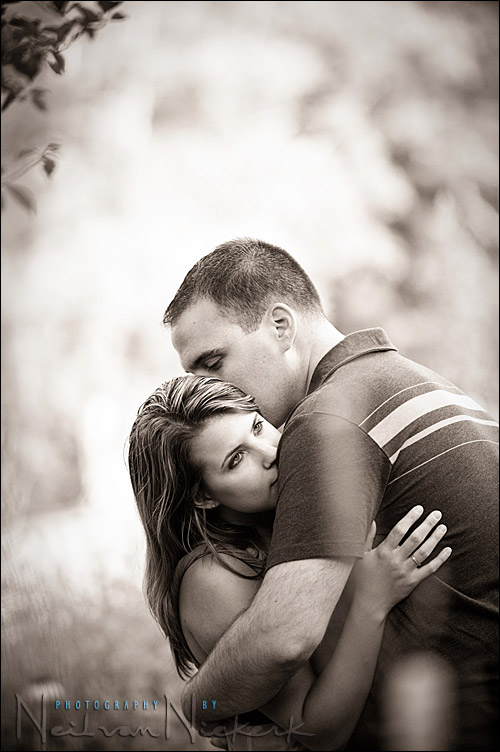
The same goes for this image from a separate sequence:
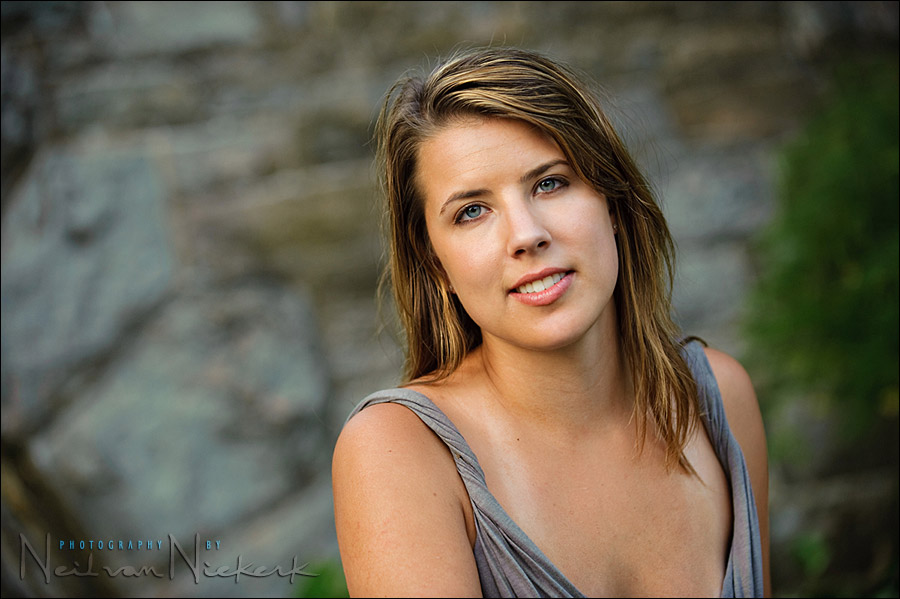
In deliberately placing the couple against the soft light in the background from the sun going down, I didn’t need flash either. The light on them was even, and the rim-light helped to give some separation from the background .. along with the shallow depth-of-field. (f2.8 @ 70mm)
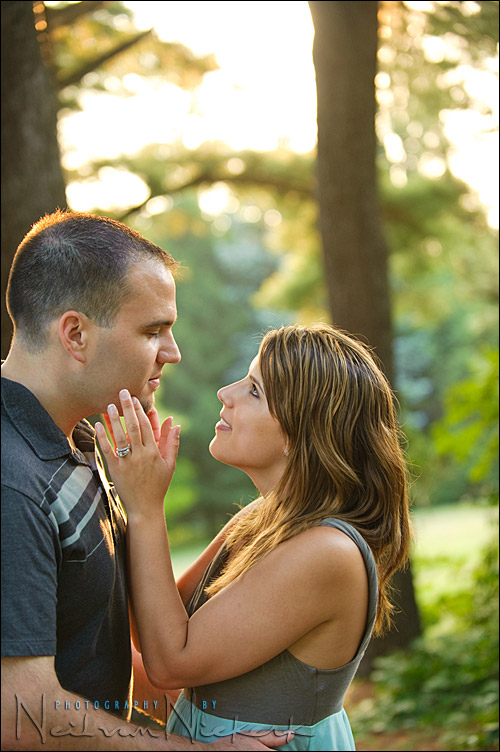
The observation with all this is that I deliberately use fill-flash where I think it is needed … but at the same time it becomes necessary to recognize when the available light is perfect. And often it needs you to direct your subject such the light falling on them is improved.
Hi Neil
Great pictures and Great tips. Thanks for all the invaluable info that you keep doling out.Bought your book and enjoying reading it.
Also attended your workshop in San Francisco this year.
Regards
-MP
Neil….Your book is great…I keep reading it over and over and ench time I pick out some new information…Looking foward to book two.
I have been a huge fan of your work. I have been reading your blog for the last two years and had to go out and buy the book as well. just wanted to say thank you for helping me grow as a wedding photographer.
Great article. Even when you use flash it will have only a very small affect – nice and subtle.
Question though. Do you increase the flashgun’s EV compensation for back lighting?
Just thinking that the flashgun will be fooled into underexposing anyway, so it may need to come up to -1EV maybe?
Or maybe Nikon flashguns are not so easily fooled – ha ha. I know the canon flashgun will not always give you what you ask for even when camera is in manual as its auto-exposure overrides what the camera tells it.
Pat
PatB Wedding Photography
How much flash exposure compensation (FEC) you need to add will depend on what you are doing with your foreground and your background exposures .. and what your ambient light is for your subject in the foreground, compared to the background lighting.
Dividing this into two very broad scenarios:
1.) if you want to set your camera controls to expose correctly (or nearly correctly) for your background .. then you would need a lot of flash to expose correctly for your subject .. and with TTL flash you would then be around 0ev FEC. However, as you mention there most cameras’ metering for TTL flash is influenced by strong backlighting. Therefore you would need to push the FEC even higher .. possibly 1ev or more. You would have to look at your camera’s preview to decide how much FEC.
2.) if you want to essentially ignore the background exposure by letting it blow out because you are exposing for your subject .. then you would just need a touch of fill-flash and therefore you’d have your FEC set to -2ev or -3ev. Somewhere around there, adjusted to taste. Or .. no flash at all, as in that last example I showed.
Also, video will not always record or “see” the flash when it is fired.
Thanks Neil!
I must say that I too am thoroughly enjoying your book, not only because I admire your work, but also because of the clear and thorough style of writing.
I have seen, on another pro website the topic “Cheating the Flash” where the photographer goes above max synch speed and loses just a bit of flash illumination in a lower part of the frame. I have also read that a Canon camera with speedlight attached cannot be used above 1/250th without jumping to FP or High Speed mode. So are they achieving this “Cheating the Flash” by using radio pocket wizards and manual mode flash?
Hi Neil,
Thanks for responding and have a better understanding regarding flash or no flash outdoors. I have found during the outdoor wedding ceremonies I’ve photographed, to use a touch of flash to be safe. Each outdoor ceremony can be held at different times of day and the direction the shots are taken in conjunction with where the light is coming from can make it challenging. I will typically shoot at ISO 200 @ 1/200 give or take, with usually -2 to -3 on my canon speedlight. But thanks to your input I can clearly see when to apply flash photographing posed shots especially.
Hi there, I’ve just found your website and it’s a great resource for info…thanks for sharing.
I normally stick with aperture mode, sometime P mode when using flash and have really only used manual mode when photographing a ceremony without flash as the lighting conditions usually stay the same.
When the canon camera is in manual mode does ettl 2 work? Or does the speedlite have to be in manual mode too.
Many thanks….I’m looking forward to reading the rest of your blog