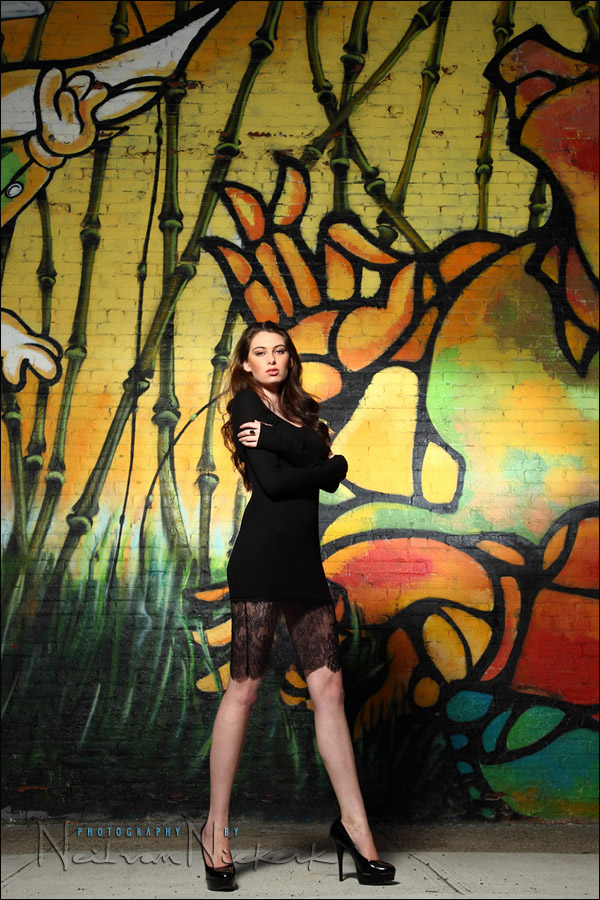
review: Canon ST-E3-RT Speedlite Transmitter and Canon 600EX-RT
In my review of the Canon Speedlite 600EX-RT, I’ve already raved about the ease of use of the new speedlite – thanks to a menu system that you can follow without having to decipher it via a manual), but mostly because of the built-in radio control of the flash. This elevates the Canon 600EX-RT to a new level. As mentioned in my review, I really think this flashgun will change things in the photo industry. It’s huge.
The main advantages of the Canon ST-E3 Speedlite Transmitter (B&H / Amazon), is that you can change the flashes’ output directly from your camera. No need to run to and fro between your speedlights to change a flash’ output. And of course, The Big Thing about the new flash system, is the built-in radio control. You’re not limited by line-of-sight anymore, or compelled to buy radio slaves. It is obvious that Canon has done their homework on this puppy. While it is a complex flash system, the Canon ST-E3-RT isn’t a complicated device to use.
To test this system, I used three Canon 600EX-RT Speedlites (affiliate) and a Canon ST-E3 Speedlite Transmitter (affiliate) during a photo-shoot.
Check out this behind-the-scenes video clip of how the Canon 600EX-RT speedlites were set up for this photo shoot.
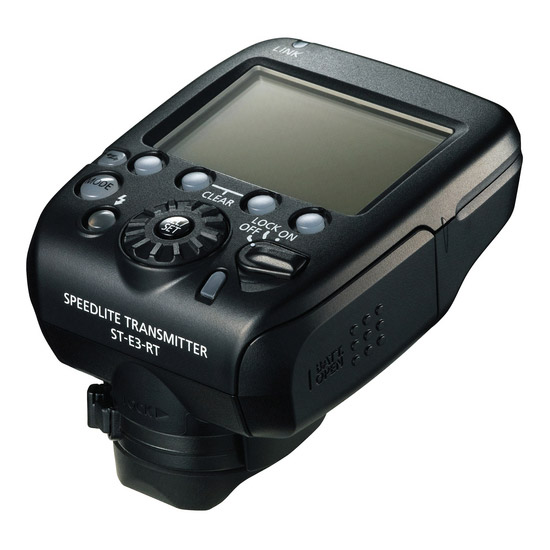
Canon ST-E3-RT features
1. Ease of use.
The ST-E3-RT controller has an LED which shows when a speedlite is connected to it. Beautiful. No guesswork.
You can control up to 5 groups of flashes with the latest Canon SLRs, or up to 3 groups with the previous generations of Canon SLRs (such as the 5D mark II). On paper, it looks impressive, but a simple listing of specs doesn’t quite do it justice. From the way the transmitter is angled towards the photographer to make the display easily readable, to the large LCD, it is all designed to make your life as a photographer much easier.
2. backwards compatibility
You can use the Canon 600EX-RT and Canon ST-E3-EX on any Canon D-SLR, although the one mode – Gr – is only available for the most recent Canon SLRs like the 5D mark III.
So, if you’re interested in what the new Canon flash system has to offer, you can use it already.
3. using the Canon ST-E3-RT
There are 4 main modes in which you use the controller:
ETTL – you can group your flashes as All; A:B or A:B C
Manual – you can similarly group your flashes as All; A:B or A:B C
Multi – for stroboscopic effect
Gr – this is the most interesting of modes – you can simultaneously set A or B or C up as either manual or TTL
The Gr mode is only accessible with the recent generation of Canon SLRs – the 5D mark III and the Canon 1D-X, or any future cameras.
What sets this mode apart, is that the Canon flashes are now controllable in the same way that the Nikon speedlights are – instead of ratios, you now control your speedlights in absolute values. Much more logical, in my opinion. You can have group A as TTL, and group B as manually controlled flashes … with their levels controlled by you, from the camera’s position.
In this photo session, I used the Manual mode, instead of Gr mode, since I was using the Canon 5D mark II.
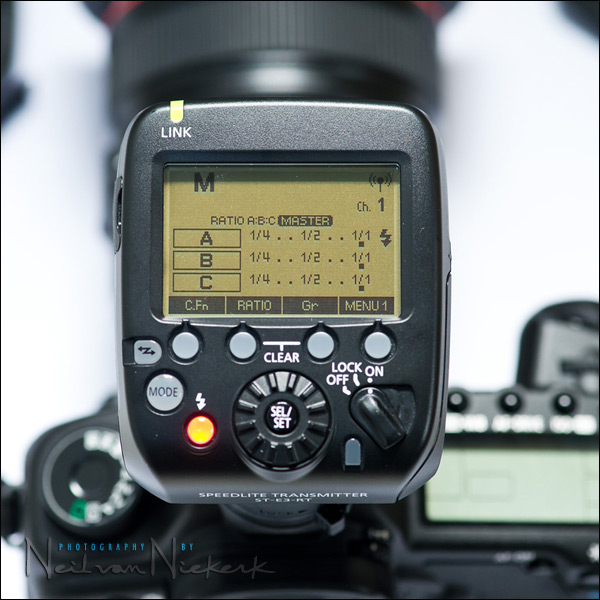
There are 4 levels of menu, which offers you control over different aspects of your flash:
– Custom functions
– flash exposure bracketing
– flash exposure compensation (overall and for individual groups)
– high-speed flash sync
– ratios and groups
– channel & ID
And unlike the obscure menu of the Canon 580EX II, the menu system of the ST-E3-RT and 600EX-RT, are obvious. They tell you what you’re looking at. No need to delve into the menu every time you want to change a custom setting. Finally! Thank you, Canon!
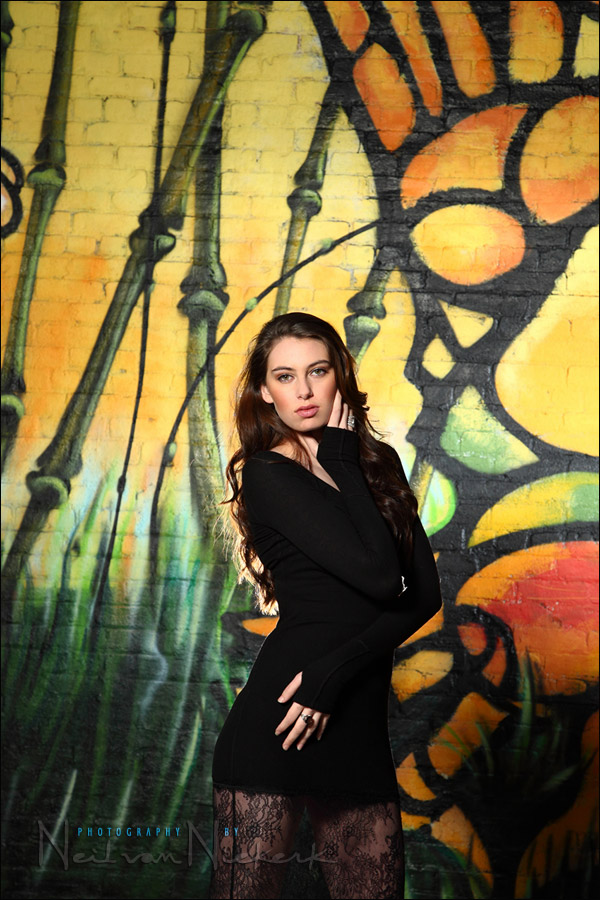
Using the new Canon flash system during a photo shoot
To test out the Canon 600EX-RT Speedlite (affiliate) and the Canon ST-E3 Speedlite Transmitter (affiliate), I met up with a model, Molly K, in Brooklyn. Molly has appeared a few times already in recent articles on the Tangents blog. (Molly K’s Model Mayhem page)
We started off in a well-known area of Brooklyn. This amazing graffiti is well-known in the area as a backdrop for photographers, especially wedding photographers.
I wanted to use 3 speedlights, all controlled by the ST-E3-RT:
A: the main light on our model,
diffused with my favorite Lastolite EZYBOX Softbox (24″x24″) (affiliate)
B: the 2nd flash on the background to create a hot-spot behind her.
(I had to flag this with black foamie thing to ensure no direct flash fell on her from this.)
C: the 3rd flash directly behind her as a rim-light.
B and C were bare flashes, undiffused.
I used the three speedlights in Manual Mode, with the flashes set up as A:B C Since I was using a Canon 5D mark II, I couldn’t use the Gr mode, but had to use the Manual mode. Ultimately, in this case, the results are the same, since I didn’t have the need here to mix TTL flash and manual flash.
Here is the pull-back shot of the final set-up.
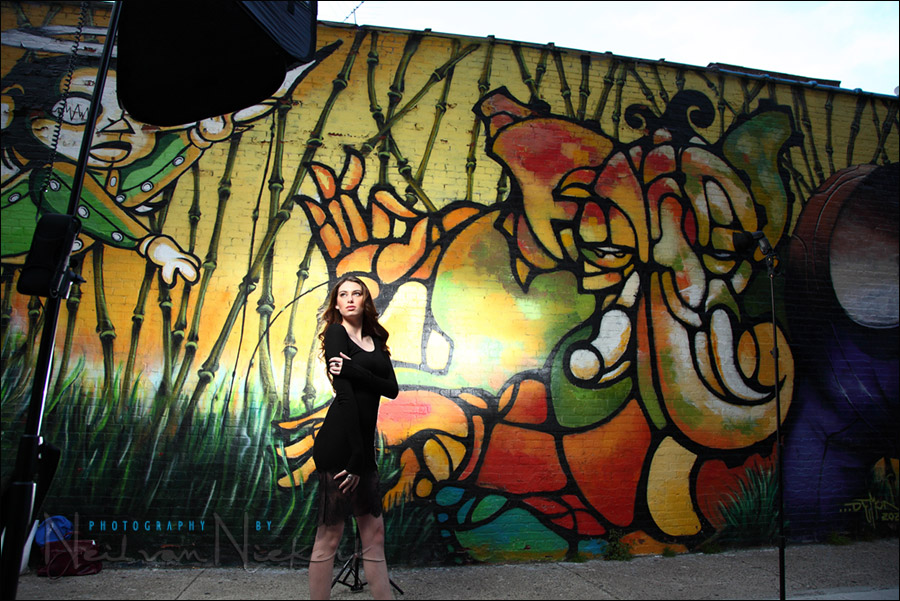
camera settings for the image at the top:
1/100 @ f7.1 @ 400 ISO … available light completely under-exposed
The behind-the-scenes video clip as I set every thing up, will explain more.
You can actually hear the thought-process.
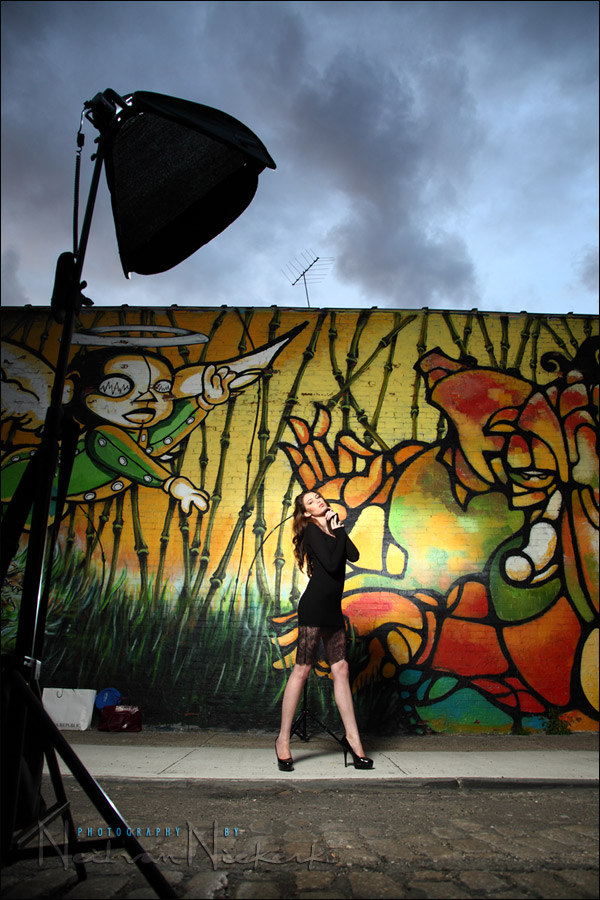
For the one pull-back shot, I took a vertical photo, and saw this dramatic sky, and decided to use it for another set-up where we shot up the street.
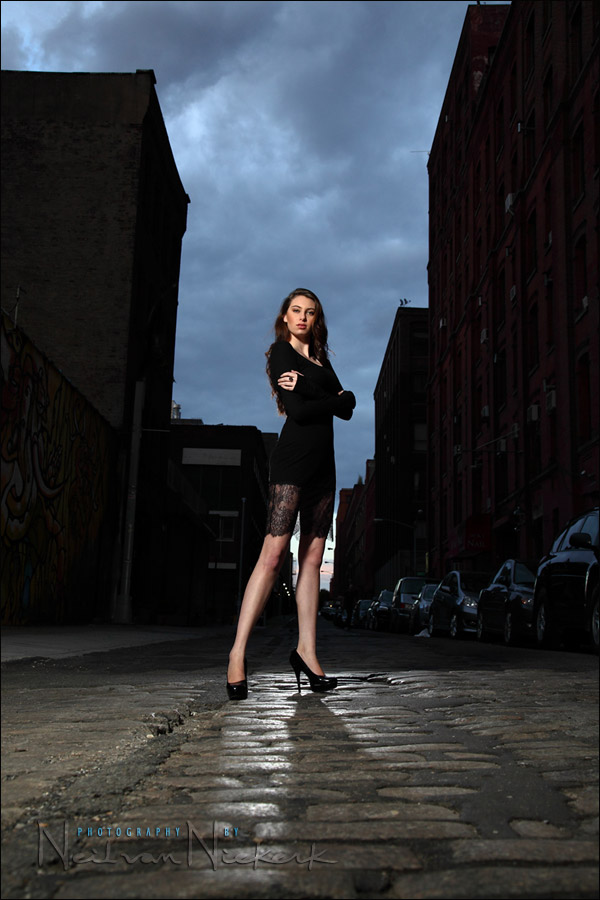
My final summary, using Canon 600EX-RT Speedlites (affiliate) and the Canon ST-E3 Speedlite Transmitter (affiliate) during an actual shoot – well, color me impressed!
Photo gear used during this photo session
- Canon 600EX-RT (B&H / Amazon)
- Canon ST-E3 Speedlite Transmitter (B&H / Amazon)
- Canon CP-E4 battery pack
- Canon 24-105mm f/4L IS
- Canon 5D Mark II
- Lastolite Hot Shoe EZYBOX Softbox Kit (24″x24″)
- Manfrotto 1051BAC – compact light-stand
- Manfrotto 1004BAC – tall light-stand
- Frio ColdShoe Mount
- black foamie thing
- video clip shot with:
- Nikon D4 camera
- Nikon 24-70mm f2.8G ED
Related links
- review: Canon Speedlite 600EX-RT
- video clip: using the Canon 600EX-RT Speedlites on a photo shoot
- Other Canon photo gear reviews.
Fascinating as always! Love the inclusion of the video, brings it all home so much better than text alone. Thanks for the effort.
See You been busy Neil! Keep up the good work – cant wait to meet you and shoot together!
Great Video bye the way!
Keep Well!!!
Neil,
How does the new Canon system compare to or differ from in terms of functionality from the Pocket Wizard AC3 AC5 combination? Would you care to comment please?
I wonder what Nikon’s response will be to Canon’s ST-E3-RT Speedlite Transmitter ? The “line of sight” & other problems of the Nikon CLS system made PocketWizard successful.
DSLR’s should have the wireless system built into the camera’s. I don’t like a camera to look like a christmas tree with all kinds of external gadgets which can be built into a camera, like GPS and Flash Radio transmitters. Here is an example of a patent for “Built-in Pocketwizard Transmitter for DSLRs”
Even cheap mobile phones have built in GPS’s (the technology is available), but a basic GPS for a camera cost a fortune.
How does the ST-E3-RT compare with the PocketWizard system?
Mike & Marcel … It’s difficult to say how the PocketWizard TT5 system compares to this, since we’re not dealing with the radio-frequency interference of the 580EX II anymore.
The AC3 Controller of PocketWizard, is actually easier to use than the ST-E3-RT, because the dials and switches are physical and immediately available without pushing buttons and going through a menu.
As it is, Canon shooters who are expanding their flash system now for the first time, have a clear choice here – the Canon 600EX-RT.
Even for those with an existing setup, it is a very attractive upgrade. And if you add up the costs and resale value of older gear, it isn’t too steep an upgrade .. especially if you consider the convenience.
Neil vN
Great review and images Neil.
Canon has definitely taken the lead on this and I hope Nikon answers soon. I use Radio Poppers to achieve the same results but I would be happier with less velcro…
hey Neil,
You dont have problems removing the 600EX flash off the Frio? takes me years to get them off. what’s your trick?
strong thumbs!
Neil vN
So amI right that this new Canon system is basically Nikon’s system + radio + 2 more groups?
The thing that really makes the Canon 600EX-RT stand out, is the built-in radio controlled capability. Nikon doesn’t have that … yet.
Neil vN
Great review. When I first purchased my three 600EX-RT units I was a little hesitant about them, since I’d heard they weren’t fully compatible with my 5D2 cameras. Allegedly the 600EX-RT units can’t use HSS when used in wireless trigger mode (ie, the reason I bought them in the first place!). Also, the manual says my max sync speed would be reduced to 1/100th. This was completely unacceptable so I made sure to test them out in the store before I bought them. No problems at all using HSS with the OCF units, nor was my max sync speed reduced. And, unlike the setup between my 580EXII units and my Pocket Wizard TT5 units, these new Canon 600EX-RT speedlights worked EVERY SINGLE TIME, whether they were on-camera or off-camera.
I didn’t buy the ST-E3 since there’s no focus-assist (similar to the drawback of the PW AC3 Zone Controller), while the 600EX-RT units themselves offer all the functionality of the ST-E3 and I can use one on-camera to achieve focus-assist in low light if I want. It’s also very easy to disable the on-camera unit from firing.
I do agree that the lack of AF-assist is a negative. I rely on it in low light.
Neil vN
Photomatte, I’m glad you mentioned about HSS with the 5D II. I often wondered if it was possible as I would need this to work for me on my 5D II. You also answered my other concern in regards to AF-assist. Now I know to buy another flash instead of the transmitter. Glad I read the comments! And Neil, your reviews are what keep my camera bag top notch :-)
@Mike – in addition to the AC3 controller advantage, one other minor advantage to the pocketwizard ControlTL system is that it’s capable of rear-curtain sync (perhaps not a big deal to most), whereas the new Canon system cannot do rear-sync. I now have both systems and the Canon setup is certainly much easier to deal with in terms of less gear to carry, connect, fewer batteries to maintain, etc. And that green LINK confirmation light on each of the canon devices is a beautiful confirmation that the thing is going to fire.
Great video using the Nikon D4. Thanks for providing us with beautiful clear crisp sounds. Many others do not produce the quality sound found in your videos.
I am almost ashamed to ask but knowing the answer helps me arrive at the AH-HA moment. I assume the camera was set on manual ( you mentioned the settings ) Can I correctly assume that the three flash groups were set to TTL ???
For the sound in the video clip – I was miked up with a Sennheiser lapel microphone. It definitely makes the sound much clearer, especially with the amount of ambient noise in the busy city.
Re the flash settings – from the article’s text:
“I used the three speedlights in Manual Mode, with the flashes set up as A:B C Since I was using a Canon 5D mark II, I couldn’t use the Gr mode, but had to use the Manual mode. Ultimately, in this case, the results are the same, since I didn’t have the need here to mix TTL flash and manual flash.”
Neil vN
For those not wanting to trade-in their 580 EX IIs for 600EX-RTs and an ST-E3-EX, the Phottix System (whose interface Canon seems to have copied) works great.
Another great review. The only essential photography blog IMHO.
I was sitting on the fence about the 600s until I read your earlier review. I purchased two the next day. Loving them. A third will be on the way soon.
I can’t let the Gang of Four reference go unchallenged. Entertainment wasn’t a bad debut, but I prefer The Clash, The Only Ones, The Sex Pistols, The Saints, The Birthday Party, The Dead Kennedys, or a couple of New York’s finest: The Ramones and The New York Dolls. Then there’s the Stooges….
PLease don’t forget Stiff Little Fingers. b.t.w. great system works like a charm.
Good review and I’m glad Canon is going in this direction. I invite you to look at Phottix Odin triggers. Very similar functionality (including Gr for older camera + eTTL flash), HSS, and Odin LED looks very similar to 600EX-RT. And did I say that Odin is extremely easy to use?
Good seeing and assisting you at After Dark CLT. Love your blog.
Hi Neil
I always look forward to your monthly newsletters. Love to attend one of your seminars in NY but the bus service from here is not all the hot.
We have invested in a black foamie thing which we have found to be invaluable. Your description at the end of review of the New Flash and Transmitter listing the equipment you used, brought a smile to my face when I saw you listed the “black foamie thing”
regards
Derek
Hi everybody, i have a question:
last week i purchased a couple of 600ex and a st-e3-rt and i am very happy with them, especially for letting me say goodbye to Pocketwizard…
The only thing not clear to me: with the st-e3-rt mounted on the camera in E-TTL mode, if i change the flash exposure from the transmitter it does not seem to have any effect to the slave flashguns, or at least the values on the flash display remain the same.
When in manual mode instead every change made on the transmitter also correctly affects the flashes.
Am i missing something..?
Cheers,
Carlo.
Sorry, i forgot to say that i am using a 5D Mark II…
Carlo .. make sure you’re not in Gr Mode. This only works for the 5D mark III and the 1Dx.
Neil vN
Hi Neil, no i am not in Gr Mode, just in simple, good old E-TTL. One flash slave A, the other one is slave B. The ST-E3 display says ETTL, and the “ALL” field is visible: when i dial on flash exposure compensation on the transmitter there’s no response on any of the flashes, although on the transmitter i can see that the values change. I made a few test shots against a grey background but the results were not helpful at all…
Thanks..
Ehm, when i say ” there’s no response on any of the flashes” i mean that the exposure values scale does not change…
Problem solved.. well it was not a problem actually, but this morning i test-shot a few pics at a model on a black background, the camera on a tripod with the transmitter and a single external 600 EX on a tripod too. The model was not moving and so the camera settings and lens zoom were the same all along the quick session. I just changed the FEC values from -3 to +3 shooting a single picture for every different step.
Everything worked out right, which means that the amount of flash burst did varied according to the different FEC values that i set on the ST-E3, although on the flash LCD screen the FEC value always remained at the neutral position.
After all i was just worried for this lack of communication between the ST-E3 and the flashes, and although the most important thing is that they DO communicate, it wouldn’t be a bad idea for Canon to mention this kind of behaviour somewhere on their user guides…
That’s all, now i go wasting some tenths of GigaBytes on this warm sunny day here in Sestri Levante…!
Cheers,
Carlo.
Hello Neil, I wonder if you did some testing on the shooting distance.?
very good your video, and I have his book released here in Brazil. Dedicated Flash, it changed my way of shooting, thanks.
With my work, I am usually in fairly close proximity to the units. Unlike sports photographers, for example. With that, I didn’t do any distance testing.
Neil vN
Thanks for responding Neil, congratulations on your work and for his book, I’m always showing to friends who have problems with flash … big hug.
Eric Cravo.
A question posted with the Vimeo clip on lighting demo with Canon 600EX-RT speedlites:
I don’t usually make a note of the power setting of the individual speedlights. The only time it is of note (or concern), is when I am operating at full manual output. Then I’ve reached a ceiling that I need to be aware of.
And yes, I could’ve reduced the power / moved closer. It’s that balance between aperture / ISO / power / distance. You can change any of the parameters, if you adjust with one of the others.
Hi Neal,
Great reviews and great that you reply to all of these questions.
I did read that you say that the pw with ac3 is quicker to setup. But I wonder if the transmitter menu still works fast enough to switch channels on and off and change the intensity during a wedding ceremony
I think if you’re used to the Canon transmitter, you should be able to do it fluently and fast. It just needs some hands-on practice to get the dexterity.
Re flash during the ceremony, I don’t set up additional lighting.
I do sometimes use on-camera bounce flash during the wedding ceremony.
Hey god review
I just bught a 600ex and the st-e3 and it is a grait system. Now i godt the eos 6D and tryed it out words perfekt.
But i am trying the Collor filters, and can’t realt se what is going on, When I shout indoors with ambient light at about 2700K i put the collorfilter on the flash. On top off the camere it works fine, but with the off camera with the st-e3 it dosn’t. But if i set the whitebalance manualy there is no difference.
Great review Neil thank you. I have just switched over to Canon and your reviews and information on their flash range has been hugely useful to me.
Paul
Neil,
Thanks for a great review. I just purchased two 600’s and an ST-E3 from B&H through your website link to help support this fantastic Tangents blog. You’ve got the best photog website on the planet!
-Lew
hey is anyone try 600 ex rt +st-e3 with canon 6d ?
is the HSS work with 6d?
because i want to shoot in outdoor at the sunlight with over 1/2000ss
Yup, HSS works with the Canon 6D and Canon 600EX-RT
Neil,
I am hoping you can answer my questions. Would you know if I can use the st-e3 and 600ex-rt for manual output on “non-Canon” bodies, e.g. Leica R8, etc? I very much like the ability to change the manual flash power on the 600ex-rt using the st-e3. As you might have guessed, I don’t have a 600ex-rt and st-e3 available to check them out.
Thank You,
Kit
Nope, you’re out of luck there.
Dear Neil,
I see that the Frio cold shoe mounts are updated with a version V2 on their website. I was wondering if you had any problems with the weather sealing of the 600EX-RT flashes, and not able to lock down both the Frio cold shoe mount *and* the lock mechanism of the flash itself?
I’ve read some bad experiences from others with the 580EXII flashes that causes problems with the locking mechanisms. Have they fixed these issues with their second version of the Frio cold shoe mount?
Hi Neil,
First of all, thank you for all the wonderfull books and tanglets on this website. I learned a lot the last few years reading all the artikles. Keep up the work.
I have a 580EX and 600EX-RT with an 5Dmk3 at the moment and I want to extent my wedding photography to off-camera flash. I want to choose between the PW TT5/AC3 system or the ST 3-RT.
I know the first one gives me the opportunity for using the 580EX flash as a second light, but I am not convinced it is the right decission.
After reading and reading and reading, all sorts of reviews, websites and other stuff about the two systems (Canon vs PW) I am at a loss.
Since you have experience with both systems, what would you prefer? Is an investment in the PW system a better choice or is it better to stay with Canon and eventually exchange my 580EX for a second 600EX-RT?
I think a long-term view is best here – that you’d be better off with just the Canon 600EX-RT speedlites
I bought the ST3RT and I do like the similarity between the 600EX and ST-3. A bonus is the possibility to change the flash setting directly from the menu of my 5Dmk3.
Now I think it is the best choice indeed (although I have no experience with the PW to compare).
Thanks for the advise. Now I can start learning and expand my possibilities with flash.
Hi Neil,
Thanks for the review.
I hope the 2nd curtain sync functionality is merely a ‘firmware’ update at sometime and not something that is impossible. The lack of this would be okay in most situations, except say for example shooting a wedding reception where one wishes to capture the dancing with some motion.
I have a couple questions – can one adjust the power of the 600ex-rt in manual from the ST-E3? And second question, is this set up light meter friendly – i.e., unlike Phottix Odin that still fires a pre-flash even when using on manual.
thanks
Jason
Jason .. You can directly adjust the manual output of your flashes via the ST-E3.
And this is going to make you happy … you can totally use a lightmeter with the ST-E3 and 600EX-RT combo when you’re using manual flash. Better yet, the red test button on the ST-E3 fires the 600EX-RT at the actual output you’ve set it to. Genius!
Hey Neil, thanks for the review. I’m in the market for either one 600ex-rt and a st-e3-rt transmitter orrr just two 600ex-rt’s. What combo should I go with if you were in my shoes? Thanks!
I like the ST-E3 a lot. In a way it is easier to use than the speedlight. (It is also less expensive.)
The one downfall for me is that the ST-E3 doesn’t have AF-assist, unlike the speedlight.
So you have to balance those considerations.
Thanks so much Neil, you have answered the questions that I was unable to find on the net, I think you have sold it to me :)
Dear Neil,
Thank you very much for your helpful reviews about some photographers nightmares,.. flashes. (at least mine)
I would like to ask you for very important advice. I am going to use set up for off camera flash on location (inside or outside) for different types of headshot’s. I need set up ease to carry around.
I got Canon 7D and speedlight 580 EX II. I know they can work together in off
camera settings which I have tried but I didn’t like because you are very limited.
Is CANON 600 EX-RT are to going work with canon 7D as off camera flash perfectly in any settings? I do prefer use manual. or what is the best solution to using Speedlight 580 EX II as off camera flash. It is little bit dilemma because I do’t want to spent a lot’s of money just do slightly improve what I got. Your advice will be very appreciated.
Many Thanks
Henika
I do think you’ll love the 600EX speedlights. You lose the Group function, but the rest works very well.
Dear Neil,
Thank you for your advice. Sorry about the “group function” do you mean they will not fire as a group of 600EX speedlights with my canon 7D ?
Yes, I must admit 600EX speedlight sound amazing.
Many Thanks,
Henika
The Group function allows these Canon speedlights to be controlled like the Nikon speedlights – you can have the different speedlights set to TTL or Manual, as you please. (As opposed to the original way of using Canon speedlights in ratios, or as Manual-only speedlights.)
Thank you, Neil for your very intelligent response. I have to think about it all.
Hi Neil,
Just a quick question about your team for fashion shoots: do you employ stylists? How on earth did you find such great wardrobes otherwise?
Thanks again – Tangents is my internet photography oracle!
:)
In this case, the wardrobe, styling and hair & make-up was all done and provided by the model, Molly K.
Hi Neil. Thanks you for this post on the STE3 and Canon 600EX-RT Speedlights. I am planning on purchasing the STE3 in NYC, however my flash units were purchased in SA- Do you perhaps know if the built-in radio control of the US STE 3 will work on the European Canon Flash models? Does it perhaps use a different frequency transmitter?
Regards | Michael
read over your review and comments above again and again, still cant find the answer I am looking for.
You said with 5D MkII the GR feature cannot be used, however I am able to use that feature. BUT I cannot get second-curtain sync neither with the flash nor with the transmitter. Having bought the 2 600ex RTs and a transmitter specificaly for this purpose, I find it very odd noone mentioned it in reviews before.
Yes, you can use Group Mode with pre-2012 Canon cameras…but you’re limited to having those groups be entirely ETTL or entirely manual. With the post-2012 cameras, the 600EX-RT will allow you to have some flashes set to ETTL and others set to Manual. This is perfect for when I’m shooting portraits: my stationary, off-camera speedlights are set to Manual Mode–since their distance to my subject(s) remains a constant–while my on-camera speedlight is set to ETTL, since I may be moving around a bit as I shoot.
See my review of the YongNuo YN-E3-RT, below, to see how you can utilize all of the functions on a 600EX-RT with older Canon cameras.
Another comment to add to the thread. While I am normally an advocate for buying Canon accessories for Canon cameras, I have strayed from that path recently. I have 3 of the Canon 600EX-RT speedlights but have returned my Canon ST-E3 since it didn’t have a focus-assist light built in. The YongNuo YN-E3-RT is nearly identical to Canon’s ST-E3, and it has all the functions of the Canon model….PLUS it has a focus-assist light built in. But the really big deal about the YN-E3-RT is that it offers FULL functionality on pre-2012 Canon cameras. This means I can use either my 5D3 or my 5D2 with the YN-E3-RT and be able to use Group Mode! A very nice option to have if my main camera, the 5D3, were to fail on me during a shoot. Oh, and the price of the YN-E3-RT is half of what Canon charges….
Hello, I have been using my ST-E3-RT with the 5DII and 40D. Last time I put the transmitter on the 5DII it would not go off. After checking the External Speedlite Control MENU, I’ve got “This menu cannot be displayed. Incompatible flash, etc.” Everything works fine with the 40D though. Single 600EX-RT flash mounted on the 5DII works as intended as well.
Is this some kind of the known trouble? I asked Canon Support, now waiting to hear from them. Will appreciate any suggestion.
I reckon nobody bumped into such a problem – lucky you. I seemed to figure out the problem. Although the ST-E3-RT hot shoe contacts looked good, I still rubbed them with alcohol. The trouble persisted making me think the problem was somewhere else. Today trying to make it work again I gave the transmitter a jiggle on the top of the hot shoe – and the camera started seeing it (on and off though). So now it looks like a contact group intermittent malfunction. Hmmm…
Andrei … good to hear you figured out this problem. I had a look, and my 5D mk2 worked just like I mentioned in this article, so I was stumped.
Hello,
I want to know is ? that I’ve 2 canon camera bodies on which I’m using 70-200mm canon f/2.8Lii and on other canon 35mm f/2 and I’ve 3 speedlite 600EX-RT , now i wanted to buy Speedlite Transmitter ST-E3-RT
when shooting with the both cameras using this Speedlite Transmitter ST-E3-RT on 1 camera body !
Now will you please clear my confusion that what if I’m using this ST-E3-RT transmitter on my camera body 1 it will fire the both speedlites which are on stands ! when I’m using my 2nd camera body does those speedlites will fire on the same time ?
Regards
Raj … you will either need to move the ST-E3-RT to each body you are using, or use an ST-E3-RT on each body. Then yes, it would work like that where you can trigger both speedlites from different bodies without changing anything.
Dear Sir,
thank your very much for your support and time really appreciated, well in this way I need to buy two this ST-E3-RT transmitters ? let say I’m using 3 speedlites on TTL and manual mode of the camera synced with one ST-E3-RT on camera 1 and I’m using the second ST-E3-RT on camera 2 ! the information will be same ? with the lite system ? or it will be fumble ? thanks once again for your prompt response ! stay safe & blessed
Love & Blessings
Raj
You are going to need a master controller for each body … whether it is an ST-E3, or another 600EX.
In my experience there is nothing needed from your side to adjust – you just shoot. Of course, if you are using manual flash, the settings on each of the controllers need to be the same. Similarly, for TTL, your FEC needs to be the same for each controller. But it really is straight-forward enough.
Just bought the 600EX-RT II to go with my 600EX-RTs and the ST-E3 RT transmitter. This second incarnation looks like it may eliminate that over-heating issue that sometimes occured with the ist iteration, and also it seems to have a rather more user-friendly menu. All in all, its a great system and just so easy to set up and use. You save time, power, batteries, and headaches with this brilliant gear from Canon.
Are the menus on the 600EX-RT ll and the ST-E3 RT identical? Thanks for all the great tips and instructions on your site.
I don’t have a 600EX-RT II on hand, but the menu on the 1st version was very similar to that of the ST-E3 RT. I can’t imagine they changed it much, for it makes most sense for the flash and the transmitter to have near-identical menus.