spacer
spacer

Tangents

shooting promotional photos for a band

October 17, 2011

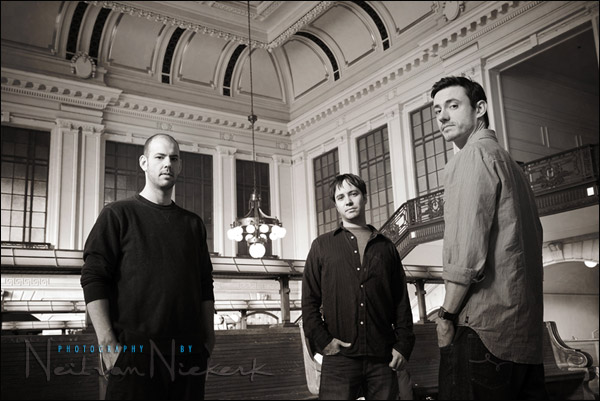
camera settings: 1/50 @ f8 @ 800 ISO … lens zoomed to 35mm;  available light

shooting promotional photos for a band

Anyone who knows me well is probably very aware that my first true love is music. I live my life to a music soundtrack. There’s always music playing. Not the radio, but music of my own choice. I love music … however, my sense of rhythm isn’t all that it should’ve been for me to be a natural muso. But still, I love music. All of which meant that one few non-negotiable rules for my daughter was that she had to take music lessons. So she plays bari sax in the high-school’s Jazz band, and she’s also been taking guitar lessons for a few years now with a guitar teacher, Gerard.

All of which brings us to this photo session – promotional photos of Gerard’s band. That is Gerard (right) and Ed (center : piano) and Joe (left : guitar). I met up this weekend with them in Hoboken. Perfect for the urban feel to the photos. Hanging out with them for a few hours coming up with ideas and places for photos, was great fun. The camaraderie between them will be familiar to anyone who has ever played in a band. You connect. That all too short time I played tenor sax in a rock band back in South Africa circa 1999, just before we emigrated to the USA, was one of the best times in my life. But I digress. It was cool to hang out with these three musicians for the afternoon.

Here are some of my favorite images, with some details  …

(more…)

       Comments (18)


off-camera flash – creating separation with back-lighting (model – Bethany)

July 22, 2011

off-camera flash – creating separation with back-lighting

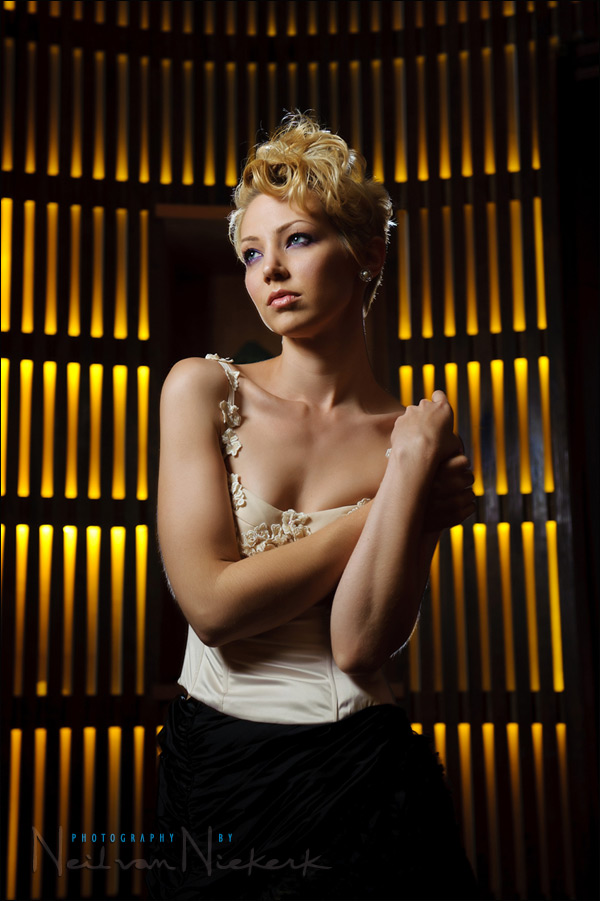
Another image from the photo session with Bethany, when I was in San Francisco earlier this year. This interesting background is part of the lobby area of a San Francisco night-club. I knew the wooden panelling and subdued incandescent lighting would make an interesting background because of the repetitive pattern and glow. A slow shutter speed brought the background light in … and then I used flash to light her. I didn’t gel my flash – specifically so that the background light would go that warm. The pull-back shot will show the simplicity of the lighting …

(more…)

       Comments (24)


manual off-camera fill-flash, controlling contrast (model – Ulorin)

April 24, 2011

manual off-camera fill-flash, controlling the contrast

In using a softbox outdoors on location, we easily get beautiful soft light. When we work indoors however, where the flash dominates, then the results can look very contrasty. The reason for this is that outdoors, the available light acts like a fill light.  This is especially true when we consider our available light in our overall result and balance our flash with the available light. With the softbox being the only light source, the light, while still soft, can be too contrasty for our liking. Still, that single softbox is a lot better than hard direct off-camera flash … but it can be improved with some fill light.

The photo above of  Ulorin, our model at the recent workshop in San Francisco, was lit with the 24×24 Lastolite Ezybox softbox. But we did lift the shadows with some more off-camera fill flash, bounced into the room.

Here’s the short explanation and a longer, thorough explanation of how we went about it …

(more…)

       Comments (16)


off-camera fill-flash in bright sunlight

November 19, 2010

shooting in bright sunlight with off-camera fill-flash

This adorable kid looked at the camera briefly because I was singing to him.  Kids are devious little creatures. They know when you’re calling them and will purposely ignore you.  So you have to be crafty too in getting their attention. Of course, you have to be ready for the moment … and shoot a lot. Sometimes that Decisive Moment is to be found in the edit.

The photo session was from 12 noon to 1pm. So the sun was high overhead. We’re often told that the sun directly overhead isn’t the best time to take photographs.  While this isn’t as ideal as the fabled ‘Golden Hour’ – that time just before dusk and just after dawn – there are ways of working with hard sunlight and still get great images …

(more…)

       Comments (24)


resource: off camera flash photography techniques

June 10, 2010

off-camera flash photography

To keep the sprawl of articles on the topic of off-camera flash together that exists on this site, I’ve created an additional page to the main flash photography pages,  Simply titled, off-camera flash, it lists all the relevant articles.  A snippet from the actual article will help it from being more easy for the eye to scan and find something relevant and of interest.  I will keep adding future articles posted to the blog, and keep it as a handy resource.

(more…)

       Comments (6)


balancing flash with ambient exposure

April 8, 2010

balancing flash with available light / ambient exposure

Since many of the questions I get on the Tangents blog relate to balancing flash with available light, I want to pull the replies together into a single article.  A reference point again, instead of the replies scattered throughout this website.

The questions most often revolve around:
-  exposure metering for available light ,
-  exposure metering for TTL flash and ambient light,
-  whether to use manual flash or TTL flash,
-  flash exposure compensation (FEC),
-  choice of aperture,
-  maximum flash sync speed,
-  metering for off-camera manual flash and ambient light
-  choosing our settings to balance manual flash and ambient light,
-  whether to drag the shutter, or not.

The answer to the questions about how to balance flash and ambient light, is often along the lines of “it depends”.  It really depends on:
- the scenario you have, and
- what you want to achieve.

Now that all sounds quite vague.  Being told that you can pretty much “do what you want”, doesn’t help if you don’t even quite know where to start.  Most of the answers are in the linked articles there, and on this page on my Top 20 Flash Photography Tips.

But, let’s look at one specific image, and analyze what our options are, and see if we can make sense of it all …

(more…)

       Comments (55)


balancing flash and ambient exposure – where do you even start?

February 9, 2010

balancing flash and ambient exposure

This topic – balancing flash and ambient exposure – seems to one that many newer photographers struggle with. The big hurdle seems to be the basic starting point – how do you decide on the exposure for each?

I’d like to explore this topic a bit with this post.  The trigger for this was a question that someone emailed me regarding an image in my book on flash photography. Instead of answering the question directly, I thought that a wider answer might be more illuminating. We’re still on that perpetual quest for more aha! moments. So let’s see where we head with this. (I’ll come back to the specific question and answer at the end of this.)

But why do we even want to add flash to a subject when the available light is soft?

The answer is that with flash we can control the direction and quality of light, and create a more dynamic image.

We don’t necessarily just use flash to avoid camera shake and / or poor exposure in low light. We use flash to create better light on our subject. We can ‘clean up’ the light that falls on our subject. Or to create more dynamic and interesting light. It’s about control. We decide.  So where do we start?

The simplest approach for me, when I work in fairly flat and even ambient light, is to under-expose the ambient light by a certain amount.  Then we add flash for correct exposure.  So how much do we under-expose the ambient light by?  Well, it depends. Usually a stop is good. Two stops can also work. If you’ve seen some of the images in fashion and music magazines where the subject is in a pool of light .. yet, the sunlit cityscape is darker, then that is because the photographer under-exposed the ambient light by 2-3 stops. Even in bright sunlight.   So we have some leeway.  That should ease some of the anxiety.

Under-exposing the ambient light by a stop, and then adding flash …  is but one scenario, and one recipe. This approach won’t apply to every possible situation you might encounter .. but it’s a good starting point in grasping that Big Question – where do we even start in balancing flash and ambient light?

Let’s start of with an example where the previous method wouldn’t work:

settings: 1/125 @ f3.5 @ 800 ISO
lighting:  Q-flash T5D-R, in TTL mode diffused by medium softbox to the right

(A speedlight in the softbox would’ve worked just as well here.)

Here’s the image without flash, just so we have a reference ..

(more…)

       Comments (38)


favorite image from the weekend ..

October 27, 2009


[ click on the photo for a larger image ]

using off-camera flash on location

It was a busy weekend again, with a wedding and a portrait session on Sunday.  From the photo session on Sunday, here’s my favorite image of the day.  I just love the way the background appears in this photograph.  The bokeh of this lens is just wonderful.

camera settings:  1/250th @ f4 @ 400 ISO
The camera used was the Nikon D3, (B&H), and the lens was the 70-200mm f2.8 VR , (B&H).
A telephoto zoom like this, or the Canon 70-200mm f2.8 IS, (B&H), is essential for this kind of portrait work.

That image is typical of the separation you can create between your subject and the background, by zooming tighter.  Here I was zoomed to 170mm .. for no real reason than I liked the perspective at this point.  I had a comfortable working distance in that he could listen and see any instructions I gave him on how to pose … yet the perspective is nice and tight.

Lighting is exactly as described on this previous post on off-camera lighting, where I used the Q-flash’s wireless TTL system.  The Q-flash was held to my left, and at about 45 degrees to the boy, and diffused with a softbox.

My choice of settings was for the background exposure, and I was at maximum sync speed for a very specific reason.  In using TTL flash, I was able to control my background exposure from my camera, by changing my aperture and ISO as needed .. while remaining at a high enough shutter speed.

And that’s it.

If you find these articles interesting and of value, then you can help by using
these affiliate links to order equipment & other goodies. Thank you!

Stay informed of new articles via the monthly newsletter.
Also join us on the Tangents forum for further discussions.

       Comments (33)


here’s why I love off-camera lighting ..

October 18, 2009

There are a few reasons why I love off-camera lighting, and I want to show some images from a recent photo session with one of my couples, Jill & Mike, as an example.

The main reason for me, is that you can have perfect lighting on your subject’s face with much more freedom than if you just relied on the available light. I am usually quite particular about the backgrounds to my photos, where it is in my control. The backgrounds need to be complementary, or add something to the image. I have a preference for an out-of-focus background. The defocused backgrounds create separation that helps my subjects pop out.

When I only use available light with a photo session, I am reliant on finding both a good background, AND great light on my subjects’ features. However, when using supplementary lighting, (such as flash with a softbox), the pressure is off. I pretty much just have to find a nice background, add my subject, and then use off-camera lighting to light them properly. Dead easy.

Here’s a straight-forward portrait of the couple against a background which I knew would work – the sun-soaked leaves in the back would create a golden glow behind them.

(more…)

       Comments (42)


lighting the wedding formals (part 1)

October 6, 2009

lighting and photographing the wedding formals

With this, the first in a loose series on lighting and photographing the family formals at weddings, I would like to show that with a simple approach it is possible to get clean results that work every time.

In lighting the formals, I don’t try to get all Rembrandt, but prefer a fairly flat way of lighting everyone.  I keep the lighting static for all the images, whether I am photographing one person or twenty.  With time usually being a real constraint during the wedding day, there simply isn’t the opportunity to play around too much with the lighting .. and I find a simple predictable way of lighting works best.

Before we get to the actual gear I use, let’s start off with exposure metering for flash.

Because I work with off-camera lighting, and everyone is static in relation to the lights, it is much much simpler to work with manual flash.  With TTL flash there is the chance (or risk, if you will), of exposure varying from image to image.  This will slow your post-production workflow down as you now have to correct exposure for individual images.  In the end it is just simpler to work with manual flash in this instance.

You can work with a flash meter, however, I use the histogram with as much accuracy by metering for the brightest relevant tone – the white dress.  Since the lighting setup is straight-forward and the lighting pattern quite even, metering for the flash exposure is pretty simple as well.

The flash exposure is chosen for a specific aperture and ISO – we need enough depth-of-field, and f5.6 is good for a small group of people in line with each other.   For our ISO setting, we need as low as possible to get the best results – the best color reproduction and contrast, and as little amount of digital noise as we can tolerate .. and on modern D-SLRs an ISO of 400 gives very good results indeed, and can even be considered a low ISO setting.

But these settings also need to be chosen in relation to our available light .. and for the image above, here is the available light only shot:

(more…)

       Comments (59)


All Rights Reserved © 2006-09 | Client Login