wedding photography, The Grove, New Jersey
overview: Cherryl & Jim’s wedding at The Grove, NJ
A little bit of info about the video and stills photography …
The video footage was shot by Jessica, using a Canon 5D mk II (B&H) and mostly using the Canon 24-105mm f4L IS lens (B&H). All the footage was shot with the camera on the Manfrotto fluid video monopod (B&H). I didn’t want to bring in a steadicam or slider, since I was there to photograph the wedding, and there was already a videographer. So Jessica had to be discreet and in the background as far as possible. With the monopod, the camera is steady, and the photographer can remain quietly in one spot, capturing video.
One thing I should mention – and this will be old news to video shooters – when we first started doing video with the HD-DLSR, it soon became obvious that static video footage is boring. There either has to be some movement in the frame, or you have to introduce movement by using a steadicam or a slider. The slider is ideal for creating dynamic video footage of a static set-up. But, as I said, we didn’t use one here. Just the video monopod.
Regarding the choice of Canon in this regard – for I am sure there will be questions about this since I predominantly shoot with Nikon. Even though I went with Nikon again more than 2 years ago, I kept a small Canon system. Mostly this was for workshops, and to remain familiar with the Canon flash system. I’d guess that 60% of the Tangents audience shoots with Canon, so I have to be au fait with Canon in that regard as well.
I wanted to bring in video as well into the repertoire, since I strongly believe that stills and video are converging technologies. At the moment, the Canon 5D mk II dominates the HD video field. I therefore made the easy decision to upgrade my classic Canon 5D body to a 5D mk II body. Superb image quality and 1080p video. Great! Count me in.
This video clip was edited with iMovie ’11, but we’ll have to move up to something more powerful and flexible.
Music for the video clip provided by Triple Scoop Music
[ For more videos, follow me on Vimeo / YouTube ]
Regarding the stills photography – regular readers of the Tangents blog will see there’s nothing dramatically new here in terms of the equipment or lighting technique. Some of the lighting technique was already discussed in a previous post on using video light for the romantic portraits. During the bridal preparation, I used the Nikon 85mm f1.4G (B&H) a lot. So any stills frame that has shallow depth-of-field during the prep … that was the 85mm f1.4
The bridal party was lit with a single Lastolite Hot Shoe EZYBOX Softbox Kit (24″x24″) (B&H). Even though I used a relatively small softbox for such a large group, the contrast in the images isn’t too strong. The reason for this is that there was already so much ambient light streaming in from behind through the curtains.
I triggered the speedlight in the softbox with the PocketWizard FlexTT5 transceiver (B&H). Have I mentioned yet how much I love these?
The static shots of the bridal party was shot with the off-camera speedlight set to manual via the FlexTT5. But where I had the groomsmen and bridesmaids walk towards the camera … ie, their distance to the light changed … then I simply switched the slave / remote flash over to TTL mode via the on-camera FlexTT5. Simple and easy.

The rest of the day, I used a single on-camera speedlight and the infamous black foamie thing to help with bouncing my flash.
During the church ceremony, I only used flash during the processional. And as mentioned, a single on-camera flash bounced behind me to clean up the light.

1/160 @ f3.5 @ 1600 … flash set to TTL
Even during the reception, I only used the on-camera bounce flash. But it did help that the reception venue was large. Low ceilings make it difficult to spread the light far.
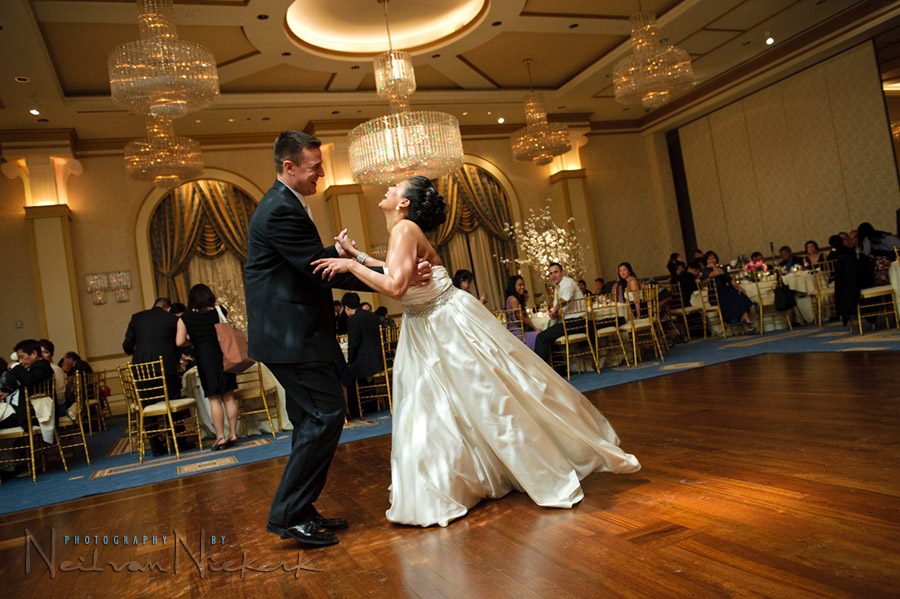
1/100 @ f3.5 @ 1600 ISO … flash set to TTL
I think the dappled light on her is partially also from my flash hitting the chandelier, but it is difficult to say now in retrospect. Either way, I like the way it looks here.
gear used for the HD video
Canon 5D mk II (B&H)
Manfrotto fluid video monopod (B&H)
Canon 24-105mm f4L IS (B&H)
Canon 85mm f1.8 USM (B&H)
gear used for the stills photography
Nikon D3; Nikon 24-70mm f2.8G ED AF-S (B&H)
Nikon 70-200mm f2.8 AF-S VR II (B&H)
Nikon 85mm f1.4G (B&H)
Nikon 16mm f2.8D fishe-eye (B&H)
Nikon SB-900 (B&H); Nikon SD-9 battery pack (B&H);
Lastolite Hot Shoe EZYBOX Softbox Kit (24″x24″) (B&H)
PocketWizard FlexTT5 transceiver (B&H)
I can only say this:
Flash photography with no flash.
It is so hard to notice that you are actually using flash.
Love the photos.
I am currently reading your new book, and I love it so far.
I have question regarding the contrast of your photos.
Do they come like this naturally or your use the combination of exposure , black levels or curves settings in the post processing to get more contrast?
Fusion well done! I enjoyed the video and stills brought together and I know they will love it.
As always great pictures with skilful use of flash and friendly atmosphere during the session.
Hi Neil,
I love these photos and this is a great post! I’m just curious as to what your white balancing method is though.
-Chris Gampat
Lead Writer
BHInsights.com
Chris .. my approach to white balance is a fairly simplistic one – I mostly use a few of the WB presets, and then adjust to taste as part of my regular RAW workflow.
Neil,
Fabulous work as always. I am on your new book right now. But let me tell you although i read your blog religiously, buying your first book, reading it and the fact that i have it always at hand benefitted me very much.
What software do you use to create the video slideshow.
Thanks and keep it coming
Gregory Job
Hi Neil,
Loving your site – I view it 5 days a week.
I am not sure how to search or if you have it listed as a tangent – I am a solo wedding shooter and I am always looking to find ways to make the greatest looking images without the need for a assistant or to carry every peice of equipment I own on a shoot. I am currently shooting the Nikon D3.
Thanks a Bunch !
Paul in Minneapolis
Paul .. in terms of lighting, make sure you have portable off-camera lighting that is easy to set up and control.
I vary between using speedlights and the Lastolite Ezybox (when I need to travel light), and Q-flashes and umbrellas when I have my van nearby.
Other than that, you need to be on the move. I do nearly all my wedding photography with just the 24-70mm f2.8 and the 70-200mm f2.8
But I do have a full arsenal of lenses that I use for wedding photography.
When I work outdoors on my own, I try my best to direct my subjects so that there is no hard sun falling on them. If I work in bright sun, I will place them with their backs to the sun. Check this link for how I work when I shoot weddings in bright sunlight.
Indoors, aside from when I do group shots, I will mostly just use on-camera bounce flash with the black foamie thing. No fong dong. (I see you mentioned in your email that you have two(?) of these.)
Ultimately, it’s about being able to work fast and travel light … with the best equipment available.
That was a nice video. :-)
It looks like Nikon needs to play catch up in the HD video department again.
What factors made you decide that you need to move beyond iMovie ’11 for your next video? The next level of video editors by Apple would be Final Cut Express ($200) and Final Cut Pro ($1000).
Neil, you are right about the video being very static. Without some movement introduced occasionally it does get a little boring. Even with the monopod you can get some movement by adding pans and tilts. You can even lean into and out of a shot to get a push or pull, be it a small one. Variety of the video, distance to subject, lens changes would help mix it up and make it more interesting. Love the stills.
Neil, I find your site extremely useful: thanks for sharing your knowledge.
I would like to know -if possible- your opinion about this: in low light situations, set the camera in Auto-ISO, Manual aperture/speed, and use the on-camera flash (manual or TTL) just as fill flash. (I know: I will have to deal with some grain…lets say I accept that).
There’s a ‘rule’ in the camera club world that mixing vertical and horizontal images in an ‘AV’ (club-speak for a slide show!) is not a great idea. Here I found that the fusion of video was great when it was between video and horizontal still bit it did seem to jar when the still was vertical. Perhaps there’s some life in the old ‘rules’! Perhaps more complex transitions are needed…
Otherwise really great and certainly where we’re headed.
LawrenceB
Neil,
Just curious…do you think it’s possible to shoot BOTH stills and video from the same camera?
I know it would take some more time, but could you get away with shooting your stills and then grabbing some video, especially for the hybrid type of presentation like you showed?
Hi Neil, “stills and video are converging technologies” I couldn’t agree more Neil, I also believe that by using video alongside or combined with the photos offers customers/clients lots more choice and also more scope for original ways of packaging the final product to them. Its amazing how video changes everything, something I believe that will become a standard service that photographers will be expected to deliver on.
You’re an inspiration as always. (especially for rookies like me)
Thanks again.
I want to say something in Dutch: Wauw! Verukkelijk mooi! (very beautiful)