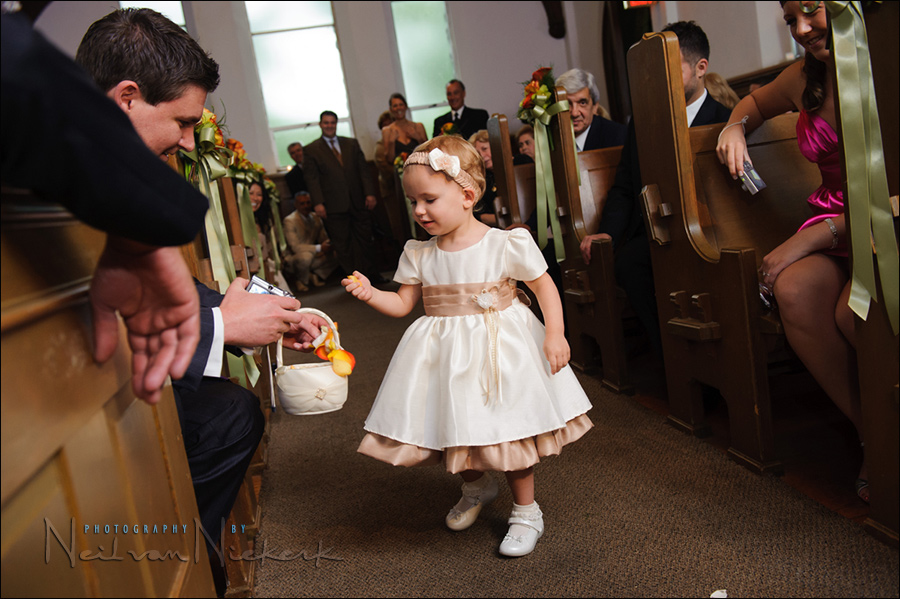
Photographing the wedding processional
The processional is technically probably the most difficult part of a wedding to shoot and get right. Light levels are low in cavernous churches, while people are walking towards you. Getting enough light on them, and having that light look good, as well as getting the image sharp .. that’s a tall order.
In the photo at the top, the adorable flower girl just had to stop and check in with dad half-way down the aisle.
[ 1/80th @ f4 @ 1600 ISO // Nikon SB-900, Nikon D3, Nikon 24-70mm f2.8 ]
I use on-camera flash to photograph the wedding processional. I always try to find a way to bounce the flash so that the light is soft and flattering. I want the flash to enhance the available light. I nearly always gel the flash for incandescent lighting indoors to make the flash not be as obvious. This way I am adding tungsten light to the tungsten light and the flash therefore blends more easily with the prevailing light.
I find my settings so that the available light is about 1 stop (or a little more) under-exposed, and then bounce flash behind me into the church .. but still making sure I have a useful shutter speed. By the way: 1/60th isn’t necessarily a useful starting point.
This does mean cranking up the ISO considerably … I’m often somewhere between 1600-3200 ISO, at wide apertures. Therefore a high-ISO capable camera is essential for me to work in what is usually under-lit scenarios.
I really really really try my best to stay away from using a diffuser cup of any kind, since this most often just makes for ugly flash photos. But sometimes when the church is simply too large, or has wooden paneling, then I am forced to accept that compromise.
Here are a few more examples:
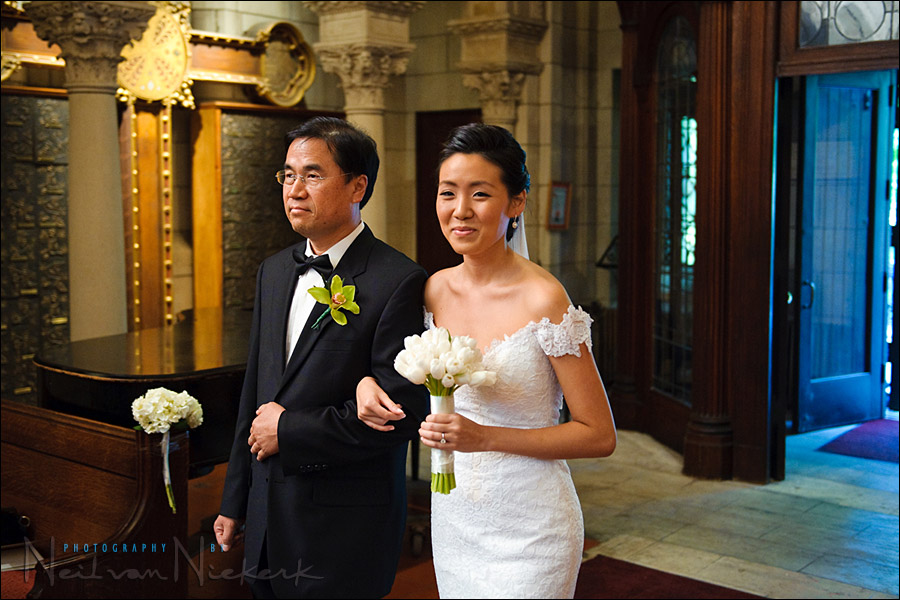
- 1/100th @ f2.8 @ 2500 ISO
- Nikon SB-900, Nikon D3, Nikon 24-70mm f/2.8
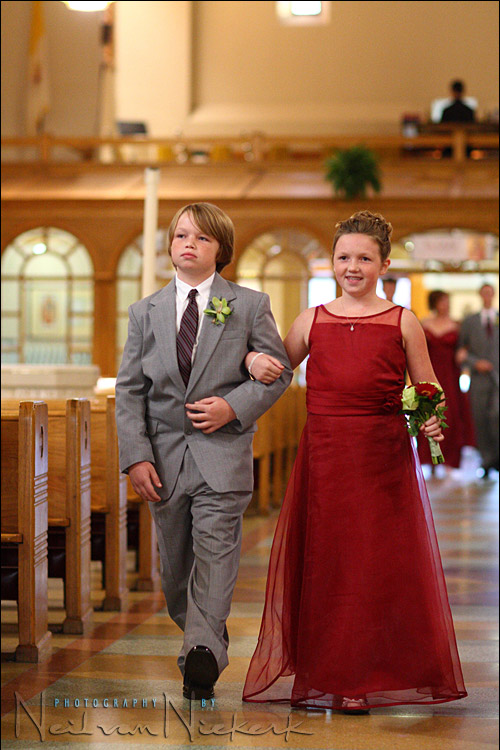
- 1/250th @ f2 @ 2000 ISO
- Canon 580EX II, Canon 1D mkIII, Canon 85mm f/1.2 II
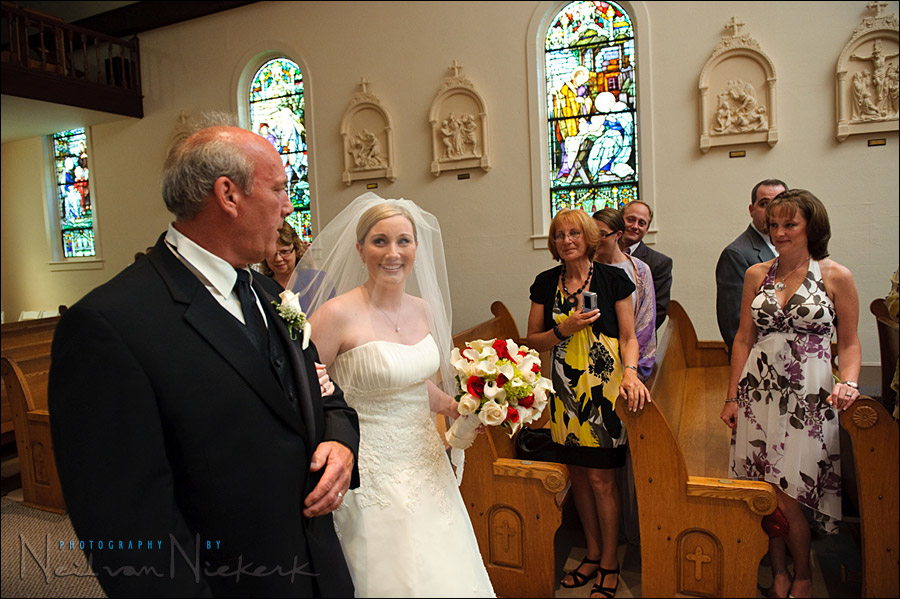
- 1/125th @ f3.5 @ 1600 ISO
- Nikon SB-900, Nikon D3, Nikon 24-70mm f/2.8
Below is the image from my second photographer on that wedding, where you can see me at the very edge of the frame. Well, not quite me, but The Black Foamie Thing – the flash modifier I still prefer to use with processionals. Even though it isn’t an efficient use of the light from the flashgun, I want “pretty light” instead of volumes of light from my flashgun.
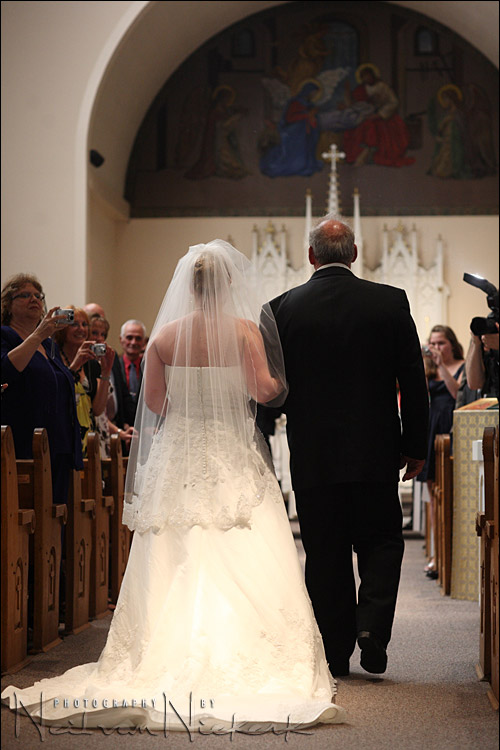
By bouncing flash into these large places, I use a battery pack to make sure the flash recycles fast enough.
Photographing the second processional
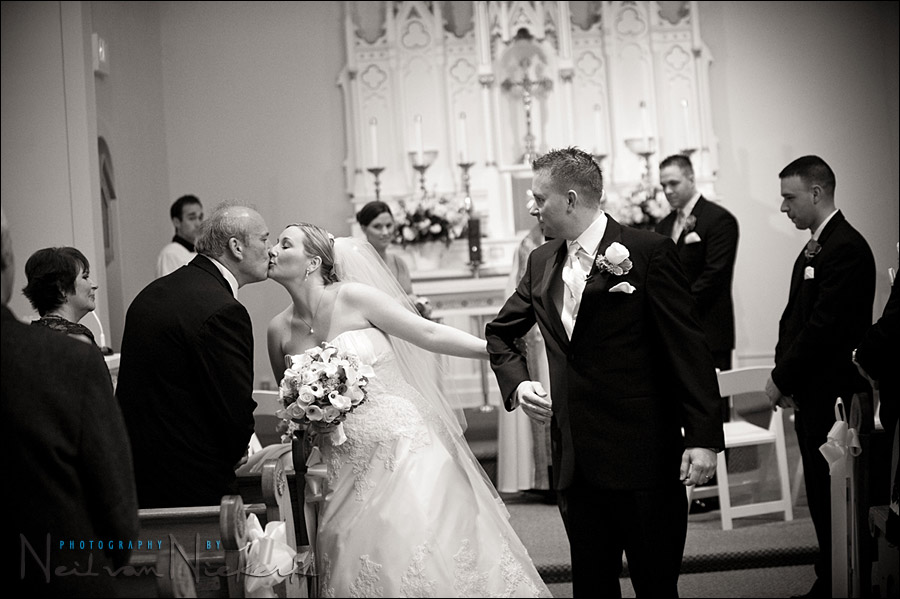
- 1/250th @ f2.8 @ 2000 ISO
- Nikon SB-900, Nikon D3, Nikon 70-200mm f/2.8
This technique would obviously also work for the second processional. Apparently that is the correct phrase: “second processional”. Not the “recessional”, as I was once corrected by a priest when I talked about the recessional. It’s the second processional. Now you know.
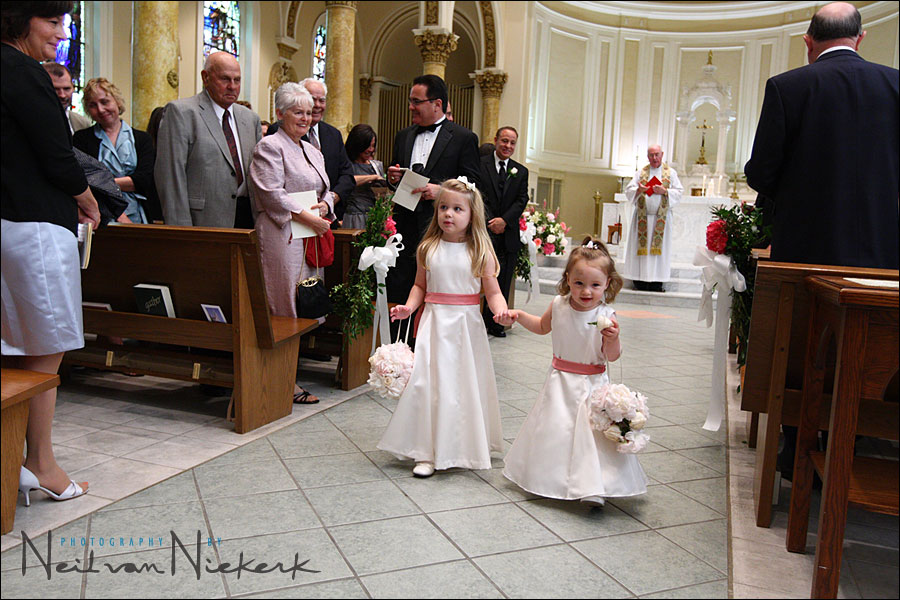
- 1/100th @ f3.5 @ 2500 ISO
- Canon 580EX II, Canon 1D mkIII, Canon 16-35mm f/2.8 II
Photographing the groom’s reaction
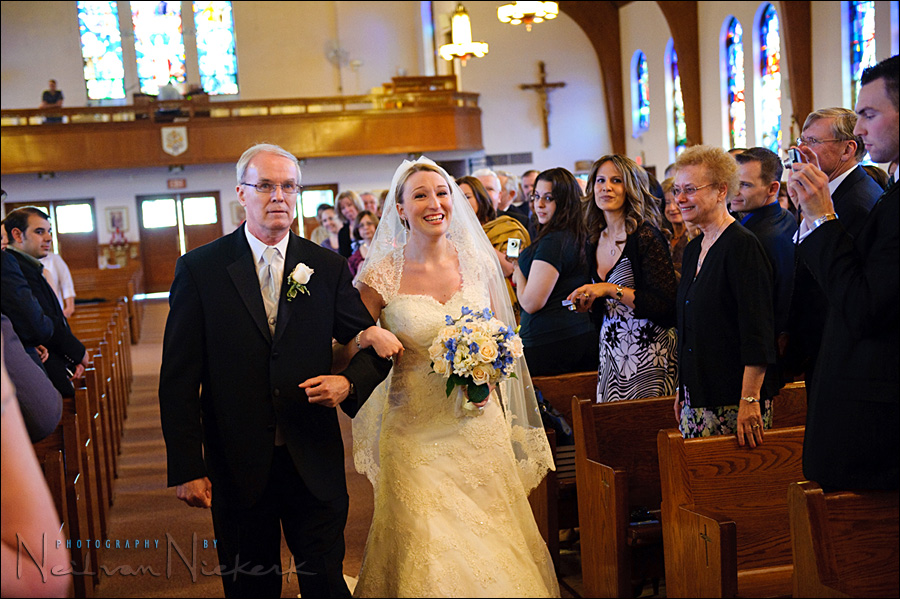
- 1/100th @ f3.2 @ 2500 ISO
- Nikon SB-900, Nikon D3, Nikon 24-70mm f/2.8
The ideal is to have a photo of the groom’s expression as the bride comes down the aisle. So do swing around at some point to grab a shot of the groom watching his bride walk towards him.
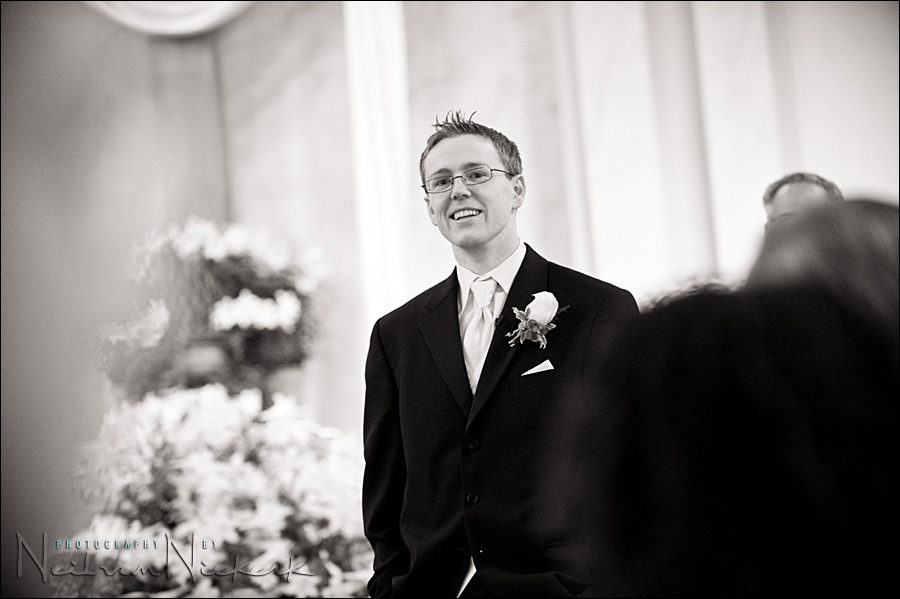
- 1/100th @ f2.8 @ 2000 ISO
- Nikon SB-900, Nikon D3, Nikon 70-200mm f/2.8
Just to make sure I have this type of photograph, I do take a shot or two the groom just before the bride comes down the aisle. You have such a limited time-frame, and you could be up against wedding guests stepping into the aisle, or family members with iPads, that it is too unpredictable to rely purely on the authentic moment happening for your camera.
Summary
So there is my approach to photographing the processional. No specific settings that I could advise to be used, but rather a range of settings. I really much more prefer a natural look to the lighting, but with the light being “open” rather than the top-heavy light you usually find in a church. I therefore use my flash to augment the light in the church .. and for that, I need high ISOs and wide apertures and a sensible shutter speed.
Related articles
- Flash photography during the wedding ceremony in church
- Photographing the wedding processional with extreme bounce flash
- Bounce flash photography & the inverse square law
- Bounce flash photography at wedding receptions
- Wedding photography: using high ISO and flash at the reception
- Bouncing on-camera flash in manual mode
- More articles about wedding photography
Neil,
I really appreciate your efforts in Planet Neil, and your generosity in sharing your knowledge of photography. I follow several very good photographers on the web, but your photos always show the best lighting, exposure and naturalness.
Thanks for sharing,
Gene
You know Neil, I am quite relieved to read this. I only recently got my 580 EX II and I am still learning how to use it. I would also like to be able to shoot natural light because that is what I’ve had to make do with. However on many occasions the high ISO and wide aperture have not been able to cut it. For a while there, I was thinking that I would just have to accept getting used to flahsing everything, but it’s good to learn about your tread-lightly technique.
Hi Neil,
you wrote:
“find my settings so that the available light is about 1 stop (or a little more) under-exposed, and then bounce flash behind me into the church….”
I wonder how does it look like, when you bounce the flash behind you. Does it mean you aim the flash toward the opposite direction?
Andreas
Hi Neil,
Now that almost everyone has a compact camera at a wedding…
Do you find more and more that some of your photographs have to be binned due harsh direct flash light from the guests compacts being captured in your photographs?
Kind regards,
David
Per the previous post and the photo you posted with your camera on the right, there definately are a bunch of uncle bobs there! Looks like your second shooter even caught your flash.
Once again, your methods of photographing as well as teaching are fabulous!!! I greatly appreciate this one in particular, as I’ve recently had some VERY dark churches and was not happy with the outcome.
I would also like to ask you, what do YOU do to nail that focus? It all seems to happen so quick, and I despise the hit and miss that seems to come with continuous mode. Care you share your tips and tricks?
Thanks so much!
Thank you for the tip! This is the most difficult moment to photograph in the wedding.
I am going to practice this, including the battery pack for the Canon 580EXII for fast recycling.
HI Neil,
I was the third shooter (not good enough to be a second or got paid) in a wedding several weeks ago using the techniques that I learned from your class and this site. Results were pretty good BUT quite a few of my pictures were ruined by Uncle Bob’s flash AF (auto focus) IR light on my subject’s face. Any suggestion?
Ben
Neil,
Many thanks for showing what most other tutors do not show. I have juggled with the same parameters, but never tried a tungsten gel.
As Amy asked above, how do you get such spot on focus ?
Regards,
Jim
Hi Neil:
Once again, a great post, congratulations.
My question is: since you work with very large apertures, you end up with a very shallow DOF, producing great blurring effects in the backgrounds, but risking your focus. How do you manage your focusing points in a situation like the processional? Are you all nervous jiggling around with the camera dial? I usually am.
All the best,
Andre.
Andre,
Very good question! I hope Neil can give us an insight to his focusing methods in these situations.
Regards
Jack
Reading some of the recent comments, and although Neil may have a few tips on focus, there is one primary advantage he has over most people. He used the Nikon D3X. Top of the line pro camera (probably the best one out there right now) that has many focus points and algorhithms that work better at detecting the face or subject than other cameras.
The ISO and image quality of that camera is absolutely remarkable but does come at a price few of us can afford.
Hi, Neil,
Beautiful photographs! Would you change your approach if the “second processional” is strongly backlit (huge window in assembly hall)?
Thanks!
Gretje
Dear Neil or knowledgeable reader,
I have a newbie question about high-iso capable cameras. Right now, I use an amateur camera (Canon Rebel XT), and I’m thinking of upgrading if only because the noise level on my camera at 1600 iso is nearly unbearable. Am I correct in thinking that on higher-end or professional cameras there is much less noise at the same iso level?
Andre Pereira,
Regarding the rebel, it is a wonderful camera and can take many great photos as I used to have one myself. When using high iso, please remember that correct exposure make a huge difference in acceptable noise levels. Aside from that however, and I am sure someone with a statistical analysis will correct me, but from visual observation, here is my run down on it for the current models of canon. The rebel shooting at iso 200 would probably be the same as a 40d or 50d shooting at iso 400, while the 5d and 1d series you could shoot at around iso 1000 compared to the rebels iso 100 and get similar noise. So yes, the pro models have a distinct advantage in iso performance. The Nikon D3X has far better iso abilities than the canon 1d at this time, but looking forward to the release of the 1d mark IV or whatever they call it as I would bet the iso capabilities will be astonishing. These however are only opinions based on visual observation as me and some friends actually tested out some shots and compared.
So no scientific research, but I did quickly upgrade my rebel when I started shooting low light situations as I was disapointed with it as well along with some other reasons.
I also have a frind that shoots for a pro sports team and he just sold a couple hundred grand worth canon gear to move to the Nikon D3X for the sole purpose of better iso capabilities.
Long and short still, it is the user than makes the shot, not the camera, even with the abilities of the pro camera they still need direction such as where to focus, but with the auto focus you do have better luck at nailing your intended target.
Ok, getting off topic here as the discussion is about the processional, not iso performance.
I am also guessing that in an attempt to answer the last question about how to do it in the old days, was just to either suffer with the noise or deal with the flash look. In the film days, it seems that film grain was always better looking than the iso noise we have today.
Hi Jeff:
I never tried a Nikon D3X, I have a Canon EOS 50D. I once tried a Canon 1D Mk3 for 2 weeks and it really has an outstanding behaviour regarding the auto focus, but you stil need to tell the camera what you want it to do…
Regards,
“I nearly always gel my flash for Tungsten, to make the flash not be as obvious.”
Would you gel for fluorescent if that were the main light source in a venue?
So how was it done before???
==================
Hi Neil,
Yet another excellent post.
I do have a question though.
You said that
“Therefore a high-ISO capable camera like the Nikon D3 is essential to me for my work. A Nikon D700, or Canon 5D mkII or Canon 1D mkIII would be just as good a choice to shoot in what is usually an under-lit scenario.”
Well, the thing is, these cameras weren’t always around. So what would you have done differently in the days of say the Nikon D1 or D2x (which wasn’t known for great output above ISO800) and the SB-800 flash? How did photogs/you manage before the super-duper cams you mentioned and Canon 35mm DSLRs?
Please note, this is not a rude or rhetorical question; I really wanna learn.
Thanks in advance.
Hello Neil, when I see those high ISO’s one thing comes to mind….GRAIN. I guess like mentioned above, proper exposure is key but also notice the FStops…you need a fast lense correct. Was this TTL or Manual.???
Antonio
Antonio, looking at that 2nd image from above,
(where I initially wrote the EXIF data wrong, but have now corrected it)
1/100th @ f2.8 @ 2500 ISO
I don’t see much noise at 2500 ISO.
You also have to keep in mind the final use of the image .. for a wedding album.
Already, with 12 megapixels I am downsizing for album panoramas .. and a photo like that might be used as maybe around a 5×7 size image. Not only that, but noise prints differently than you see it on your screen.
So I can near guarantee you that with that image, you will not see noise when printed in an album. And that is even without any noise reduction applied to it, other than the default setting in ACR.
With the right cameras, high-ISO noise just isn’t much of an issue any more.
Neil vN
When you say you bounce your flash over your shoulder into the church, what are you bouncing the flash off of?
A lot of the churches I’ve watched photographers work are massive and very very dark. I wouldn’t think there would be anything behind you to bounce off of – other than Uncle Tom in the pews on the grooms side – and I’m sure he wouldn’t appreciate his bald head acting as a reflector :)
Robert, if you look at that photo of the bride from behind, you’ll see what I am bouncing my flash into .. just in the general direction I want my light to come from.
It does seem incredible, but at some point where you have a suitable aperture and ISO combination, you can get surprising results.
Key here is that the flash doesn’t completely dominate as the main light source, but instead is “riding on top of” the available light.
Have a look at this sequence of images again,
as well as this previous post.
In both those examples, the flash exposure is riding on top of the ambient exposure which is perhaps a stop (or maybe more) under-exposed. The TTL flash then takes care of the rest … as long as the attempt is realistic. Your flashgun only has so many electrons that it can turn into photons.
I do zoom my flash-head now for more efficient light from my flashgun.
Excellent work. Excellent info.
Hi Neil
Many thanks for all the tips, invaluable stuff.
You said you fire off several shots fast during the recessional- I think think with an SB-800 the recycle time is a couple of seconds, so when I do this I get one correct exposure and a couple of dark frames.
Are you therefore using an external battery pack such as the slim Quantum one, to recharge the flash?
I only looked through this post so apologies if I missed this elsewhere on the site.
Thanks, Mark
A battery pack is essential for this. You need a fast recycling time.
With my Nikon’s I use the Nikon SD-9 battery pack. I fold the flaps on the pouch over my camera strap, and that way attach it to my camera. I use NiMH rechargeables with these. (You can see the charger and brand of batteries on this page).
.
With Canon I used (and would recommend) the Canon CP-E4 battery pack, and I clip this onto the camera strap as well.
.
For more juice than the battery packs with rechargeable batteries, I use the Quantum Turbo SC battery pack – (SC = Slim & Compact) . As the name says, it is slim and compact – yet offers great capacity.
.
The advantage of the Nikon SD-8A and Canon CP-E3 over the Turbo SC, is that by clipping the much lighter battery pack to the camera strap, it leaves the camera bodies independent of me. That makes the cameras easier to set down, or switch them to the other shoulder.
Another advantage over the smaller battery packs by Nikon and Canon, is that they won’t damage your speedlight when you rapidly fire your flash. The Quantum has the potential of doing that if you’re not careful.
Neil vN
Sorry Neil, one more question.
Would you recommend using Auto-ISO in the church or do you think this makes exposure and flash output too unpredictable even with a minimum shutter speed set? I’m just starting to delve into my D3’s detailed menus you may be able to tell :)
Neil,
kinda off-topic….but you mentioned above ‘down-sizing’ for the wedding album. not sure if I’m taking it the right way but i’ve been wondering if it’s completely necessary to use full resolution/sized files for images in an album especially when they are only going to to be the equivalent of 4×6 or smaller on each page???? i, for example, use BayPhoto and their ROES order system and uploading all those full resolution images can take quite a long time. do you have a standard that you downsize to?
“I mainly just use the center AF point to focus, or one of the cross-type sensors close to the center.”
Neil, in Single AF mode, you can only use one focus point as your target. So what do you mean by one of the “cross-type sensors close to the center”? Are you talking about moving your focus point within a 51, 21, 9 sensor area (that is configurable in camera) or something else?
Neil
Love your site! I want to make sure I’m understanding your technique here…you are pointing your flash the opposite direction from your subject to bounce the light? What if the church has high ceilings? How far is your subject away from you? Because your flash is not shooting toward your subject, are you increasing your power on the flash?
Thank you!
George
A quick question about autofocus…with the processional are you using a servo type or single shot? This choice has often driven me crazy. I’m using a Canon setup.
Neil, you said “I now shoot with two D3 bodies (and might get a D700 for back-up, or perhaps wait for the follow-up to the D700). I was thing about getting a D700 but do you think that their will a follow-up for the D700 soon? If so I will wait.
Hi Neil,
I am in the process of gathering information to purchase a set of equipment for wedding photography. I would like your opinion on my battery pack, flash and flash bracket decision.
I will purchase a Canon 5D mark ii and 24-70 mm f2.8L lens. I wan to buy flash 580 EX II but some one suggested me to go with a Quantum QFlash Trio. What flash would you recommend?
I also want to purchase a batter pack, Quantum Turbo 2×2, but I am not sure I can connect the camera to the flash? Would the pack be able to power both the camera and the flash for a whole day of taking picture?
Would you recommend to have a flash bracket?
Thank you very much for your expert opinion,
Kevin
Neil,
Could you give us an approximate flash head angle (degrees up and sideways) of the picture above where your camera is visible?
To me it looks like your flash is pointing forward (and a little bit upwards) but that would seem to contradict your practice. Is it possibly closer to 45 deg right and 30 up?
(Thanks very much for sharing your expertise.)
Les
Ted,
If you’re interested in Nikon technology trends, head over to Thom Hogan’s website, bythom.com. He is a Nikon professional photographer that keeps track of Nikon trends and releases.
Hi Neil,
Am I allowed to translate your work into Vietnamese? Please let me know my limits.
Thanks,
Chieu
Hi Neil,
Thanks for the great advice on how to photograph the processional as it seems like a more difficult part of the ceremony to photograph. Do you use 2 D3 bodies with different lenses on them for a wedding so you don’t have to switch lenses? I’m just trying to figure out what I should do as I have to photograph my 2nd wedding soon and am wanting to know which lenses are best for what parts of the ceremony. I’ll be shooting with just the one body. Would you normally just switch between using a standard zoom lens and telephoto zoom lens? Would you ever use something like the 50mm f/1.4, or 105VR during a ceremony?
Thanks,
Andrew
Hi Neil,
Regarding shooting in dark churches…
I currently have a D300 & D700. Since I only like to use the D700 at high iso’s and am shooting in an extra dark church soon (will probably shoot at 3200 instead of my typical 800-2000 iso during ceremony)… I am wondering if I should rent a second D700, or should I rent a D3 instead? Would the D3 require much getting used to ahead of time or are the controls very similar to the D700?
Thanks Neil!
Neil, let me add my name to those that are thankful to have found this site. My thinking has changed so much that my struggle now is to discern when NOT to use flash.
I have two questions if you don’t mind. One, when you say you zoom your flash now, do you zoom all the way in (say 85mm?), or do you change the zoom with the situation?
Also, given the fast paced nature of the processional, when do you determine your FEC? Do you take some test shots before people start walking and quickly dial it in at that point?
Thanks in advance. By the way, just ordered the book and am very much looking forward to reading it.
Hi Neil,
Regarding your response Brian S.’s post, what does the SB-900’s zoom range do the light of the flash? At 200mm, is the light brighter or “narrower?” At 17mm, is the light “wider?” The default behavior of the SB-900 is to match its zoom length with the lens focal length on the camera, so what does it mean to override this? I noticed that my lens can be at 100mm, but I can override the SB-900 to be at 35mm zoom.
Regarding using 2 bodies, do you have a flash attached to both bodies at all times, only on one body, or do you move it back and forth?
I used this bounce technique whenever possible. When the walls are green or too high I use the lumiquest promax system, which works much better than the sto-fen omnibounce, I think.
Thanks!
Hi Neil,
When you gel your flash, do you set your WB to one of the preset mode or do you use Kelvin? Also when you shooting at high ISO 1600 or above, how much power are you pumping out of your SB900 or SB800 and is your flash set to TTL or manual?
Btw, I’m very jealous of your work and knowledge ?
You have been a great help! Thank you so much!
Brian
Vancouver,BC
Hi Neil. Your blog is very informational and am loving all of the lighting tips. I am an employee for a photography company here in Las Vegas that shoots weddings for a couple of high end casinos. It’s kind of of run and gun. Weddings take 10 minutes or so and I am only allowed to take pictures from 3 different spots in the chapel. I absolutely despise harsh flash photography and try to bounce whenever I can. However I am having some difficulty in getting the look I want (natural as possible). Unfortunately, I am using a Nikon d70s, sb800 speedflash, 18-70mm 3.5-5.6 lens and strobobracket. I say unfortunately because I am not sure with the equipment used I will be able to get the results I am looking for.
The first photo of the couple is bounced straight up and diffuses well (we are not allowed any post process work and do not shoot RAW so the wite balance is off).
first image
The second photo below is from the rear of the chapel and I cannot move in closer unless I zoom of course, which I do.
second image
Horrible flash lighting! Not natural at all. Any suggestions?
Just a side note. This is NOT the type of photography I shoot when I am contracted for a wedding on my own. However, I still would like to put out a good final product for the bride and groom. Any critique or help would be appreciated. Keep up the good work.
… just wanted to say great work … loved the lighting as well on the father giving away his daughter … did you use a diffuser on your SB?
Hi Neil-
First, thank you for all your dedication to improving the skills of your fellow photographers. Your efforts are very much appreciated. My question is about what you do when prohibited from using flash during the processional or ceremony? Is there anything we can do to improve the quality of our images during what is certainly one of the most difficult shooting scenarios.
Sincerely,
Corey Schwartz
Hi Neil, first off, thank you!! I wanted to make sure I understand the steps you take when you enter a church and you start setting up your camera for the shot:
1. You meter for ambient light and underexpose by a stop?
2. How do you know how much power to dial in on the flash if you don’t have a subject to test on? Every church is different and bouncing your flash would give you different results? Do you rely on TTL to take care of the flash exposure? I know you like to adjust your flash power constantly … I can’t figure out what your procedure is for setting up the shot before the bride comes in. I greatly appreciate your work!
I did some testing in a very big church with high ceilings. The walls were close enough to bounce I think – about 20ft away from me. I have a D700, sb800 and I was using 28-70, f2.8.
I tested the black foamie thing and all of the shots (except a couple when the subject was very close) were under exposed about a stop. I saw this in the histogram and would increase FEC up to +3 at times but still no consistent results. I realize now that I was shooting at iso 1000 or 1600 and a lot of yours are iso 2000 – 2500. I wonder if I wasn’t letting in enough ambient light.
As I recall, the ambient was more than 1 stop under exposed. Is that why the flash wasn’t exposing properly? More flash power or ambient light was needed? Many shots were iso 1000 or 1600, f3.2, 1/100th. I remember looking at the meter and the ambient being underexposed more than a stop (more like 2). Should I have increased the iso to 2500? I have a hang up of feeling safe under-exposing the ambient by 2 stops to freeze action with the flash.
On another note, I need to get a battery pack asap so I can fire a lot to get ‘the shot’. I called “the store” today and was told that all wedding photographers use
Quantum Instruments -Turbo Battery with 120 / 240VAC Charger and at $389, I told him that was too much.
He then recommended Quantum Instruments, Battery 1 Plus Battery Pack (6V) for $214 plus cable. Do I really need all of that power to shoot the way you do? I love your work!
The sales guy said the Nikon, SD-8A Battery Pack at $150 isn’t enough power to shoot weddings. What would you do because what you do is working!
Thanks so much for all of you help!
THanks for your quick reply. I’m kicking myself I didn’t wait longer to get your reply because now I’m in a predicament. I was anxious to order a battery pack so it would get here by the weekend (I’m helping at a wedding) and ordered the SD-8 based on an earlier post of yours..
“Re battery packs, yes you can connect a Quantum pack to your battery, especially if you want faster recycling. Mostly though, I get by with the camera manufacturers’ battery packs. They don’t recharge quite as fast as the Quantum 2×2 (although this might in fact be a plus point).
What I prefer about the CP-E4 / SD-9 battery packs, is that I can attach those to my camera strap and then free myself from a cable to a battery pack on my belt.”
Now that you say for the church, you swap over to the Quantum SC batteries, I’m wondering if I purchased the wrong thing.
I really value your opinion bc I am striving to have nice images like yours so could you please tell me if I should keep the SD-8 or return it and order the Quantum today? I can pay for rush delivery for it to get here by the weekend. The last thing I want to do is buy the wrong piece of equipment bc I’ve done that way too many times and wasted my money. If I should get a Quantum, which one?
Thanks again!
I see why it’s a tough call. I will keep the SD-8 then. At least it’s better than having no battery pack. And when I start raking in the dough with all the wedding gigs I plan to book (crossing fingers and praying now), I can buy a Quantum. There will be times I will need the SD-8 even after I own a Quantum right?
You’re awesome for being so helpful!
Hi Neil,
I have read what you’ve written on this blog about how you take your photos in the processional, the formal and the reception, but I have not seen anything that tells me as you take your photos during the ceremony. Can you show me the link to that part of your articles?
Regards,
Alfredo
RE: 3rd Shooter: Very rarely but sometimes when Uncle Bob or Aunt Bobbi get a bit annoying I will bounce flash off of them or I will work my way to so as to get in their shot estpecially when they are getting in the way of our work – usually works but you don’t want to offend any one because all your future customers are watching you (weddings are your audition for your next client). 3rd shooting – unfortunately unless you really look the part, pro camera, big lens, etc I think many times will think you are an enthusiast and may not take you seriously…
Alfredo .. you’ll be happy to hear about the new article on using flash during the wedding ceremony in the church.
Hi Neil, in the big cavernous churches with wood panelling where you’re forced to use a diffuser cup, how are you then aiming your flash? I get much nicer light if the flash head is pointing straight up with the cup on rather than aimed straight at my subjects. But you do lose a lot of light and the flash struggles to freeze the movement in the processional: I’m not getting high enough shutter speeds even at 2500 ISO on my 5DII. Any tips? Many thanks.
Catherine .. when I use a diffuser cup in this situation, I usually have my flash in a tilted-forward bounce position. It isn’t necessarily to bounce my flash around the place … but rather to force light fall-off in the foreground.
If my flash was pointing straight forward, then the ground right in front of me would be brightly lit. (You’ve probably noticed this already.) Instead then, I tilt my flash up (or, if you want, tilted forward from the upright position), so that the ground in front of me receives about the same amount of light as my subjects.
So it really is about feathering the light. I hope this makes sense.
re the choice of shutter speeds. In this situation, you are letting your flash take care of proper exposure. So your ambient will be under-exposed to an extent. So you can push your shutter speed up a bit to where you are comfortable that you won’t get subject movement.
I realize this is primarily a discussion about indoor / flash photography, but do you have any recommendations about using fill flash when photography a wedding outdoors? Especially in bright sun ( assumimg overhead sun)? Or should one just shoot in existing light and worry about fill flash only if they are shaded?
At the end of this page, there’s a link to more articles about wedding photography, and there you’ll find the link to the article on shooting wedding portraits in bright sunlight.
Neil, a little off-topic, but are you shooting in Auto ISO while in Manual mode? I noticed that all three settings (Shutter, Aperture and ISO) changed quite often. I don’t know how one could concentrate on shooting while changing all of the settings from shot to shot.
Never with auto ISO. For me, that would defeat the entire point of shooting in manual exposure mode, because it would bring in a variable again.
I want manual exposure mode on my camera, because then my ambient exposure is fixed. Then, as a variable (if necessary), I can bring in TTL flash.
Hi Neil,
I’m a beginner autodidact wedding photographer and i’m faced with a big lighing problems each time i shooting at the wedding processional (bride, groom and specials guests down the church aisle) …
It’s been difficult for me to correctly set my exposure, because when they come down to the aisle, the church door are obviously large open and this cause that the background is always overexposed because of the lighting come in from the church door !!!
I’m wondering how can i deal with that, and where i’m supose to be standing … In the middle of the aisle, on the side or in a bench place ???
Note: I wish you understand me well, because i’m a french canadian from Québec and my english is not so good … :)
Thank you and have a nice day !!!
Jonathan, there isn’t much you can do about that background light blowing out like that, if you’re only using bounce flash. The bounce flash just isn’t strong enough. Direct flash on the other hand, usually looks pretty ugly. So I prefer to allow the background light to blow out.
I don’t like standing at the front, because I feel it is intrusive, but this is usually where I land up. I’d prefer to be part-way down the aisle, in a pew.
Neil I always find the processional the most challenging part of any wedding, there is some great advice here, thank once again for sharing
HI Neil,
thank you for this precious technique you share. However, I still have 2 questions: 1. do you set then manually the zoom of the flash to maximum everytime when you use the piece of black foam?
2. what about the setting of the WB when you use the fluorescent gel?
Thank you very much
Christian
I usually zoom to the maximum when I bounce my flash like that.
With fluorescent lighting, I normally use the 1/2 CTS, and try to dominate the ambient light with flash. Fluorescent lighting varies a LOT in color temperature. Fortunately, you don’t much get the sickly green industrial fluorescent lighting in offices and workplaces and public places. So you can just use flash with a gel for Incandescent light, such as the 1/2 CTS, and get away with it.
I just want to say how refreshing and sensible your advice is! So much flash advice is so technical and just seems overwhelming, I love to keep things simple and if you get too bogged down in technical stuff and using extra equipment, it just takes away from feeling the moment and getting the shots! I find your site so useful and interesting, thanks so much
Ailsa x
Hi Neil, thank you very much for the tips, I would like to ask a question :
I use a 430 ex II, and when I don’ t have anything to bounce it off, I use a little piece of card behind it as a diffuser, and it offers acceptable results, in landscape modes. But when comes the moment I have to use the portrait mode, especially in shorter focal lenghts, then I have no regular lights on my subjects (from right to left or vice versa), what do you propose to solve this.
Thank you.
Njaka .. what you’re looking for is a flash bracket.
Neil, in the processional, as a rough guide how many photographs do you take in succession in order to find the final shot?
I try to get 2-3 shots of every bridesmaid coming down the aisle. I need more than one shot ideally because of blinks, etc. But I usually only select one image of each to give to my clients.
Neil, i have a question sir…
i normally shoot with or without flash on AV with TTL. do you always shoot in Manual mode and why?
cheers
It is the only way I have control over my ambient exposure, with consistency between images.
Neil…. Thanks for sharing…. Quick question about lens choice for processionals. I own two cameras so I can only choose two. Which of these is best????
85 1.2
24-70 2.8
135 3.5
200 2.8
Fisheye 8 3.5
I tend to play it safe, so I mostly use the 24-70mm f/2.8
It gives me the best range when I work fairly close to people walking down the aisle.
I do keep the 70-200mm f/2.8 on another body, to photograph the bride’s entrance into the church, if this is possible. It depends on the light and the distance.
I have used the 85mm lens, but find the zooms more flexible.
I’ve seen photos by other photographers who prefer working at a longer distance from people walking down the aisle, and these look great … but, as I said, I prefer to play it safe with a medium-range zoom.
As for the fish-eye … it is my least used lens. I’m not fond of the look.
Here are examples of how I switch it between the two cameras.
First, the 70-200mm f/2.8
and then for closer up, the 24-70mm f/2.8
Awesome advice!!!!! I, like you, like the closer images. More expression!!!!! Thanks so much for the input. Great pictures here.
Excellent article, curious about one thing because it always seems to be an occasional hit or miss when the bridesmaids and bride are walking down the isle. Do you switch over to AF-C mode? I shoot Canon so I am almost always in AI Focus or with Nikon I think this is AF-A. But I have read lately that AI Servo or AF-C may be a better option for this part of the ceremony. What is your take on this? Thanks, Sean Holder Photography
I shoot in AF-S / Single mode.
But then again, I use the D3 / D3s / D4 line of cameras. They lock focus really quickly.
I like Single / AF-S mode for this, because the flash emits the auto-focus assist beam.
It doesn’t in Servo / AF-C.
Hi Neil,
I just love your site, and your advice is worth it’s weight in gold!
I have been reading this article over and over, a couple of question spring to mind if that’s ok?
One is sometimes when I have bounced flash and the flash has had to travel quite a way I have seen ghosting on the image where the ambient is slightly out of synce from the flash exposure. I’m confused why this is happening in rooms smaller than the church in your article. Maybe my shutter speed needs to be higher than it was, not sure. During this time I assume you never drop below 1/100 due to movement towards you?
And when you decide there is no way you can bounce am I right in saying you use a stofen diffuser at 45 degrees? I have a wedding in May where the venue has dark brown walls and maybe a slightly lighter ceiling very high up. Am I best using the 45 degree stofen method?
Many thanks.
You’re correct – your shutter speed is too low in that case.
The downside is, as you increase your shutter speed, your background is likely to go darker.
What does help is how the inverse square law makes the background brighter when you bounce flash.
And when you have nothing to bounce your flash off, and off-camera lighting isn’t possible, then yes, direct flash (with or without diffuser cup) is your most practical solution. I’d still drag the shutter then to bring in some of the available light.
Oh just realised I has another question too!
I’ll also be shooting at another venue with mixed lighting. One side of the ceremony room has natural light coming in and the rest of the dark room is lit by tungsten light, how would you attack this type of ceremony? Over power all the light with flash?
If possible, add flash to the one side. Either as normal flash, or the other side as a gelled flash.
This is really a tough scenario because you’re unlikely to get that much light in from your flash if the venue is large.
Then there are two options – just go with it, because *this* is what it looked like … or go to B&W.
Great article and tips. Thank you