Shutter speed controls background exposure? Usually …
Something I kick against when I try to teach others about flash photography, is the use of short-cut phrases. Those axioms that are supposed to help the understanding of how to mix flash with ambient light, can often mislead you since they don’t give you all the information.
Two of those phrases were recently discussed here:
- aperture controls flash exposure,
- shutter speed controls available light.
These are merely reductions of the way that shutter speed, aperture and ISO inter-relate with available light and flash. With those simplifications, those two phrases then become misleading. On top of that, they become meaningless when you work with TTL flash.
Instead, I would really urge anyone who wants to come to grips with understanding how flash and available light correlate via your camera settings, to try and get the wider view on all of this, and understand how manual flash and TTL flash differ.
I encountered another one of those misleading phrases recently while teaching someone. When I showed a sequence of images as part of the explanation of balancing manual flash with available light, the reply was … “shutter speed controls the background exposure”. Except, in this case, the automatic response was the wrong answer.
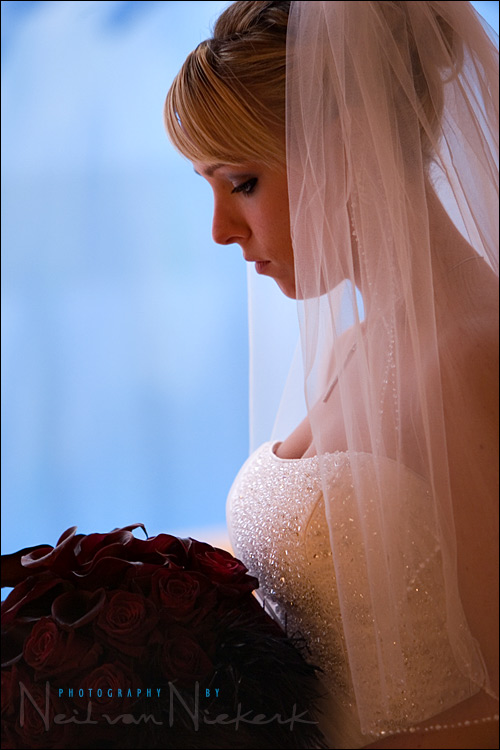
So let’s look at the photo above, which is the photo in question:
My settings were: 1/40th @ f2.8 @ 400 ISO
The setup was as follows ..
On this wedding day, it was raining hard outside, so I had to come up with all kinds of ideas for interesting portraits indoors in this house. Outside the main bedroom on the first floor, was the landing of the steps leading up from the living room. There was a blue mural with dolphins painted on it, and you can see this as the out-of-focus blue area in this photo.
Inside the bedroom where three large incandescent lamps. (Tungsten light).
To light the blue mural, I placed a flashgun on a light-stand on the ground floor. The flashgun (a Q-flash) was set to 1/8th power (or there-abouts). It was set to manual output, and the flashgun was pointed straight up into the stairwell leading to the bedrooms.
So looking at this photo, the blue background (the mural), is lit entirely by manual flash. The bride in the foreground is lit mostly by the incandescent lamps inside the bedroom.
So let’s break this down into two parts .. the flash exposure and the ambient exposure.
Manual flash exposure is controlled by 4 settings:
– aperture,
– ISO,
– distance between subject and light source,
– power setting on the flashgun / power-pack.
In this specific scenario, the distance is a fixed value, since the light-stand can’t really be moved from its position. Similarly, the power setting of the flashgun is fixed, since I can’t run like a lunatic up and down the stairs to adjust the power. That would just destroy my cool professional demeanor that I was trying to maintain in front of my client .. while actually sweating trying to come up with fresh ideas.
Okay, so distance is fixed, and power is fixed. That leaves aperture and ISO as my two controls that I have available to me to control how bright the blue background will appear.
In other words, from where I stand inside the bedroom, I can control whether the blue background will be washed out (over-exposed to an extent), or saturated (under-exposed to an extent) … simply by dialing my aperture and ISO.
In this case I liked how it appeared with my aperture at f2.8 and my ISO at 400.
Next up, let’s consider the available light
Available light is controlled by aperture, ISO and shutter speed. Always has been, and probably always will be.
In this scenario, our aperture and ISO is fixed for my particular liking of how the blue appears in the image as I saw it on the back of my LCD screen. This leaves shutter speed as my only independent control for available light.
And now with my shutter speed, I can control how bright my subject (which is lit only with ambient light), appears in relation to the background (which is lit by flash).
Bringing it all together
So for this particular example, the usual idiom that we hear that shutter speed controls the background exposure, is thrown upside down. For this specific scenario, shutter speed was the independent control for my foreground exposure.
Note that I didn’t say that “shutter speed now controls the foreground exposure”. That would be an incomplete description, since aperture and ISO also control the ambient exposure for my subject in the foreground. It is simpler however with manual flash, to change the shutter speed as the independent control for available light. And note, I mention manual flash specifically. TTL flash is an entirely different beast.
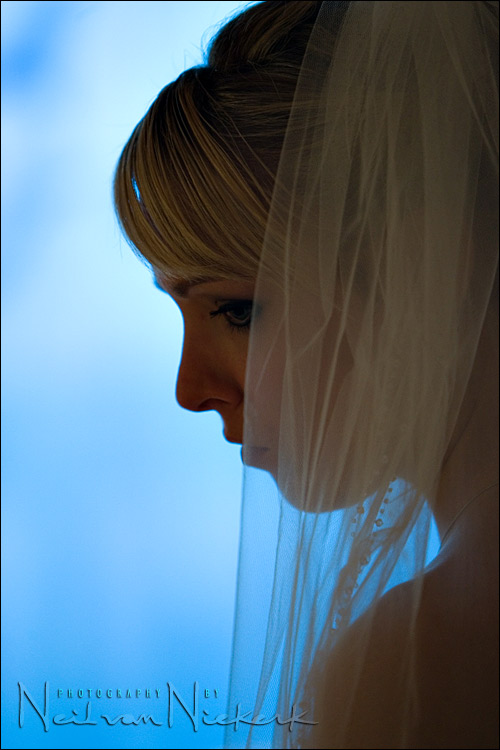
So here is how I controlled my foreground exposure in this scenario. I changed my shutter speed from 1/40th to 1/100th, and the bride was near-silhouetted against the background. There is a change in the exact colour of the blue background, because I played with the WB of the raw image, so don’t let that mislead you. And yes, I know there is some subject movement in that shot. But the image works. ; )
Summary
A clear understanding of how shutter speed, aperture and ISO inter-relate for ambient light and manual flash and TTL flash, is far more useful than learning shortcut phrases. When you’re in an unusual situation, you’ll be better of with real knowledge, rather than memorized phrases that don’t give you the entire story.
Related articles
- Balancing flash and ambient exposure (model: Anelisa)
- When aperture does NOT control flash exposure
- Flash exposure is controlled by aperture – but only for manual flash
- Tutorial – balancing flash and ambient (model: Camille)
- Tutorials: Flash Photography Techniques
I agree with you, but people like to learn the short sentences by heart, and repeat them to understand them better. Thus if they want short, yet working, sentences, I would say that:
– aperture controls everything (ambient and flash)
– iso controls everything (ambient and flash)
– shutter speed controls ambient (and not flash)
;)
Hello Neil, always goot to read and learn. One question, what type of Lense you used?
Antonio
Antonio .. it was the Canon 70-200mm f2.8 IS (B&H) lens.
It becomes essential that such a long lens have stabilization (or vibration reduction), when you hand-hold it. And when you hit shutter speeds such as 1/40th as in the image at the top, then the stabilization feature becomes a life-saver.
Thanks Neil.
I’ve been reading and watching many well know flash instructors that constantly throw out these kinds of statements, even when they are contradicting themselves. Luckily I’ve read this blog enough times that I knew what they really ment to say.
Wouldn’t it be more accurate to say that shutter speed controls the ambient, as in whatever is lit by the ambient source? None the less, your point about fully understanding the interaction of you settings is important.
Bryan .. that’d be correct.
As long as we don’t fall into the other trap and make that an absolute statement that “shutter speed controls the ambient light”. Because then we’d be forgetting again about ISO and aperture.
And the moment we shoot with TTL flash instead of manual flash, we can just as easily change any of those three settings – shutter speed, aperture, ISO – with equal ease.
It might seem at times like I am laboring semantic differences .. but I believe it is essential that we don’t reduce the information to a “sound bite” which takes us away from completely understanding how all the controls interact for ambient light, and both manual flash and TTL flash.
“Next up, let’s consider the available light. Available light is controlled by aperture, ISO and shutter speed.”
Two additional controls :
1. distance between subject and light source i.e. moving lamps closer if subject can’t be moved from doorway;
2. power setting : i.e. dimmer switch, one or both lamps on, increased diffusion over source .
as always a great post !
Hey Neil, I understand what your saying but (playing devils advocate) is this not technically two photos – 1 of the background lit by a strobe and 1 the foreground lit by available ?
The background is flash lit and to control it, you could just dial up or down your Fstop – which is Ap controlling Flash exp.
On the foreground your still using shutter speed controls available light.
I understand that thinking about it as 1 photo takes a little more dissecting but to me it seems to still prove both statements correct.
Just out of idle curiosity how much time did you get with the bride to get these shots – here in the UK we seem very pushed for time – I have to battle to get more creative time but brides understand that in order to get what they want, they need to give a little also.
ciao
dp
Hi there David …
Oooh! that phrase – playing devil’s advocate – is just a red flag to this bull. ;)
>> The background is flash lit and to control it, you could just dial up or down your F-stop – which is Ap controlling Flash exp.
Then you need to re-read that article mentioned earlier on what I deem to be the ‘urban legends’ of flash photography. You immediately fall into the trap here of not distinguishing that you are talking about manual flash. TTL works entirely differently. And then you neglect to mention that ISO would also affect the manual flash exposure there.
>> On the foreground you’re still using shutter speed controls available light.
It is easier in this case, since with manual flash and ambient light, shutter speed is my independent control of the ambient exposure. But don’t forget that aperture and ISO still have an effect.
>> I understand that thinking about it as 1 photo takes a little more dissecting but to me it seems to still prove both statements correct.
Then re-read that article mentioned earlier, until you don’t feel the compulsion to reply with a “… but … ” ;)
As to how much time I get with brides … I try to wangle as much as I can when I meet the bride during the consultation and subsequent follow-up meetings and phone calls and emails.
I generally try for 30 mins with just the couple, but often have to settle for less … but just as often get more.
Neil vN
As I already mentioned in the Flickr group, I would say:
– flash exposure is influenced by aperture and ISO
– ambient exposure is influenced by aperture, ISO and shutter speed
But, to correct that: This applies only under the following assumptions:
– constant flash position and direction
– constant flash power
– manual flash, no TTL
– in short: everything constant but only that single value change of ISO, shutter or aperture
Of course, there is much more behind this and therefore one must understand the basics. But for a quick help to remember by heart I think this it’s acceptable.
I agree with Adam: As always a great post! brings us back to the basics and makes us think again. Thanks Neil!
Hi Neil,
Love you posts in general.
You write that “Manual flash is controlled by 4 settings”. What about (flash lit) subject to camera distance? As the light is reflected off the subject the inverse square law comes into play. Move closer to the lit subject and more light will hit your sensor, right? (Note, this could also be relevant for ambient if the ambient is not the sun).
So, you challenge the usefulness of memorizing these sentences:
– aperture controls flash exposure,
– shutter speed controls available light.
I agree that the first sentence is misleading but second one is quite true assuming the other variables (power setting or subject distance) are constant which, as in your example, they quite often are.
But still, the interesting part is not how you “control the light” but how you “control the _mix_ of the light”. And learning those two sentences may actually not help you mix the light. To mix available light with flash (as I see it):
– you change the flash part of the mix using both aperture (or ISO) and shutter speed controls but in opposite directions
– you change the ambient part of the mix using shutter speed (only)
The tricky part is that the flash part of the mix cannot be controlled by only a single control. Changing either the aperture or the ISO will not change the mix (balance), you just change the overall exposure. If you dial +1 on the aperture you have to dial -1 on the shutter speed to get a net +1 to the flash part. On the other hand you _can_ control the ambient by just changing the shutter speed.
Sorry, long reply. Hope I got my meaning across.
Lovely picture by the way.
Cheers
Mikkel
You’re going to have to do a complete re-think on this one. ;)
It is subject-to-light distance that comes into play. NOT the camera-to-subject distance.
Neil vN
Hey Neil, just thought I’d mention that these are fantastic photos – regardless of the technicals. Can’t overlook the aesthetics – :o)
I’ve read these sorta things for years and honestly, i just dont get it and never really understood this. How can you say that aperture and iso control the background (in this case) and then you go and futz with the shutter speed…wouldnt that just change the light in the background?
You never actually mention what shutter speed is your baseline (im assuming 160th)
So, lets say it all looked good at 2.8 at 400iso (which btw is very convient in this case because i would imagine that 2.8 is where you wanted to be in the first place)
Ok, so now you go up the stairs and now need to balance the bride with shutter…so you changed it…why wouldnt the background light change also? that just doenst make sense to me..
If i followed your exact descripton, and then changed shutter speed, the wall in the BG now would not be where i wanted it.
Mark, when you wonder why the change in shutter speed wouldn’t affect the background, re-read this part of the original post:
“So looking at this photo, the blue background (the mural), is lit entirely by manual flash. ”
The background, for this image, is lit up entirely by manual flash. No available light. Therefore shutter speed has NO effect on the background exposure. (While not going over max sync speed of course.)
I don’t understand what you mean by what is my baseline shutter speed ?
And when you repeat the question as to why the background light didn’t change, I’ll have to state this again: Shutter speed has NO effect on flash exposure (while remaining at or below max sync speed.) This is one of those crucial points around which much of flash & ambient exposure hinges.
You absolutely need to grasp that.
And then it would make even more sense as to why I wrote this entire article.
Ok. I do grasp that the wall in question is not exposed by anything else, but that would truly mean that it’s pitch black in the room. But, I do get what you’re saying in this case. The amount of shutter you adjusted by wasn’t truly enough to change the BG exposure. I see how this is somewhat opposite then the norm. I always figure in my logic that there’s always light somewhere and adjusting shutter to the extreme (like 10 sec) would change the light so I’m always thinking in that manner.
Btw, I do want to say that I find your site/blog truly inspiring and have learned so much from reading it.
Mark .. the landing area behind the bride wasn’t pitch black, but the ambient light levels were low enough not to have a huge influence on the exposure.
In understanding how the balance works between flash (whether manual or TTL), and ambient light, we need not think of the extremes .. you know, “pitch black background that is 100% lit up by manual flash”. The approximation is still truthful and gets us there – it was dark enough to make my explanation sense-ful.
Oh, and what I was talking about concerning ‘baseline’; I was just assuming you were checking the exposure of BG with some sorta shutter speed (along with aperture and ISO). I had heard that 160th was the norm when doing this. I just figured u had to have some idea of the flash setting. Afterall, how did u figure 1/4 was right?
I am finding it hard to wrap my brain around the fact that the setting that was chosen did not change exposure from something like 1/200th shutter to all the way down to 1/40th. Would this not have picked up some ambient even on an overcast day?
I’m not sure if you actually mean 1/160th .. or meant to say 1/60th
1/60th is often taken to be the “minimum hand-holdable shutter speed” … erroneously so.
If you meant 1/160th .. I wouldn’t know where that specific value came from or would have significance.
Check out these two articles which deal with choice of shutter speeds:
– Faster, faster!
– How low can you go?
Changing from 1/200th to 1/40th in the house (not 1/4th) would have changed the amount of background light that comes into play, whether from elsewhere in the house, or light in the landing area, or light spilling from the main bedroom area.
And yet … the light levels were low enough for me to disregard it in figuring out how to balance flash with available light in this scenario.
I suspect this is one of those cases where the arm-chair appraisal of a scenario tends to be be parsed to a degree you never would in a real-world situation. ;)
Ok just went back and re-read your write up about max sync speed and finally get it. I finally understand what u mean by shutter has no “direct” effect on flash exp.
Hello Neil,
Just a thanks to you. After so many years struggling with the dreaded on camera flash syndrome, I got to hand it to you. You certainly have me working an on camera flash in a new and better way.
Thanks again!
Neil
In summary, can we say that:
Aperture controls flash exposure
Shutter Speed, ISO and Aperture controls available or ambient light.
By the way, how do calculate/decide what ISO to use. Do you use Auto ISO.
Thanks
Martian
Martian … nope. That’s not the entire picture.
Go through this article where I explain that aperture and ISO control flash exposure for manual flash. For TTL flash, only the flash exposure compensation controls the flash exposure.
I use the lowest possible ISO that I can get, while still having a shutter speed that is fast enough, and an aperture that gives me enough DoF. And nope, I never use Auto ISO for that brings back another level of automation that I don’t necessarily want.
Neil vN
Neil….I look at your photos and am amazed at the beautiful colors….I know you shoot only in RAW but I would like your or any of the bloggers opinion on in- camera sharpening, saturation ect. I can’t seem to get your coloring with my XTI. Your efforts to inform us are admirable. Thanks!!
Chuck .. I think this warrants a thorough blog posting all of its own. I’ll post something in the next few weeks, with perhaps screen captures as I work on a RAW image.
Neil – Absolutely love the lighting on the background and the overall balance of this image – The colour and saturation you achieve with a simple shot are amazing