spacer
spacer

Tangents

tutorial: how to use the guide number of your flash

March 8, 2012

using the guide number of your flash to determine flash exposure

GN  =  distance  *  f-stop

Your flash’s Guide Number (GN) is determined at 100 ISO, when it gives correct exposure at a certain distance, multiplied by the f-stop

The idea that we can figure out the manual flash exposure by the combination of distance and aperture (for a given ISO setting), was covered in these recent topics:

getting the most out of your flash / speedlite / speedlight
practical tutorial: controls for manual flash exposure

In these articles, we relied on the display on the back of the speedlight to show us the distance we need to hold the flash from our subject. A flashmeter / lightmeter would’ve given us a similar answer. (There might be a discrepancy, since the manufacturers tend to be a little bit optimistic about what the flashgun is capable of.)

Now, the question is, what do we do if our speedlights don’t show the distance / aperture relationship on its display, or if we don’t have a lightmeter on hand?

(more…)

       Comments (16)


flash & ambient light – reverse engineering an image (2)

July 27, 2010

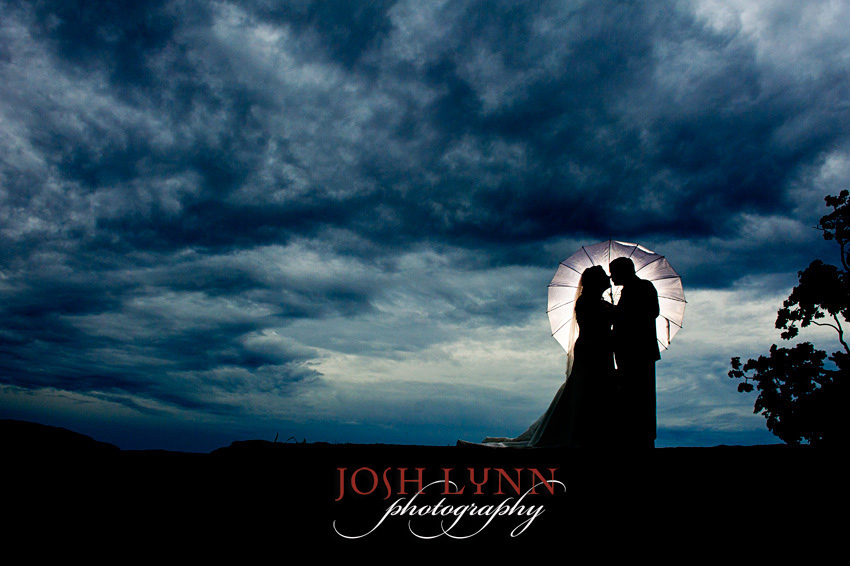
My friend, Josh Lynn, just posted this spectacular wedding photograph.  It does look like he used flash there, so I thought this would make a another good example to see if we can ‘reverse engineer’ a photograph in terms of his settings and setup.

I first had a guess at how he set this up; and then had a look at the EXIF data, and this revealed the true story.  See if you can decipher this image yourself, without scrolling down at first …

(more…)

       Comments (28)


using a neutral density (ND) filter with flash

July 16, 2010

using neutral density (ND) filters with flash to control depth of field

Working in bright light, the limitation of having a maximum flash sync speed forces a small aperture on us.  That small aperture means more depth of field than we might like.

There are two ways to force a high shutter speed / wide aperture combination:
- go to high speed sync (HSS) mode. But this dramatically cuts down our power of our flash;
- use a neutral density (ND) filter …

(more…)

       Comments (28)


first curtain sync vs rear curtain sync

June 2, 2010

first curtain vs rear (2nd) curtain flash sync

A topic that has been briefly discussed on the Tangents blog before, is that of first curtain flash sync vs second curtain flash sync.  First curtain sync is also often called front curtain sync; and rear curtain sync is often called second curtain sync. (This is also covered in my book on flash photography).

Since it is an important topic in flash photography, let’s look at what this entails and the difference between the two ways we can sync our flash .. and why would the one way would be preferable over the other.

To help us with the explanation, we have a great subject who was quite willing to pose for some comparative photographs:

(more…)

       Comments (10)


background exposure and flash

April 28, 2010

flash photography – background exposure and flash

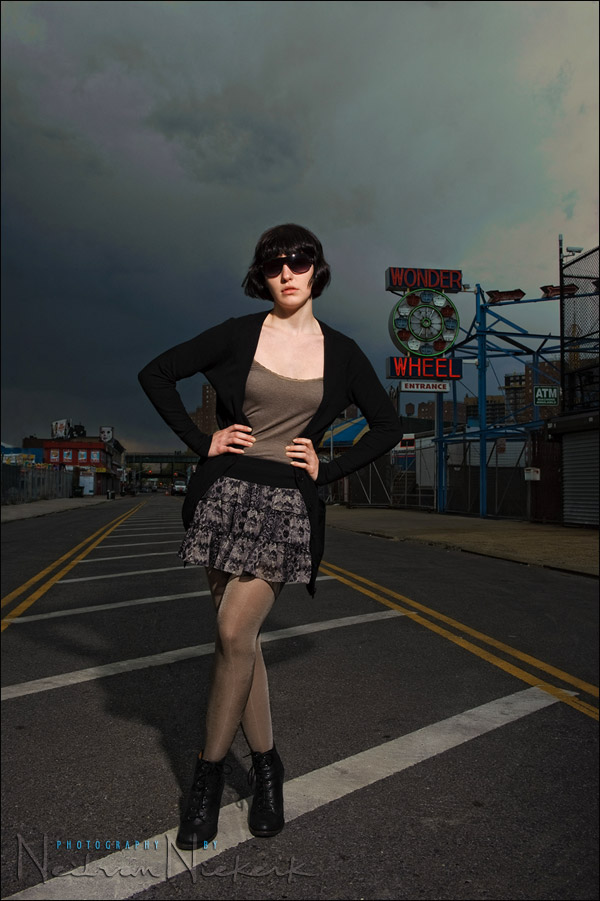
When I saw this dramatic sky with the approaching storm during our recent shoot at Coney Island, I knew I wanted to photograph our model against it.  By the time I actually started taking photos, the raindrops were already spattering around us. So there was little time to work.

I knew I wanted a brooding sky.  Now, depending on how I chose my exposure, I could’ve had a much the sky appear much brighter, or just a little bit brighter than shown here.  There’s a whole range of possibilities in how I could’ve exposed for my background, and we can choose a wide range of settings.  In this sense there really isn’t any “incorrect exposure” for this particular background. Of course, it doesn’t make sense to choose our settings such that we’d over-expose our model.

This is idea holds true while we consider the sky as our main background.  The street areas, and the amusement park areas are indeed under-exposed.  They do appear too dark if I had chosen that as my specific background. But the sky as such, isn’t under-exposed.  This might seem a semantic difference, but it is an important distinction to make, in that quite often there is no specific under- or over-exposure, but just a way that YOU decide to expose for certain tones.  I simple chose to expose for the sky as darker tones.  And I could’ve placed them “anywhere”, even as near-black.

Here is the test shot without flash …

(more…)

       Comments (6)


balancing flash with ambient exposure

April 8, 2010

balancing flash with available light / ambient exposure

Since many of the questions I get on the Tangents blog relate to balancing flash with available light, I want to pull the replies together into a single article.  A reference point again, instead of the replies scattered throughout this website.

The questions most often revolve around:
-  exposure metering for available light ,
-  exposure metering for TTL flash and ambient light,
-  whether to use manual flash or TTL flash,
-  flash exposure compensation (FEC),
-  choice of aperture,
-  maximum flash sync speed,
-  metering for off-camera manual flash and ambient light
-  choosing our settings to balance manual flash and ambient light,
-  whether to drag the shutter, or not.

The answer to the questions about how to balance flash and ambient light, is often along the lines of “it depends”.  It really depends on:
- the scenario you have, and
- what you want to achieve.

Now that all sounds quite vague.  Being told that you can pretty much “do what you want”, doesn’t help if you don’t even quite know where to start.  Most of the answers are in the linked articles there, and on this page on my Top 20 Flash Photography Tips.

But, let’s look at one specific image, and analyze what our options are, and see if we can make sense of it all …

(more…)

       Comments (56)


balancing flash and ambient exposure – where do you even start?

February 9, 2010

balancing flash and ambient exposure

This topic – balancing flash and ambient exposure – seems to one that many newer photographers struggle with. The big hurdle seems to be the basic starting point – how do you decide on the exposure for each?

I’d like to explore this topic a bit with this post.  The trigger for this was a question that someone emailed me regarding an image in my book on flash photography. Instead of answering the question directly, I thought that a wider answer might be more illuminating. We’re still on that perpetual quest for more aha! moments. So let’s see where we head with this. (I’ll come back to the specific question and answer at the end of this.)

But why do we even want to add flash to a subject when the available light is soft?

The answer is that with flash we can control the direction and quality of light, and create a more dynamic image.

We don’t necessarily just use flash to avoid camera shake and / or poor exposure in low light. We use flash to create better light on our subject. We can ‘clean up’ the light that falls on our subject. Or to create more dynamic and interesting light. It’s about control. We decide.  So where do we start?

The simplest approach for me, when I work in fairly flat and even ambient light, is to under-expose the ambient light by a certain amount.  Then we add flash for correct exposure.  So how much do we under-expose the ambient light by?  Well, it depends. Usually a stop is good. Two stops can also work. If you’ve seen some of the images in fashion and music magazines where the subject is in a pool of light .. yet, the sunlit cityscape is darker, then that is because the photographer under-exposed the ambient light by 2-3 stops. Even in bright sunlight.   So we have some leeway.  That should ease some of the anxiety.

Under-exposing the ambient light by a stop, and then adding flash …  is but one scenario, and one recipe. This approach won’t apply to every possible situation you might encounter .. but it’s a good starting point in grasping that Big Question – where do we even start in balancing flash and ambient light?

Let’s start of with an example where the previous method wouldn’t work:

settings: 1/125 @ f3.5 @ 800 ISO
lighting:  Q-flash T5D-R, in TTL mode diffused by medium softbox to the right

(A speedlight in the softbox would’ve worked just as well here.)

Here’s the image without flash, just so we have a reference ..

(more…)

       Comments (39)


flash and low ambient light – when panic sets in

January 11, 2010

flash photography in low ambient light

I’m often asked what I would do when I encounter a situation where you need to use flash, but there is no easy way to bounce flash.  My answer invariably is .. you’re screwed!

Well, not really.  My advice is that you have to improvise and find some way of finessing your light.  In tough situations, you still want to try and shy away from using direct on-camera flash whenever possible.  Direct on-camera flash as the main source of light rarely looks good.  And I only use the word ‘rarely’ there as a hedge against someone finding that single rare moment where direct on-camera flash actually was aesthetically the best choice.

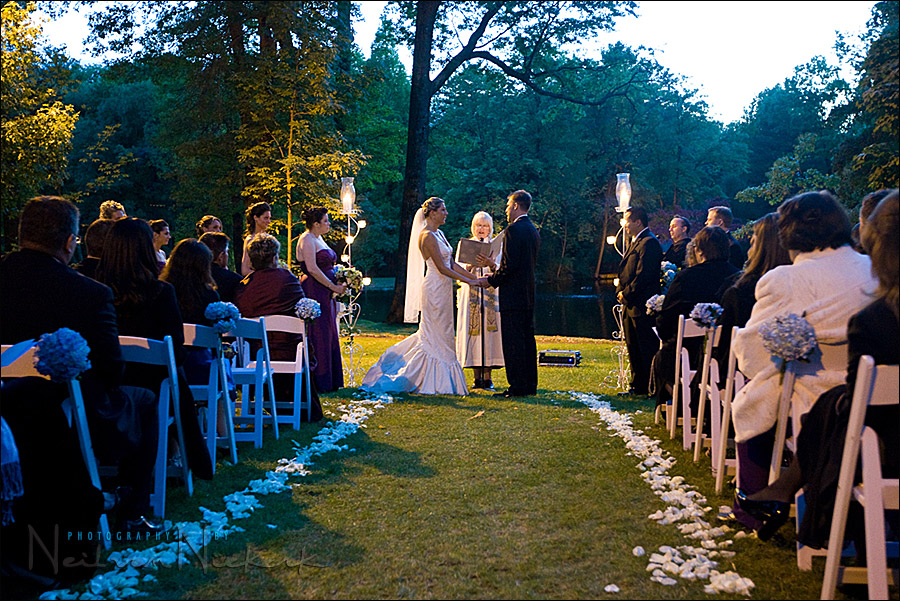
As an example of what I meant by improvising, here is a wedding I photographed at the Pleasantdale Chateau – a top venue in New Jersey for any wedding photographer.

Earlier in the day, working outside with the couple, we had great light.  There was a changing mix of dramatic light and soft light, which made it easy getting beautiful photos of the couple:

Later in the evening, just using bounce flash was enough to work with:

However, the outside ceremony was scheduled for early evening.  I knew that even if the ceremony started on time, the light would gradually fade into darkness as the event progressed.

I now had to balance the practical consideration of getting sharp images, with the artistic consideration of retaining the mood of the setting and the mood of the ceremony.  I couldn’t rely on there being enough available light to carry myself and my second photographer through the time of dusk setting in.  Direct on-camera flash just doesn’t look that good, but there really was no way to bounce flash there .. we were outside next to a lake.

This is where panic set in.  I desperately want to give my clients images that look as great as those they saw in my sample albums or on my website.  But there were the practical matters to consider.
I wanted both these things -  sharp images, but also images that retained the mood …

(more…)

       Comments (41)


flagging your speedlight

January 9, 2010

This dramatic portrait of a model, Ambyr, comes from Mitch Todd.

Mitch attended the Dallas workshop last year, and sent me this image just a few days ago. He used a speedlight on a light-stand to give direct off-camera light on the model, but he also used a piece of black foam to flag the light, so that the spill light was contained.  This caused the distinct light fall-off that you see there.

What I like about this, is the off-the-cuff improvisation during a shoot.  A simple adaptation that gave different results than just bouncing flash.

Mitch’s description of the technique:

“I used some of my extra “black foamie thing” material to make a snoot for my 580 EX II strobe and shot this picture in an attempt to emulate the video light glamour shots we did at the Dallas workshop.  I made the snoot made with black foam attached to the strobe with a hair band.

Shot with my Canon 7D and Canon 24-70 F2.8 lens.
ISO 100, 1/250, F9.0 – which made the lighted hallway go dark.

Lit with 1 Canon 580 EX II strobe at 1/2 or full power on a Cheetah stand in her hallway.  I shot a few exposures of Ambyr and used a combination of histogram and LCD screen and crossed my fingers.

I am very happy with the results and will be using this technique again.  No Photoshopping yet.  The model loves it.  I never would have thought of doing lighting like this before your workshop.  Thanks.”

If you find these articles interesting and of value, then you can help by using
these affiliate links to order equipment & other goodies.   Thank you!

Stay informed of new articles via the monthly newsletter.
Also join us on the Tangents forum for further discussions.

       Comments (15)


combining flash and ambient light

January 4, 2010

combining flash and ambient light

Going by the emails that I receive, one of the areas that many photographers struggle with is that of combining ambient exposure and flash exposure.  This question  is also expressed in other ways.  It can be a frustrated, “where do we even start?”  I also often see it expressed as an involved step-by-step deconstruction of technique, making the entire process more complex than it is.

In reply to that, and many other emails I’ve received in the past few months, I’d like to offer an analysis of a few images from a recent shoot.


[ click on the photo for a larger image ]

One of my favorite clients has the most adorable baby boy that she wanted some portraits of.  I had to shoot fast, since his attention span was .. oh, zero.   He’s still a baby!  I also wanted to be able to cover myself in getting some available-light only portraits, and some with bounce flash.  I didn’t want the flash to be overwhelmingly bright.  And in bouncing the flash, there was also less chance of disturbing the baby.   So I had to mix it up in order to get some variety, and be sure of images that worked.

The image at the top was shot with the Nikon D3 and the Nikon 70-200mm f2.8 AF-S
Lighting here was a combination of available light and bounce flash.  And as usual, I used the black foamie thing to flag the flash so NO light from the flashgun fell directly on the child.

My camera settings:  1/100 @ f4.5 @ 640 ISO, using TTL flash
The FEC was not recorded, but would’ve been around 0EV because my flash isn’t merely fill-flash here, but fairly dominant.

Now where the settings look like they might be informative, I also often feel that these numerical values are a diversion.  Too many photographers will get hooked on the choice of f4.5 over another aperture.  Whey 1/100th of a second?  Why 640 ISO?

The truth is that this could’ve been a different combination of settings.  What is important here, is the quality of light.  It is our major concern here, and should interest us more than f4.5 at this moment.

The light on the baby’s face is directional.  There is more light coming from camera left .. and from this you should be able to deduce that I did indeed bounce my flash to my left.  Using that piece of black foam to flag my flash, I was able to get directional light like that.

The light is soft.  Since I bounced my flash into the room, and it bounced off the walls, and furniture, I will have soft light.

So those two aspects of the light from my flash is easily understood – soft directional light.

Now let’s look at how I chose to balance my flash with the available light …

(more…)

       Comments (46)


Older Posts »


All Rights Reserved © 2006-09 | Client Login